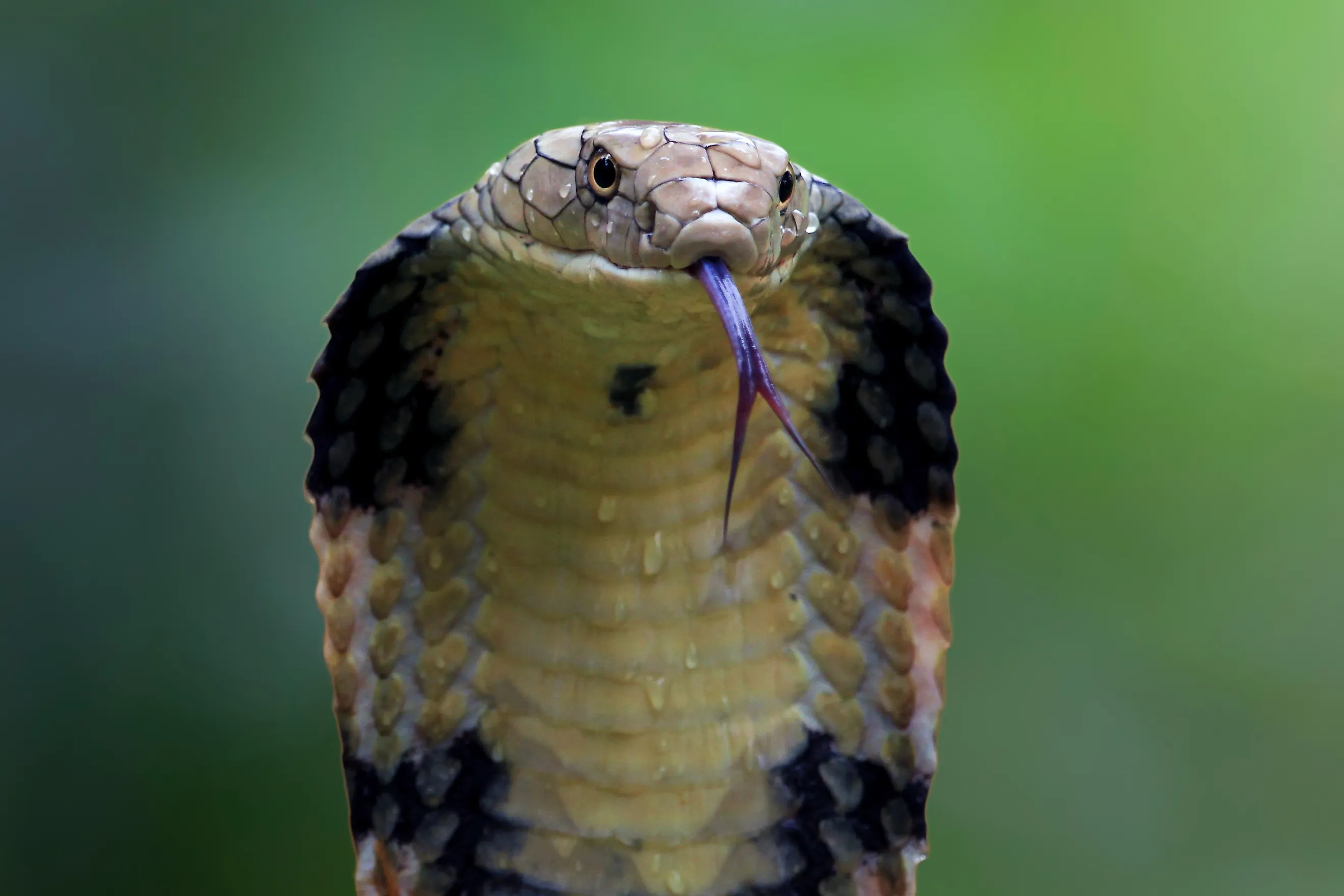
King Cobra
King cobras are equally feared and revered. They are also somewhat misunderstood. For instance, the king cobra is not actually a cobra. True cobras belong to the genus Naja, while king cobras are the only extant member of the genus Ophiophagus. True cobras are opportunistic hunters, preying on rodents, birds, reptiles, and amphibians, while the king cobra primarily eats other snakes, including true cobras, hence their name. While true cobras are less than seven feet in length, king cobras can grow up to 18 feet. Like true cobras, however, king cobras are highly venomous. And perhaps most famously, as depicted in movies and literature, the king cobra can stand high enough to look a human in the eye, emitting a low growl rather than the expected hiss. Read on to learn more about this fascinating species.
Taxonomic Classification

The king cobra regularly exceeds the size of most Naja species and is also the world’s longest venomous snake. It had long been thought that there was a single species of king cobra, but researchers have proposed recognizing four species; however, this proposed four-species classification is recent and has not yet been universally accepted across the scientific community. While true cobras belong to the Naja genus, and both king cobras and true cobras are part of the Elapidae family, which represents front-fanged venomous snakes with relatively fixed fangs, king cobras are of the genus Ophiophagus (derived from the Greek for “snake eater”).
Physical Description

As the world’s largest venomous snake, adult king cobras on average measure 10 to 13 feet, but they can reach over 18 feet in length. They typically weigh an average of 13 to 20 pounds. Male king cobras are larger than females. The skin varies depending on habitat, and colors range from olive green, tan, brown, to black. A distinct feature is a white or yellow chevron-shaped crossband along the body, and the belly tends to be cream or pale yellow. Young king cobras are generally black with bright yellow or white bands. These patterns change as they mature and develop their adult colors. A key distinguishing feature of the king cobra is its hood. When threatened, it will extend its neck ribs to form a long, narrow hood. The king cobra’s hood is generally narrower and more elongated than that of true cobras, allowing it to lift a third of its body straight off the ground, with the capability to look a human in the eye. The back of the head features a pair of large occipital scales, something that true cobras lack.
Habitat and Range

The king cobra is found in tropical forests, bamboo thickets, and mangrove swamps, and is commonly associated with humid habitats near water sources. Its range includes dense highland rainforests, bamboo thickets, and open woodlands. Excellent swimmers, they are usually found near streams, rivers, and lakes. They occur at elevations up to 6,600 feet in the Himalayas, in the Terai region. King cobras prefer undisturbed forests, but they are highly adaptable and also inhabit the edges of agricultural lands, cleared forests, and rural villages. Primarily terrestrial but semi-arboreal, king cobras occasionally climb trees and shrubs.
Found across much of South and Southeast Asia, king cobras inhabit regions including India, Bangladesh, Myanmar, Thailand, Malaysia, Indonesia, and the Philippines. The recent genetic and morphological research that proposes dividing the king cobra into four distinct species recognizes the following geographic ranges: the northern king cobra (Ophiophagus hannah), found across northern India and parts of mainland Southeast Asia; the Western Ghats king cobra (Ophiophagus kaalinga), endemic to southwestern India; the Sunda king cobra (Ophiophagus bungarus), distributed throughout the Malay Peninsula and Greater Sunda Islands; and the Luzon king cobra (Ophiophagus salvatana), found only on the Philippine island of Luzon. Again, this revised classification is still relatively new and has not yet been universally adopted.
Diet

The king cobra is considered an apex predator. As adults, they have no natural predators, although they can be vulnerable as juveniles and when still in the egg. At smaller sizes, they are vulnerable to birds of prey, other snakes, including king cobras, mongooses, and even insects and arachnids, such as army ants and giant centipedes. King cobras track their prey with their powerful sense of smell and chemical trails left by their prey. They often target non-venomous snakes, such as Asian rat snakes and pythons. However, they regularly prey on toxic and venomous snakes, such as kraits and pit vipers, in addition to true cobras. When food is scarce, they will turn to cannibalism, targeting smaller king cobras and juveniles. They are capable of consuming snakes much larger than their own head.
Secondary food sources include non-snakes, and king cobras are very adaptable. When food is scarce, they will hunt lizards, including monitor lizards, and on rare occasions, small vertebrates such as rodents and birds. When hunting, king cobras quickly paralyze the nervous system of their prey with a high-dose delivery of potent neurotoxic venom. Like other snakes, king cobras swallow their prey whole rather than chewing or tearing it apart. Flexible ligaments connecting the bones of the lower jaw allow the mouth to expand around large prey, which is typically swallowed headfirst. During the swallowing process, the snake can extend its glottis, a tube-like opening connected to the trachea, allowing it to continue breathing while consuming a meal. With a slow metabolism, a king cobra can be sustained for several weeks with one large feed and can survive for months if necessary without eating again.
Behavior

As an intelligent but reclusive snake, king cobras generally avoid humans. If the king cobra cannot escape a threat, it will utilize its characteristic warning display: rearing up, where the snake lifts to one-third of its body straight off the ground. A large adult can stand up to 6 feet in height. With its hood and rearing stance, the king cobra will hiss with a distinct growl. When attacking, the king cobra typically maintains its bite while delivering a large dose of potent neurotoxic venom capable of rapidly disabling the nervous system of its prey.
Reproduction

Outside of breeding season, king cobras are solitary. King cobras typically reach sexual maturity at 5 to 6 years. When the female is ready to mate, she will shed her skin, releasing pheromones that can attract a male from a distance. From January through April, males will engage in ritualistic “wrestling” matches, attempting to push the other male’s head down to establish dominance. They will only rarely bite or attempt to kill their opponent. The triumphant male then intertwines with the female and copulates for up to 2 hours.
The king cobra is the only snake in the world known to construct elaborate above-ground nests from vegetation and actively guard them. The female will use her body to gather leaves and branches, then she will lay between 21 and 40 eggs and coil herself on top of the leaf mound covering the eggs. She remains until they hatch and will display extremely defensive behavior to any intruders. Interestingly, the female will abandon the nest right before the eggs hatch. The reason for this behavior is not fully understood, though some speculate that this prevents her from eating the hatchlings.
Importance and Threats

King cobras hold important cultural and religious significance throughout much of South and Southeast Asia, where they are both revered and feared. Their striking appearance and deadly venom have made them powerful symbols in mythology, folklore, and religious traditions. In Hinduism, cobras are closely associated with Lord Shiva, who is often depicted wearing Vasuki, the serpent-king, around his neck. In Buddhist traditions, serpent beings known as nāgas are regarded as protective guardians of sacred places and are sometimes associated with cobras. Across Southeast Asian folklore, these serpent figures are commonly linked to rivers, rainfall, fertility, and protection.
King cobras also play an important ecological role in the forest and wetland ecosystems they inhabit. As apex predators that primarily prey on other snakes, they help regulate reptile populations and maintain ecological balance. Although rodents are not a major part of their diet, their presence contributes indirectly to broader food web stability. King cobra venom is also of significant scientific interest due to its complex chemical composition, and researchers continue to study its potential applications in pain management and neurological medicine. In addition, the presence of king cobras can reflect the overall health of the forest ecosystems in which they live.

King cobras are listed as Vulnerable on the International Union for Conservation of Nature (IUCN) Red List due to population declines driven largely by human activity. Major threats include habitat loss from deforestation and agricultural expansion, collection for the skin trade and traditional medicine, and capture for the exotic pet trade. In many regions, king cobras are also killed out of fear when encountered near human settlements.