Cougar
The cougar is a large, tawny cat that has adapted to more environments than almost any other land mammal in the Americas, from snowbound mountain forests to lowland deserts and tropical swamps. Depending on where a person lives, the same animal might be called a mountain lion, a puma, a panther, or a catamount, and that abundance of names is itself a clue to how widely the species ranges. Behind the many names is a single, remarkably consistent predator whose biology, hunting strategy, and place in the food web reward a closer look.
Names and Classification

The cougar's scientific name is Puma concolor, in which the species name means "of one color" in Latin, a reference to the adult's uniform coat. The species sits in the genus Puma within the cat family, Felidae, and specifically within the subfamily Felinae, the lineage informally known as the "small cats." That placement surprises many people, because a large male can outweigh an adult human. Size is not the dividing line, however. True big cats belong to the genus Panthera, and the cougar's closest living relatives are actually the jaguarundi and the cheetah rather than the lion or the tiger.
Few animals carry more labels. Puma concolor holds the Guinness World Record for the mammal with the greatest number of common names, with more than forty documented in English alone. Many of those names trace back to the peoples who lived alongside the cat for millennia. "Puma" comes from Quechua, the language of the Inca, and roughly means a powerful animal, while "cougar" descends from a Tupi word recorded in Brazil and later reshaped by Portuguese and French speakers. "Panther" is a general term for solidly colored cats, which is why it attaches to this species in the southeastern United States. Which name a person uses depends largely on geography.
Classifying the cougar below the species level has a long and contested history. Following the first scientific description, naturalists eventually proposed as many as thirty-two subspecies based on differences in size, coat, and skull measurements. Genetic studies in the late twentieth century complicated that picture, showing that the proposed subspecies were far too similar at the molecular level and that only about six broad phylogeographic groups exist. In its 2017 revision of cat taxonomy, the IUCN Cat Specialist Group reduced the species to just two recognized subspecies: Puma concolor couguar across North and Central America, which includes the Florida panther, and Puma concolor concolor across South America.
Physical Description
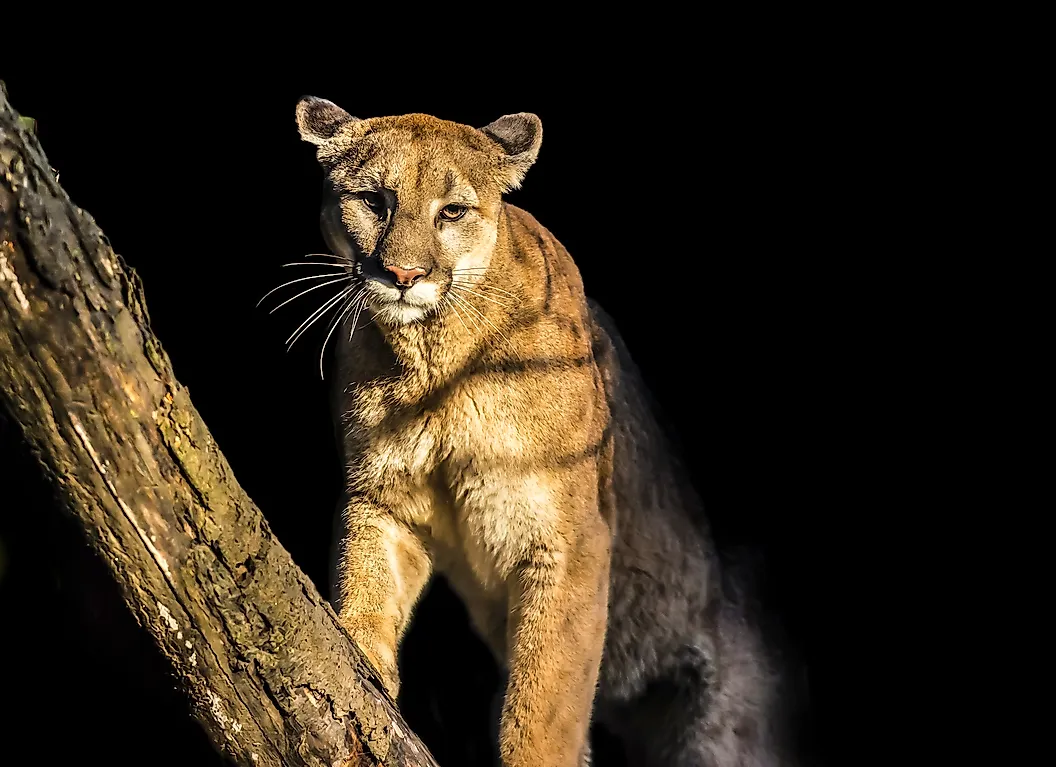
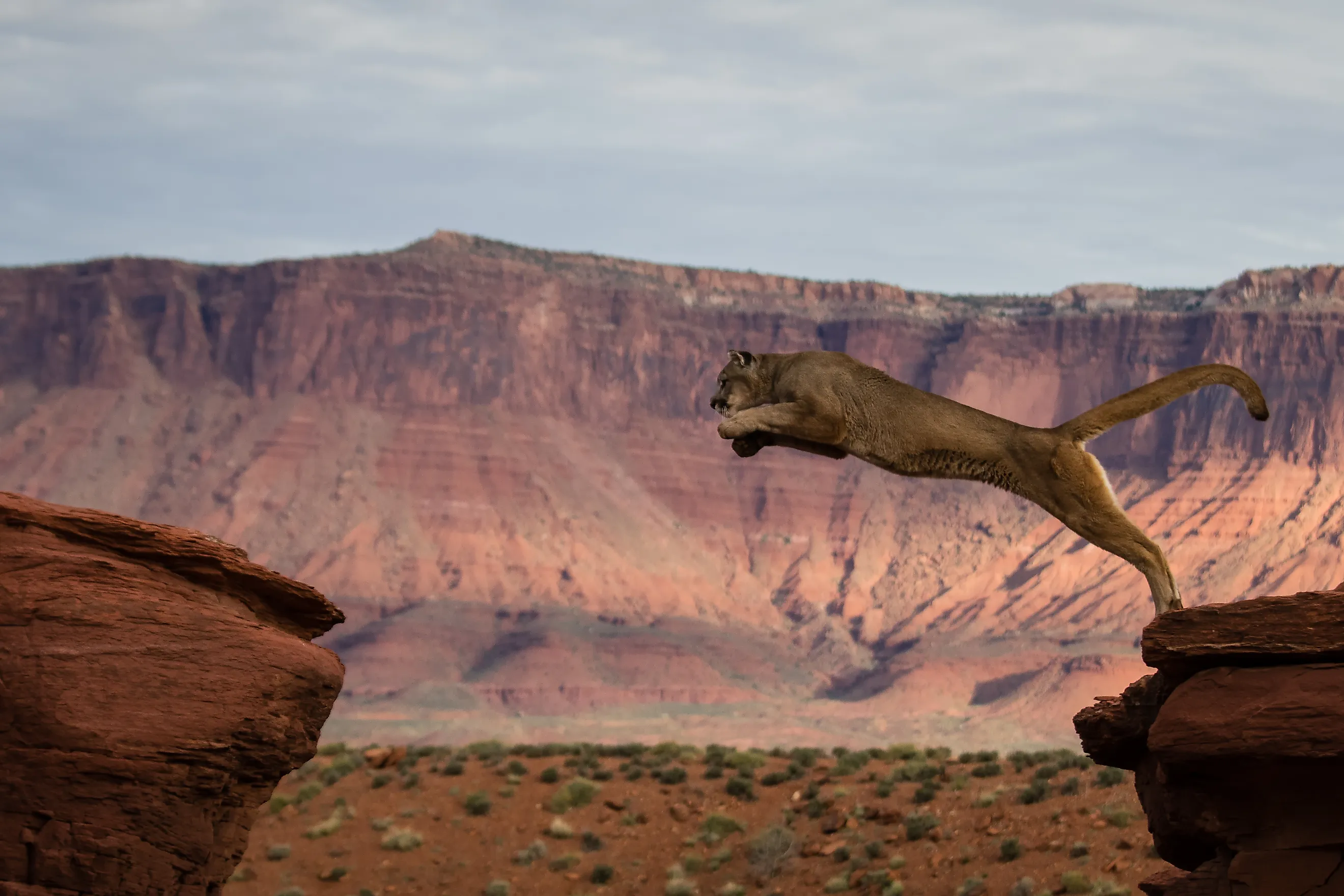
Cougars are powerfully built and slender, with small rounded heads, upright ears, and notably long tails that aid balance during fast turns and leaps. Coat color ranges from silvery gray through tawny tan to reddish brown, typically darker along the back and paler, almost white, on the belly, throat, and inner legs. The tip of the tail, the backs of the ears, and the muzzle usually carry dark markings. Measured from the nose to the tip of the tail, an adult is roughly 1.5 to 2.75 meters long. Males are the heavier sex at about 53 to 100 kilograms, while females generally weigh 29 to 64 kilograms, which makes the cougar the second largest cat in the New World after the jaguar.
Cubs look strikingly different from their parents. They are born with dark spots and blue eyes, camouflage that helps conceal them in the den. The spots fade as the cat matures and largely disappear by around nine months, while the eyes shift toward the amber of an adult. Body size also varies with latitude in a way that follows Bergmann's rule, the biological pattern in which members of a wide-ranging species tend to be smaller near the equator and larger toward the poles.
Range and Habitat

The cougar is the most widely distributed native land mammal in the Western Hemisphere. Its territory reaches north into the Yukon and British Columbia in Canada and extends south to the Andes of Patagonia in Chile and Argentina, spanning more than twenty countries across North, Central, and South America. That breadth reflects an unusual tolerance for different conditions. Cougars live in coniferous and tropical forests, prairies, rocky canyons, deserts, and swamps, and they range from sea level to elevations above 3,000 meters.
Individuals need a great deal of space. Home ranges vary widely with terrain and prey, but a male's range commonly exceeds 250 square kilometers and overlaps the smaller ranges of several females. Because the cats are solitary, they rely on indirect signals to manage these territories, leaving scent marks, scrapes in the soil, and clawed logs to advertise their presence and avoid direct confrontation.
Diet
Cougars are obligate carnivores, and across North America deer make up the bulk of their diet; one survey of studies found that roughly two-thirds of prey items were hoofed mammals, especially deer. Where larger prey is available, they take elk and occasionally moose, and in Patagonia they depend heavily on the guanaco. They round out their diet with smaller animals such as rabbits, porcupines, rodents, and birds. A cougar will also kill livestock, including sheep, goats, and even animals as large as cattle and horses, which is a frequent source of conflict with ranchers.
Behavior

Outside of mating and the period when a mother is raising young, cougars live alone. They are most active in the low light of dusk and dawn and through the night, which coincides with the activity of the deer they hunt, though daytime sightings do occur. One of the clearest signs that the cougar belongs among the small cats is its voice. It cannot roar. The roaring cats of the genus Panthera have a specialized, flexible hyoid bone in the throat; the cougar's hyoid is rigid, so instead of roaring it purrs, chirps, growls, hisses, and produces an eerie, high-pitched scream. Females use that scream to advertise for mates, which has earned the species the nickname "mountain screamer."
The cougar is built for short, explosive bursts of power rather than endurance. It has the proportionally longest hind legs in the cat family and a flexible spine similar to a cheetah's, which together allow it to change direction instantly, sprint at roughly 64 to 80 kilometers per hour, leap about 5.5 meters straight up into a tree, and clear well over 12 meters in a single bound. As an ambush hunter, it relies on stealth rather than speed over distance, stalking close and then pouncing from behind or above. It typically kills with a bite to the neck or the base of the skull, then drags the carcass into brush or another concealed spot and feeds on it over several days before hunting again.
Reproduction

Cougars have no fixed breeding season and can mate at any time of year. When a female is receptive, she signals with scent marking and vocalizations, a male joins her for a brief courtship of a few days, and the two then part ways. The species is polygynous, meaning a male may breed with several females whose ranges overlap his own, while taking no part in raising the young.
After a gestation of roughly 90 to 96 days, the female gives birth to a litter of one to six cubs, with two or three being typical. The cubs are helpless at birth, blind and weighing only about half a kilogram. They begin to wean at two to three months but stay with their mother and learn to hunt for another year or more, usually becoming independent somewhere between fifteen and twenty-four months of age. In the wild, cougars generally live around eight to thirteen years, though individuals in captivity have reached close to twenty.
Threats and Conservation

As a species, the cougar is listed as Least Concern on the IUCN Red List, a reflection of its wide distribution rather than uniform security. Its history in North America is in fact one of dramatic retreat. Hunting and persecution through the nineteenth and twentieth centuries wiped the cat out of roughly two-thirds of its range in the United States, eliminating it from nearly the entire eastern half of the country. The eastern cougar, long classified within Puma concolor couguar, was eventually declared extinct.
The most fragile survivor is the Florida panther, an endangered population reduced to an estimated 100 to 200 animals in the swamps and forests of southern Florida. By the 1990s, inbreeding threatened the remnant population so severely that biologists introduced several female cougars from Texas in 1995 to restore genetic diversity, a controversial step that is credited with pulling the panther back from the edge. The broader pressures on cougars are familiar ones for large predators: habitat loss and fragmentation from development, vehicle collisions, killing in defense of livestock, and trophy hunting. Researchers have also documented declines where gray wolves have returned, since wolves compete for the same prey, steal cougar kills, and will hunt cougar cubs and even adults using the advantage of the pack.
Importance to the Ecosystem
As an apex predator, the cougar helps regulate the populations of deer, elk, and other herbivores, and that role ripples outward through the rest of the ecosystem. By limiting browsing pressure, cougars indirectly shape vegetation and the many smaller species that depend on it, a pattern ecologists describe as a trophic cascade. Their value is magnified by the enormous areas they require. Because protecting enough land for a cougar population also protects countless other species that share the same habitat, conservationists treat the cat as an umbrella species, one whose preservation shelters a whole community of life. The cougar has carried cultural weight for just as long, appearing across the Americas as a symbol of grace and power and as a sacred animal in many Indigenous traditions.