These 11 Towns In Florida Were Ranked Among US Favorites In 2026
Some Florida towns are best known for their rituals. On summer afternoons, boats gather in the shallow water at Crab Island near Destin, and each October the docks fill with spectators for the Destin Fishing Rodeo weigh-ins. In Key West, the day winds down at Mallory Square, where the Sunset Celebration draws a crowd to the waterfront each evening. Here are 11 Florida towns that rank among US favorites in 2026 and what sets each one apart.
St. Augustine

The walls of Castillo de San Marcos look rough and pitted up close because they are made from millions of tiny shells. Spanish workers quarried the coquina on Anastasia Island, ferried it across Matanzas Bay, and began building the fort in 1672. Unlike harder stone that can crack when struck, coquina compressed under cannon fire, helping the Castillo survive attacks that destroyed earlier defenses. That fort is one reason St. Augustine draws so many visitors. The Spanish founded the settlement in 1565, and much of its history remains concentrated around a compact downtown.
Walk south from the Castillo and the street pattern leads toward Plaza de la Constitución, part of St. Augustine's Spanish colonial town plan. The Cathedral Basilica, Trinity Episcopal Church, and the old public market surround the square. A monument erected in 1814 to commemorate the Spanish Constitution still stands in the plaza. The architecture changes again around buildings associated with Henry Flagler's transformation of St. Augustine into a Gilded Age resort. The former Ponce de Leon Hotel, now part of Flagler College, is known for its towers, courtyard, terra-cotta details, and Spanish Renaissance Revival design. Centuries of construction are visible within a few blocks here, from the coquina walls of a 17th-century Spanish fortress to Flagler's elaborate 19th-century hotel.
Sarasota

Five stories of pink stucco, glazed terra-cotta ornament, arched windows, and a tower rise beside Sarasota Bay at Ca' d'Zan. John and Mable Ringling commissioned the Venetian Gothic mansion in 1924 after traveling extensively in Europe, and construction was completed in 1926. Its name translates roughly to "House of John" in the Venetian dialect. The mansion belongs to The Ringling, the 66-acre museum complex that grew from the couple's Sarasota estate. Its grounds now include the Museum of Art, Circus Museum, Bayfront Gardens, and Historic Asolo Theater.
Sarasota's circus connection is one reason the city looks different from other Gulf Coast destinations, but the 1920s building boom left its mark well beyond the Ringling property. The Sarasota Opera House opened as the Edwards Theatre in 1926. The Sarasota County Courthouse, completed the same year, incorporates wrought iron, terra-cotta tile, and Spanish barrel tiles. Sarasota pairs its cultural attractions with access to Gulf beaches. Across Sarasota Bay, the John Ringling Causeway leads toward St. Armands Circle and Lido Key. A visitor could spend the morning examining circus costumes and carved parade wagons, tour a Venetian-inspired mansion after lunch, then cross the causeway toward the Gulf before sunset.
Destin

Look north from Destin Pass on a summer afternoon, and the boats gathered in shallow water mark Crab Island. Despite the name, there is no conventional island there today. Crab Island is a submerged sandbar north of the pass, and its shallow waters have made it a popular gathering spot for boaters. Destin itself occupies a narrow piece of the Florida Panhandle between Choctawhatchee Bay and the Gulf. Destin Pass connects the two bodies of water, which helps explain why boats and fishing remain so prominent around the harbor.
Not all of Destin's shoreline is lined with docks and development. At Henderson Beach State Park, dunes rise as high as 30 feet behind the beach. The park protects the last remaining coastal scrub area in Destin. A nature trail passes through dune and scrub habitat where visitors may see gopher tortoises, shorebirds, and other coastal wildlife. October shifts attention back to the harbor during the Destin Fishing Rodeo, a local tradition dating to 1948. Boats return to the docks with their catches while spectators gather for weigh-ins, keeping the town's fishing history in public view.
Anna Maria Island

Pine Avenue is barely wide enough to forget that water lies at both ends. The road crosses the northern part of Anna Maria Island, passing cottages and low-rise buildings before reaching Tampa Bay at the Anna Maria City Pier. Anna Maria Island is a seven-mile, seahorse-shaped barrier island, with the Gulf on the west and Palma Sola Bay on the east. Pine Avenue's modest scale is part of its appeal. Rather than passing high-rise hotels, visitors encounter brightly painted buildings, porches, galleries, and shops on the way across the island.
At the island's northern end, Bean Point takes its name from George Emerson Bean, an early permanent settler. The beach curves around the tip of the island near the meeting of Tampa Bay and the Gulf, with fewer buildings immediately behind the sand than at many of the beaches farther south. Visitors without a car can use the island's fare-free trolley to travel between the three island communities and public beach areas.
Sanibel

Shell hunters on Sanibel have a recognizable posture: head down, knees slightly bent, eyes fixed on the sand. Locals even have a name for it, the Sanibel Stoop. Sanibel's shelling reputation is what made the island famous. Another trait that influences the town's laid-back feel is the lack of beachfront high-rises. Sanivel also has roughly 25 miles of bike paths.
Mangroves replace shell-covered sand on the northern side of the island at J.N. "Ding" Darling National Wildlife Refuge. More than 245 bird species have been recorded there. Roseate spoonbills, herons, egrets, pelicans, and other birds use its tidal flats and mangrove habitat for feeding, nesting, or resting. The four-mile Wildlife Drive can be traveled by car or bicycle, and three walking trails branch into the refuge. Two canoe launches also connect visitors with its waterways. Sanibel was devastated by Hurricane Ian in 2022. By early 2026, more than 70 percent of the island's hotels and businesses had reopened.
Stuart

A giant sailfish leaping from blue water would look perfectly at home on a Stuart sign. The town has long used the nickname "Sailfish Capital of the World," a reference to the sport fishing associated with nearby Atlantic waters. Water also reaches directly into downtown. The St. Lucie River passes the central district, with Flagler Park occupying riverfront land near the Roosevelt Bridge. Shepard Park sits along another section of the waterfront. Downtown's best-known cultural landmark is the Lyric Theatre, which traces its history to Florida's 1920s land boom. What began as a silent movie house now hosts concerts, comedy, theater, and other performances.
The Stuart Heritage Museum tells a more local story from inside a former feed supply building. Its collections cover subjects ranging from local businesses to fishing and everyday life along the St. Lucie. Rather than separating downtown from the water, Stuart keeps the two side by side. A few blocks can take visitors from the Lyric Theatre to the riverfront, where boats moving along the St. Lucie replace downtown traffic as the view.
Fernandina Beach

Fernandina Beach has two historic street plans rather than one. Old Town Fernandina preserves a Spanish plat from 1811 near the Amelia River. It is often described as the last Spanish city platted in the Western Hemisphere. The center of activity later shifted south after David Yulee developed the Florida Railroad, leaving today's downtown with buildings largely dating from the late 19th and early 20th centuries. That history is visible in Victorian-era houses and commercial buildings throughout the historic district. The historic district spans 52 blocks.
A few miles north, the brick walls of Fort Clinch face Cumberland Sound and the mouth of the St. Marys River. Construction began in 1847 as part of a national system of coastal defenses. The fort was meant to protect Fernandina's deep-water port and the eastern end of Florida's cross-state railroad. Fort Clinch was never fully completed, yet troops occupied it during several periods, including the Civil War, Spanish-American War, and World War II. Fernandina Beach's Spanish street grid, Victorian downtown, railroad history, and unfinished coastal fortress put several eras of Florida history within the same end of Amelia Island.
Naples

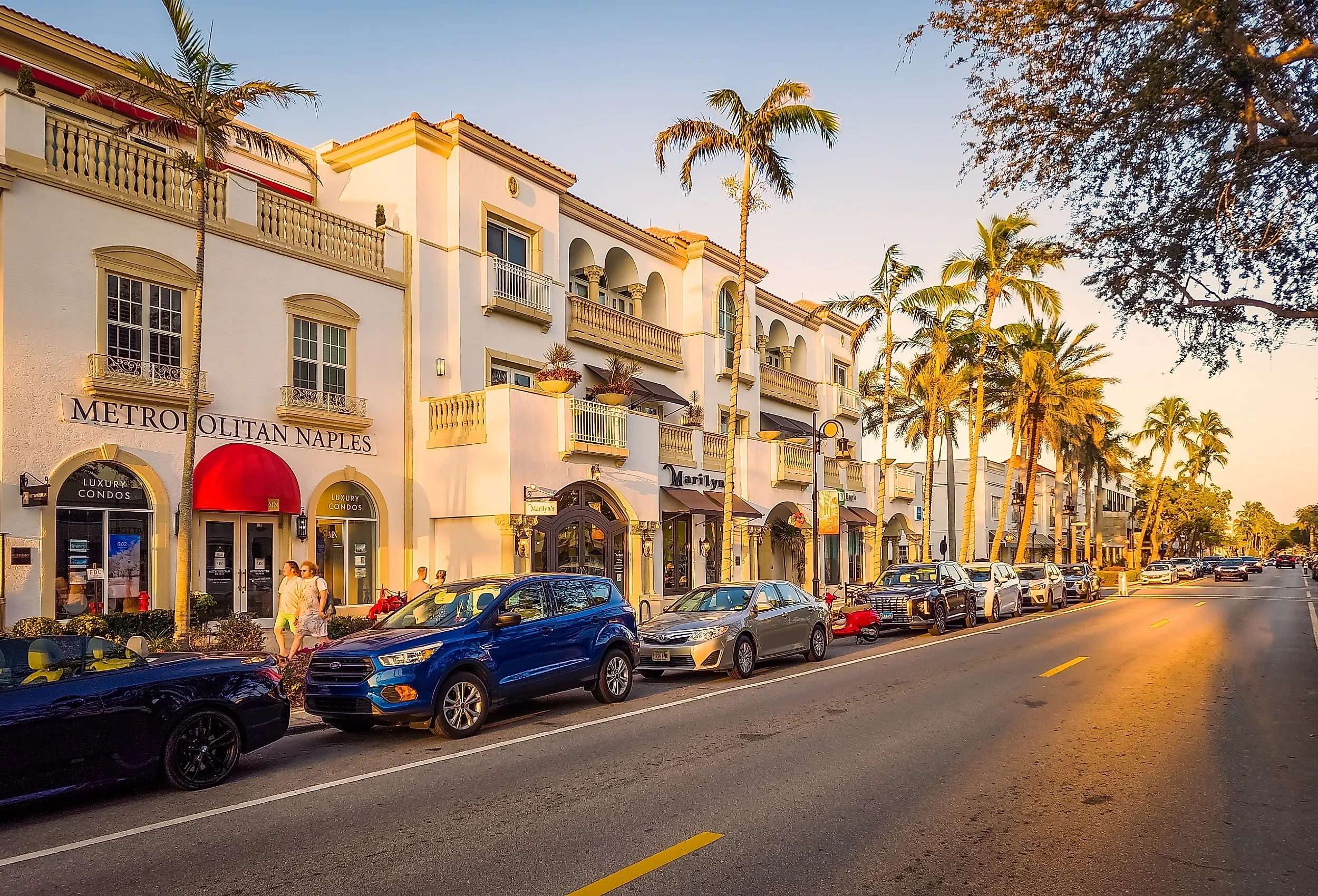
The Gulf is only a few blocks away when standing on Fifth Avenue South, but Naples' main downtown street has its own identity. Landscaped sidewalks, courtyards, galleries, and restaurants line the corridor leading west toward the beach. Fifth Avenue is often called Naples' "Main Street." Naples Beach is part of the draw, but recent developments in the city's arts scene add another reason to visit.
Chief among them is the Baker Museum at Artis-Naples. The museum shares the cultural campus with the Naples Philharmonic, giving visitors a reason to leave the shoreline for exhibitions, concerts, and performances. The Baker Museum's 25th-anniversary programming in 2026 includes work associated with artists and photographers such as Tamara de Lempicka and Ansel Adams. For travelers splitting a day between the two, Fifth Avenue runs toward the Gulf while Artis-Naples sits farther north. The two sides of Naples make more sense as separate outings than attractions to cram into a single walk.
Palm Beach

Henry Flagler built on a scale that is difficult to appreciate until standing in front of Whitehall. Completed in 1902 as a wedding gift for Flagler's third wife, Mary Lily Kenan, the mansion contains more than 75 rooms across roughly 100,000 square feet. Architects Carrère and Hastings designed the estate, which now houses the Henry Morrison Flagler Museum. Flagler's development of Florida's East Coast Railway helped establish Palm Beach as a winter resort, but another architect later gave much of the town its Mediterranean appearance. Addison Mizner became closely associated with Palm Beach's Mediterranean Revival architecture during the early 20th century.
His influence can be seen around Worth Avenue, where stucco walls, tiled roofs, archways, courtyards, and narrow pedestrian passages called vias interrupt the conventional storefront pattern. Duck into one of those passages and the traffic on Worth Avenue quickly disappears behind fountains, staircases, plants, and small courtyards. The Palm Beach Lake Trail shows a quieter side of town than Worth Avenue. The Lake Trail follows the Lake Worth Lagoon side of the barrier island. Rather than oceanfront hotels, this route passes docks, tropical landscaping, and the backs of Palm Beach estates, with West Palm Beach visible across the lagoon.
Islamorada

Eight-foot walls at Windley Key Fossil Reef Geological State Park are filled with the remains of an ancient coral reef. The rock is Key Largo limestone, formed from fossilized coral and other marine material. The reef dates to roughly 125,000 years ago. Quarrying exposed cross-sections where visitors can still identify fossil coral in the stone. The quarry has a second story tied to the development of the Keys. Stone was cut here during construction of Henry Flagler's Overseas Railroad in the early 1900s. Quarrying continued afterward for decorative stone known as Keystone, and old equipment remains on the property.
Islamorada, an Upper Keys community, is known for snorkeling, diving, boating, and its island setting. The History of Diving Museum makes sense in that setting. Its collections trace centuries of efforts to work and travel underwater, including early diving helmets and breathing equipment. Offshore, coral reefs turn the subject from museum history into something visitors can see in the water. Windley Key is the more unusual stop, though. Instead of viewing coral through a mask, visitors can inspect the fossil remains of an ancient reef in the walls of a former quarry.
Key West

US 1 eventually runs out of road in Key West. The highway's southern terminus is part of the island's appeal, as is the Southernmost Point Buoy, a Key West landmark. There is much more to see in Key West than a concrete buoy. Old Town contains rows of Conch houses, wooden homes adapted to the Keys' subtropical climate. Porches, shutters, raised foundations, metal roofs, and decorative wood trim appear in different combinations along the streets. The architecture reflects Caribbean influences as well as American building traditions.
The Key West Lighthouse has watched over the island from its current location since the 19th century. Nearby, the Ernest Hemingway Home preserves another period in Key West history. Hemingway lived there during the 1930s, when he wrote several of his best-known works. Late afternoon belongs to Mallory Square. Its Sunset Celebration brings artists, performers, vendors, and crowds to the waterfront each evening as boats cross the horizon.
Florida Favorites
A traveler standing beside fossil coral at Windley Key would have little reason to mistake Islamorada for Palm Beach, where Whitehall's marble halls recall Henry Flagler's Gilded Age fortune. Fernandina Beach still follows an 1811 Spanish plat in Old Town, while St. Augustine's coquina Castillo dates to the 1600s. Florida's natural settings change just as sharply. Sanibel has tidal flats filled with wading birds and beaches covered in shells. Thirty-foot dunes rise behind Henderson Beach in Destin. Anna Maria Island narrows between the Gulf and Palma Sola Bay, and the St. Lucie River runs alongside downtown Stuart. Florida contains multitudes, and each one of these top towns is a destination in its own right.