American Towns Founded By Immigrants From One Village
Very few towns in the United States were founded by immigrants from just one village or community. The ones established this way by a small group of villagers share something special. They are tightly-knit communities defined by traditions and ways of life from "the old country." Roseto in Pennsylvania was founded by immigrants from an Italian village. Locke in California was built by Chinese immigrants for Chinese immigrants. Towns like these stretch across the country, coast to coast, and remain welcoming to visitors from all walks of life today.
Roseto, Pennsylvania

Roseto, Pennsylvania is often referred to as the "original Italian-American borough." This town in Northampton County was settled in 1882 by stonecutters and laborers from the mountain village of Roseto Valfortore in Foggia, Italy. Researchers in the 1960s discovered that residents of Roseto had very low rates of heart attacks and lived longer than the national average, despite eating high-fat diets, smoking, and drinking alcohol. In medical history, this became known as the "Roseto Effect," which postulated that tight-knit communities with multigenerational households, close neighbors, deep social ties, and church involvement, acted as a buffer against stress. After some years, however, as Roseto became more modernized and traditional ties to the "old country" eroded, the heart attack rate rose to that of nearby, average towns.
Today, Roseto is still a tightly-knit community of about 1,500 people, just 23 miles north of Allentown. The town is no longer almost 100% Italian-Americans, however, with most estimating that percentage now at 40%. Roseto still has local Italian-American businesses like Ruggiero's Market downtown, which has been in operation since 1919. Each year, Roseto celebrates the Roseto Big Time during the third week of July, with food, carnival rides, and fireworks.
Amana Colonies, Iowa

Seven community villages in Iowa, called the Amana Colonies, were established by German Pietist immigrants belonging to the Community of True Inspiration church who came to New York from Hessian and German communities before relocating to east-central Iowa in 1855. The seven villages were originally Amana, East Amana, West Amana, South Amana, High Amana, Middle Amana, and Homestead. Now collectively named a National Historic Landmark, these seven villages functioned communally until the 1930s, when the calico print works, woolen mill, and flour mill closed. The communal system was then abandoned, and the Amana Society, Inc. was created as a joint-stock company separate from the church to manage the business enterprises of the village. One of the most popular businesses that emerged from the Amana Colonies is Amana Refrigeration, founded in 1934.
The Amana Society, Inc. continues to manage 26,000 acres of farmland, pasture, and forested land in Iowa County, with 450 historic buildings, and the Amana Churches, still standing across seven villages. Tourism is a huge contributor to Amana's economy today. While the 2020 census recorded just 388 people living in the main village of Amana, the historic area colonies are home to about 1,500 full-time residents, with Middle and Main Amana housing the largest share of residents. It is estimated that half of Amana's residents are descendants of the original German colonists, and some older residents still speak the local Amana German dialect. Residents can exercise and relax on the Amana Colonies Recreational Trail, a biking and hiking trail that runs just over three miles between Main and Middle Amana. Small-town traditional German-inspired festivals held annually include Maifest in early May, Oktoberfest each October, and Tannenbaum Forest in November and December.
Locke, California

The only town in the U.S. built by Chinese, for Chinese, Locke, California was founded by immigrants from Heungshan (Zhongshan) County, Guangdong Province, China in 1915 in the Sacramento-San Joaquin River Delta. What started as just three buildings; a store and saloon, hotel and restaurant, and gambling hall, grew into the town of Locke as more Chinese families moved to the town and found work at its local farms and canneries. Chinese-language schools were formed, and Locke was known as a welcoming town to Chinese immigrants during a time when other towns were not as welcoming.
Now a National Historic Landmark District, the 14-acre town of Locke in Sacramento County, just 30 miles south of Sacramento, is home to about 100 residents, with only a fraction being of Chinese descent. Visitors to Locke can explore the Dai Loy Museum (the former gambling hall), and check out the Locke Chinese School Museum, the original Chinese language school in town. Small-town festivals such as the Chinese New Year Celebration each February and the Locke Asian Pacific Spring Festival in May celebrate Locke's heritage and draw visitors to the town each year.
New Glarus, Wisconsin

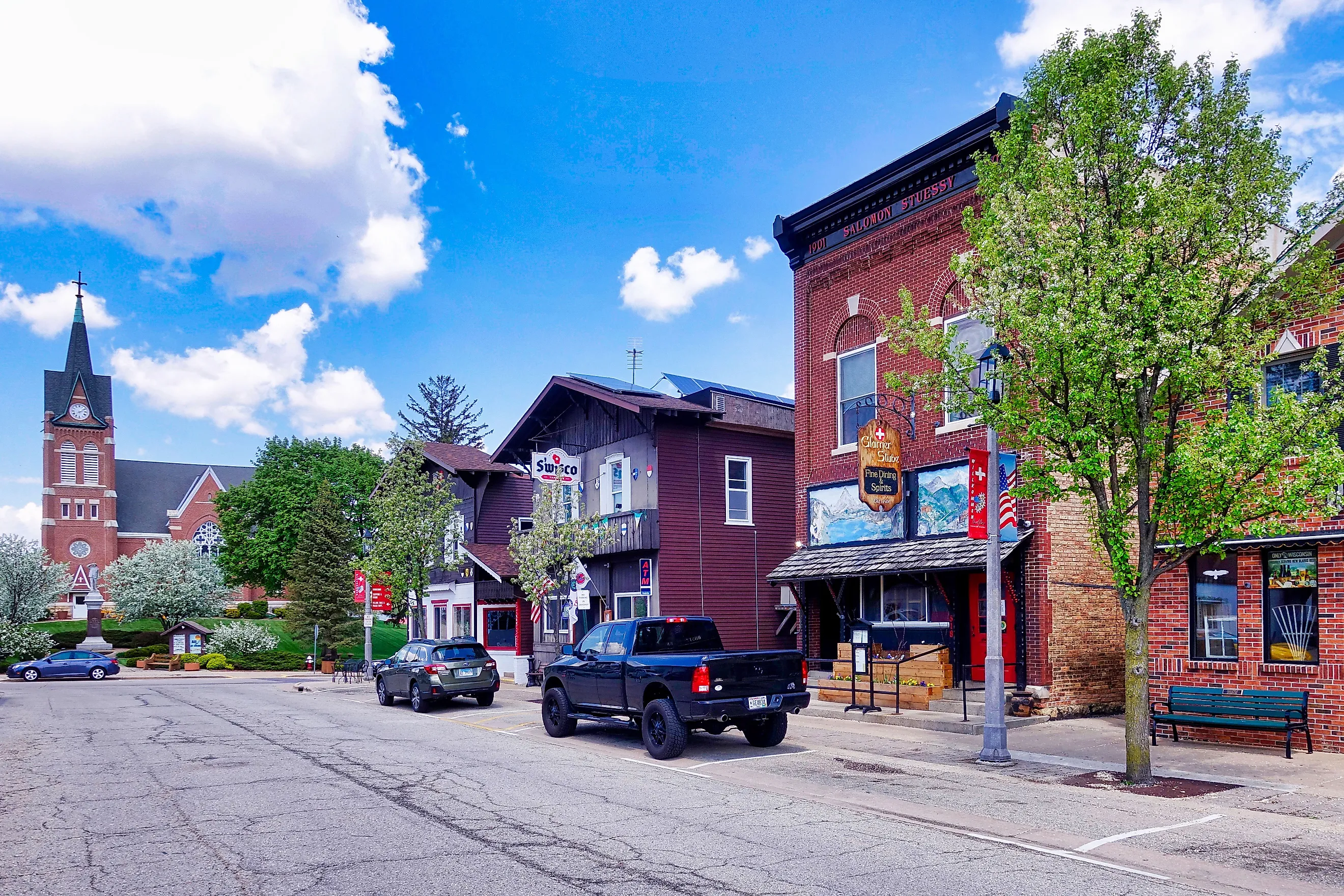
After an economic crisis hit the Canton of Glarus in Switzerland in 1845, the local government formed an emigration society and sent pioneers to buy land in southern Wisconsin. They relocated 108 citizens from Glarus directly to the new site, New Glarus, which today is called "America's Little Switzerland." More and more Swiss immigrants kept coming to New Glarus, bringing their Swiss-German traditions with them. Just over 2,200 residents live in New Glarus today, with over 18% claiming Swiss heritage.
Visitors to New Glarus may enjoy the Swiss Historical Village museum where they can learn more about the town's unique heritage. The New Glarus Mural on 2nd Street depicts scenes from the town's founding and history. Yearly events like Swiss Volksfest (Swiss Independence Day), celebrated in August, and New Glarus Oktoberfest in September attract thousands of visitors who want to experience a bit of Swiss and German Heritage on this side of the Atlantic.
Castroville, Texas

The town of Castroville, Texas, 25 miles west of San Antonio, was founded by settlers from Alsace, France in 1844. Now known as the "Little Alsace of Texas," Castroville's founder, Henri Castro recruited Alsatian families to this town on the banks of the Medina River. The settlers turned Castroville into a mini-European village, and many original buildings are still standing today. In fact, the town's Visitor Center, the Steinbach Haus, was originally built in 1618 in Alsace, France, but was disassembled and shipped to Castroville in 1998. More than 96 historic homes and buildings, built between 1844 and 1920, are still standing today.
St. Louis Day, celebrated each August in Castroville, is a huge carnival with authentic Alsatian sausage, carnival rides, and family activities. The town's population of almost 3,000, along with visitors, come together at this festival. They also appreciate Castroville Regional Park, with its hiking trails, fishing spots on the Medina River, and relaxation. Estimates of how many of Castroville's current residents can trace their heritage to Alsace are unavailable. However, some residents still speak Alsatian, a language mixing German, Celtic, Yiddish, and French.
Freistadt/Mequon, Wisconsin

Sitting on the western edge of the town of Mequon in Wisconsin's Ozaukee County, the community of Freistadt was settled in 1839 by 250 Pomeranian immigrants from Prussia who were fleeing religious persecution near the Baltic Sea. They moved as a single unit, purchased a tract of land together, and founded the first German settlement in Wisconsin, naming it "Free City," or Freistadt. They established Trinity Lutheran Church, recognized as the oldest Lutheran congregation in Wisconsin. One early business, Boehlke Plumbing and Hardware, established in 1927, is still running today and owned by Roger Boehlke, grandson of the original owner.
The Freistadt section of Mequon today measures about two square miles, and, as it is an unincorporated community, the U.S. Census Bureau does not track an official population. Many of Freistadt's longtime residents are descendants of the settlers, and new residents are also moving into this small area of Mequon. Pride in its heritage shows through in things like the town's Alte Kameraden Band, established 85 years ago and still performing German music. Trinity Freistadt Historical Society puts on events and reenactments each year that help to tell the story of the history of the Free City.
Built By Immigrants, And Still Enduring
The towns described here share one commonality: they were each established by immigrants from a specific place. Many of the traditions and cultures that came from those places still endure today. Whether it's the Prussian-German influence of Freistadt, Wisconsin, or the truly unique collection of Amana Colonies in Iowa, the hard work and dedication of immigrants built each of these towns. Visit them today to witness their long-standing heritage and feel the closeness still present within each of these communities.