The Oldest Breweries Operating In America
There's a pretty good chance that the beer served at your grandparents' wedding (possibly even your great-grandparents' wedding) came from a brewery that's still in business and that it'll also be the one you and your friends crack open when the weekend rolls around.
Each of the old breweries we've included on our list got their start in the 1800s, found fans in their neighborhoods, and then, despite booze bans, fires, and changes of ownership, survived well into the 21st century. They were also each started or expanded by immigrants from Europe, who brought with them centuries-old brewing traditions, all still doing what they do best.
We've ranked America's oldest beermakers by the year they began brewing in the town where they still brew today. And we're taking their word for it, using the date published in their own history.
Prohibition isn't a disqualifier, since every one of them kept things going by making other products, including "near beer" (a malt drink brewed under the legal limit of half a percent alcohol), ice cream, soda, or malted milk between 1920 and 1933.
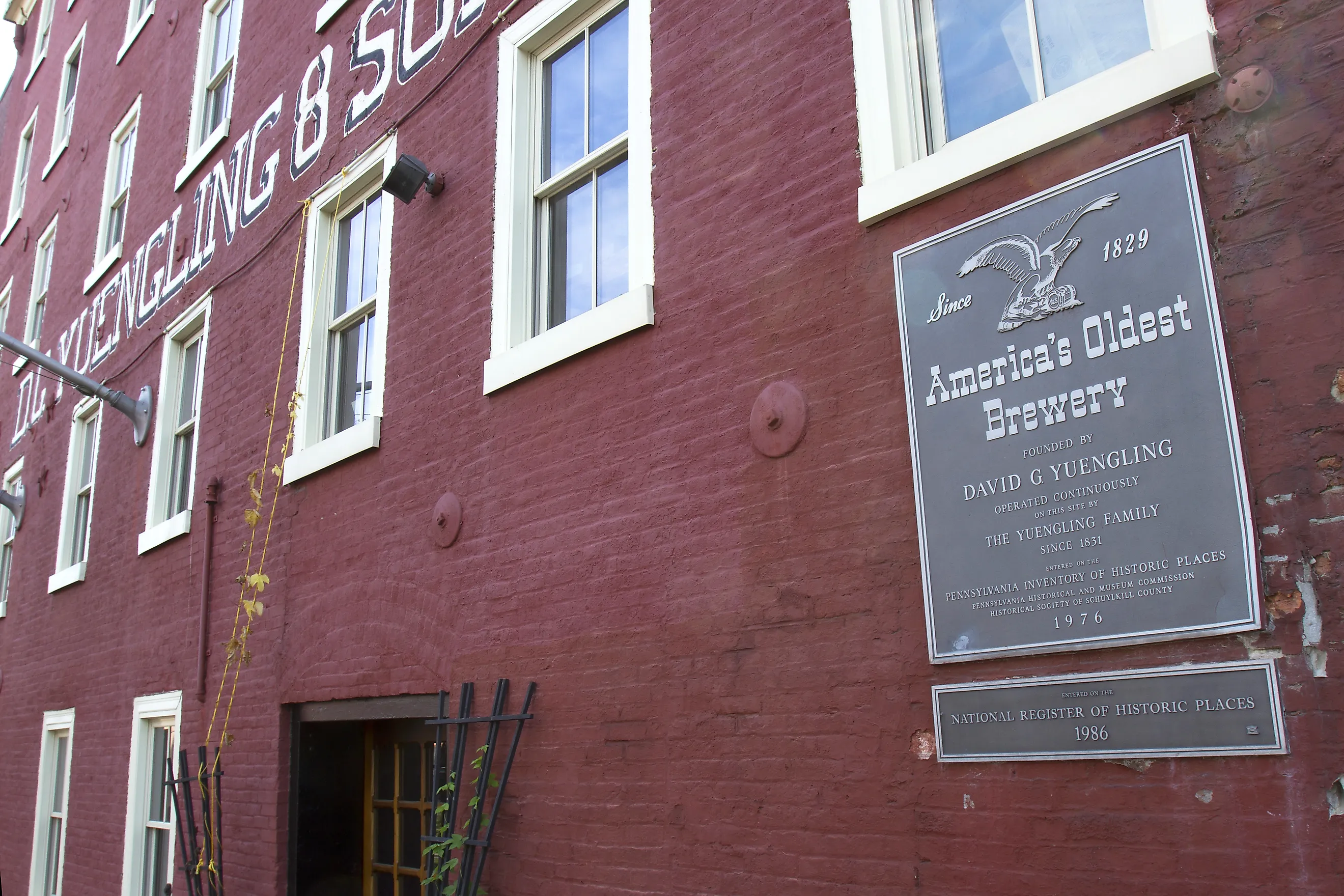
1. D.G. Yuengling & Son, Pottsville, Pennsylvania (1829)

The Germans know a thing or two about making great beer, so when David Gottlieb Jüngling arrived in America from Württemberg, Germany, in 1828, a brewery was an obvious choice for a business.
Anglicizing his name to Yuengling, he opened the Eagle Brewery on Centre Street in Pottsville the following year. A fire destroyed it in 1831, and the replacement at 5th and Mahantongo Streets is where the company still brews today.

The caves that were dug into Sharp Mountain behind the brewhouse to age its beer were sealed up by federal agents during Prohibition. To stay in business, the family sold near beers named Yuengling Special, Juvo, and Por-Tor. They also opened an ice cream dairy across the street in 1920. It closed in 1985, and its building is now the brewery's gift shop, museum, and tasting room.
Nearly 200 years after its founding, it's still family-run. Dick Yuengling Jr., fifth generation, took charge in 1985 and introduced Traditional Lager, now the flagship brew, in 1987. His four daughters run the company as the sixth generation.
The brewing complex itself was listed on the National Register of Historic Places in 1985. Tours are free and last an hour.
2. Minhas Craft Brewery, Monroe, Wisconsin (1845)
In Wisconsin, it was the turn of a Swiss immigrant named Bissinger to introduce the populace to European beers, opening a winter-only brewery on 14th Avenue in Monroe in 1845. German immigrant, John Knipschildt, bought it in 1848, and a fire leveled the plant in 1875. The Blumer family, also Swiss, took over in the 1880s and put their name on it, and during Prohibition turned to making ice cream.
Joseph Huber became president in 1944 and renamed the business after himself in 1947, and Huber Bock is still brewed here. Canadian siblings Ravinder and Manjit Minhas of Calgary, Alberta, bought the company in October 2006 and gave it its current name.
Tours run daily and end with (naturally) a six-pack to take home with you. The Herb and Helen Haydock World of Beer Memorabilia Museum is free to enter and displays brewery memorabilia from the mid-1800s. Crews digging the basement for a 7,600-square-foot addition to the tour center turned up intact 22-ounce bottles embossed with the words "Monroe Brewery Monroe WIS," now more than a century old. The brewery plans to display them in the new wing once it is finished.
3. Anheuser-Busch, St. Louis, Missouri (1852)

Anheuser-Busch dates its founding to 1852, when a small brewery opened on the Pestalozzi Street site in St. Louis where it still brews. Soap maker Eberhard Anheuser bought the struggling Bavarian Brewery in 1860, and his German-immigrant son-in-law, Adolphus Busch, introduced Budweiser in 1876 and Michelob in 1896.
The six-story Brew House, built between 1891 and 1892 with a multi-story hop chandelier and ornamental ironwork, is the centerpiece of the first brewery ever designated a National Historic Landmark.

Bevo, a non-alcoholic cereal beverage launched in 1916, sold 2.2 million cases in its first six months, but when its popularity waned, the brewery turned to ice cream, brewer's yeast, malt syrup, infant formula, and truck bodies. The first of the company's famous Clydesdales arrived in 1933 as a gift from two Busch sons to their father to mark the repeal of Prohibition.
The brewery's Clydesdales kept in St. Louis still live in the original stables from 1885 and are part of the Beermaster Tour, which covers two miles in two hours and also includes the beechwood aging cellars. AB InBev, out of Belgium, has owned the company since November 2008.
4. Stevens Point Brewery, Stevens Point, Wisconsin (1857)
Wisconsin's second entry on this list was started in 1857 by German immigrants Frank Wahle and George Ruder on Water Street in Stevens Point. The cellars and outer walls the duo had built are still part of the plant.
Jacob Lutz bought the business in 1867 with his brother, Andrew, and built a stone brewhouse in 1872. Ludwig Korfmann, a Milwaukee brewery-supplies salesman, bought the company in 1924 when it was surviving on sales of near beer and soft drinks.
The brewery's Point Special Beverage, a near beer, hit the shelves in 1929 and became Point Special Beer after repeal in 1933. Barton Beers of Chicago owned the brewery from 1992 until a Milwaukee developer, Jim Wiechmann, moved ownership back to Wisconsin in 2002.
A $2.5 million brewhouse was added in 2023, and a taproom with 36 taps opened in 2024 in the old grain-milling building from 1936. Tours are available and include samples.
5. August Schell Brewing Company, New Ulm, Minnesota (1860)

In 1926, Prohibition was in its seventh year, and with no end in sight, the family that owned August Schell Brewing Company tried selling it but failed. So, they kept it, scraping by on near beer, root beer, soft drinks, and candy sales until repeal.
By then, the brewery that German-born August Schell started in 1860 with partner Jacob Bernhardt, a former St. Paul brewmaster, had been in business for 66 years.

The four-story brick brewhouse you see today went up in the 1880s, and the Schell mansion in 1885, and both are now listed on the National Register of Historic Places. Ted Marti, fifth generation of the founding family, handed daily operations to his sons Kyle, Franz, and Jace in September 2020. Grain Belt Premium, bought from the bankrupt Minnesota Brewing Company in 2002, was the brewery's top seller by the end of that year.
Tours are available, the formal gardens planted in 1885 (complete with peacocks) are free to wander, and the Bierhalle taproom is open daily.
6. Straub Brewery, St. Marys, Pennsylvania (1872)

Walk into Straub Brewery in St. Marys on a weekday between the hours of 9 am and 4 pm, show ID proving you're 21 or over, and the Eternal Tap will pour you a free beer, with a limit of two glasses or 15 minutes, whichever comes first. The tradition belongs to a company that has never left St. Marys, and is still run by the family of Peter Straub. He was a cooper, a highly skilled craftsman specializing in building the wooden barrels and casks essential to the brewing industry, from Germany.
Straub emigrated to the US at 19 and, in 1872, became brewmaster of the Benzinger Spring Brewery, named for the mountain spring beneath it.
Straub married the owner's daughter in 1875 and had bought out every other shareholder by 1878. His sons ran it as Peter Straub and Sons after his death in 1913, it incorporated as Straub Brewery in 1947, and his great-great-grandson Bill Brock is now president and CEO.
Free tours for ages 12 and up start at the Visitor Center and Tap Room on Brusselles Street, a brick house built in 1917.
7. Coors Brewing Company, Golden, Colorado (1873)

Colorado went dry on January 1, 1916, four years before the rest of the country, so the Coors brewery in Golden had a 17-year dry spell to survive, rather than 13. It did so by making malted milk for the candy maker Mars, a near beer called Mannah, and porcelain, a sideline that survives as CoorsTek. Malted milk stayed in production until 1957.
The plant beside Clear Creek began as an old tannery that Adolph Coors, born in what was then Prussia (now Germany), bought with partner Jacob Schueler in 1873, five years after stowing away on a ship to Baltimore. Coors was sole owner by 1880.
Coors Banquet, the original Golden lager, took its name in 1937 in honor of the miners who drank it, and the company says Golden is the only place it has ever been brewed.
Now owned by Molson Coors, formed in a 2005 merger, the Golden plant is what the company calls the world's largest single-site brewery. In 2025, it completed a modernization that replaced its horizontal fermenters with vertical tanks. The brewery's 90-minute tours are offered Thursday to Monday.
8. F.X. Matt Brewing Company, Utica, New York (1888)

When Prohibition ended on December 5, 1933, the West End Brewing Company of Utica was the first brewer in the country to obtain a license, making its Utica Club the country's first beer legally sold. It stayed afloat during the dry years by making Utica Club soft drinks and was the only Utica brewery to survive them.
Led by Francis Xavier Matt, who emigrated from Germany at just 19 in 1878 and went to work for Carl Bierbauer's Columbia Brewery, the company reorganized in 1888 under the West End name with 12 employees.
The Saranac line, launched with Saranac 1888 Lager in 1985 for the centennial, is now the company's flagship brand. Now run by a fourth generation of the family, the brewery celebrated 138 years in Utica in March 2026 at its 1888 Biergarten and Tavern on Varick Street. VIP tours run Fridays and Saturdays and end with sampling.
America's Oldest Breweries Began In Europe
As we researched America's oldest brewers, one thing became increasingly clear: every brewery included on our list was started or built by European immigrants, most of them German. Yuengling and Straub came from Württemberg, Ruder from Bavaria, Coors from Prussia, Schell from the Black Forest, Anheuser, Busch, and Matt from elsewhere in Germany, and Bissinger in Monroe from Switzerland. Most of them brewed lager, a cold-fermented, slow-aged style that needed caves and ice, and the towns they picked had both.
But what of major brands like Pabst? Well, ranking by the year a company began brewing in the town where it still brews is a stricter test than ranking by brand age. That's why names like Pabst, founded in Milwaukee in 1844 but without a brewery since 1996, and Leinenkugel's, founded in Chippewa Falls, Wisconsin, in 1867 and made in Milwaukee since 2025, didn't make the cut.
The eight that pass the test also share another attribute. When the dry years of Prohibition came, they did what their founders had done on arriving in America: they found another trade, making ice cream, malted milk, or soda while waiting for the good times to roll once more. So, drink responsibly. And when you do drink, make it a beer. Cheers!