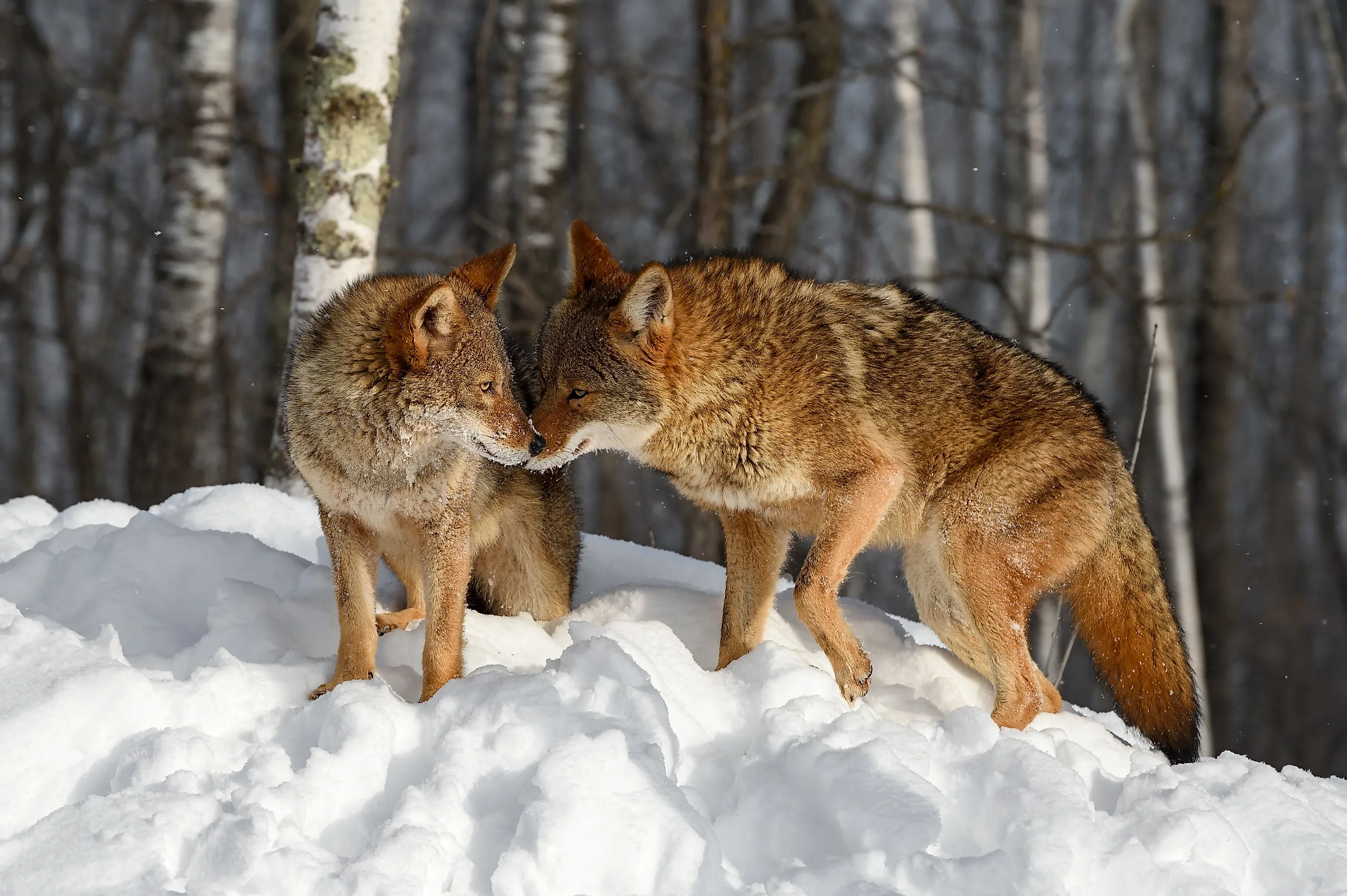
The National Parks With The Most Coyotes
Coyotes have established themselves as predators in several national parks, and research on them dates back decades. In March 1937, growing pressure to kill the animals led the National Park Service to commission a scientific study of coyotes in Yellowstone National Park. A biologist conducted the fieldwork, and the resulting 1940 report became the fourth volume in the agency's Fauna of the National Parks series. Today, the agency describes coyotes as abundant throughout Yellowstone. Other parks, including Ohio's Cuyahoga Valley, have recorded population densities, tracked individual animals, and documented hunting behavior and interactions with larger predators. These seven parks stand out for their established coyote populations and research revealing how the animals live.
Yellowstone National Park, Wyoming, Montana, And Idaho

The last Yellowstone wolf pack was killed in 1926, leaving coyotes with fewer competing predators for nearly 70 years. According to the National Park Service, the disappearance of wolves likely contributed to higher coyote densities in this part of the Rocky Mountains. Yellowstone coyotes lived in family groups of up to seven animals. When wolves returned in 1995, coyote numbers on the northern range declined by as much as 50% as wolves killed adults and pups, competed for food, and occupied territory.

A 2007 study in the Journal of Animal Ecology found that coyote densities in the Lamar River Valley were approximately 39% lower following wolf reintroduction, and family groups shrank to breeding adults and their pups. Wolves also provide opportunities to scavenge, and researchers observing the Lamar Valley between 1997 and 2000 documented coyotes feeding on carcasses left by wolves. The Park Service still describes coyotes as abundant throughout Yellowstone, with more recent trends indicating an increase in the Lamar Valley.
Grand Teton National Park, Wyoming

In a 2008 study of newborn pronghorn in and around Grand Teton National Park, coyotes were identified as a leading cause of fawn mortality. Wolves dispersing south from Yellowstone produced their first documented litter in the park, in western Wyoming, in 1999. Researchers tracking radio-collared coyotes found densities 33% lower in areas with abundant wolves than at a wolf-free study site. The National Park Service's species inventory classifies coyotes in Grand Teton as abundant.

Resident coyotes with established territories were comparatively stable, while transients experienced much greater pressure. Wolves accounted for 56% of recorded transient coyote deaths, and transients in wolf-occupied areas were 117% more likely to disperse. Human activity accounted for 29% of all recorded coyote mortality. The effects reached the prey as well, with researchers documenting 34% less coyote predation on pronghorn fawns in wolf-occupied areas, a detailed account of how competing predators influence one another.
Cuyahoga Valley National Park, Ohio

Cuyahoga Valley National Park occupies a corridor of forests, wetlands, and open fields between Cleveland and Akron. Coyotes returned to the valley during the 1980s after a long absence, and beginning in 1993, park staff estimated their numbers by broadcasting recorded calls at night and listening for responses. The program documented an initial increase followed by stabilization. An earlier National Park Service estimate placed the population at 60 to 100 coyotes, while a more recent estimate puts it at 100 to 150.

A study of coyote diets found raccoon remains in 18% of scat samples collected in the late 1990s, along with deer remains that came primarily from scavenged carcasses. Later research used GPS collars to follow 27 coyotes through the park's forested and developed landscapes along the Cuyahoga River. Coyotes here typically live in family groups of two adults and their offspring, and their calls are often heard throughout the valley.
Death Valley National Park, California And Nevada

Coyotes occupy a wide range of habitats in Death Valley National Park, from the salt flats of the valley floor to mountain forests at higher elevations. The National Park Service describes these desert coyotes as relatively small, generally weighing 15 to 30 pounds. Rabbits and rodents are important food sources, supplemented by fruits such as prickly pear, cultivated dates, and grapes. Feeding by visitors has also altered their behavior, and animals accustomed to handouts may wait in roadways or approach stopped vehicles.

On Christmas Day 2023, a coyote that had spent months approaching vehicles along Badwater Road near Golden Canyon was struck and killed. Rangers had tried to discourage the behavior with paintballs and pepper spray, but the park superintendent explained that the animal had learned to avoid rangers while continuing to approach other vehicles. A similar incident occurred in November 2019, when an adult female known for approaching cars was struck and killed on Artists Drive. Feeding wildlife is prohibited in the park.
Rocky Mountain National Park, Colorado

The coyote has a long history in Rocky Mountain National Park, where its presence is reflected in local place names. Kawuneeche Valley, on the park's western side, takes its name from an Arapaho expression commonly translated as "coyote river." The valley follows the upper Colorado River and includes the Coyote Valley Trail. Coyotes were regularly killed in the years following the park's establishment in 1915, but the species persisted, and historical National Park Service accounts described coyotes as very common.

Moraine Park, Hallowell Park, and Beaver Meadows were among the locations identified for observing them, and scat studies in Moraine Park identified deer and rodents among their food sources. The park has also documented group hunting. Coyotes sometimes gather in winter groups to pursue prey, and one group was observed driving bighorn sheep uphill toward other coyotes positioned to intercept a lamb or ewe. These observations illustrate the species' adaptable hunting strategies in the park's mountain environments.
Great Smoky Mountains National Park, Tennessee And North Carolina

Great Smoky Mountains National Park has provided researchers with an opportunity to study the expansion of coyotes into the southern Appalachian Mountains. A University of Tennessee study examined the animals as they established themselves in Tennessee, including areas protected from hunting within the park. During howl surveys in 1990 and 1991, researchers recorded 27 coyote responses in Cades Cove alone, more than twice the response rate recorded elsewhere in the park. Preliminary density estimates ranged from one coyote per 5.1 square miles to one per 15.3 square miles.

The park also played a role in red wolf recovery efforts. The US Fish and Wildlife Service established an experimental reintroduction program in 1991, with releases continuing during the 1990s, but the project ended in 1998 due to low pup survival and difficulties in establishing stable territories. Of 30 pups born in the wild, only two that were removed at six months of age were known to have survived. Coyotes remain part of the park's documented mammal community.
Acadia National Park, Maine

Coyotes became established in Acadia National Park relatively recently. The first animals on Mount Desert Island probably crossed from the mainland during the winter of 1980 to 1981, and a coyote was observed on Cadillac Mountain in 1981. They remained uncommon during the 1980s and early 1990s, but by 2003, the park's wildlife biologist described them as common. Acadia began studying interactions between coyotes and white-tailed deer as early as 1991, adding another mammalian predator to the island's forests and coastal habitats.

Acadia's coyotes are part of the eastern population, which interbred with wolves as coyotes expanded eastward around the northern Great Lakes. A genetic study involving 462 northeastern coyotes found an average ancestry of approximately 64% coyote, 13% gray wolf, 13% eastern wolf, and 10% domestic dog. Eastern coyotes are generally larger than their western counterparts, with females commonly weighing around 35 to 40 pounds and males averaging 45 to 55 pounds.
Counting The Song Dogs

Coyotes occupy a remarkable variety of environments across these seven national parks. Yellowstone and Grand Teton have produced detailed research on competition between coyotes and wolves, while Cuyahoga Valley has maintained decades of population monitoring. Death Valley documents their interactions with visitors, and the eastern parks illustrate how successfully coyotes have expanded into new habitats. Together, these records show why the adaptable predator, sometimes called the "song dog," remains an important subject of wildlife research across the national park system.