The State Parks That Look Like Another Country
The United States is an incredibly diverse place, its landscapes no less. Several state parks contain scenery that resembles places thousands of miles away, from sandstone formations in Utah that recall Turkey's Cappadocia to the shallow turquoise waters in the Florida Keys that bring the Bahamas to mind. Elsewhere, mossy ravines and basalt cliffs suggest parts of Britain, Iceland, and other European locales. These similarities often reflect shared geological processes or comparable climate conditions. Each of the doppelganger parks we will cover below also has its own unique history, wildlife, and terrain beyond the most familiar views, making them worth a trip even if you can afford to fly abroad.
Ha Ha Tonka State Park - Bavaria, Germany

Stone castle ruins above wooded bluffs give Ha Ha Tonka State Park a resemblance to Bavaria's hilltop fortresses. Near Camdenton, Missouri, old, roofless walls overlook the Lake of the Ozarks, with forest surrounding a former estate.

Kansas City businessman Robert McClure Snyder began construction on this spot in 1905, envisioning a European-style residence. His sons later completed the building, which burned in 1942. Today, Castle Trail leads to views of the surviving pieces of the home and the water below. Dell Rim Trail passes the estate's stone water tower, giving another reminder of the property's original scale.
Beyond the ruins, Spring Trail follows Ha Ha Tonka Spring, where clear water emerges beneath limestone bluffs. A natural bridge and the Colosseum sinkhole add geological interest, while oak woodlands frame the castle views with autumn foliage during October and early November.
Ricketts Glen State Park - Ireland or the UK

Moss-covered ledges, shaded streams, and waterfalls provide Ricketts Glen State Park in northeastern Pennsylvania with a look that is oddly similar to the wooded ravines of Ireland and Britain. The comparison is strongest in Ganoga Glen and Glen Leigh, where water drops over layered rock beneath a thick forest canopy. Moreover, ferns and mosses soften the edges of boulders, while sections of old-growth trees, reminiscent of something in The Lord of the Rings, enclose sections of the gorge.

Waterfall in Glenariff Forest Park, Northern Ireland, United Kingdom.
The Falls Trail System here passes 21 waterfalls, including Ganoga Falls, the tallest at 94 feet (29 meters). A 3.2-mile (5.1-km) loop combines Highland Trail with the routes through both glens, taking hikers past most of the cascades. Stone steps and narrow paths follow the steep terrain, with stretches close to the water. Note that these can be quite demanding trails at times, and wet rock can make footing slippery.
Frequent overcast weather, just like that in the British Isles, further emphasizes the green vegetation and dark stone, while autumn brings brilliant yellow and orange foliage above the ravines and fallen leaves along the stream banks.
Valley of Fire State Park - Jordan or Australia

Just outside of Las Vegas, red sandstone towers and bare desert basins give Nevada's Valley of Fire State Park the same colors and exposed desert landscape associated with Wadi Rum in Jordan or Australia's aptly named "Red Centre."
Its Aztec sandstone began as ancient sand dunes, preserving sweeping layers that remain visible across weathered cliffs and rounded outcrops. Iron oxides account for the deep red coloring, while erosion has carved wave-like arches, hollows, and narrow passages.

Elephant Rock, near the eastern entrance, has an arch resembling a trunk beneath a bulky stone body, and farther into the park, the "Fire Wave" displays curved bands of red and cream sandstone. White Domes introduces other pale rock formations and a slot canyon, adding contrasts similar to the sandstone variations found around Wadi Rum. Then, at Atlatl Rock, stairs lead to a viewing platform beside some very interesting petroglyphs created by natives who traveled the land long before the United States became a country.
The surrounding Mojave Desert also supports creosote bushes and desert bighorn sheep, which sometimes appear on the slopes beside the park's roads.
Goblin Valley State Park - Cappadocia, Turkey (or an alien planet)

Thousands of sandstone hoodoos crowd Goblin Valley State Park in Utah, recalling the fairy-like chimneys of Cappadocia, Turkey on the other side of the world. Here, many formations have bulbous tops and narrow bases, creating fields of mushroom-shaped rocks beneath. If you're not familiar with Asia Minor, its unusual silhouettes could also make the park seem like an alien world, famously used as a shooting location for the movie Galaxy Quest as a result.

The "goblins" formed from Entrada sandstone deposited during the Jurassic period. Uneven weathering and erosion gradually removed softer material, leaving harder sections standing as isolated pillars. These days, you can walk among them in none other than the "Valley of the Goblins," where routes often weave through clusters of stone rather than following a prescribed trail. Near the approach road, the "Three Sisters" groups three tall hoodoos on a shared pedestal, a landmark worth seeing too. For a different perspective, the hike toward Goblin's Lair follows the edge of the cliffs to a cavernous chamber.
Wherever you go, stay off the goblins themselves, since climbing can damage their fragile surfaces (something that has happened in the past, unfortunately).
Palouse Falls State Park Heritage Site - Iceland

The Palouse River plunges 200 feet (61 meters) into a basalt amphitheater at Palouse Falls State Park Heritage Site in southeastern Washington. Dark volcanic cliffs, a waterfall, and treeless surroundings recall Iceland's waterfall-laden countryside. On top of that, vertical columns and stacked rock layers frame the plunge pool, while the river continues south through a winding gorge toward the Snake River.

Ice Age floods carved this terrain more than 13,000 years ago, cutting through older lava flows and leaving the canyon. Fryxell Overlook, the park's highest viewpoint, takes in both the waterfall and the gorge downstream, while a lower viewing area reached by steps offers a more direct look at the waterway. A paved interpretive path explains the canyon's history.
Spring runoff usually increases the waterfall's volume, while winter can add ice along the cliffs. Also keep in mind that all trails into the canyon and to the waterfall's base are permanently closed, so visitors must remain in designated areas.
Bahia Honda State Park - The Bahamas

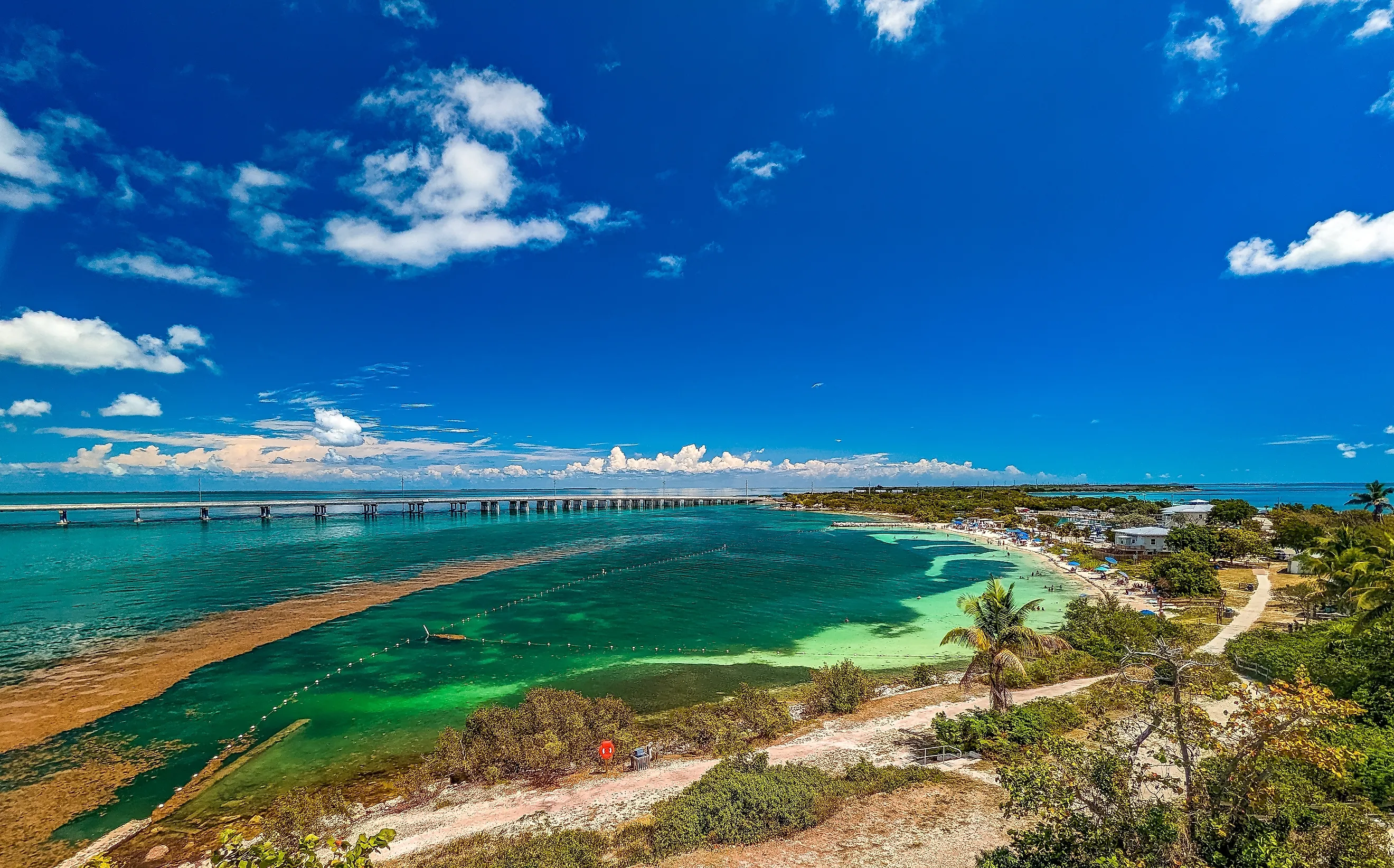
At Bahia Honda State Park, pale sand borders shallow turquoise water, creating a shoreline closer in appearance to the Bahamas than Florida's mainland beaches. The resemblance is strongest along Sandspur Beach, where low coastal vegetation backs a long stretch of sand, and the Atlantic Ocean extends toward an open horizon. Clear days really bring out the differences between the kinds of pale sandy shallows and darker patches of seagrass many associate the Caribbean with.

Calusa Beach offers a swimming area beside the old Bahia Honda Rail Bridge, while Loggerhead Beach faces the open ocean near the island's southwestern end. Snorkelers can explore nearshore habitats when visibility permits, looking for small fish among seagrass and sandy bottom, whereas kayaking gives another view of the island's low shoreline.
For an elevated perspective, a trail leads onto an accessible section of the old bridge approach. The structure belonged to Henry Flagler's Overseas Railroad, which connected the Florida Keys to the mainland in the early 1900s.
You Don't Have to Go Far to See the Natural Wonders of the World at These State Parks
A visit to the above-mentioned destinations can center on a single feature such as Palouse Falls, or take several hours of walking through expansive terrain like in Goblin Valley. Seeing them may save you some time and money on travel, too. Regardless, make sure to plan around the conditions at each destination, as desert heat, slippery gorge trails, and coastal weather affect what you can see and do.