The Deepest Cave In Any National Park
Plunging to a depth of 1,604 feet, Lechuguilla Cave within Carlsbad Caverns National Park in New Mexico is the deepest cave of any United States National Park. This world-famous cave system sits within 46,766 federally protected acres of the limestone and dolomite Guadalupe Mountains, formed in the Permian Basin.
Several large caves exist within the park, including Carlsbad Cavern, Spider Cave, Slaughter Canyon Cave, and the deepest, Lechuguilla Cave; access to which is limited to researchers and approved exploration expeditions only.
Carlsbad, Spider Cave, and Slaughter Canyon all host public tours. Carlsbad is the most accessible to public touring with developed pathways, and contains the largest, publicly accessible cave chamber in North America, the 8.2-acre Big Room.
While Lechuguilla Cave is not accessible to public tours, for anyone visiting Carlsbad Caverns National Park, it's still absolutely worth learning about Lechuguilla's terrain and incredible subterranean ecosystem and its importance to cave research.
Discovering the Vastness of Lechuguilla Cave

At over 150 miles of winding passageways, Lechuguilla Cave is not only the deepest within any National Park, but it's also one of the ten longest caves in the world. However, the title of the longest cave system within a national park, and the entire world for that matter, belongs to Mammoth Cave in Kentucky.
Until 1986, Lechuguilla Cave was seen as a small system within Carlsbad Caverns National Park, consisting of a 90-foot entrance pit that led to 400 feet of dead-end passageways. Since the 1950s, groups of cavers have heard strong gusts of wind blowing from the bottom of the cave, signaling that somewhere, amidst the rubble-choked floor, a passageway existed and the cave system continued.
On May 26th, 1986, everything changed when a group of Colorado cavers received permission from the National Park Service (NPS) to begin digging into the rubble at the bottom of the pit to look for additional passageways. On that day, cavers made a monumental breakthrough from the floor of the pit into large, walking passageways, officially opening up human exploration of what is now considered one of the finest and uniquely decorated caves on the planet. Since the breakthrough, cavers have mapped over 150 miles of passages and explored to a depth of 1,604 feet.
What Lies Inside

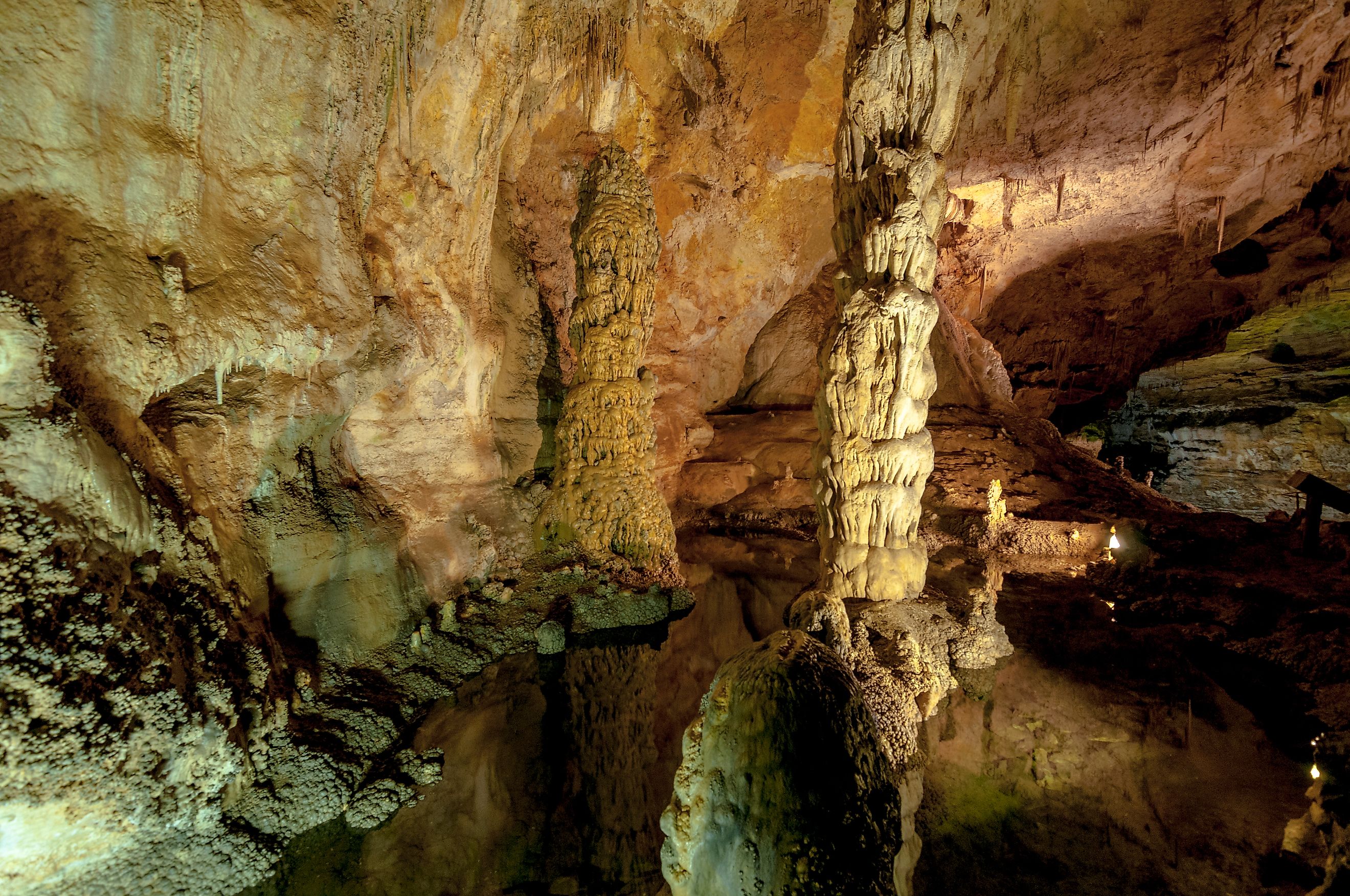
In addition to its vast network of passageways, Lechuguilla also revealed a dense concentration of gypsum, yellow sulfur deposits, and an array of rare speleothems (cave formations), some of which are currently unknown in any other cave in the world.
These formations include 20-foot gypsum chandeliers, gypsum hairs and beards of the same length, and soda straws that hang 18 feet from the ceiling. Hydromagnesite balloons, cave pearls, helictites forming underwater, rusticles, and the looping u-shaped and j-shaped formations known as u-loops and j-loops add to the cave's impressive variety.
The profusion of gypsum and sulfur in Lechuguilla points to sulfuric acid as the force that dissolved the cave. Scientists believe the acid formed when hydrogen sulfide, rising from nearby oil deposits, mixed with oxygenated groundwater. As a result, the chambers opened from the bottom up instead of being carved by water seeping down from the surface.
In a 2020 study published in the International Journal of Speleology, researchers found barite crystals growing in a shallow pool and in dripping stalactites. Microbes covered the pool crystals, pointing to the formations as biothems, cave formations that exist due in part to bacterial activity.
A Natural Laboratory for Scientists

Scientists from several fields have turned Lechuguilla into a research site, and each field reads the cave differently.
In a 2012 study published in the journal PLoS ONE, a microbiologist team from McMaster University and the University of Akron screened 93 bacterial strains, collected from about 1,300 feet below the surface, from a section of cave isolated for more than four million years.
Nearly all resisted at least one antibiotic, and three strains of Streptomyces resisted 14 different drugs. Many strains defended themselves the same way surface bacteria do, but one species resisted the drug daptomycin by breaking it apart at a critical point, a tactic new to science.
Geomicrobiologists study how microbes interact with rock. In 2003, researchers sampled the dark ferromanganese deposits that coat parts of Lechuguilla and nearby Spider Cave. They found diverse microbial communities and a fourfold enrichment of oxidized iron and manganese from bedrock to the darkest deposits, evidence that microorganisms may help build the crusts.
Geochemists use the cave's pools to study subterranean water. A 2022 study in Applied Geochemistry measured tritium, chlorine-36, and water isotopes in pools at different depths in Lechuguilla and Carlsbad Cavern. The team wanted to see how far the radioactive "bomb pulse" from mid-century nuclear testing had traveled underground. The signal reached depths of more than 650 feet within a few decades, which supports studying cave formations as records of past events.
From the Visitor Trails to Lechuguilla

Members of the public cannot descend into Lechuguilla, but the daily guided tours of Carlsbad Caverns, and the periodic off-trail tours of Spider Cave and Slaughter Canyon Cave reveal the same limestone environment to visitors. Lechuguilla surpasses its neighbors in size and depth, but no room found in the deeper cave has topped the 8.2-acre Big Room of Carlsbad Cavern.
Approved expeditions keep extending Lechuguilla's survey, with the map pushing past 150 miles in October 2019. It's possible that a future expedition will extend the depth record as well, adding new passageways to one of the most unique caves in the world.