9 Michigan Small Towns With Unmatched Friendliness
Michigan's most welcoming small towns tend to have one defining trait. Holland plants six million tulips and draws nearly a million visitors each May. Leland's fishing shanties have been on the National Register since 2022. Rogers City sits above a freshwater marine sanctuary on Lake Huron. Each of the nine towns here has something like that: one detail that makes the stop worthwhile.
Holland

For one week each May, the whole town turns out to scrub the parade route by hand, a Dutch tradition Holland has kept alive at its Tulip Time Festival since 1929. Klompen dancers in wooden shoes fill the streets, and the costumes, sewn by local seamstresses using hooks and eyes instead of zippers, often pass from a grandmother to a granddaughter. Nearly six million tulips bloom across the city's parks and boulevards, and close to a million visitors come to see them, many of them housed by neighbors who coordinate whole busloads block by block. Holland was settled in 1847 by Dutch Calvinist Separatists who came from the Netherlands seeking religious freedom and relief from hard economic times. The 2020 Census put the population at about 34,400, and over a quarter of residents still claim Dutch ancestry.
The welcome extends past the festival into the everyday. Locals call Holland the "City of Churches," and the roughly 140 congregations in the greater area helped give the place its reputation for looking after its own. One of those churches started the "What Would Jesus Do?" bracelet movement in 1989, a small idea that traveled the country. Downtown along 8th Street, the sidewalks stay clear all winter thanks to the Snowmelt Project, which pipes warm water from the power plant beneath the pavement so shoppers and residents can move comfortably between the locally owned cafes, breweries, and stores. The Latin Americans United for Progress group hosts events through Tulip Time as well, a sign of how the town's circle has widened as its population has changed.
When the crowds thin, Holland settles back onto its waterfront. The city sits on Lake Macatawa near Lake Michigan, with public beaches at Tunnel Park and Holland State Park, and the Holland Harbor Light, known to everyone as "Big Red," standing across the channel. De Zwaan, an original 250-year-old Dutch windmill, still turns at Windmill Island Gardens, and the Holland Museum, Cappon House, and Settlers House Museum keep the city's story close at hand. The Yorktown cruise ship calls here too, but most visitors find the best of Holland on foot.
Leland

Leland's working waterfront is the reason to come, and the reason people stay friendly. The Fishtown Historic District, added to the National Register in 2022, is no museum reconstruction. Its weathered shanties, wooden docks, and working boats still bring in the day's catch, and the same families who fish these waters run the smokehouses and charter trips that visitors book. Stroll the docks at the right hour and you can watch the boats unload, buy whitefish straight off the operation, and fall into conversation with people who have done this work for generations. The village sits between Lake Michigan and Lake Leelanau, about 40 minutes from Traverse City. Its name comes from an Anishinaabe term often rendered as "delight of life."
The town gathers around its food and its makers. The Leland Wine and Food Festival each summer pulls in regional wineries and restaurants for a day of local flavors, and the celebration doubles as a reunion for people who summer here year after year. On Main Street, Tampico Imports sells jewelry made from Petoskey stones and Leland Blue, the slag glass left behind by the old iron smelter, while the Dam Candy Store and Peninsula Provisions stock treats and local foods. Galleries like Two Fish and the Brenda J. Clark Gallery give local artists a place to show their work, and the shopkeepers tend to know their regulars by name.
For a longer outing, the Manitou Island Transit runs a ferry from May through October to North and South Manitou Islands, about 16 miles west of Leland Harbor and roughly 90 minutes out. The islands trade Leland's docks for empty beaches and backcountry trails, a different side of Great Lakes country. Most visitors come back to Leland for dinner, drawn by the same easy hospitality that made them want to linger in the first place.
Muskegon

Muskegon was once the "Lumber Queen of the World," and the lumber it shipped helped rebuild Chicago after the Great Fire of 1871. By the late 1800s the boom had reportedly made it home to more millionaires per capita than almost any town in America. That fortune faded, but the civic pride did not, and today residents pour it into a downtown they have spent two decades bringing back to life. The name comes from the Ottawa word Masquigon, meaning marshy river. The city sits on the south shore of Muskegon Lake, a harbor that opens onto Lake Michigan, and locals treat the long beachfront at Pere Marquette Park as a shared backyard.
The town's welcome shows up loudest on its event calendar, which runs nearly nonstop through the warm months. Taste of Muskegon, the Burning Foot Beer Festival, Powerboat Weekend, and an Irish and Celtic Festival fill the downtown with crowds that are as much local as tourist. Volunteers built and tend the Monet Garden of Muskegon, a pocket re-creation of Claude Monet's garden in Giverny, France, complete with a blue footbridge and rose-covered arches. The same community spirit keeps the USS Silversides Submarine Museum and the neighboring USS LST 393 Veterans Museum staffed and open, both of them WWII vessels preserved by people who wanted the history kept where the public could touch it.
At the harbor mouth, the South Pierhead Lighthouse from 1903 and the breakwater built in 1931 draw photographers at sunset. When the Coast Guard deemed the light surplus in 2008, it offered the structure at no cost to the Michigan Lighthouse Conservancy, a statewide nonprofit that took ownership in 2010 and keeps it standing. Come winter, the lake-effect snow piles up as Canadian air crosses the open water, and the town turns to snow sports and its indoor venues without missing a beat.
Dexter

Dexter runs on volunteer energy, and you feel it the moment you reach the restored downtown of Queen Anne and Italianate buildings. This community of roughly 4,500 grew up along the Huron River and Mill Creek, where early industry tapped the water for power, and the same river now ties the town together. Locals paddle and tube it with outfitters like Skip's Huron River Canoe Livery, walk and bike the Border-to-Border Trail that runs nearly 43 miles across Washtenaw County, and turn out for events at the parks and the well-loved public library. The town's reputation for friendliness rests on that habit of showing up for one another.
The heart of it is Dexter Daze, the annual late-summer festival where the whole town spills onto the streets for live music, food vendors, and family activities organized largely by neighbors. Between festivals, daily life centers on the kind of independent spots people are loyal to: the old-school A&W drive-up, Dexter Creamery for ice cream, fish and chips at the Dexter Pub, and deep-dish at Cottage Inn. On weekends the scenic roads along the Huron River fill with cyclists, motorcycle clubs, and classic-car drivers who treat the route as a standing get-together.
Dexter sits just northwest of Ann Arbor, close enough to borrow the city's culture while keeping its own personality. Residents can drop into Nickels Arcade near the University of Michigan, catch a Big Ten game, or wander the Ann Arbor Art Fair each July, which spreads across roughly 30 downtown blocks and draws around half a million people. That mix of small-town closeness and nearby amenities, along with a slow pace and strong schools, is why Dexter often turns up on lists of Michigan communities favored by retirees.
Houghton

Houghton greets its brutal winters with a joke and a party. Students and locals like to say the year has two seasons, "winter's here" and "winter's coming," and the annual Winter Carnival turns that attitude into a town-wide celebration of ice fishing, snowshoeing, outdoor hockey, and snow sculpture. The carnival has set world records for the largest snowball fight and the most people making snow angels at once, the kind of stunt a community attempts only when everyone agrees to show up. Copper built this place: Native Americans mined it here for thousands of years before settlers arrived for the boom, and Cornish and Finnish immigrants who came for the mines left their mark on the food and traditions. Houghton is the largest city on the Keweenaw Peninsula, home to about 8,400 residents, and sits along the Keweenaw Waterway off Lake Superior, the largest freshwater lake in the world by surface area.
Michigan Technological University, founded in 1885, anchors the town's social life and its sense of inclusion. The school's Parade of Nations each summer celebrates the many cultures its students bring to the Upper Peninsula, and Bridgefest honors the Portage Lake Lift Bridge with a weekend that locals pair with Seafoodfest. Nearby Chassell adds a Strawberry Festival with an art market. The A.E. Seaman Mineral Museum holds more than 400,000 specimens, including a Guinness-record native copper slab, a 19-ton piece pulled from the bottom of Lake Superior.
Houghton is also the jumping-off point for Isle Royale National Park, reached by ferry or, sometimes, floatplane. The park and its 400-plus islands rank among the least-visited in the system, drawing fewer people in a year than Yellowstone sees in a day. Isle Royale is the world's fifth-largest lake island and a UNESCO Biosphere Reserve, with 165 miles of backcountry trail, about 200 inland lakes, and Mount Desor at its high point. Its solitude is the draw, and the welcome in Houghton is what sends backpackers off well-fed and points them home again.
Empire

With about 300 residents, Empire is small enough that the welcome is personal. The village sits at the edge of Sleeping Bear Dunes National Lakeshore, on the traditional homelands of the Odawa Nation, where 450-foot bluffs rise over Lake Michigan. The Empire Bluff Trail, a roughly two-mile round trip, ends at an overlook worth the climb, and Empire Beach is the village swimming spot, though no lifeguards are on duty and the rip currents demand respect. Joe's Friendly Tavern lives up to its name as the place where visitors and locals end up at the same bar, and the Sleeping Bear Gallery and Empire Village Inn round out a downtown you can cross in a few minutes.
The town's biggest day is the Empire Asparagus Festival, a homegrown celebration of the area's farm heritage with food, music, and the kind of small-town traditions that bring out every generation. Because Empire has few chain hotels, lodging means cabins, cottages, a renovated train caboose with a fire pit, or a lake house, and booking ahead is part of the deal. That scarcity keeps the village quiet and the visitors invested, since anyone who comes has made a deliberate choice to be here.
Beyond the dunes, the water is the other draw. The Crystal River offers a beginner-friendly paddle that families favor, while the Manistee and Boardman rivers test more experienced kayakers and canoeists. Empire stays uncrowded compared with the bigger tourist towns, which is exactly what its regulars prize. Whether you spend the day on the dunes or by the lake at dusk, the easygoing spirit is the thing people remember.
Saugatuck

Saugatuck made its welcome its identity. A lumber town and port of fewer than 800 full-time residents, it grew into one of Michigan's most openly inclusive destinations, known with neighboring Douglas and Fennville as the "Art Coast of Michigan." The three communities share 12 miles of Lake Michigan shoreline and six beaches, and the town has long been a haven for the LGBTQ+ community. The Dunes Resort bills itself as the largest LGBTQ+ resort in the Midwest, and that reputation for acceptance shapes how the whole town treats newcomers. Saugatuck sits 12 miles from Holland and 45 miles from Grand Rapids.
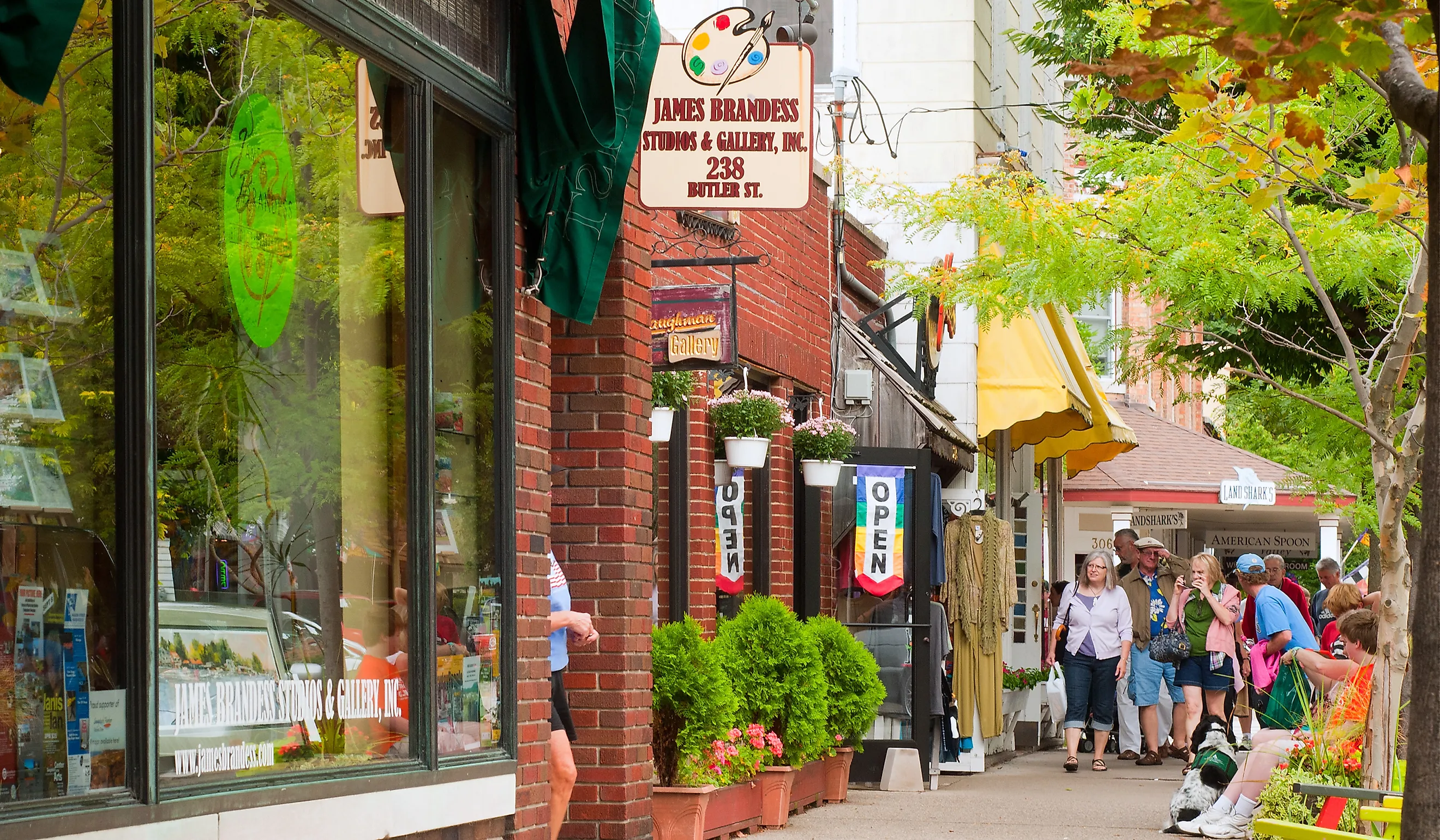
Art is the common language. The Saugatuck Center for the Arts anchors a downtown lined with galleries and studios, and Ox-Bow, an art school founded more than a century ago, still draws working artists who become part of the community. Amazwi Contemporary Art spotlights modern African work, and public art turns up on the streets between the shops. Oval Beach, widely rated among the Midwest's best, gives the artistic crowd somewhere to spread out, and the Saugatuck Dune Rides give families a reason to laugh together on the sand.
The town's traditions keep everyone coming back to the same riverbank. The annual Venetian Festival at the end of July fills the waterfront with parades, fireworks, and music, and the hand-cranked chain ferry across the Kalamazoo River has carried passengers the same low-tech way for generations. What holds Saugatuck together is the way its residents guard that character, supporting the small businesses and the open-door spirit that made the place what it is.
Rogers City

Rogers City calls itself the Salmon Capital, and the title sets the tone for a community of about 2,800 that organizes its year around the water. The 100-slip municipal marina sends out charter boats for salmon, and the town's calendar fills with reasons to gather: the four-day Great Lakes Lighthouse Festival in August, the Labor Day weekend salmon tournament, and the Rogers City Nautical Festival. The town sits on Lake Huron between Alpena and Cheboygan, within reach of Thunder Bay National Marine Sanctuary, the nation's first freshwater marine sanctuary, whose protected shipwrecks draw divers from across the region.
The Forty Mile Point Lighthouse is the town's gathering place as much as its landmark. The red-and-white light and keeper's house, just off US-23 on Michigan's Heritage Route, charge no admission and rely on volunteer docents who clearly enjoy the work, with a gift shop and beach access alongside. When the water runs low, the bones of the Joseph S. Fay shipwreck surface along the shore. A short drive inland leads to Ocqueoc Falls, the largest waterfall in Michigan's Lower Peninsula, where the Ocqueoc River has cut a channel through limestone bedrock and swimmers wade the tiered pools all summer.
For a quieter day, P.H. Hoeft State Park offers sand dunes, long beach walks, and good campsites, and the paved Huron Sunrise Trail links downtown to the lighthouse along a flat, family-friendly route. The Great Lakes Lore Maritime Museum keeps the shipping stories alive through exhibits and volunteers who lived the work. After a day on the water, locals point newcomers to The Lighthouse Restaurant or Up North 23 for comfort food, the last stop in a town that treats every visitor like a returning one.
Charlevoix

Charlevoix wedges itself between Lake Michigan and Lake Charlevoix, and its 2,500 year-round residents have a knack for making visitors feel like locals fast. The town's signature is the cluster of Mushroom Houses, the curving stone cottages architect Earl Young built from local boulders over half a century, which give downtown a look found nowhere else in the Midwest. Round Lake forms the heart of town, ringed by boutiques, galleries, and waterfront restaurants, and a stroll there usually turns up a street musician playing to the farmers-market crowd. The town sits about an hour from Traverse City.
Summer is when the community comes out in force. The Charlevoix Venetian Festival each July brings parades, carnival rides, live music, and fireworks down to the water, drawing back the families who have summered here for decades. Castle Farms, built as a model dairy farm by an executive of Sears, Roebuck & Co., now hosts visitors among its stone buildings, gardens, and ponds. Fisherman's Island State Park offers shoreline and trails, and the Charlevoix South Pier Light Station frames the Lake Michigan sunsets that pull people to the breakwater each evening.
The town also serves as the gateway to Beaver Island, a ferry ride out into Lake Michigan and a favorite day trip for residents who want quiet. Visitors pack a picnic, drive to the island's south end to see Beaver Head Lighthouse, and hunt the shoreline for fossilized, soft-gray Petoskey stones. Charlevoix manages to feel polished and unpretentious at once, which is why so many visitors decide they belong here.
What Makes These Towns Welcoming
The thread running through all nine is that the welcome is built, not advertised. Holland's neighbors house a million festivalgoers and scrub the streets by hand. Leland's fishing families still work the docks and talk to anyone who wanders down. Houghton throws a record-setting party rather than complain about the snow, and Saugatuck made acceptance the center of its identity. Muskegon poured its old lumber fortune into a downtown its volunteers refuse to let fade, while Dexter, Empire, Rogers City, and Charlevoix each run on the same volunteer energy and the same instinct to fold a visitor into the community. Their lakes and lighthouses bring people in, but it is the people who decide whether a stop becomes a place worth returning to.