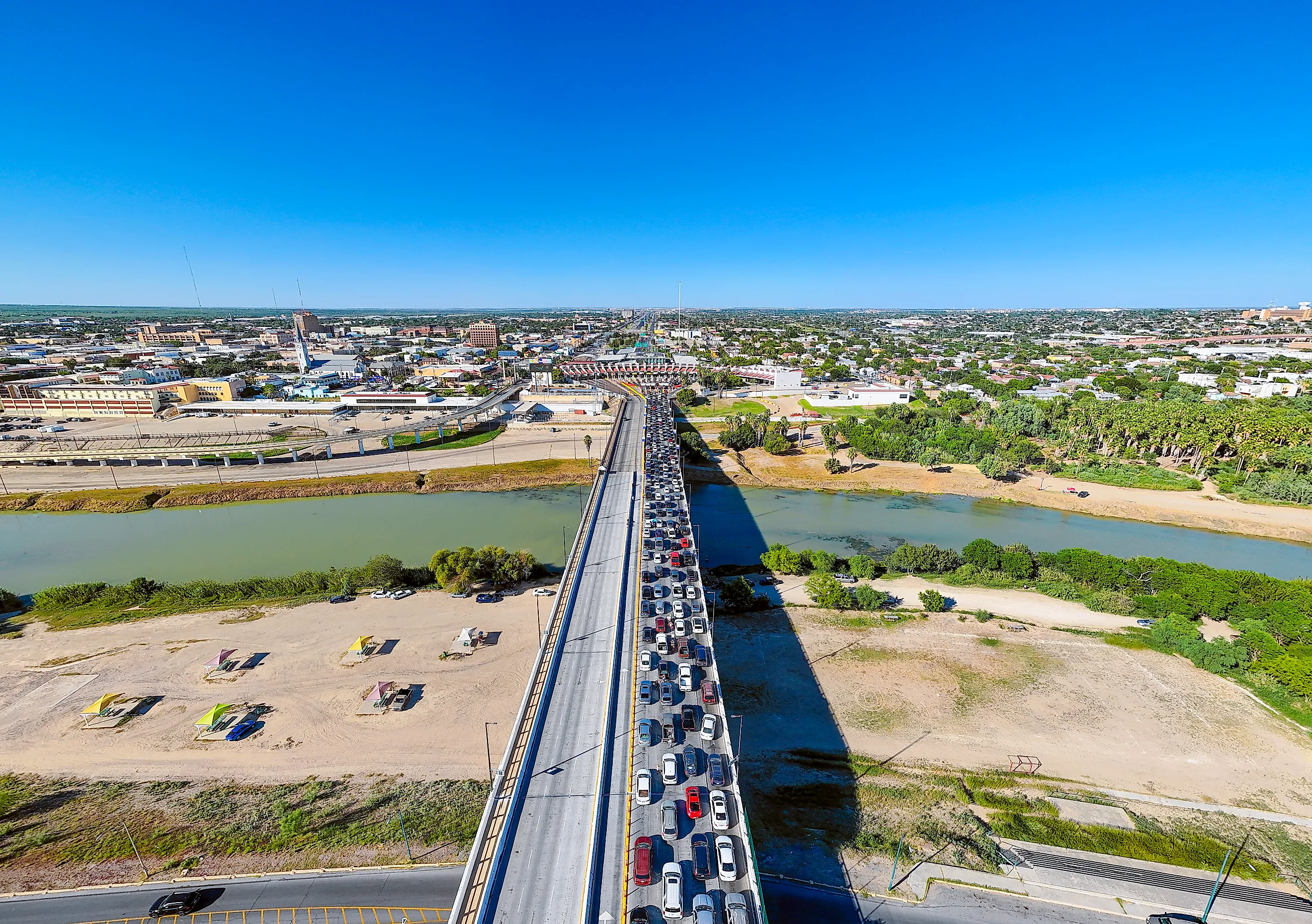
The Busiest Border Crossings in the United States
Every year, tens of millions of cars, trucks, and people file through a short list of gates along the edges of the United States, and a handful of them do almost all the heavy lifting. The Bureau of Transportation Statistics counted roughly 94 million personal vehicles rolling into the country by land in 2025, plus about 45 million people on foot. Most of that traffic funnels through a few famous chokepoints where a metro area on one side effectively shares a downtown with a metro area on the other. Some move commuters by the hundred thousand. Others move a good chunk of the continent's freight. These are the busiest ports of entry in the country, and the numbers behind them are genuinely hard to picture.
San Ysidro, California

Nothing else on the continent is close. San Ysidro, the crossing that stitches San Diego to Tijuana, is the busiest land border crossing in the Western Hemisphere and the fourth-busiest on Earth, moving somewhere north of 100 million crossings a year. In 2024 alone it processed 14.8 million cars entering the country, roughly one in five of every personal vehicle that crossed into the US by land. That is a single intersection doing the traffic of a mid-sized country.
The reason is simple: this is a commuter crossing, not a tourist one. Something like 70,000 to 90,000 people pass through daily, many of them driving to work in San Diego and home to Tijuana the same evening. Wait times are the stuff of local legend, occasionally stretching past two hours, which means San Ysidro may also be the only border crossing on Earth with its own genre of podcast listener: the person who has been in the same lane since breakfast.
El Paso, Texas

El Paso runs a whole system of bridges, not a single gate. The Paso del Norte crossing links El Paso with Ciudad Juarez across the Rio Grande, and the traffic is spread across several spans, including the Bridge of the Americas, the Stanton Street Bridge, the Paso del Norte Bridge, and the Ysleta-Zaragoza Bridge downstream. Together they make El Paso one of the two or three busiest passenger-vehicle gateways on the southern border, year in and year out.
What makes El Paso unusual is how completely the two cities function as one. The metro area spilling across the river is home to well over two million people, and the bridges are less an international frontier than the busiest set of cross-town connectors most Americans have never driven. Locals talk about "going to the other side" for dinner the way other people talk about crossing a bridge to a different neighborhood, which, functionally, it is.
Otay Mesa, California

Otay Mesa is San Ysidro's hardworking sibling, and it exists largely because somebody had to handle the trucks. Sitting about six miles east of San Ysidro, it took over all commercial truck traffic for the San Diego-Tijuana region back in the 1980s, and it remains one of the busiest freight crossings on the entire southern border, moving roughly a million loaded trucks a year on top of heavy passenger traffic.
The division of labor is the whole point. San Ysidro gets the commuters and the pedestrians; Otay Mesa gets the eighteen-wheelers hauling televisions, medical devices, and produce. If you have ever bought a flat-screen assembled in Tijuana, there is a fair chance it entered your country here, waiting patiently in a line of trucks rather than a line of minivans.
Laredo, Texas

If San Ysidro is the people champion, Laredo is the money champion, and it is not particularly close. Laredo handles more trade value than any other border crossing in the country, moving well over 30 billion dollars of goods in a single month in 2026 and roughly 38% of all the trucks that enter the US from Mexico. Its five international bridges across the Rio Grande carry close to three million loaded trucks a year.
The interesting part is why the number keeps climbing. As manufacturing shifts closer to the US market, a trend the logistics industry calls nearshoring, freight that once crossed the Pacific by ship now rolls up through Mexico by truck, and a huge share of it lands in Laredo. A city of about 260,000 people has quietly become one of the most important trade doorways on the continent, which is a lot of responsibility for a place best known regionally for its heat.
Buffalo-Niagara Falls, New York

The southern border gets the attention, but the busiest passenger gateway on the northern line runs through Buffalo. Its bridges to Ontario, including the Peace Bridge and the spans near Niagara Falls, handled about 4.4 million cars entering from Canada in 2024, an increase of more than 11% in a single year, and account for roughly a fifth of all personal vehicles crossing the northern border.
Proximity to a very large waterfall does not hurt. Buffalo sits across the river from a dense stretch of southern Ontario, and the crossing carries the usual border-town mix of shoppers, day-trippers, workers, and families with relatives on both sides. It is a reminder that the Canadian border, quieter in the headlines, still moves millions of ordinary trips a year on habit alone.
Detroit, Michigan

Detroit is the northern border's freight capital. The crossing to Windsor, Ontario, anchored by the Ambassador Bridge and the tunnel beneath the river, is the top port for Canadian truck traffic, handling nearly 1.4 million incoming trucks in 2024 and better than a third of all the freight rolling in from Canada. By trade value it trails only Laredo among all US crossings, which for Detroit is one more industrial superlative in a long list.
Much of that is the auto industry crossing the river to build a car. Parts made on one side are trucked to plants on the other and back again, sometimes several times, before a finished vehicle rolls off the line. The Detroit River is, in a real sense, an assembly line with a customs booth in the middle. When bridge construction snarls traffic here, carriers shift north to the Blue Water Bridge at Port Huron, which is why its numbers jump whenever Detroit's dip.
The Numbers Behind the Gates
The rankings depend entirely on what you count. Measure people and personal vehicles, and San Ysidro wins in a landslide, with El Paso and the other California and Texas passenger crossings close behind. Measure the dollar value of freight, and the crown passes to Laredo, with Detroit second. Count trucks, and the southern border leans on Laredo, El Paso, and Otay Mesa while the northern border runs through Detroit, Port Huron, and Buffalo. It is less a single leaderboard than several overlapping ones, all pointing at the same short list of extraordinarily busy places.
| Port of Entry | Border | Busiest for |
|---|---|---|
| San Ysidro, CA | Mexico | Personal vehicles and pedestrians (busiest overall) |
| El Paso, TX | Mexico | Passenger vehicles and pedestrians |
| Otay Mesa, CA | Mexico | Trucks and passenger vehicles (San Diego freight) |
| Laredo, TX | Mexico | Freight value and truck volume (busiest for trade) |
| Hidalgo, TX | Mexico | Passenger vehicles and trucks (Rio Grande Valley) |
| Calexico, CA | Mexico | Passenger vehicles and pedestrians (Imperial Valley) |
| Buffalo-Niagara Falls, NY | Canada | Personal vehicles (busiest northern passenger gate) |
| Detroit, MI | Canada | Trucks and freight value (busiest northern freight gate) |
| Port Huron, MI | Canada | Trucks (Blue Water Bridge) |
| Blaine, WA | Canada | Passenger vehicles (Pacific Northwest) |
Source: US Bureau of Transportation Statistics border crossing data, most recent annual releases. Rankings vary by measure and year; the ports above are consistently among the busiest in their categories.