9 Northern Ireland Towns With Unforgettable Main Streets
Sea loughs and the open Atlantic both touch the towns on this list. Northern Ireland packs its coastline tight with working harbors and walkable village centers. The main streets here carry the weight of the place. They run past Georgian courthouses and family ice cream parlors and craft yards built inside old dairy markets. Each one rewards an afternoon spent on foot rather than behind a windshield. These nine towns prove the point street by street.
Portrush

Three Blue Flag beaches ring the Ramore Head peninsula at Portrush, a notable haul given that the whole of Northern Ireland holds only about eight. East Strand and West Strand sit on either side of the roughly one-mile (1.6-kilometer) headland, while Whiterocks runs east along the coast past the Royal Portrush links, its white limestone cliffs cut into caves and arches. Portrush leans into the surf so hard that it gets called the "Surfing Capital of Northern Ireland," and the beach breaks back that reputation up.
Main Street forms the spine of the town between the harbor and Ramore Head, and it stays busy with shops, galleries, and places to eat. Frankie Creith Art Gallery & Studio and White Horses Gallery put local work on the walls, while Jingles Gift Shop and the R & J Hillis department store handle the retail trade. When hunger hits, Saffron Indian Restaurant turns out South Asian plates and Kiwi's Brew Bar stacks up burgers.
Portstewart

John Cromie founded Portstewart in 1792 and named it after his maternal ancestors, the Stewarts. The fishing village he started had grown into a fashionable Victorian seaside resort by the late 19th century. Today its roughly 7,850 residents share a crescent waterfront known simply as the Promenade, lined with Victorian-era buildings and sheltered by rocky headlands.
Culture Coffee and the other cafes along the Promenade handle the morning crowd with coffee and pastries. A few doors down stands Morelli's, the Italian ice cream business the family founded in nearby Coleraine in 1911 and later brought to the seafront here. Morelli's still scoops the Knickerbocker Glory sundae alongside Irish smash burgers. The Promenade runs east to Portstewart Harbour, where fishing trips and boat charters launch, and west toward Portstewart Strand, a National Trust beach that stretches two miles (3.2 kilometers) under the dunes.
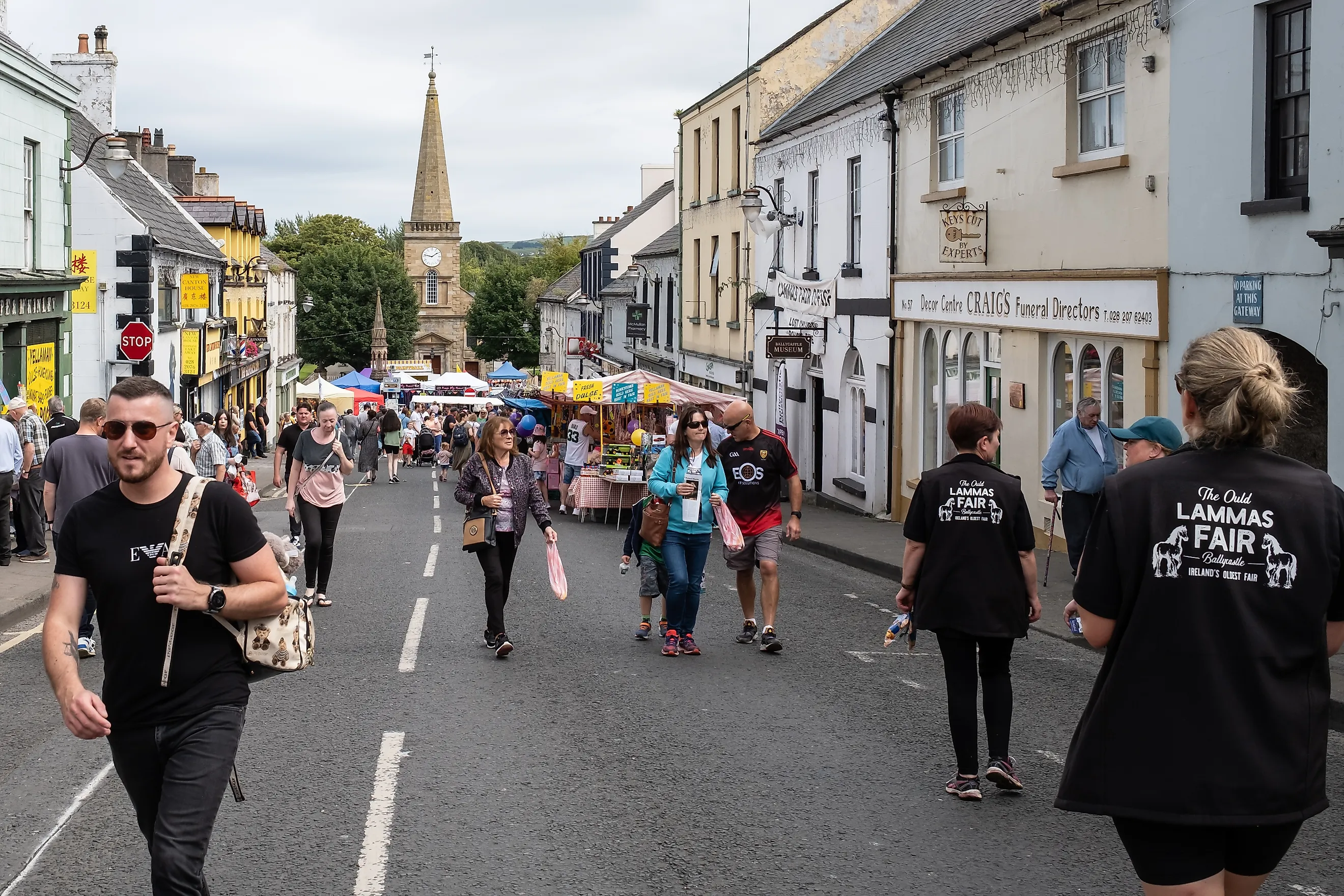
Ballycastle

Castle Street anchors Ballycastle about 20 miles (32 kilometers) east along the coast, and more than 50 listed buildings line it inside an 18th-century conservation area. The street holds the town's dining trade. The House of McDonnell, a long-running pub on the strip, hosts traditional Irish music sessions through the week. The Cellar Restaurant nearby seats diners in restored church pews and runs a seafood-heavy menu of mussels, chowder, and surf-and-turf tacos. Castle Street ends at Ballycastle Seafront and Beach, which opens onto the Causeway Coast and the North Atlantic Ocean.
Cushendall

The Curfew Tower has stood at the center of Cushendall since 1817, when landlord Francis Turnly built it to hold troublemakers, its design borrowed from towers he had seen along the Great Wall of China. Mill Street runs out from that landmark as the heart of a small, pedestrian-friendly village where three of the Glens of Antrim meet: Glenballyemon, Glenaan, and Glencorp. The Glens of Antrim Historical Society digs into local heritage with lectures at the Old Schoolhouse. Shopping runs to D Kearney and Sons butcher and Celtic Craft for gifts. Each August the village fills for the Heart of the Glens Festival, a nine-day run of music and events, and the Cushendall Coastal Path and beach edge the village for walks close to town.
Castlewellan

Two squares organize Castlewellan, a town of fewer than 3,000 people at the foot of Slievenaslat Mountain. Nana's Kitchen works the heart of town with salads, sandwiches, and the traditional Ulster Fry. Upper Square gathers more eateries around the public library. The real draw sits less than two miles (3.2 kilometers) from the center, about a 20-minute walk: Castlewellan Forest Park, with 7.5 miles (12 kilometers) of walking and biking trails, a Victorian castle above the lake, and the Peace Maze. Planted in 6,000 yew trees to mark the end of the Troubles, the maze is the largest permanent hedge maze in Europe.
Newcastle

Newcastle runs along the shore of the Irish Sea with the Mourne Mountains rising behind it. Its walkable center offers a good run of shops and kitchens. The Shimna Cafe handles breakfast, and Villa Vinci covers Mediterranean and Italian plates. The road leads down to the Promenade, where the Newcastle Artisan Market takes over the courtyard of the Newcastle Centre once a month, filling it with small traders, local food, handicrafts, and original art. Newcastle Beach opens up for swimming and picnics in the warmer months, though no lifeguard patrols it.
Enniskillen

Enniskillen sits on an island that splits the upper and lower halves of Lough Erne, the second-largest lake system in Northern Ireland after Lough Neagh. The town's oldest building, Enniskillen Castle, went up in the 15th century as the stronghold of the Maguire clan, who ruled County Fermanagh from the 14th century until the English took the castle for good in 1607. Church Street and High Street, the town's pedestrian-friendly main streets, carry an active arts scene. The standout stop is the Buttermarket Craft and Design Courtyard, set inside a restored 19th-century dairy market, where cafes, galleries, tattoo parlors, and craft stores fill the old stalls.
Rostrevor

Carlingford Lough laps right up against Rostrevor, where Church Street and the surrounding lanes hold the village center close to the water. Independent shops and eateries set the tone along the main street. Good Craic Gifts & Souvenirs sells Celtic-inspired keepsakes, and Pawfect Paws Dog Cafe and Bakery, just off Church Street, hands out treats to dogs and their owners alike. Five minutes on foot from the center, the Fairy Glen follows the Kilbroney River past trees and footbridges for an easy walk.
Royal Hillsborough

In 2021, Hillsborough became Royal Hillsborough, the first town or village in Northern Ireland granted the "royal" prefix. The honor recognized Hillsborough Castle and Gardens, the royal family's official residence in the region, whose 100 acres of woodland trails sit open to the public. The County Down village had carried its Georgian look long before the title arrived, and it shows up in the stonework less than 15 miles (24 kilometers) from Belfast.
Main Street threads past that history, including the 18th-century Hillsborough Courthouse and the nearby Hillsborough Fort. The Hillside, a rustic pub with a deep food and drink menu, sits along the way. A turn onto Lisburn Street leads to Kin & Folk Bakery + Coffee for fresh sausage rolls and banana bread.
Walking Northern Ireland's Main Streets
What separates these towns from a roadside stop is the way history sits at street level. A 19th-century dairy market in Enniskillen now holds galleries instead of butter. An 1817 prison tower marks the crossroads in Cushendall. An ice cream recipe carried over from Italy in 1911 still draws a line down the Promenade in Portstewart. None of it shows up from a car window. These main streets reward the people who park and walk.