6 Most Beautiful Gothic Churches In Michigan
Michigan's church landscape holds a surprising wealth of Gothic architecture. From the great cities of Detroit and Pontiac to quiet island towns on the Detroit River to the Copper Country of the Upper Peninsula, the Gothic style appears in stone and wood. These six churches were created in times when pointed arches, tall stained-glass windows, and spires shaped a language of faith and community. Each has a story linked to local history and an architectural identity rooted in Gothic Revival, Carpenter Gothic, or Collegiate Gothic traditions.
Cathedral Church of St. Paul (Detroit)

The Cathedral Church of St. Paul in Detroit stands as a major expression of Late Gothic Revival design. Its congregation is the oldest Episcopal parish in the Northwest Territory, formed long before Michigan became a state. You can even see a stone tablet mounted on a wall that references Alanson Welton, considered one of the first clergymen of the American Church and one of Detroit's earliest Protestant clergymen. In 1912, the cathedral church was designated as the seat of the Episcopal Diocese of Michigan.
The current building on Woodward Avenue was designed by Ralph Adams Cram, a leading American architect specializing in Gothic Revival architecture, and was constructed in 1907 and 1908. Its limestone walls rise with pointed arches and wide stained glass that filter light into the nave. Because it was built using medieval construction techniques without a steel structure, massive stone pillars support the weight of the lead roof. The stone work, carvings, and the large rose window bring the spirit of Medieval cathedrals to the American Midwest. Unfortunately, it wasn't fully completed as the bell tower was never finished.

Inside, the cathedral is known for elaborate, colorful Pewabic tile floors and ornate carved dark oak woodwork. The windows feature abstract designs that interpret themes of creation and historical scenes that seem drawn from the heart of the Gothic's medieval ideals. The funeral of automotive giant Henry Ford was held here in 1947, drawing thousands and marking the cathedral as both a civic and a religious landmark. As both a spiritual center still in operation and an architectural landmark, St. Paul's was added to the National Register of Historic Places in 1982 and remains a defining example of Neo-Gothic architecture in Michigan.
Sweetest Heart of Mary Roman Catholic Church (Detroit)

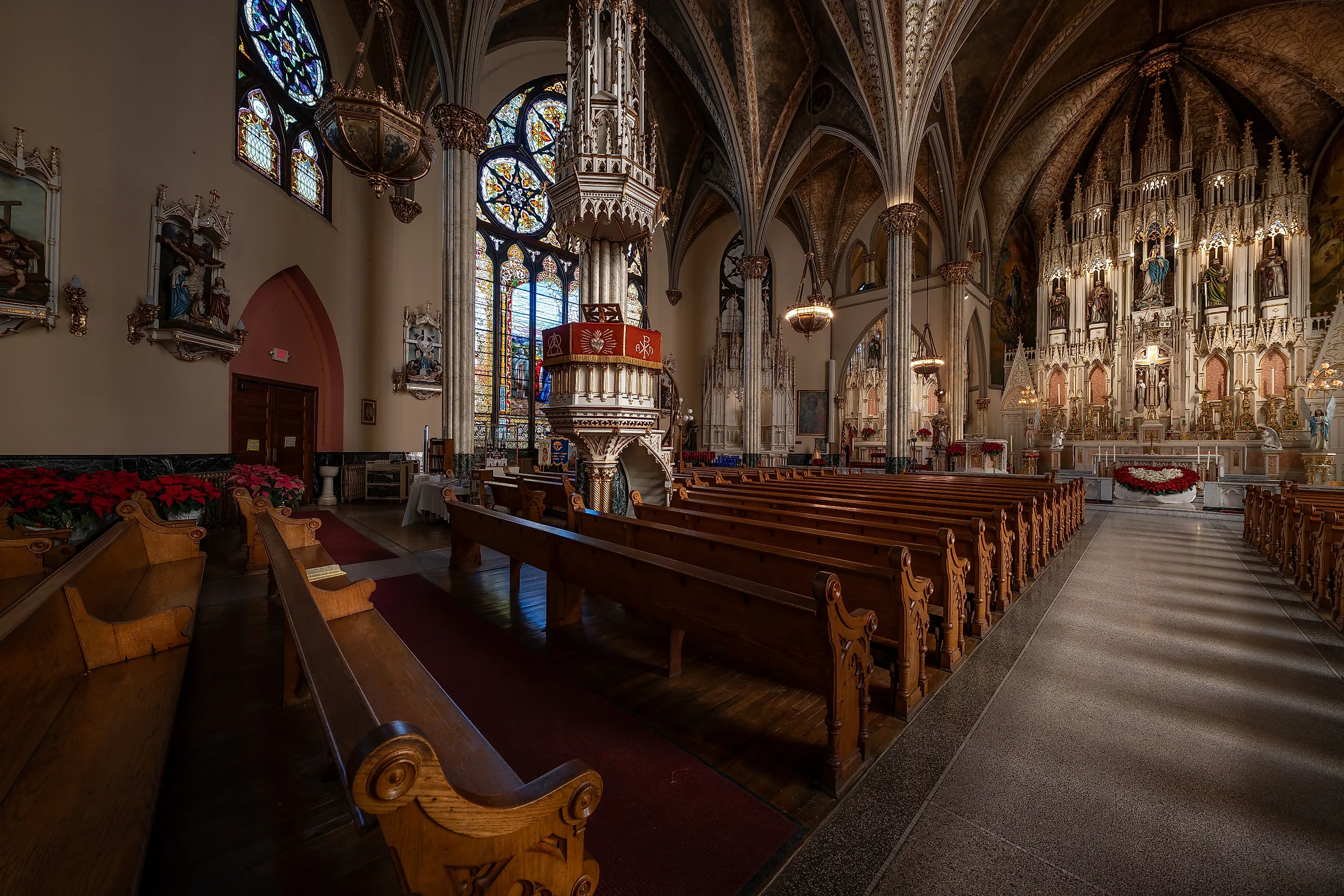
The Sweetest Heart of Mary Roman Catholic Church in Detroit illustrates how the Gothic Revival was modified for immigrant communities in the late 19th century. Built between 1890 and 1893, the church was designed by architects Spier and Rohns for a growing Polish Catholic community and became the largest Catholic Church in Michigan. Its red-brick, cross-shaped building sits on Russell Street, with twin towers and pointed spires that flank the entrance, forming a familiar Gothic silhouette. Stone trim, rusticated lower levels, and large pointed-arch portals create a dramatic facade that visitors can explore year-round.

The stained glass inside the Sweetest Heart of Mary is especially notable. Many windows were produced by Detroit Stained Glass Works, including a transept scene of the Holy Family in Saint Joseph's workshop and nave windows that won awards at the 1893 World's Columbian Exposition in Chicago. A historic Austin pipe organ from 1893 continues to play during services today, making the interior not only visually rich but also acoustically resonant. This church remains one of the most photographed and impressive Gothic Revival structures in the Midwest. It was listed on the National Register of Historic Places in 1978. Plus, the Annual Pierogi Festival held here has become the largest religious festival in the City of Detroit.
All Saints Episcopal Church (Saugatuck)

All Saints Episcopal Church in Saugatuck is a good example of Carpenter Gothic, a style in which wood replaces stone while preserving Gothic ornamentation. It was completed quickly between 1872 and 1873. It features board-and-batten construction, lancet windows, and a modillioned tower with an open belfry above the entrance. Detroit architect Gordon W. Lloyd, trained in England, brought the ideals of the English parish church to this Michigan shore town.
Carpenter Gothic churches, such as All Saints, employ steep gables, pointed windows, and wooden trim to translate the vertical energy of stone Gothic into a lighter, more intimate medium. The inside of the church has a beautiful rose window, exposed wooden trusses, and simple pine finishes that mirror its rural origins. Although smaller than grand cathedrals, this church has a strong visual appeal online and in person, combining historical design with the seaside charm of Saugatuck. It was added to the National Register of Historic Places in 1984.
St. James Episcopal Church (Grosse Ile)
St. James Episcopal Church on Grosse Ile offers another perspective on Carpenter Gothic. Built in 1867 and completed in 1868, architect Gordon Lloyd designed this church as well as many other buildings in the Diocese, and this chapel reflects early board-and-batten techniques, a feature of rural Gothic design. Its steep gabled roof and trimmed vergeboards give it the look of an English country church. In 1898, the Tiffany window "Angel of Praise" was installed in memory of Col. John Biddle's mother, thereby enriching its wooden frame and stained-glass design. When the sun streams through the Angel of Praise stained-glass window in the afternoon, it illuminates the church beautifully.
The church stands in the historic East River Road district, connecting it to other period architecture on Grosse Ile. The red doors, which are dedicated to Lisette Denison Forth, a self-liberated former slave and longtime household servant of the John Biddle family, left all her savings to build this church. Though modest in scale, St. James exemplifies the charm and craftsmanship of Carpenter Gothic in Michigan. A larger church was constructed on the same site in 1958, and the 1867 structure was retained as the chapel for the new church. This chapel was listed in the National Register of Historic Places in 1971 and is considered one of Lloyd's finest works.
St. Vincent de Paul Church Complex (Pontiac)
The St. Vincent de Paul Church in Pontiac exemplifies Collegiate Gothic and High Gothic Revival influences in suburban Michigan. Built in 1885 by Donaldson & Meier, the brick church is cruciform in plan, with tall stained-glass windows, pointed-arch doorways, and a tower with a steep spire that marks the skyline of Woodward Avenue. A 6600-pound bell was installed in the church in 1890. The overall design of the building follows Gothic Revival principles, emphasizing verticality, light, and intricate detailing.
The church complex also includes St. Frederick's School and a convent, both of which continued the Collegiate Gothic style to create a cohesive Gothic experience in Pontiac's historic district. This style draws on medieval English college buildings, characterized by symmetrical facades, pointed-arch entries, and minimal stone detailing. Of the five buildings in the complex, only three - the church, the school, and the convent - were added to the National Register of Historic Places in 1989. The other two buildings - the rectory and parish hall - have been altered substantially, and no longer resemble their original form.
Trinity Episcopal Church (Houghton)
Trinity Episcopal Church in Houghton adds a northern chapter to Michigan's Gothic story. Initially, Trinity started as a wooden church in 1906 in Hancock. It was then moved to its current location in Houghton. While moving across the Portage Canal on a barge, it had accidentally become free overnight and was found floating away. After recapturing it, the current church was completed on Easter Day in 1910. This brick Gothic Revival church used Jacobsville Sandstone for its trim and foundation. The square tower, capped with crenellations and exposed wooden arches spanning the nave, gives the church a sense of solidity and spiritual focus.
The Oxford Movement influenced the church's interior design by integrating powerful symbolism within its walls, aiming to create a ceremonial space that felt rooted in Anglican tradition. They also have a beautiful Austin organ from 1913, which is still in operation today. The Trinity Episcopal Church was designated a Michigan State Historic Site in 1986, highlighting its local importance among Michigan's Gothic churches.
Across Michigan, these six Gothic churches create a visual thread through towns and cities. From grand cathedrals to humble wooden chapels, these buildings reflect how the Gothic style adapted to the place, available materials, and the community's needs. These churches offer not just a spiritual space to worship today, but architectural heritage worth exploring and photographing.