8 Most Walkable Town Centers In Portugal
In many of Portugal's smaller towns, the most visited historic sights and landmarks sit only a short walk apart, and the streets between them are best explored on foot. In Ponte de Lima, a medieval bridge over the Lima leads straight into the town square. Óbidos lets visitors climb atop its walls for a view over the streets below. Shoppers can pick up fresh fruit on the Praça da Fruta in Caldas da Rainha, an easy place to refuel partway through a stroll. Viana do Castelo has a hospital ship docked in town that is open for tours. These are 8 of the most walkable town centers in Portugal, each compact enough that the next stop is only a few steps away.
Viana do Castelo

Praça da República is Viana do Castelo's main square, with a 16th-century fountain at its east end beside the Misericórdia building and the old town hall. The Museu do Traje on the square shows Alto Minho dress, from work clothes to the black dresses worn by brides, across a collection of 900 pieces, and runs embroidery workshops. A few minutes away on Largo de São Domingos, the Museu de Artes Decorativas is housed in a 1724 mansion with blue baroque tile panels of hunting scenes and the four continents, plus a chapel with a baroque altarpiece. Down at the old commercial dock on the Lima, the Gil Eannes hospital ship opens its bridge, bakery, engine room, and operating room to visitors, and a simulator lets you practice docking on the river. From the center, the Elevador de Santa Luzia climbs 160 meters over 650 meters of track to the sanctuary atop the hill, offering views over the city and the Lima estuary.
Ponte de Lima

Avenida dos Plátanos runs along the left bank of the Lima in Ponte de Lima, a pedestrian avenue passing century-old trees. From under the trees, walkers look across to the medieval bridge and the houses along the riverfront. Every two weeks, the Feira Quinzenal sets up on the sandy riverbank on this same side, a market that goes back to the town charter of 1125. The avenue leads to Largo de Camões, with its Renaissance fountain, at the town end of the Ponte Romana e Medieval. The bridge crosses the Lima on about 15 pointed medieval arches, past a stone cross, to five Roman arches on the Arcozelo bank. Just over the bridge, the Museu do Brinquedo Português in Casa do Arnado has more than 3,000 toys made between the 19th century and 1986. It follows Portugal's toy makers on the ground floor, then lays out toys by decade upstairs, from tin flutes and wooden beach buckets to plastic cars and Smurfs. The Festival Internacional de Jardins fills the same bank each season with themed show gardens built by international teams.
Tomar

Praça da República is the heart of Tomar, with the Igreja de São João Baptista, a Gothic, Manueline, and Baroque parish church, on the square. A statue of Gualdim Pais, the city's founder, stands in the middle of the square between the town hall and the church. A short walk away, Parque do Mouchão takes up an island in the Nabão, with a large wooden waterwheel at its entrance. Besides it, the Complexo Cultural da Levada fills two old flour mills on the river, A Nabantina and A Portuguesa, with exhibits on milling, the foundry, and the power station, plus a Templar interpretation center. Up the hill, the Convento de Cristo was the seat of the Templars, and later the Order of Christ, and recent conservation works have been reopening the cloisters in stages. Visitors see the round Charola church and the Manueline chapter window. The convent's old enclosure, the Mata Nacional dos Sete Montes, has old cypress, oak, and olive trees spread around the Charolinha, a small round chapel in a pool reached by a stone bridge.
Caldas da Rainha

Caldas da Rainha's Praça da República, known to everyone as Praça da Fruta, hosts an open-air market every day, with fruit, vegetables, bread, and flowers sold on the same spot since the end of the 15th century. Up on Largo Rainha Dona Leonor, the thermal hospital Queen Leonor founded in 1485 still stands, though thermal treatments have been suspended since August 2026. Next door, the Igreja de Nossa Senhora do Pópulo has a Manueline bell tower with carved gargoyles, and inside, 16th-century Seville azulejos and a main altarpiece. Next to it is Parque D. Carlos I, which covers 11 hectares and features boat rides on the large lake, the Casa dos Barcos, sculptures throughout the grounds, and space for cultural and sports events. The Museu José Malhoa inside the park shows 19th and 20th century painting, sculpture, and ceramics, led by Malhoa's own canvases alongside work by Columbano and Bordalo Pinheiro.
Óbidos

Rua Direita runs the length of Óbidos inside the walls, from the Porta da Vila up to the castle. The gate's inner walls are covered in baroque azulejo panels from the 1740s. The walls are open to walk, a 1,565-meter circuit along the top with no railing. Off Rua Direita, the Igreja de Santa Maria on Praça de Santa Maria is lined with 17th-century azulejo panels and has paintings by Josefa d'Óbidos, and King Afonso V married his cousin Isabel there in 1441. Out on the square, the pillory stands over the fountain, carved with the royal arms and the shrimp net emblem of Queen Leonor. The fountain draws from the aqueduct, which runs about 3.6 kilometers into town, partly above ground and partly underground. Near the castle end of town, the Igreja de São Tiago, begun in the 12th century, is now the Livraria de Santiago, a bookshop that also hosts films, debates, and exhibitions. Each spring, usually in March, the Festival Internacional de Chocolate takes over the castle grounds.
Ericeira

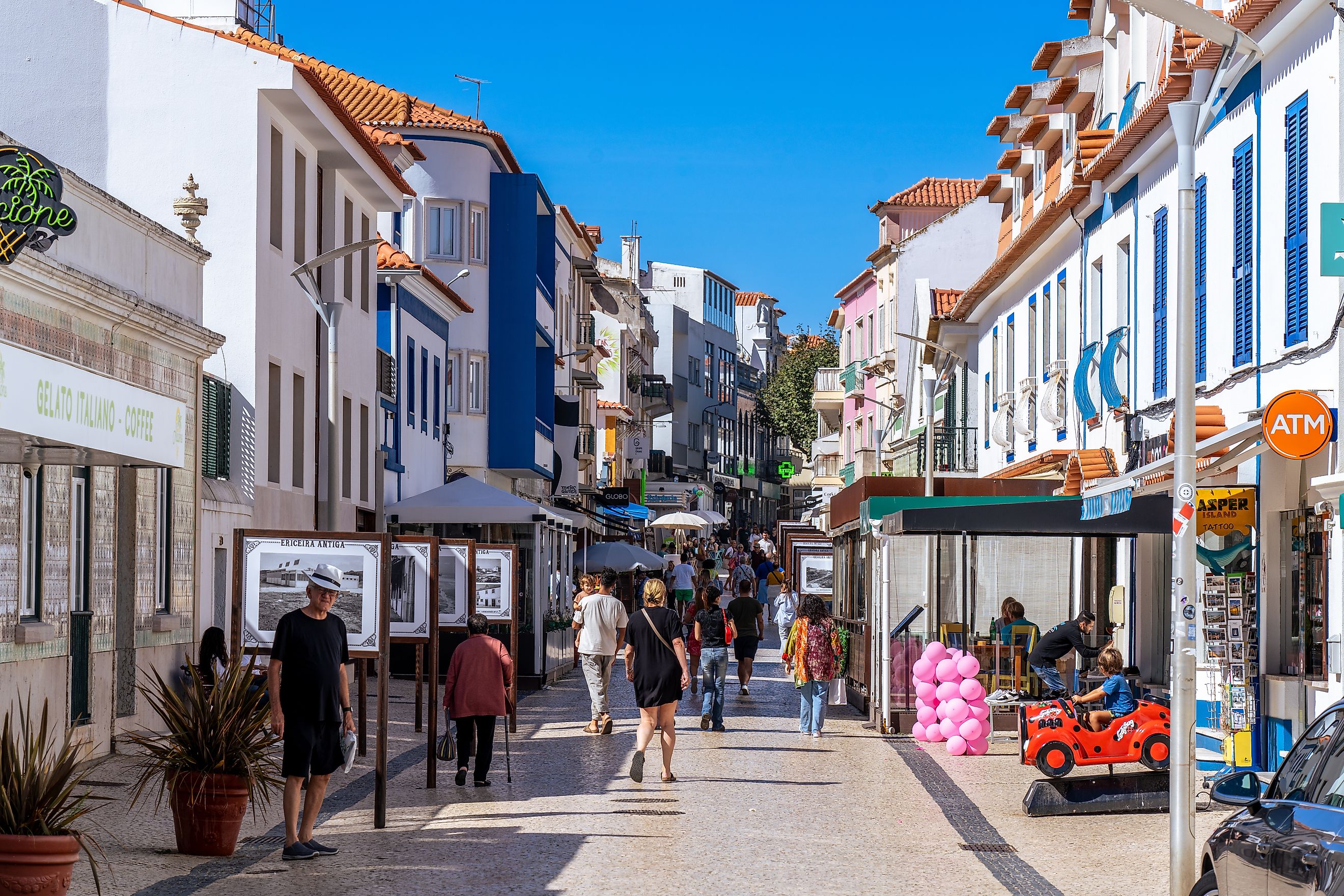
The winding streets of Ericeira's historic center are lined with white façades, many of them decorated with azulejo panels. The old town sits above Praia dos Pescadores, the fishing beach where swimmers use the sheltered bay that the harbor pier creates. The Capela de Nossa Senhora da Boa Viagem e Santo António stands on a platform above the beach. It once served as a lighthouse for boats coming into the harbor. The festival of Nossa Senhora da Boa Viagem, patron of Ericeira's fishermen, falls on the third weekend of August. In the old town, the Igreja de São Pedro on Largo de São Pedro has a single nave lined with 18th-century blue and yellow azulejos. The coast on either side of town has been a World Surfing Reserve since 2011. Breaks such as Ribeira d'Ilhas and Coxos fall within the reserve, and windsurfers, kitesurfers, and bodyboarders head out along the same stretch.
Tavira

Praça da República opens onto the Gilão river in the middle of Tavira, and walkers cross from the square to the far bank on the seven arches of the Ponte Antiga. In the square, the Núcleo Museológico Islâmico shows Tavira's Islamic period, led by the Vaso de Tavira, beside a stretch of 12th-century rammed-earth wall. Up the Santa Maria hill, visitors walk the castle walls and the garden inside them, past a surviving Almohad tower. On the way up, the Igreja da Misericórdia has a Renaissance portal carved with grotesques and a niche of Our Lady flanked by Saint Peter and Saint Paul. Inside, azulejo panels from 1760 show the 14 Works of Mercy. The Palácio da Galeria, the main building of the municipal museum, hosts exhibitions of local heritage and contemporary art around a Renaissance-era arcaded courtyard. Next to the castle, the 13th-century Igreja de Santa Maria do Castelo has the tomb of Dom Paio Peres Correia and the remains of seven knights killed in battle in 1242. Back on the river, the 1887 Mercado da Ribeira now houses shops and cafés in its old market hall, and the Jardim do Coreto beside it has an octagonal iron bandstand cast in Porto.
Vila Real de Santo António

Praça Marquês de Pombal is the center of Vila Real de Santo António's grid of streets, paved in black and white cobblestones that radiate from an obelisk raised in 1776. The Igreja de Nossa Senhora da Encarnação faces the obelisk from the north side of the square, and even the privately built houses around the grid follow the same architectural formula. On Rua Teófilo Braga, the Centro Cultural António Aleixo, named for the poet born in town in 1899, hosts exhibitions and shows in a building of Moorish-inspired design. Gardens line the bank of the Guadiana along Avenida da República beside the former Customs House, looking across the river to Ayamonte. The ferry to Ayamonte leaves from the marina on the same riverfront and crosses in about 15 minutes. At the edge of town, the Mata Nacional das Dunas Litorais stretches 3 kilometers of pine forest to Monte Gordo, with a 6-kilometer walking route and a population of chameleons.
These eight towns are full of squares, churches and riverbanks that sit a few minutes apart. A funicular up to Santa Luzia, a bookshop inside a medieval church, a ferry across the Guadiana to Spain, a toy museum on the far bank of the Lima. Whether the day calls for a museum, a swim at a fishing beach or a coffee on the main square, these are eight of the most walkable town centers in Portugal.