8 Portugal Towns With Unforgettable Main Streets
Portugal's main streets are remarkable for compressing centuries of history into a single stretch. Tavira's Rua da Liberdade leads from Praça da República toward the medieval castle walls. Óbidos lines Rua Direita with ginjinha stalls between the Porta da Vila gate and the castle. Amarante's Rua 31 de Janeiro winds toward the 18th-century granite bridge that anchors the old town. Ponte de Lima's Avenida dos Plátanos runs along the riverbank past one of the country's most photographed crossings. Discover Portuguese towns with main streets worth exploring on foot.
Tavira

With origins reaching back into antiquity and shaped by centuries of Moorish, medieval, and 18th-century Portuguese influence, Tavira sits in the eastern Algarve about 28 km east of Faro. Its main street, Rua da Liberdade, runs north from the central Praça da República toward the upper historic quarter, serving as the town's primary stretch for shops, cafés, and community life. The post office and several banks sit along its length, giving it a local feel even during tourist season.
Walking up Rua da Liberdade leads you toward the Castle of Tavira, a medieval fortification built on the foundations of a structure believed to date back thousands of years. The current castle walls give clear views over the town's terracotta rooftops, the medieval Ponte Antiga, and the Gilão River below. Rua da Liberdade flows south into Praça da República, the town's central square and social hub. Outdoor cafés line the perimeter, and the adjacent Mercado da Ribeira is a strong spot for a morning coffee or fresh seafood lunch along the river.
Óbidos

Óbidos is one of the most intact medieval towns in Portugal. Declared one of the Seven Architectural Wonders of Portugal, it has retained its medieval character in a way few towns anywhere in Europe have managed. Its main street, Rua Direita, has served the town since the 14th century, connecting the Porta da Vila gate to the castle at the far end. Many of the original Gothic features such as arched windows, narrow doorways, and decorative ceramic house-number tiles survive in the whitewashed buildings that line both sides of the cobbled street.

One of the most distinctive Óbidos experiences along Rua Direita is sampling ginjinha d'óbidos, the local sweet cherry liqueur, served traditionally in edible chocolate cups at small stalls and bars along the street. Bar Ibn Errik Rex on Rua Direita is an iconic place to try it and also serves flame-grilled chorizo sausage. A unique feature of Óbidos is the chance to walk atop the fortified town walls that encircle it, with views over the terracotta rooftops and countryside beyond. The walk starts near the Porta da Vila and follows the walls in either direction. Some sections are uneven and without handrails so caution is advised.
Tomar

Tomar sits 135 km north of Lisbon on the Nabão River in central Portugal. The town has a smaller population and is compact enough to explore on foot. Its grid-like street plan gives it an unusual sense of order compared to other medieval towns and makes the historic center easy to navigate. The main street, Rua Serpa Pinto, is the principal pedestrian thoroughfare, running from Praça da República south to the Nabão River. Family-owned businesses, traditional tile-decorated façades, cafés, and a handful of artisanal shops line its cobbled length, with the Templar castle visible on the hill to the north.
The crown jewel of Tomar, the Convento de Cristo, is a UNESCO World Heritage Site and one of the most important religious complexes in Portugal. Founded by the Templars in the 12th century, it includes the octagonal Charola, a series of Gothic and Manueline cloisters, and the famous Chapter House window considered a masterpiece of Manueline architecture. Every four years Rua Serpa Pinto is transformed for the Festa dos Tabuleiros (Festival of the Trays), one of Portugal's most distinctive celebrations. During the grand parade, hundreds of women carry ornate towers of stacked bread loaves decorated with flowers on their heads while the entire street is dressed up with flowers and paper decorations.
Lagos

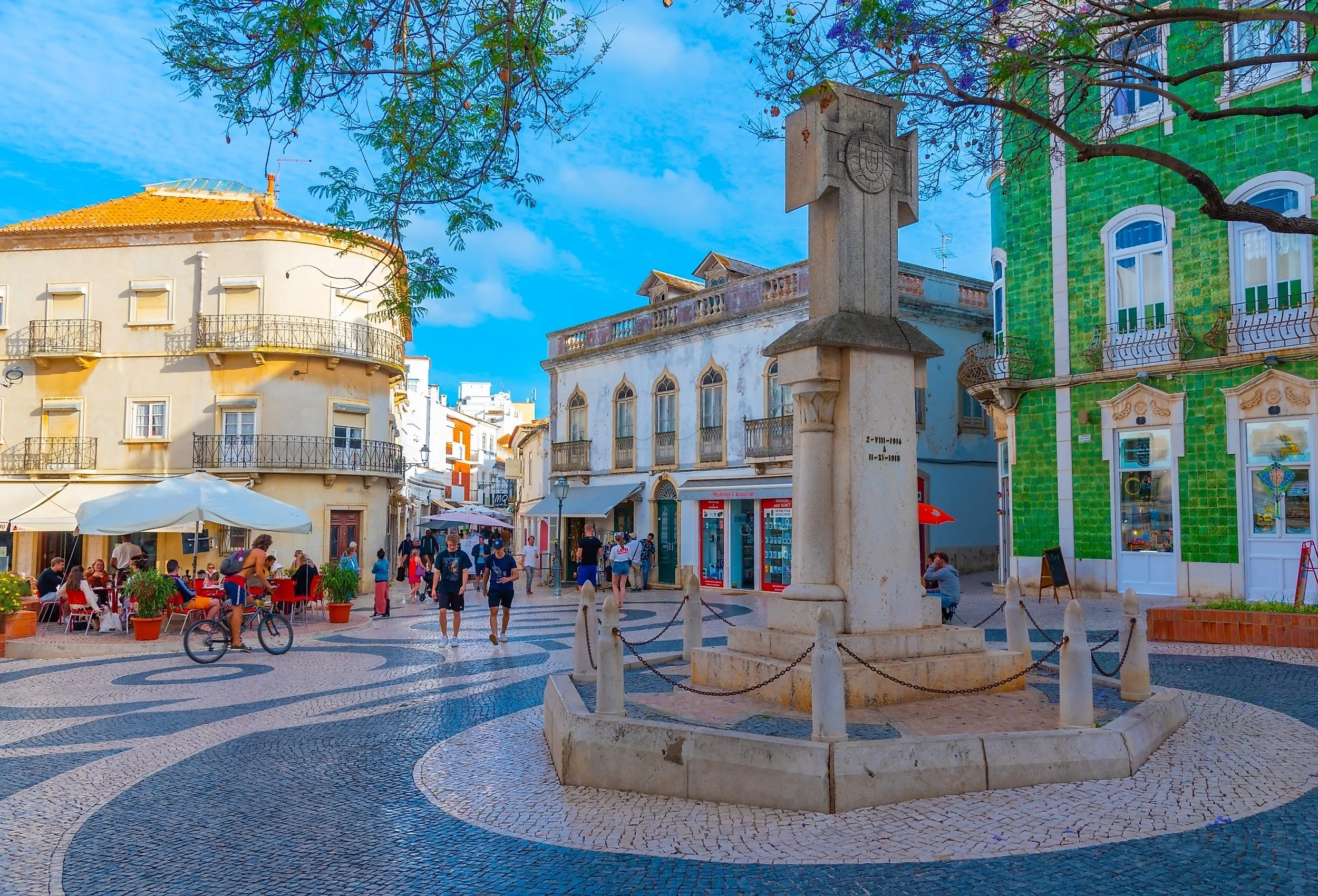
One of the most historically significant towns on the Algarve coast, Lagos was founded more than 2,000 years ago and became a key hub of Portuguese maritime exploration. The city proper has a population of approximately 22,000, contained within restored 16th-century walls that separate the compact historic center from the more modern town around it. One of the principal pedestrian streets, Rua 25 de Abril, runs through the heart of the old town and is lined with traditional shops, modern boutiques, restaurants, and bars. It connects to Praça Gil Eanes, the main square, and forms the social and commercial spine of historic Lagos.
Each summer Lagos stages the Festival dos Descobrimentos, a family-friendly event commemorating the town's connection to Portugal's maritime past. Rua 25 de Abril and the surrounding squares fill with historical reenactments, parades, music, and period costumes. Located just off Rua 25 de Abril, the Igreja de Santo António is one of Portugal's finest Baroque church interiors. Its plain exterior gives nothing away but inside the walls are covered floor to ceiling in gilded carved woodwork. The adjacent Museu Municipal displays archaeological finds from Roman times through the Age of Discovery.
Amarante

Set along a bend of the Tâmega River in northern Portugal, Amarante is known for its 18th-century granite bridge, its riverside convent, and its distinguished culinary tradition. The city has been a member of the UNESCO Creative Cities Network for Music since 2017. The main historic street, Rua 31 de Janeiro, winds through the heart of the old town lined with centuries-old granite-faced townhouses, souvenir shops, bakeries, restaurants, and taverns serving local charcuterie plates and Vinho Verde.
Leading from Rua 31 de Janeiro, the 18th-century granite bridge is Amarante's most iconic image and gives views up and down the Tâmega River. Adjacent to it the Igreja de São Gonçalo holds the tomb of the town's patron saint whose popularity for matchmaking has made him one of Portugal's most visited saints, particularly around the Festas de São Gonçalo in June. Amarante has a tradition of convent sweets and Rua 31 de Janeiro is the place to try them. The most famous of these (lérias, papos de anjo, and toucinho do céu) are egg-and-sugar treats made in the convents that once dominated the town. Confeitaria da Ponte and Confeitaria O Moinho are both well-regarded local options.
Ponte de Lima

Often described as one of the oldest towns in Portugal, Ponte de Lima sits in the Minho region of the northwest along a bend of the Lima River, crossed by a Roman bridge that has shaped the town's identity. The town's most distinctive thoroughfare is the Avenida dos Plátanos, a fully pedestrianized riverside avenue along the Lima River. Locals and visitors promenade here year-round, with views across the water to the Roman bridge and the mountains beyond.
Directly accessible from Avenida dos Plátanos, the Ponte Romana is Ponte de Lima's defining landmark. The multi-arched medieval bridge built on Roman foundations crosses the Lima River and the crossing remains one of the most photographed scenes in northern Portugal. The Caminho Português (the Portuguese Way of St. James) passes directly through Ponte de Lima along the Avenida dos Plátanos, making pilgrim sightings a regular feature of town life. Every other Monday Avenida dos Plátanos and the surrounding squares transform into one of the oldest markets in Portugal, drawing residents from surrounding villages to buy and sell food, clothing, tools, and crafts.
Estremoz

Known as the "White City" for its extensive use of white marble cut from the surrounding hills, Estremoz sits on the main Lisbon-Spain highway route in the Alentejo interior. Its medieval upper town is dominated by a 13th-century castle, visible across the surrounding landscape for miles. The main street, Rua 31 de Janeiro, runs through the lower town and serves as the focal point for traditional shops, market stalls, and daily life.
Estremoz is one of the most important centers of Portuguese ceramics and the distinctive hand-painted Bonecos de Estremoz clay figurines are the best souvenir the town offers. Local artisans can still be sought out in town including Afonso and Matilde Ginja on Rua Direita and Irmãs Flores, Inácia and Perpétua, on Largo da República. Every Saturday Rossío Marquês de Pombal square, adjacent to Rua 31 de Janeiro, fills with one of the most authentic and lively rural markets in the Alentejo. Stalls offer fresh produce, aged cheeses, antique tools, handcrafted clay figurines, and marble furniture.
Viana do Castelo

Viana do Castelo is widely regarded as one of the most attractive cities in northern Portugal. The main shopping street, Rua Manuel Espregueira, is a pedestrianized lane running from the Igreja de São Domingos back to the town's main square, Praça da República. It is lined with shops ranging from textile stores to antiques dealers, with granite-façaded or tiled buildings and wrought-iron balconies above. The street blends local commerce with genuine architectural character that keeps people coming back.
Visible from virtually every point in Viana do Castelo, the Santuário de Santa Luzia sits atop a commanding hill north of the city. The early 20th-century basilica can be reached by funicular from the town center and rewards visitors with a wide view over the Lima River estuary, the Atlantic, and the green hills of the Minho stretching north toward Spain. A short walk from Rua Manuel Espregueira toward the riverfront leads to the Ponte Eiffel. Stretching across the Lima River for 645 meters, the bridge carries road and pedestrian traffic on its upper deck and the railway on its lower deck, creating a striking geometric silhouette over the water.
Portugal Is Ready For You to Explore
Portugal's main streets are layered with centuries of ordinary and extraordinary life. Whether it is the cobblestones of Rua Direita still worn from medieval foot traffic, the marble pavements of Rua 31 de Janeiro in Estremoz, or Avenida dos Plátanos in Ponte de Lima, these are among the best streets to explore. Each town is small enough to discover on foot and connected enough to neighboring regions to serve as a base for wider exploration. Portugal rewards the willingness to follow a main street to its end and see what's around the corner.