7 Portugal Towns Where Time Stands Still
In Portugal, it is possible to leave modern life behind and explore the history of ancient stones and historic buildings. Monsanto’s buildings have literal boulders for roofs and walls, and are known as the ‘most Portuguese town’ because of its ancient appearance. Marvão offers the opportunity to touch 13th-century walls at the Castle of Marvão, which once played a crucial role in defending Portugal’s border with Spain. These and other beautiful historic towns create the sense that time stands still in Portugal, as visitors enjoy the feeling of stepping into a living history book.
Monsanto

Monsanto is located on a mountain that has attracted people since prehistoric times. It was a critical fortress for the Knights Templar in the 12th century. And, in 1938, Monsanto was named ‘The Most Portuguese Village in Portugal’, a distinction that still helps protect it from modern development. One of the town’s defining features is that its houses and businesses sit below and next to massive granite boulders. These boulders give the houses and streets a cave-like look that seems plucked straight from a fairytale. Aside from this oddity, there is lots more to see in the town, including the Castle of Monsanto. The castle sits at the highest point of a scenic walking trail, and visitors can still see some of the remaining walls and towers here.
Behind the castle is an area where more granite boulders sit, which fans of House of the Dragon will instantly recognize as the backdrop for a wedding scene. The views from here are also spectacular. Back in town, visitors can drop by Gruta, a tiny shelter wedged between two boulders. They can also take a walk to the Torre de Lucano tower, which dates back to the 15th century. It is believed the towers were once the watchtower for the town. Today, it has a weather vane rooster at the top, a gift handed over by the government when Monsanto earned the distinction of the most Portuguese village.
Marvão

Marvão is situated on a quartzite mountain ridge, approximately 2,820 feet high. The town was founded in the 9th century by Ibn Marwan, an Islamic warrior who used this high point as a military hideout. It became part of the Kingdom of Portugal in the 13th century and served as a defensive post on the Spanish border for hundreds of years. Visitors can easily explore Marvão on foot in 2026 by obtaining a Tourist Map, which details all the historical sites and other attractions.
The Castle of Marvão is a must-see, with its Romanesque doorway of the keep and the Gates of Treason still standing. Other fortified gates can also be seen, including Porta de Rodao and Porta da Rua Nova, which were built in the 17th century. Other historic buildings to explore include the Convento Nossa Senhora da Estrela, built in 1448, and the Igreja de Santa Maria, a church that was converted into a Municipal Museum in 1987. Visitors can view several historic exhibits and admire the Gothic architecture here. Those who want to explore the town’s natural surroundings can relax next to River Beach in Portagem at the bottom of the hill. The water is safe for swimming, and the surrounding hills create a picturesque scene.
Piódão

Piódão was once a medieval haven for both shepherds and outlaws hiding from authorities. This beautiful village sits in the valleys of the Serra do Açor Mountains and was so isolated that modern roads were not built here until the 20th century. In 2026, Piódão is still so small that there is just one mailbox, and some of its alleys are probably too small for people to pass through. One of its most famous attractions is the Igreja Matriz, a white-washed church that stands out against the schist architecture of the rest of the town. The church was only opened in the 18th century and has had complete renovations done since then.
As visitors explore the tiny streets of the village, they can count the blue doors and windows. It is said that the town’s isolation meant that paint colors were limited, so blue was one of the only options for those who wanted to renovate their homes. Just 4 kilometers away from the town lies Foz de Égua. This hobbit-style village features two river bridges and a suspension bridge. Visitors can swim in the river here or walk around to see the schist houses and altar at the top of the hill.
Castelo de Vide

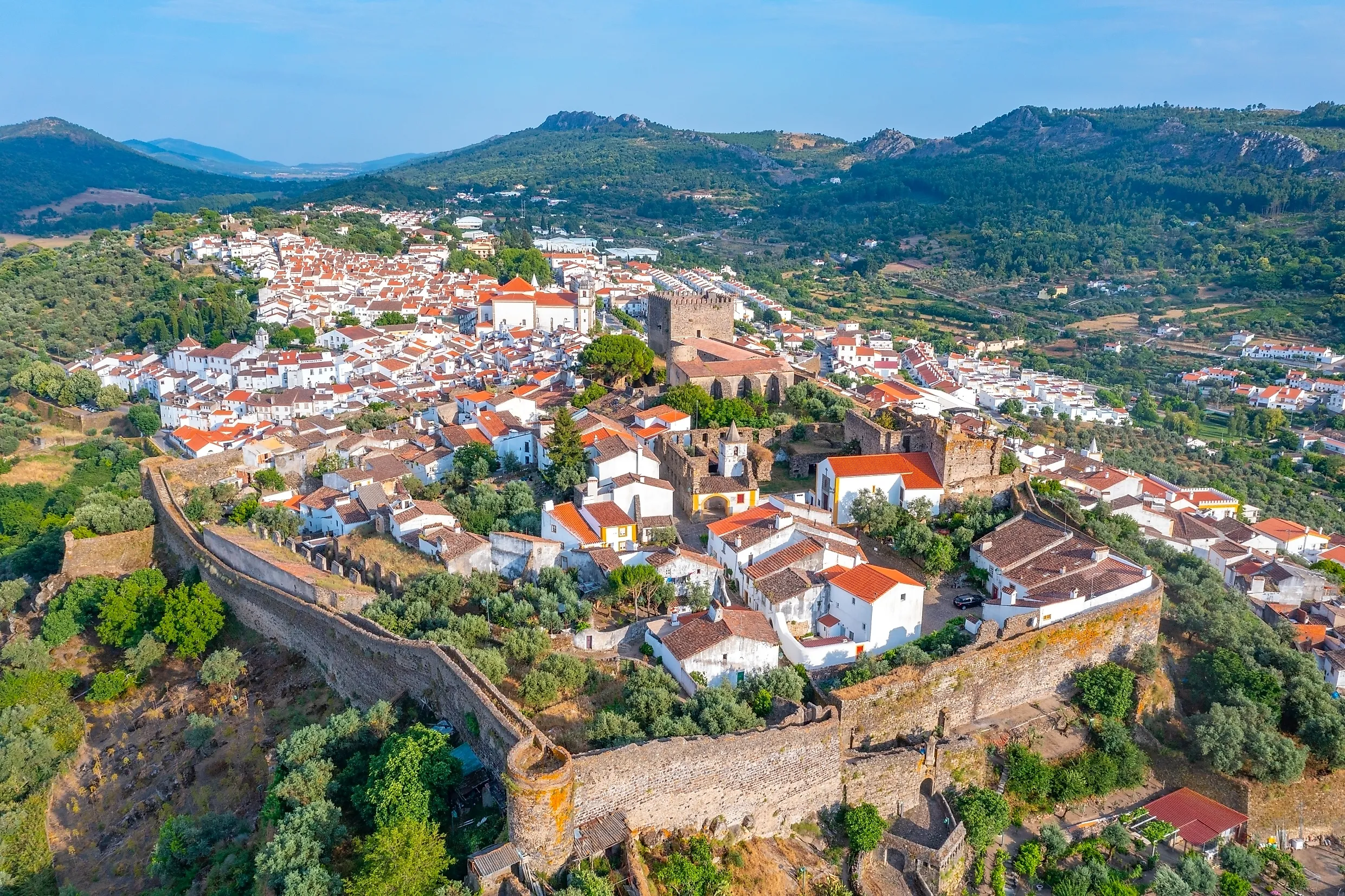
Famous for its natural springs, Castelo de Vide sprung up around a 14th-century castle. During the Spanish Inquisition in the late 15th century, many Jews fled Spain to Portugal, including towns like Castelo de Vide. As such, the town is home to one of the best-preserved Jewish quarters in Europe. The town sits on a steep hill very near the Spanish border and is instantly recognizable thanks to its whitewashed houses and red rooftops that lead the way to the castle at the top.
The Jewish Quarter features the Fonte de Vila fountain and the Sinagoga, the oldest surviving synagogue in Portugal. The synagogue also houses a small museum that visitors can explore before making their way up to the castle. There are gorgeous views to enjoy from the castle all the way to the Serra de São Mamede Mountains. In the center of town is the Praça D. Pedro V, which features Baroque palaces and the Santa Maria church. Castelo de Vide is also home to more several fountains around the town. It is said that the mineral waters in the fountains can be used for a variety of ailments, including digestive issues and high blood pressure.
Sortelha

Sortelha is one of the country’s oldest military villages. It was fortified in the early 13th century to boost the country's defensive borders. The town’s layout has not changed much since the Renaissance, creating a strong sense of time standing still. Visitors can explore the oldest part of the village, which still sits within the original castle walls. Entry to this part is through Gothic gates that lead to tiny homes built of stone. The Sortelha Castle sits on an outcropping that overlooks the village and was built here to defend the people behind it.
From the castle, visitors can look out over the plains towards the distant Estrela Mountains. In the village itself, there are four main gates to see: the Village Gate, New Gate, and two False Gates. The Village Gate is the main entrance to the town and faces east. It was once the place where projectiles were aimed at attackers who tried to force their way in. The New Gate opens to the west, while the two False Gates were used to launch surprise attacks and to escape when necessary. Visitors can also explore the Pelourinho Square, which features the armillary sphere symbolizing Portugal’s maritime history.
Azenhas do Mar

The town of Azenhas do Mar was developed around watermills that worked thanks to streams running down the cliffs next to the coast. It has been a popular seaside destination since the early 1900s, when wealthy families and winemakers from Lisbon explored its attractions. Azenhas do Mar is incredibly beautiful with its white-washed houses built on cliffs overlooking a natural swimming pool with a small sandy beach down below next to the gorgeous Atlantic.
The Cliffside Viewpoint is the best place to see the cluster of houses above the sea. There is also the scenic Coastal Trail that connects the town with the Praia das Macas and Praia Grande beaches. Those looking for some of that old-world atmosphere can take the tram from Praia das Macas to Sintra. The tram can transport upto 45 passengers and departs from the MU.SA museum. Back in Azenhas do Mar, visitors can enjoy deliciously prepared seafood and wine at the Piscinas Azenhas do Mar restaurant and enjoy the views of the ocean just above the natural pool.
Aljezur

The Moors founded Aljezur in the 10th century. They built a castle at the highest point in the area, and the town thrived. However, when the 1755 Lisbon Earthquake hit, it caused chaos by destroying the town’s lower structures. Bishop Francisco Gomes de Avelar rebuilt a new town on the opposite bank, leaving the old one preserved on its hill. Today, visitors can still see the ruins of the Aljezur Castle, which is the last castle in the Algarve region to fall to Christian forces. The castle is part of Old Town Aljezur and sits over ancient houses on cobbled streets. Those who want to learn more about the town’s history can head to the Municipal Museum, which is located in a 19th-century building that was once the town hall. There are several exhibits here, including a replica of a traditional Portuguese house.
The Museu Antoniano was badly damaged in the earthquake and was rebuilt. It was the town’s main church until 1809. The building was completely renovated in 1995 and is now the Museum of Saint Anthony. Those who want to immerse themselves in the outdoors for a bit can head to the nearby Praia do Amoreira beach, where there is a calm stream for families to enjoy. Across the cliffs lies Praia de Monte Clerigo beach with its beautiful rock formations and soft sand.
Timeless Towns Where The Clock Stops
It is so easy to lose track of time while strolling past the quirky boulder dwelling in Monsanto or exploring the places that once stood firm before an earthquake shook their foundations. The high castle walls and red house roofs that are so true to Portugal allows you to step right into a fascinating history. Modern life quickly fades into the background as you walk the narrow paths and look out over the Atlantic. If you find yourself in any of these timeless towns, you will be reminded that as the world keeps speeding up, some places are so worth keeping exactly as they have always been.