8 Most Breathtaking Towns In Portugal
Portugal is consistently ranked among Europe’s most popular destinations for international visitors. From dramatic Atlantic coastlines to historic inland fortress towns, these places reveal how varied the country can be. Some towns like Costa Nova are shaped by the sea, where fishing villages evolved into colorful destinations with striped houses and surf culture. Others like Evora preserve layers of history stretching from prehistoric stone monuments to Roman engineering and medieval fortifications. Perched on cliffs or enclosed by castle walls, the eight towns below show why Portugal remains one of Europe’s most visually unforgettable countries.
Azenhas do Mar

Portugal has no shortage of beach towns to offer eager sun-seekers, but you’d be hard-pressed to find one in a more spectacular setting than Azenhas do Mar. Perched atop a sea cliff, Azenhas do Mar is the kind of place where it’s probably easier to take an Instagram-worthy photo here than it is to take a bad one. And although it’s near the tourist hub of Sintra, Azenhas do Mar feels pleasantly removed from the crowds, making it a great choice for a laid-back beach trip.
This laid-back town is more about its vibe and scenery than its attractions, but beachgoers will find plenty to occupy their time here. Go for a swim or sunbathe on Praia de Azenhas do Mar, the beach at the base of the cliffs; watch the sunset over the whitewashed houses; and, since you’re by the sea, splash out on a seafood dinner with unbeatable views at Restaurante Piscina Azenhas do Mar.
Costa Nova

Portugal has long been a nation of seafarers, so it’s no surprise that a traditional fishing village might preserve one of the cutest townscapes in Portugal. Costa Nova has long since transcended its 19th-century beginnings as a humble fishing town, though. After the distinctive striped facades of its fisherman’s houses, or palheiros, caught the eye of wealthy visitors, Costa Nova got a face-lift, and now you’ll find rows of cheerful striped houses in every imaginable hue on this tiny strip of land between the Atlantic Ocean and the Aveiro Lagoon. The palheiros are the town’s biggest draw, but visitors can also enjoy the white sands of Costa Nova beach, examine the day’s catch at the Costa Nova fish market, and sample some of Costa Nova’s many seafood specialties at a local restaurant like Praia do Tubarao.
Chaves

Although Chaves is a relatively unknown name abroad, it hasn’t always been that way: when Portugal was a part of the Roman Empire, the town now known as Chaves was a hotspot for out-of-town visitors. The reason: its natural hot springs. Today, that Roman influence can be seen in the Ponte de Trajano, a beautiful stone bridge across the Tamega River, and at the medieval Chaves Castle, you can get an idea of the conflict this town has seen throughout its history as a strategic point safeguarding the border with Spain. But if you’re here, you’ll want to take advantage of the natural feature that put Chaves on the map, so stop by the Termas & Spa wellness complex for a rejuvenating dip in the hot springs.
Elvas

It’s not hard to see why the town of Elvas in central Portugal is a UNESCO World Heritage Site. Start with its shape: although it’s hard to see at ground level, the multi-tiered layout of this fortified garrison town is shaped like a star when seen from above. Built to defend the border against potential attacks from Spain, Elvas had to be heavily-fortified, and a walk along those fortifications is one of its highlights.
Fittingly for such a fortified city, Elvas was also equipped with an impressive water supply system, and the towering Amoreira Aqueduct is still one of its most impressive sights. Streets are cobblestoned and the local specialty is a recipe for candied plums called Ameixas d’Elvas, which can be found for sale throughout town. Add to that a laid-back vibe and few tourists, and you’ve got yourself a stellar day trip.
Ericeira

Ericeira gets the bulk of its recognition as a surfing spot, and indeed, if you love to surf, you won’t find very many better places to catch a wave than this town 45 minutes outside of Lisbon. But a bland, commercialized beach town this is not. Ericeira, like many of Portugal's coastal settlements, got its start as a fishing village, and you’ll still see the pastel-colored storefronts and homes of the workaday town it once was on a stroll through the center of town.
Although surfing has made the town a popular destination, it’s by no means detracted from Ericeira’s warmth, laid-back atmosphere, or personality. Not to mention its proximity to nature: a variety of coastal walking trails give even non-surfers a spectacular way to get outdoors and enjoy the scenery.
Evora

More populous than the other destinations on our list and known as a “museum-city” for its well-preserved Roman ruins, Evora is a UNESCO World Heritage Site illustrating several periods of Portuguese history in stone. It’s this historic character that makes Evora, located between Lisbon and the Spanish border, the ideal destination for serious history buffs and curious day-trippers alike.
If you’re looking to deep-dive into Evora’s history, start all the way back in the prehistoric era with the Evora Megalithic Circuit, along which you can see Neolithic-era stone monuments just outside the city. Then, admire the ruins of Evora’s Roman-era temple before exploring the city’s Baroque golden age on the stately campus of the University of Evora. And that’s to say nothing of this small but mighty city’s modern-day charms, from breakfast at a laid-back café full of students to a glass of local wine.
Monsanto

You’re not likely to mistake the tiny town of Monsanto for any other. How many towns in Portugal or anywhere else are built around, beneath, or on top of immense granite boulders? Monsanto is a diverting side-trip for that reason alone. Narrow alleyways leave only the necessary space between stone-walled traditional houses and granite boulders that can weigh up to 200 tons, and those close quarters make a ramble through the narrow, steep, and winding streets of Monsanto feel a little surreal.
Climb to the top of the hill for spectacular views from Castelo de Monsanto, see tombs hewn directly into the granite at the eerie Saint Miguel Chapel, and dine atop a boulder on the terrace at the Taverna Lusitana. If your ideal day trip makes you feel like you’ve stepped onto the pages of a medieval fantasy, this is the one for you.
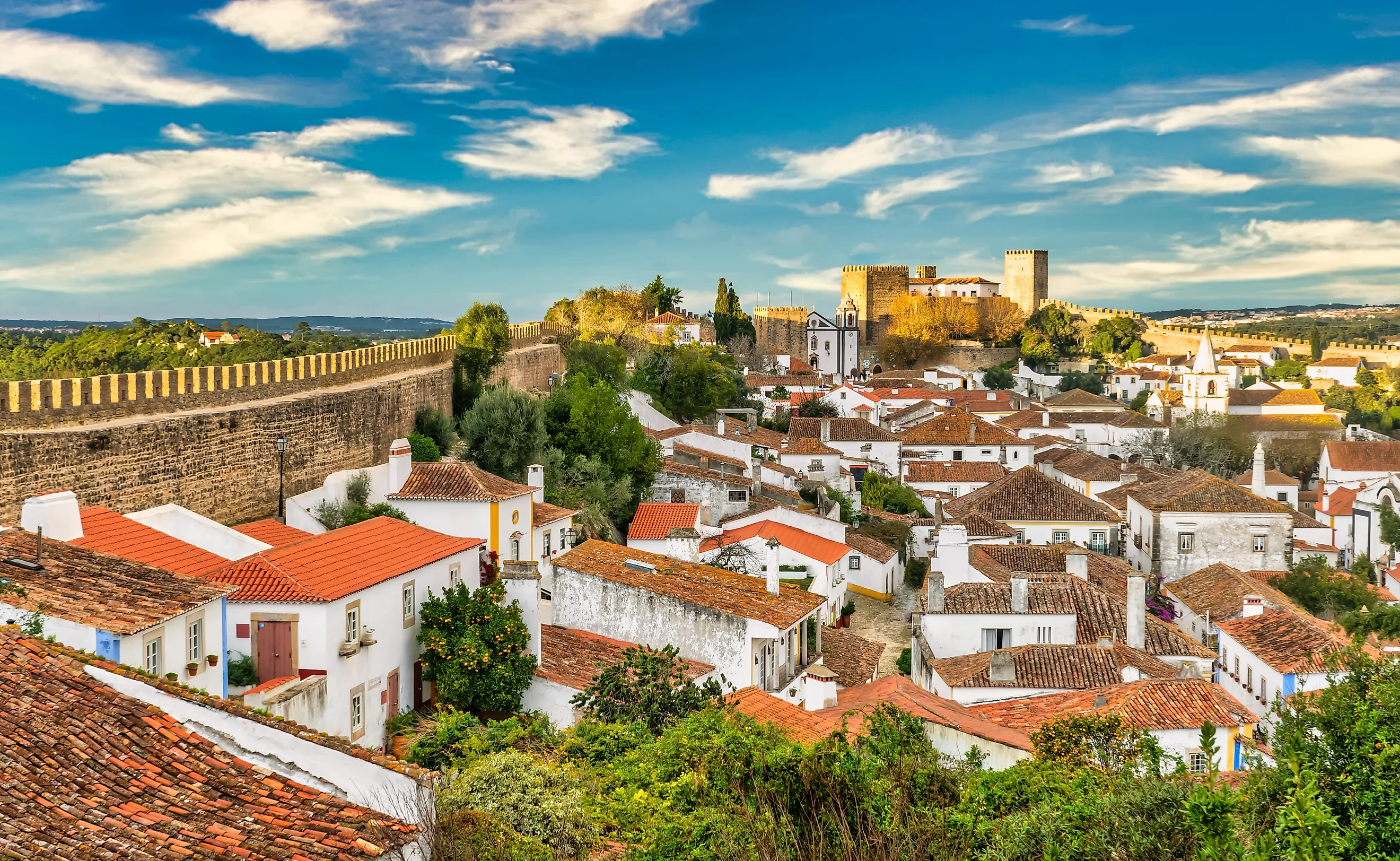
Obidos

If you’re searching for a well-preserved medieval town to visit for a taste of Portugal’s pre-modern past, allow us to recommend Obidos. It’s so picturesque that every Portuguese king from the 13th to the 19th century (symbolically?) gave the town to his bride as a wedding gift, and any bookish visitor is likely to agree it was an excellent present.
Obidos is known for its literary character and disproportionate number of bookstores per capita, even boasting the designation of UNESCO City of Literature. Santiago Bookshop, housed in a building dating back to the 12th century, is among its most notable. Also among its charms is the chance to stay the night in the impressive medieval fortress of Obidos Castle. But the real draw here is its well-preserved medieval look and feel, so don’t think of Obidos as a place you go to rush from spot to spot: this is a town to savor, photograph, and allow to transport you to centuries past.
Exploring the 8 Most Breathtaking Towns in Portugal
Portugal's diversity attracts surfers, history buffs, architecture fans, and photographers alike, all of whom should find plenty to enjoy in and around these eight most breathtaking towns in Portugal. Portugal is vibrant, inviting, and filled with history, natural beauty, and culture. Coastal villages offer waves, seafood dinners, and pastel storefronts overlooking the Atlantic, while inland towns showcase Roman bridges, medieval castles, and UNESCO-recognized fortifications.
Travelers might wander narrow lanes squeezed between enormous granite boulders, soak in hot springs once prized in Roman times, or trace centuries of scholarship and culture in a historic university town. From striped fishermen’s houses on a sandy peninsula to literary bookshops inside ancient churches, these destinations highlight how Portugal’s landscapes and traditions blend into unforgettable experiences for curious visitors.