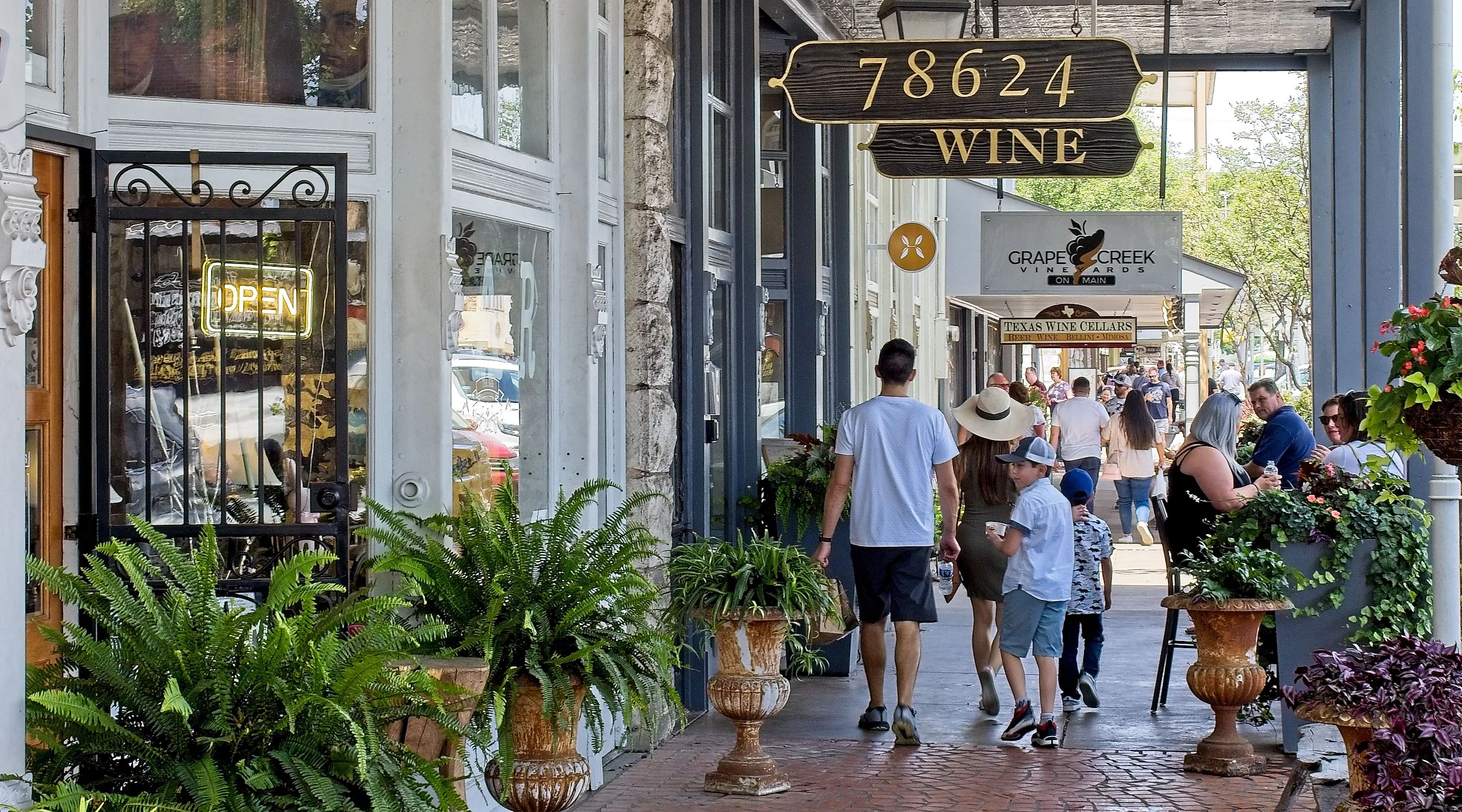
8 Most Walkable Town Centers In Texas
In a state where the Katy Freeway widens to 26 lanes, a handful of small Texas towns still work best on foot, with museums, theaters, and public art set within a few compact blocks. In Jefferson, you can see the Atalanta, the private rail car of railroad baron Jay Gould, on display on Austin Street before heading up the road to the town's Bigfoot statue. A walk along Main Street in Fredericksburg leads to the Marktplatz, where a 26-foot wooden Christmas pyramid is illuminated each November. In Mason, the Odeon Theater faces the town square, just as it has since it opened in 1928 with a showing of Metropolis. Guided walking tours in Marfa move between buildings and landmarks, including a former wool warehouse now filled with sculptures. These are eight of the most walkable town centers in Texas.
Jefferson

Local legend claims railroad baron Jay Gould routed his train away from Jefferson after locals opposed his plan to run the railroad through the center of town. The Texas and Pacific Railroad arrived in Jefferson in 1873 anyway, in part because the inland port city was already a hub for shipping. Whether or not Gould had spitefully tried to bypass Jefferson, the town got the last laugh. Gould's private rail car, the Atalanta, is permanently on display in the center of town. The luxurious parlor car included amenities like a lounge, kitchen, and bathroom. The outdoor display sits on West Austin Street.
Head up Austin Street towards the Port Jefferson History and Nature Center to see the Jefferson Bigfoot Statue that pays tribute to the local bigfoot sightings. Jefferson has been declared the "Bigfoot capital of Texas." The nature center includes a woodland hiking trail and sites like a historic steamboat landing and the location of the first public wharf. The park also contains other statues, such as a life-sized elk and metal stagecoach.
From Austin Street, it's a short walk up Polk Street toward the Museum of Measurement and Time. What started off as a personal collection of timepieces has since evolved into a full-blown museum with examples of clocks from 1700 through 2000. The collection contains more than 550 American clocks and pieces of surveying equipment. Unrelated to time keeping, there are also 1,500 sets of salt and pepper shakers representing all sorts of designs from historic buildings to silly animals.
Marshall

Jay Gould ultimately chose Marshall as the location for his Texas and Pacific Railroad. Today, all that remains of the former hub is the T&P Railroad's waiting room and administrative office building. The Texas & Pacific Railway Museum includes an exterior steam engine and Union Pacific caboose, a model train layout depicting train operations, and historic artifacts and photos from the steam era. The building also serves as a local Amtrak station.
The center of town is just five blocks down Washington Avenue where visitors can find Telegraph Park and a life-sized bronze Telegraph Statue commemorating the first telegraph office to open in Texas. The telegraph office opened in 1854 and the bronze statue depicts two men receiving a long distance communication. Just across Peter Whetstone Square, the Harrison County Historical Museum displays artifacts exploring local history including military uniforms and weapons, sporting memorabilia, and transportation.
Two blocks up Bolivar Street, the Michelson Museum of Art hosts the art collection of artist Leo Michelson. The Latvian born artist escaped Russia during the revolution of 1917 and fled France at the start of World War II before eventually settling in New York City. Michelson created more than 1,000 works before his death with his widow choosing Marshall as the home for a permanent collection of his works. Since then, the museum has acquired additional art collections, growing the permanent exhibits to include works of artists such as Milton Avery and Henri Matisse.
Port Aransas

The French pirate Captain Jean Lafitte allegedly buried treasure on Mustang Island near Port Aransas. In the early 19th century, he operated as a privateer, pillaging Spanish cargo ships while operating around the Gulf of Mexico from a base near New Orleans. Today, visitors can experience the pirate's life on a Red Dragon Pirate Cruise departing from the harbor. The tall ship sails around Lydia Ann Channel with a pirate crew featuring live cannon fire, sword fighting, and dolphin spotting.
From the marina, continue down Cotter Avenue to find Sip Yard, a live music and entertainment venue at the center of town. The multi-story, outdoor venue features food, drinks, and a variety of events like a Dolly Parton look-alike contest and game day football watch parties. Ticketed events include tribute bands.
Further down Cotter Avenue to the Patton Center for Marine Science Education. The center hosts eight large aquariums with interactive exhibits about marine life. The center also has walking trails like the Water Wise Wildlife Garden and the Wetlands Education Center where native plants and animals can be spotted. The Wetlands Center includes boardwalks to carry visitors over the marshy areas.
Seguin

The orphaned, five-year old Alice O'Brien arrived in Seguin to find her adoptive guardians Louis Dietz and his sister Mollie who built a Victorian-style playhouse for her and her cousin. Eventually, the pint-sized structure was integrated into the Dietz Cabinet and Toy Shop. Today, this little roadside attraction has been restored, along with petite furniture and vintage toys. The Dietz Doll House sits on South River Street near the center of Seguin.
Head up River Street toward the Guadalupe County Courthouse where the Original World's Largest Pecan Statue stands on the front lawn. A passionate local dentist paid to erect this tribute in 1962 celebrating the region's prolific pecan production. Two decades later, a larger pecan statue was built in Missouri, seizing the title from Seguin. Not to be outdone, the owner of the now closed Pape Pecan House built a 10-foot pecan intended for parades and once displayed the oversized nut outside the shop. And to ensure the title was not lost again, a 16 by 8 foot pecan was built for the Texas Agricultural Education & Heritage Center at the far edge of town.

Head up Austin Street to find the Stephen & Mary Birch Texas Theatre. The performing arts venue reopened in 2011 after a restoration of the 1931 building. The 350-seat theater hosts main stage productions throughout the year, live music, and holiday shows like the Heart of Texas Christmas Show and Irving Berlin's White Christmas.
Fredericksburg

Descendants of 19th century German immigrants in Fredericksburg speak Texasdeutsch, a German language dialect that evolved in the state. The legacy of German settlers goes beyond just the anachronistic language here. Friedhelm's Bavarian Inn Restaurant & Bar serves up traditional German dishes in the gasthaus, the traditional dining room. The inn's upstairs suites continue the German theme with decoration and furnishings.
Heading into town along Main Street, the Pioneer Museum sits on the corner of Milam Street. The museum maintains ten historic buildings filled with artifacts from the early days of the town in the 1840s through the 1930s. The structures include homesteads, a one-room school house, log cabin, smokehouse and more.
Continuing on Main Street and at the Marktplatz, the historic marketplace, to find a giant wooden Christmas Pyramid, known as a Weihnachtspyramide. These traditionally table-top size decorations have tiered layers with figurines telling the story of the nativity. The 26-foot tall structure in Fredericksburg is unusually large and beginning in November each year, is illuminated for the Christmas holiday. A replica of Vereins Kirche, the society church, an octagonal building, sits at the center of the market and once served as the town's first meeting hall.
Mason

A frontier town in the 1850s, little has changed in the downtown of Mason since then. Fort Mason was established in 1851 to protect the settlers from armed conflict with the native populations. Today a replica Fort Mason overlooks the town and is open to self-guided tours.
From the fort, head down Post Hill Street to Mason County Square, the center of town. The Mason Square Museum has exhibits on fossils including mammoths, local geology like the Llano Uplift, and the HooDoo War, a local conflict in 1875 and 1876 that included cattle rustling and mob lynchings.
Also facing the square is the Odeon Theater. It first opened in 1928 with a showing of Metropolis, the historic silent film. The Odeon Preservation Association was formed in 1994 to refurbish the aging building and it once more shows first-run movies as well as musical performances and other special events.
From Mason Square, head three blocks down Broad Street to the Seaquist House, a restored 19th century landmark building. The primarily Queen Anne style mansion combines a variety of architectural elements. The interior furnishings today reflect a Victorian era home largely through the donations of patrons. Public tours are held monthly throughout the year, but private tours can also be arranged.
Alpine

Stars shine bright in Alpine since it sits at the edge of the Greater Big Bend International Dark Sky Reserve, the largest in the world. Designed to protect views of the celestial bodies by preserving darkness, the area stretches across Texas and Mexico.
At the Museum of the Big Bend, exhibits on local natural and human history of the region include native people, Spanish explorers, and the westward expansion of the United States. The museum also hosts artwork like the ongoing art series The Path of Water featuring an exploration of local watersheds in site specific works. The museum is part of the Sul Ross State University Campus, a short walk from the center of town along Holland Avenue.
Downtown Alpine contains numerous public murals, like Greetings from Alpine mural at the corner of 5th and East Holland Ave. There are now more than 30 murals around town, and Alpine Alley Art, an open-air art gallery off of West Ave E including works like Kerry Awn's Big Bend Map. The streets in Alpine come alive each November for Artwalk Alpine, a two-day celebration of the outdoor artwork featuring vendors, live music on 5th Street, and an art car parade featuring uniquely crafted vehicles.
Marfa

Artist Donald Judd visited Marfa in 1971 looking for more space to expand his creative work. After acquiring a former military base with the help of the Dia Art Foundation, Judd began filling the land with his sculptures and works, as well as the work of other artists like John Chamberlain. Judd's original 340 acres are now run by the Chinati Foundation. But his efforts have turned Marfa into a living museum filled with artwork that attracts more than 50,000 people each year.
Guided tours begin at Chinati's visitor center on the old fort grounds and include the John Chamberlain Building on Highland Avenue downtown. The majority of the museum's holdings require guided tours, like the works in the John Chamberlain Building, the former Marfa Wool and Mohair Building. The building houses 25 works by the artist, installed by Chamberlain and Judd. Chamberlain's sculptures are primarily created from large pieces of metal bent into position. The guided tours include walking between different buildings in Marfa, and the foundation recommends reserving tickets ahead of time.
Head down Highland Avenue to San Antonio Street to find the Marfa & Presidio County Museum. The exhibits and collections here relate to Marfa's history rather than the artwork, and include displays on industries like ranching and mining, local fashion, and the railroad.
Continue two blocks west on San Antonio Street to find the Frida Kahlo mural, or head east to find the concrete sculpture, Fitting In (IV) Agua de Vida (Water of Life) by Hector Santos. The reclaimed concrete is built to look like a drop of water inside a woman as an acknowledgement that both are essential to life.
Small-Town Texas, One Block At A Time
If you usually see Texas through a windshield, these eight town centers make a strong case for parking the car and setting out on foot. In Marshall, a railway museum, a bronze telegraph statue, and an art museum sit within an easy walk of one another, while live music and a marine science center line Cotter Avenue in Port Aransas. Wherever you start, a stroll through these compact downtowns is the most rewarding way to experience small-town Texas.