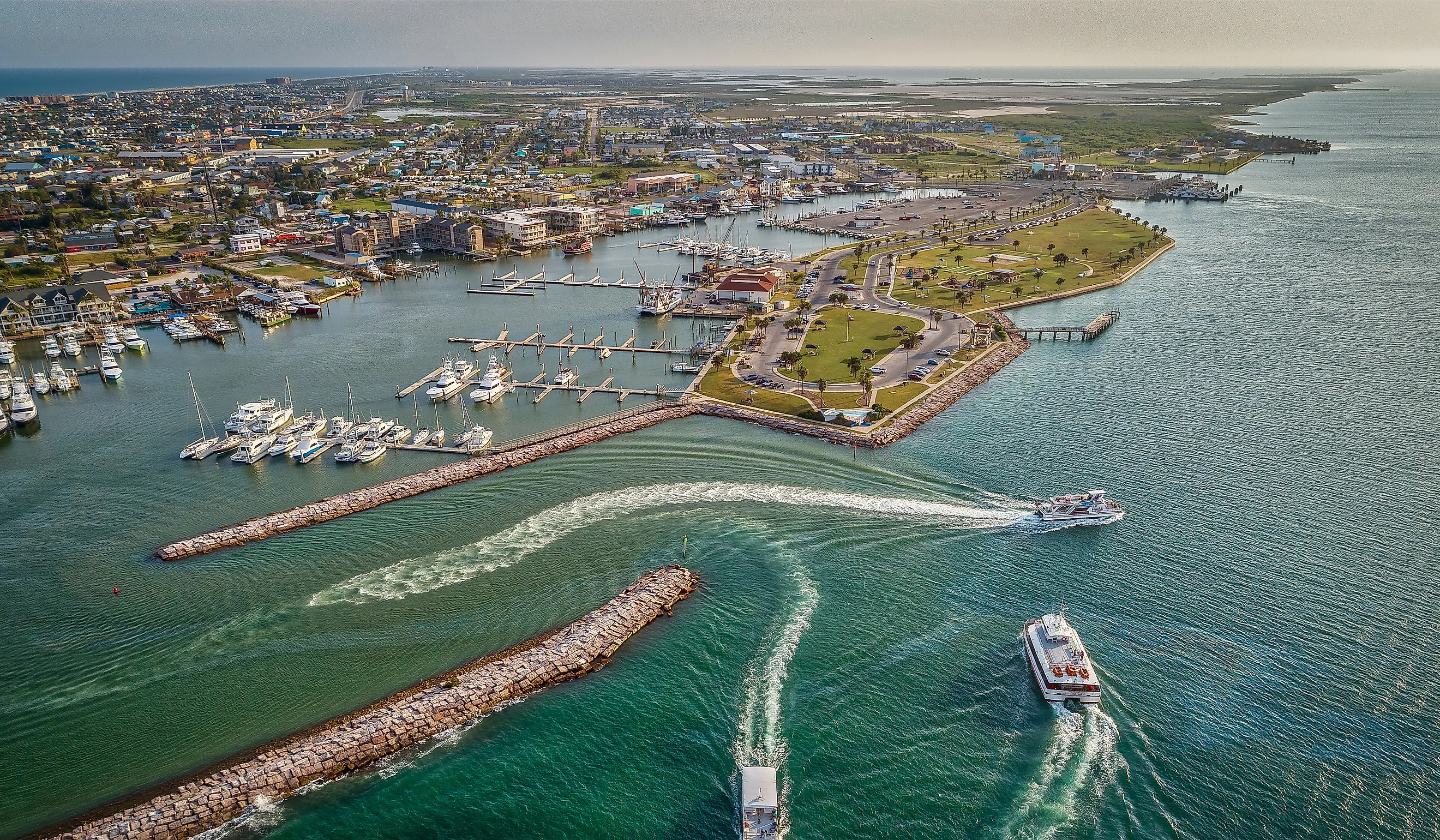
This Is The Gulf Coast's Quirkiest Little Town
Visit Port Aransas in April and you may find giant sand sculptures along the beach. Dragons and Viking ships and ten-foot busts of historical figures rise across a half-mile stretch. They’re all part of Texas SandFest, the largest native-sand sculpture competition in the country. Add 18 miles of drivable beach and more than 5,500 golf carts in everyday use. Port Aransas stands out as one of the quirkiest towns on the Gulf Coast.
The History of Port Aransas

Port Aransas sits on Mustang Island. Like most of the barrier islands along the Texas coast, Mustang Island formed about 4,500 years ago as a submerged sandbar. The Karankawa were the first inhabitants. Spanish explorer Cabeza de Vaca was likely the first European to encounter them, in 1528. The island was originally named Wild Horse Island, then Mustang Island for the wild horses called “mestenos” brought to the island by the Spanish in the 1800s.
By the 1820s, French pirate Jean Lafitte and his buccaneers had a presence in the Gulf of Mexico and spent a lot of their time on Mustang Island. The first known map of Port Aransas appeared in 1833 to help sailors navigate the region.
A fort was built on Mustang Island in 1846 to protect Aransas Bay during the Mexican-American War, and it stayed in use until after the Civil War. In the 1890s, the main town on Mustang Island was named Ropesville, which became Tarpon in 1899 thanks to the fish. By 1910, residents had started calling their town Port Aransas, and the name has stuck.
The Eight Wonders of Port Aransas

The ancient world has seven wonders. Port Aransas has done one better with eight of its own. In the early 2000s, a group of Port Aransas historians compiled a list of the town’s most distinctive landmarks. Among them is the Lydia Ann Lighthouse on adjacent Harbor Island, accessible only by boat. Construction began in 1854 and the lighthouse was first illuminated in 1857. It’s privately owned and inaccessible to the public, but boat and kayak tours take visitors right up to it for photos.
The Tarpon Inn dates to 1886, the longest-standing inn on Mustang Island. It survived fire damage and a hurricane and still operates today as a place to spend the night or grab a meal. The interior has its own peculiarities. The walls are lined with tarpon scales, each signed by the angler who caught the fish. On the back wall is a scale signed by President Franklin D. Roosevelt.
Texas SandFest

For one weekend in April, a half-mile stretch of Port Aransas beach turns into an outdoor art gallery. Sculptors carve structures entirely from on-site sand. The competition is the largest native sand sculpture event in the country. Forms range from dragons to Viking ships to ten-foot-tall busts of historical figures like President Abraham Lincoln.
The competition started in 1997 as a fundraiser for a community theater. It has since become a three-day event drawing renowned sand sculptors and tens of thousands of visitors from around the world. Port Aransas sand is well suited to sculpting because of its dense, fine-grained, angular qualities, paired with the high clay and silt content.

Sculptors are limited to trowels, spray bottles of water, and plastic straws. Finished pieces get spritzed with a water-based biodegradable glue that forms an outer shell. Judging covers originality, level of difficulty, proportions, cleanliness of finished structures, and what the festival’s master sculptor coordinators call the “wow” factor.
Beyond the sculptures, the beach has dozens of booths serving food, face painting, and locally made jewelry, clothing, and art. The festival site also includes a beer garden and small stages for live music.
Golf Cart Culture

As one of the few cities in Texas that permits golf cart operation on city streets, Port Aransas has normalized cart driving as part of the island lifestyle. Each year the number of carts in town grows. There are now over 5,500 on the island. Rentals are widely available, with cart models big enough to seat eight passengers. The beaches are all drivable, so a family can pack up towels, boards, and fishing rods and drive directly onto the sand at Port Aransas Beach.
The Gulf Coast’s Quirkiest Town
Port Aransas’s quirks are sown into its traditions and history, from the acclaimed Texas SandFest to the signed tarpon scales on the walls of the Tarpon Inn. With roads dominated by golf carts, it’s easy to browse giant dragons made of sand, sit down for a meal at the Tarpon Inn, or check off some of Port Aransas’s eight wonders in an afternoon.