The Best National Parks Near Denver
Arches holds more than 2,000 documented arches, the densest concentration anywhere.Five national parks sit within 70 to 370 miles from Denver, Colorado and each one preserves a landscape sculpted by different natural forces.
Glaciers carved the alpine peaks of Rocky Mountain National Park. Wind stacked the tallest dunes in North America at Great Sand Dunes. The Gunnison River cut Black Canyon through rock 1.8 billion years old. Salt flowing beneath Arches National Park fractured the sandstone above it, and the Green and Colorado rivers carved the mesas of Canyonlands.
The closest park can be reached in an estimated 1.5 hours by car while the furthest is about a six-hour journey, offering travelers from Denver easy weekend trip access to the vast, preserved wilderness spaces that shows the power nature truly holds.
Rocky Mountain National Park

About 70 miles northwest of Denver, 89,099 acres of alpine tundra blankets one third of Rocky Mountain National Park, making it one of the largest protected examples of that ecosystem in the contiguous United States. Elevation across the park spans 7,000 to 14,259 feet, and the Continental Divide cuts through the middle.
Rocky Mountain National Park is by far the closest national park from Denver and represents an easy day trip. It takes about an hour and a half to reach by car. Visitors also have the option to reach the park in about three hours from a bus that departs from Denver.
Glaciers and streams on both sides of the divide carved the valleys and about 150 lakes that fill the park today. Trail Ridge Road takes vehicles across the tundra landscape up to 12,183 feet, with 11 of its 48 miles above the treeline. The Alpine Visitor Center at 11,796 feet is the highest of the entire National Park Service (NPS). Elk, bighorn sheep, and moose graze the meadows and navigate the slopes throughout the park. Longs Peak, at 14,259 feet, is the highest point.
Great Sand Dunes National Park and Preserve

Over 400,000 years ago, southwest winds carried sand from the dried bed of Lake Alamosa toward a bend in the Sangre de Cristo Mountains. Opposing storm winds from the northeast trapped and sculpted the sand into the tallest dunes in North America.
The 30 square miles of dunes at Great Sand Dunes National Park and Preserve, about 235 miles from Denver via I-25 S, rise to 741 feet at Star Dune. To walk among the main dunefield, visitors can take the somewhat strenuous High Dune trail, which covers three miles roundtrip. From the summit of High Dune at 692 feet, hikers access sweeping panoramic views of the unique landscape and the Sangre de Cristo Mountains.
Sandboarding and sand sledding are allowed in approved areas of the park, and visitors can rent specially designed boards and sleds from retailers between about four and 36 miles from the park entrance.
Black Canyon of the Gunnison National Park

Cutting away at about one inch per century, the Gunnison River took about two million years to carve Black Canyon through rock that formed 1.8 billion years ago. Sitting 260 miles west of Denver, Black Canyon of the Gunnison National Park features dramatic gorge scenery and the tallest cliff in Colorado, the Painted Wall.
At 2,250 feet, the Painted Wall towers above the Gunnison River, streaked with pink pegmatite and giant crystals up to six feet long that crisscross the ancient, dark metamorphic cliff rock. The canyon narrows to about 40 feet across at river level in The Narrows.
Above, peregrine falcons nest on the cliffs, and the steep walls block so much sunlight that the gorge earned its name from the shadows. The park also became an International Dark Sky Park in 2015.
Arches National Park

More than 300 million years ago, a salt bed settled beneath what is now Arches National Park in Utah, and the sandstone that piled on top of it cracked as the salt bulged upward. Water widened those fractures in the Entrada Sandstone, and the park, 350 miles from Denver, now holds more than 2,000 documented arches. This represents the densest concentration of arches in the world. Each opening must span at least three feet across to count.
Landscape Arch stretches 306 feet across its opening, one of the longest natural spans in the world. Delicate Arch stands at the end of a hike of three miles round trip that gains 480 feet over slickrock. Balanced Rock rises 128 feet, a 3,600-ton boulder of Entrada Sandstone resting on a pedestal of eroding mudstone.
Canyonlands National Park

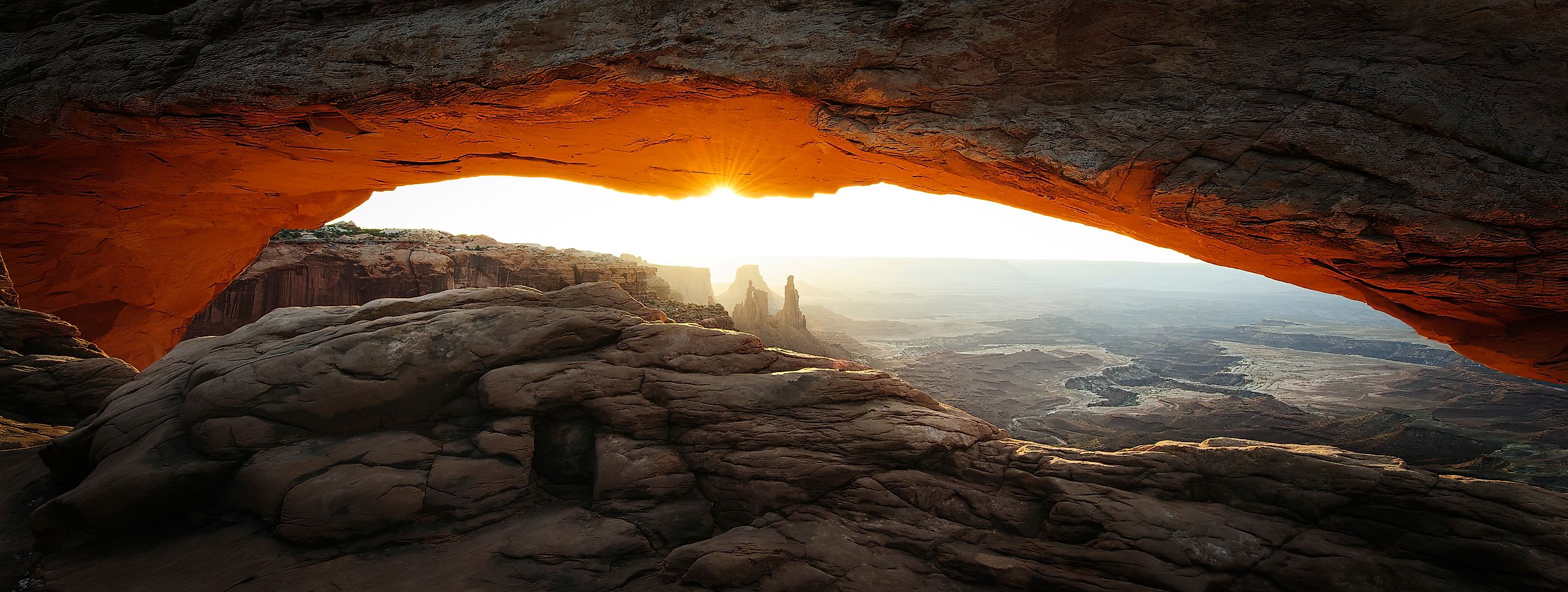
Sheer sandstone cliffs more than 1,000 feet high ring the Island in the Sky mesa at Canyonlands National Park in Utah, which lies about 363 miles from Denver. A half-mile leads to Mesa Arch, where sunrise lights the underside of the span, and the 100-mile White Rim Road loops along a sandstone bench below the mesa.
Upheaval Dome, a crater about 1,500 feet deep, keeps geologists debating whether a collapsed salt dome or a meteorite impact formed it.
In the Needles district, water carved the Cedar Mesa Sandstone into banded spires. Confluence Overlook looks down 1,000 feet on the point where the Green and Colorado rivers meet. Those rivers split the park's 337,598 acres into the Island in the Sky, the Needles, the Maze, and the rivers themselves. No roads connect the districts inside this remote park.
The Five National Parks Near Denver
Ice, wind, rivers, and salt built these five landscapes into distinct regions, but their distances from Denver sort the parks into three groups.
The Rocky Mountain National Park lies just about 70 miles from Denver, offering the easiest day trip option. Great Sand Dunes and Black Canyon of the Gunnison can both be reached in about 3.5 to four hours, making them still doable for a day trip for visitors willing to hit the road early enough and return home a bit late. Arches and Canyonlands are closer to six hours from Denver, and are better suited as two or three-day adventures.
For visitors looking for an extended trip, each park offers miles of trails, and access to unique formations and landscape features that can easily fill multiple days of exploration.