The Busiest Stretch Of Highway In The United States
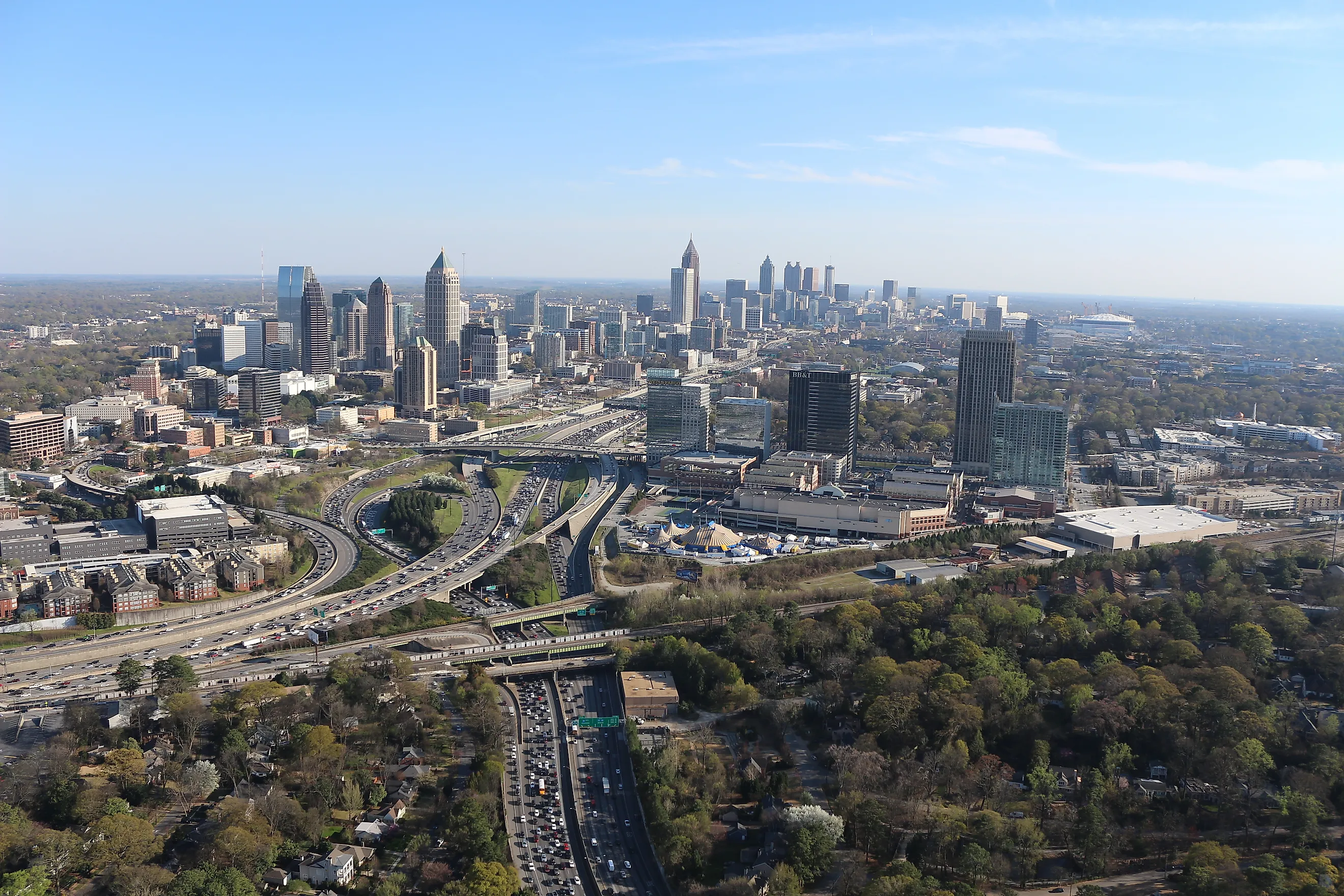
The busiest stretch of highway in the United States is the Downtown Connector in Atlanta, Georgia, the roughly 7.4-mile concurrent run of Interstate 75 and Interstate 85 through the center of the city. According to the Federal Highway Administration's Highway Performance Monitoring System, the segment carried an average of 405,000 vehicles a day in 2024, more than any other point on the national highway network.
Before calling a highway the nation’s busiest, it is important to define what “busiest” means. This article uses Annual Average Daily Traffic, or AADT, the FHWA's standard measure of how many vehicles pass a fixed point on a road over an average day, calculated over the reporting year. It is not peak-hour volume, which spikes far higher during rush periods than the daily average suggests. And it is a single-point measurement, not a corridor average, which matters because AADT on a route like I-75 changes dramatically depending on where along its 355 miles in Georgia you measure it. Under this definition, the honor goes to one specific location: the Connector's midtown stretch, where GDOT counts show volumes exceeding 400,000 vehicles on the busiest days near the 10th Street area.
What changes under a different definition

Runners-up look different depending on which yardstick is used. If the question were total vehicle-miles traveled along an entire route, the answer would shift toward a long, heavily used interstate like I-95 or I-5, since those totals compound traffic across hundreds of miles rather than concentrating it at one point. If the question were the widest highway by lane count, the answer would be the Katy Freeway section of I-10 in Houston, which reaches 26 lanes, including frontage and managed lanes. This highway is wide because of the space it needed to build, not because it carries more traffic than Atlanta's connector. If the question were busiest by state highway designation rather than federal interstate, Florida's SR-826, the Palmetto Expressway in Miami, would enter the conversation at over 324,000 AADT.
The FHWA's own 2024 data makes the point directly. Of the 25 most-traveled route locations in the country, 21 are interstates, one is a U.S. highway, and three are state routes, a reminder that "highway" covers more than the interstate system, even though interstates dominate the top of the list.
The history behind the number
The road did not start out as part of the Interstate Highway System at all. In 1944, the Atlanta City Council hired the Chicago engineering firm H.W. Lochner & Company to study the city's traffic problems and recommend a solution for the postwar growth planners expected. The resulting January 1946 report proposed six radiating expressways converging on downtown, a central spine that the report itself referred to as the "Downtown Connector." Construction on the first section, between Williams Street and the Brookwood interchange, began in 1948, and that stretch opened to traffic on September 25, 1951, a full five years before Congress authorized the national Interstate Highway System in 1956. When the interstate numbers arrived, I-75 and I-85 were routed onto the existing Connector rather than a new road built for them.
The road's expansion tracks the city's growth. It started as a six-lane expressway. GDOT's "Freeing the Freeways" program, phased in from 1976 to 1989, roughly doubled its width to ten lanes as part of a broader 126-mile regional widening effort. A further round of work added high-occupancy vehicle lanes ahead of the 1996 Summer Olympics, pushing the Connector to as many as fourteen lanes through its busiest sections. Each widening brought a few years of relief before traffic volume caught back up, a pattern familiar to planners studying induced demand on urban freeways nationwide.
Driving on the Interstate today

The Connector runs from the I-75/I-85 split south of downtown near the Georgia State Capitol, past Georgia State University, Centennial Olympic Park, the Mercedes-Benz Stadium, and Grady Memorial Hospital's namesake curve, before separating again at the Brookwood interchange in Midtown. Most of its length carries the unsigned state designations SR 401 for the I-75 portion and SR 403 for I-85, and since the 2000s it has carried the honorary name James Wendell George Parkway, a title rarely used outside official documents.
It is fully open to general traffic, with HOV lanes particularly active during peak periods, and it remains the primary north-south route through the city's core for commuters, freight, and the roughly two million passengers a year who use Hartsfield-Jackson Atlanta International Airport at its southern end. There is no plaque or overlook marking it as the nation's busiest stretch of road. Drivers mostly know it by its reputation for backups that start well before the official rush hour and by nicknames like the Grady Curve, a sweeping bend past the hospital that has become a fixture of local traffic reports.
Other busy stretches of highway in the US

I-5, Los Angeles-Long Beach-Anaheim. For years, this held the title FHWA now assigns to the Downtown Connector. As recently as the agency's 2019 data, I-5 in Los Angeles ranked first nationally; by 2024, it had slipped to second at 386,600 AADT, a reversal the FHWA itself flagged as one of the more notable shifts in its most recent report.
I-10, in Phoenix-Mesa-Scottsdale, made the sharpest climb of any location on the FHWA's list, jumping from 13th place in 2019 to third in 2024 at 386,198 AADT, reflecting the Phoenix area's rapid population growth over that period.
Lastly, I-10, also known as the Katy Freeway in Houston, earns more headlines than any other American highway thanks to its width, but its traffic volume trails the leaders. TxDOT and FHWA figures place it well below the top tier nationally, a reminder that lane count and daily traffic volume measure different things entirely; the Katy Freeway was built wide partly in response to congestion, and adding lanes did not translate into the highest AADT in the country.
Atlanta’s Downtown Connector shows just how much traffic can concentrate on a short stretch of roadway. With more than 400,000 vehicles passing through its busiest point on an average day, it leads the country under FHWA’s AADT measure, even as other highways stand out for their length, width, or peak-hour congestion. Its history also reflects Atlanta’s growth, with repeated expansions trying to keep pace with ever-rising demand.