Wolverine
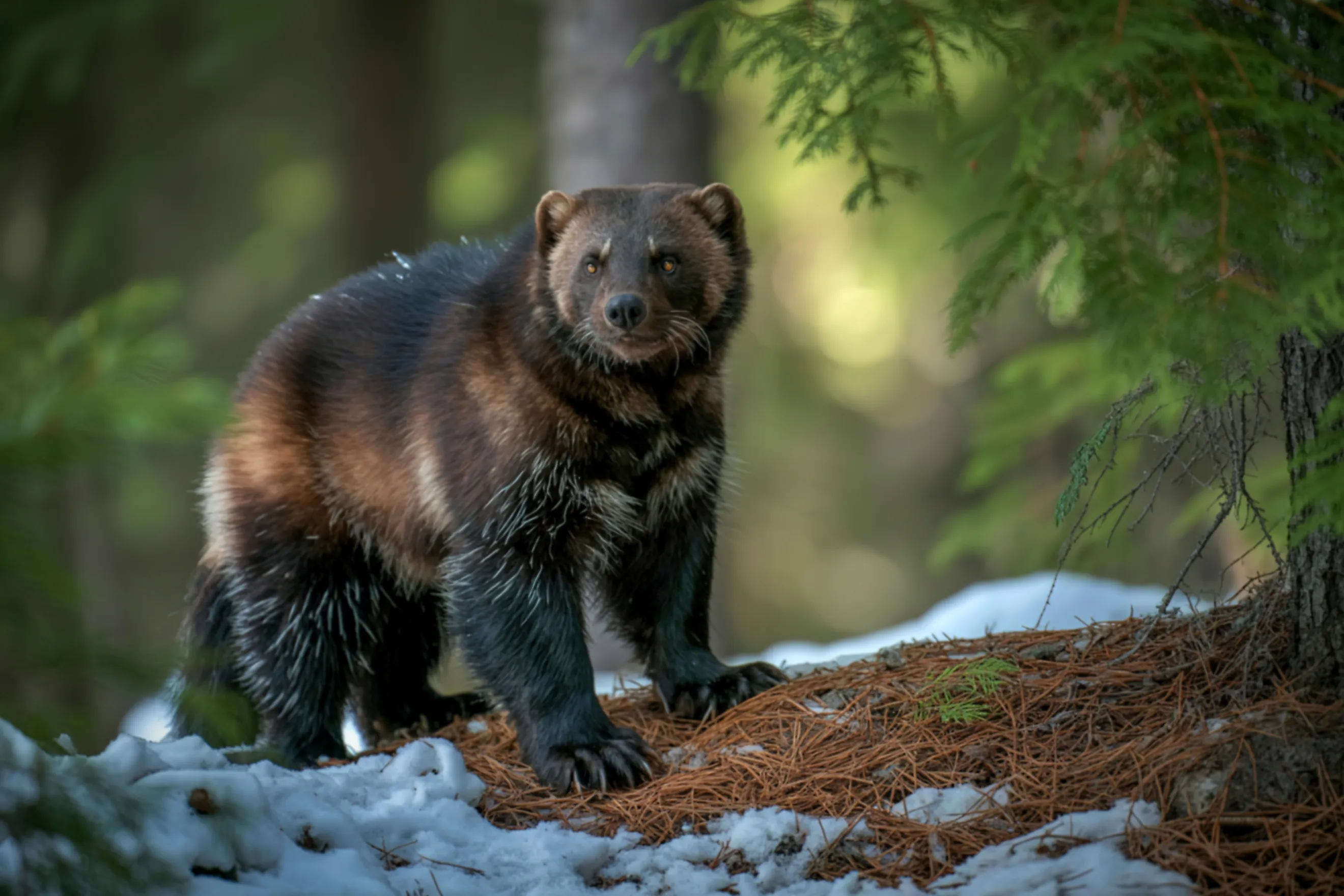
If you’ve ever seen a wolverine in its natural habitat, consider yourself lucky. These stocky, powerful carnivores are among the most elusive animals on the planet and are seldom seen by humans, even researchers and seasoned backcountry users. Wolverines are solitary animals that live at naturally low densities and require huge home ranges, especially males. They roam cold, remote parts of the Northern Hemisphere, including arctic and subarctic tundra, taiga, boreal forests, and alpine mountain regions. Perfectly adapted to deep winter conditions, their broad, snowshoe-like paws allow them to travel over deep snowpack where many other predators would struggle. Wolverines are recognized for their strength, endurance, boldness, and tenacity.
Taxonomic classification

The wolverine (Gulo gulo) is the largest land-dwelling member of the weasel family, Mustelidae. Classified within the order Carnivora, they are closely related to otters, martens, and weasels. Though they are a single species, wolverines are usually described as having North American and Eurasian subspecies. The name Gulo gulo translates to "glutton" in Latin, referring to their intense feeding habits, and they are sometimes called "carcajou" or "glutton" in different regions.
Range and Habitat

Wolverines live in Arctic, subarctic, boreal, and mountainous regions of North America, Europe, and Asia, often in areas with limited human disturbance. In North America, most wolverines live in Canada and Alaska, but rare populations and wandering individuals also occur in parts of the contiguous United States, especially the Northern Rockies and North Cascades, including areas of Montana, Idaho, Wyoming, Washington, and Oregon. In Europe and Asia, wolverines inhabit taiga, tundra, and northern mountain regions of Norway, Sweden, Finland, Russia, Siberia, and parts of northern Mongolia. Historically, wolverines occupied areas farther south than they do today, but they have been extirpated from many southern parts of their former range because of human expansion, habitat loss, and persecution.
Food

When it comes to feeding, wolverines are highly opportunistic hunters and scavengers. Strong, persistent, and well adapted to harsh conditions, they can kill prey larger than themselves, including weakened or snow-bound ungulates such as deer, caribou, reindeer, and, in rare cases, moose. In winter, however, carrion is often especially important. Wolverines regularly feed on animals killed by wolves, bears, avalanches, starvation, or harsh weather. In coastal or northern regions, they may also feed on dead marine mammals such as seals, walrus, or whales. Their diet includes small and medium-sized animals such as birds, squirrels, porcupines, hares, rodents, and eggs, and in summer they also eat berries, roots, and other plant material. Because food can be scarce in their harsh environments, wolverines cache surplus meat in rock crevices, under vegetation, or buried in snow for later use.
Physical Description

Though part of the weasel family, wolverines look somewhat like a small, low-slung bear or badger, with dense dark brown or black fur, powerful limbs, long claws, and sharp teeth. Their specialized molars and strong jaws allow them to bite through frozen meat, hide, and bone. They usually weigh 18-40 pounds (8-18 kilograms), stand about one to 1.5 feet tall at the shoulder, and are roughly two to three feet long, with a tail around 10 inches in length. Their fur is long and coarse, often with a pale brown or silver-grey facial mask, and they may have reddish, tan, or blond stripes running along their flanks toward the tail. Thick guard hairs help protect them from the cold. Many wolverines have distinctive light markings on the chest or throat. They walk partly on the soles of their feet, a semiplantigrade posture that helps them move efficiently over deep, soft snow.
Behavior and Reproduction
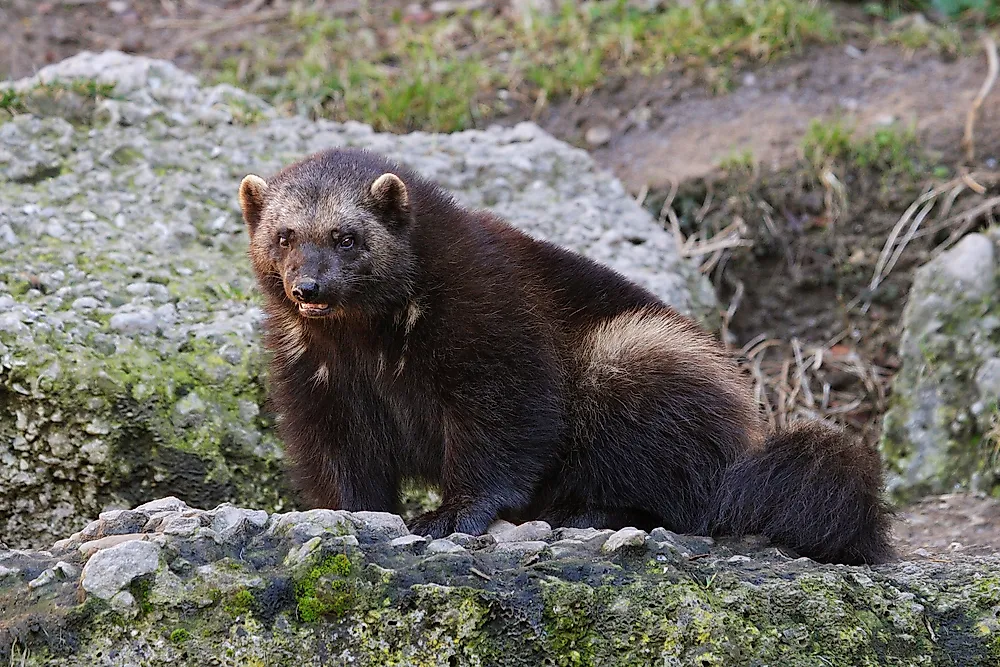
Wolverines are solitary animals for most of the year. Male wolverines are polygamous and may mate with several females whose ranges overlap their territory. Breeding usually occurs from spring through summer, but wolverines have delayed implantation, meaning the fertilized egg does not immediately implant in the uterus. Because of this, the time between mating and birth can last many months, even though active pregnancy is much shorter. Females usually give birth in late winter or early spring in deep snow dens, which can include tunnels beneath the snow surface. Litters usually contain one to five kits. Young wolverines become increasingly independent during their first year and generally reach sexual maturity around two to three years of age. Adult wolverines are built for endurance and can travel dozens of kilometres in a day across cold, rugged terrain. They mark their territory with urine and scent-gland secretions, scent-mark food caches, and scavenge from kills made by wolves, bears, and humans, including baited traps. Sometimes called the “skunk bear,” wolverines can produce a pungent odor. They do not hibernate, are capable swimmers and climbers, and communicate mostly through scent, though they may hiss, growl, or bark when threatened. Wolverines usually avoid larger predators, but when cornered or defending food, they can be extremely aggressive and tenacious.
Importance

As powerful scavengers and opportunistic predators, wolverines play an important role in Arctic, subarctic, alpine, tundra, and boreal ecosystems. By consuming carrion, they help recycle nutrients and make use of carcasses that might otherwise remain frozen for long periods. They also prey on a range of small and medium-sized animals and form part of the wider predator-scavenger community. Their presence is often a sign of big, cold, connected wilderness. Because successful denning depends on persistent spring snowpack, wolverines are also closely tied to the effects of climate change in northern and alpine environments.
Threats
Wolverines face several threats across parts of their range. These include habitat fragmentation from industrial development, roads, and increased human access; climate change, especially the loss of persistent spring snow needed for denning; human disturbance; trapping or harvest pressure in some regions; and the species’ naturally low reproductive rate. In the contiguous United States, wolverines are listed as Threatened under the U.S. Endangered Species Act, largely because warming temperatures are expected to reduce cold, snowy habitat and further fragment their range. In Canada, wolverines are federally listed under the Species at Risk Act as a species of Special Concern, though their status varies by province and territory. Northern populations in Yukon, the Northwest Territories, and Nunavut are considered relatively secure, while southern populations are more vulnerable. Globally, the IUCN Red List classifies the wolverine as Least Concern, though the overall population trend is decreasing and some regional populations face much higher risk.
Seeing a wolverine in the wild is considered a once-in-a-lifetime experience. Even researchers who spend countless hours tracking them often see them only on remote-camera footage, sometimes near carrion bait. In harsh northern and alpine environments, wolverines play an important role as scavengers, predators, and indicators of wild, connected landscapes. As roads, development, disturbance, trapping, and climate change reach farther into remote areas, some wolverine populations will face growing pressure. Because individual wolverines need such large ranges and occur at naturally low densities, local losses can be difficult to reverse. In the years ahead, the status of wolverine populations will remain a useful sign of the health and connectivity of northern and alpine ecosystems.