Endemic Birds Of The United States
An endemic species is one found in a single place and nowhere else on Earth. By that strict standard, the continental United States is home to exactly 15 endemic bird species, birds whose entire global range falls within the Lower 48. (Hawaii, isolated far out in the Pacific, has dozens of its own endemics, and Alaska adds McKay's Bunting, but those are separate stories. The birds below are the mainland's.) Some are confined to a single island or a single state. Others cling to a thin ribbon of salt marsh, a shrinking patch of prairie, or a few cold mountaintops. A striking number are in trouble, precisely because a small range leaves nowhere to retreat once habitat disappears. Here are all 15, grouped by the kind of isolation that set them apart.
California's Two State Endemics
Only two bird species on Earth are endemic to the single state of California, and the state's geography explains both: an offshore island and an isolated belt of oak woodland, each cut off enough to grow its own bird.
Island Scrub-Jay

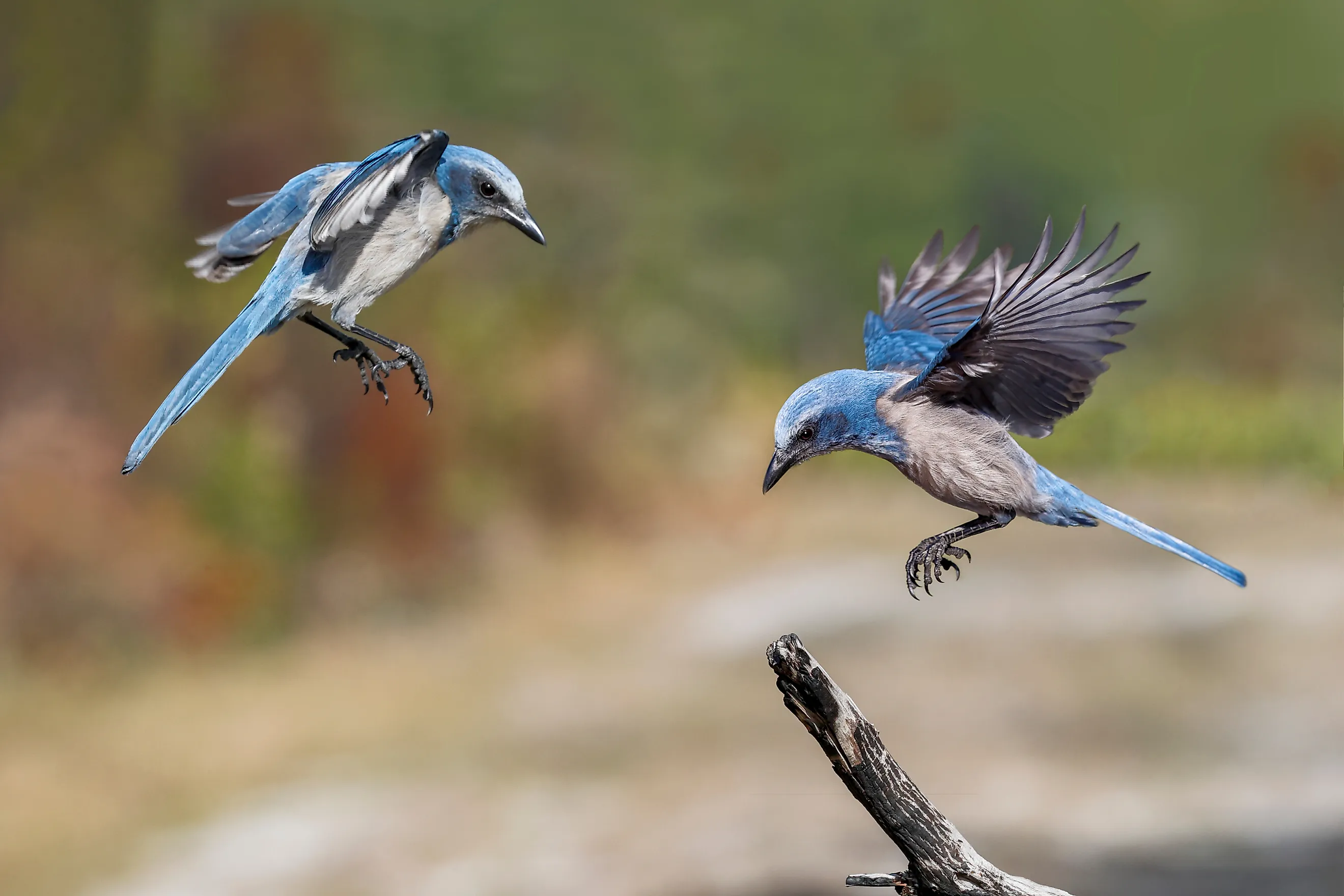
The Island Scrub-Jay (Aphelocoma insularis), a member of the crow and jay family Corvidae, lives nowhere but Santa Cruz Island, the largest of California's Channel Islands, a patch of land only about 96 square miles in size. That makes it the only island-endemic bird species north of Mexico and one of the rarest birds in North America, with just a few thousand individuals. Isolated for roughly 150,000 years, it has grown noticeably larger and heavier than its mainland cousin, the California Scrub-Jay, a textbook case of island gigantism. The IUCN lists it as Vulnerable, since a single storm, disease outbreak, or invasive predator could threaten the entire global population at once.
Yellow-billed Magpie

The Yellow-billed Magpie (Pica nuttalli), also a corvid, is the only other bird endemic to California. It occupies the oak woodlands and savannas of the Central Valley and the central coast, where it nests in loose colonies and forages in noisy, social flocks. The species was hit hard by West Nile virus in the mid-2000s, losing a large share of its population, though numbers have since recovered. The IUCN currently rates it Least Concern, but its tie to a single state's oak country keeps it on the watch lists.
Florida and the Southeastern Woods
The Southeast's fire-maintained pine savannas and Florida's relict sand scrub are habitats that barely exist anywhere else, and several birds evolved to live in them and nothing else.
Florida Scrub-Jay

The Florida Scrub-Jay (Aphelocoma coerulescens) is the only bird species endemic to Florida. A blue-and-gray corvid of the state's dry oak scrub, it survives on sandy ridges that depend on periodic fire to stay open. It is also famous for cooperative breeding: grown offspring stay on to help their parents raise the next brood and watch for predators. The IUCN has listed it as Vulnerable since 2000, and its numbers keep falling as scrub habitat is cleared for development.
Carolina Chickadee

The Carolina Chickadee (Poecile carolinensis), a small member of the tit family Paridae, is endemic to the southeastern United States and a familiar visitor at backyard feeders across the region. It is rated Least Concern, the most secure bird on this list. Where its range meets that of the nearly identical Black-capped Chickadee, the two hybridize along a narrow contact zone that has been creeping northward as winters warm.
Fish Crow

The Fish Crow (Corvus ossifragus) haunts the coastlines, marshes, and river valleys of the eastern and southeastern US, its entire range falling within the country. It looks almost exactly like the widespread American Crow and is most reliably separated by voice: a short, nasal, two-noted call rather than a clean caw. The IUCN lists it as Least Concern, and it has actually expanded inland along major river systems in recent decades.
Red-cockaded Woodpecker

The Red-cockaded Woodpecker (Dryobates borealis, also classified as Leuconotopicus borealis) is a black-and-white woodpecker of the Picidae family found across the southeastern US. Its range reaches Virginia and the Carolinas in the east, Texas and Oklahoma in the west, and Florida in the south. It is a longleaf-pine specialist and the only North American woodpecker that excavates its nest cavities in living, mature pines, relying on the trees' flowing resin to deter predators. Like the Florida Scrub-Jay, it breeds cooperatively in family groups. Decades of habitat protection and prescribed fire have paid off: the IUCN rates it Near Threatened, and in 2024 the US Fish and Wildlife Service downlisted it to Threatened, easing its longstanding Endangered status.
Bachman's Sparrow
Bachman's Sparrow (Peucaea aestivalis), a New World sparrow of the family Passerellidae, is endemic to the open pine savannas of the Southeast and named for the 19th-century naturalist Reverend John Bachman. Secretive and easily overlooked outside the breeding season, it is best detected by the male's clear, whistled song. The IUCN lists it as Near Threatened, and like much of the pinewoods community it depends on, it benefits from the prescribed burns that keep the forest floor open.
The Salt-Marsh Specialists
The tidal salt marshes of the Atlantic and Gulf coasts form a thin, linear habitat found only along the US shoreline, and the birds that specialize in it occur nowhere else.
Saltmarsh Sparrow
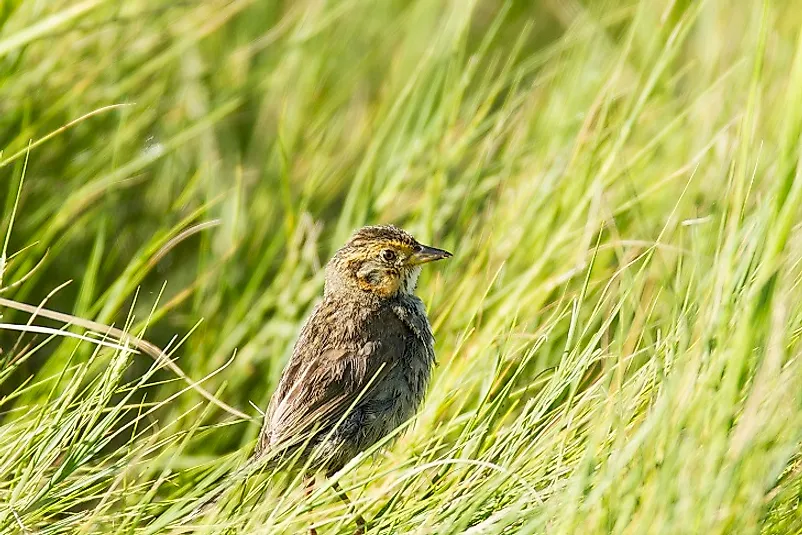
The Saltmarsh Sparrow (Ammospiza caudacuta, formerly placed in the genus Ammodramus) is an obligate tidal-marsh specialist that breeds in a narrow band of Atlantic salt marsh between Maine and Virginia. It is among the most threatened birds on this list: the IUCN now lists it as Endangered, and rising seas increasingly flood its low nests, drowning chicks and washing away eggs. Some projections warn the species could approach extinction within a few decades without intervention.
Seaside Sparrow

The Seaside Sparrow (Ammospiza maritima) lives in salt marshes along both the Atlantic and Gulf coasts of the US. The species as a whole is rated Least Concern, but its history is a warning: the Dusky Seaside Sparrow, a Florida subspecies, went extinct in 1987, and the Cape Sable subspecies of south Florida is endangered today. It shares the family Passerellidae, and its marshes, with the Saltmarsh Sparrow.
Boat-tailed Grackle

The Boat-tailed Grackle (Quiscalus major), a large, glossy blackbird of the family Icteridae, is the loud and conspicuous member of this coastal trio. Endemic to the Atlantic and Gulf coast marshes of the US, the males are iridescent black with a long, keel-shaped tail, while females are warm brown. The IUCN rates it Least Concern, and it is a common sight around southern coastal towns and wetlands.
Grouse of the Open West
The grasslands and sagebrush seas of the interior West once stretched unbroken for hundreds of miles. As that habitat fragmented, three large ground birds were left restricted entirely to the United States.
Greater Prairie-Chicken

The Greater Prairie-Chicken (Tympanuchus cupido), a member of the grouse and pheasant family Phasianidae, is a barred brown bird of the central US prairies, found across Kansas, Nebraska, and the Dakotas. Each spring, males gather on communal display grounds called leks and inflate orange neck sacs to produce a deep booming call that carries across the grass. The IUCN now lists it as Near Threatened. Its history reflects the fate of the prairie itself: the eastern Heath Hen subspecies went extinct in 1932, and the Attwater's subspecies of the Texas coast is critically endangered.
Lesser Prairie-Chicken

The Lesser Prairie-Chicken (Tympanuchus pallidicinctus) is the smaller, paler relative of the Greater, restricted to the southern High Plains across parts of Kansas, Oklahoma, Texas, New Mexico, and Colorado. Its habitat has shrunk by roughly 90 percent, leaving an estimated 32,000 birds, and the IUCN rates it Vulnerable. Its legal status has whipsawed: granted Endangered Species Act protection in 2022, the listing was struck down by a federal court and then formally removed in February 2026, leaving the bird without federal protection.
Gunnison Sage-Grouse

The Gunnison Sage-Grouse (Centrocercus minimus) survives in just two pockets of sagebrush country in southwestern Colorado and southeastern Utah. It was recognized as a distinct species only in 2000, the first new bird species described in the US since the 19th century, after researchers documented its smaller size, thicker head plumes, and different courtship display compared with the Greater Sage-Grouse. With fewer than about 4,000 birds remaining, the IUCN lists it as Endangered.
Finches of the Alpine Heights
The highest mountaintops act like islands in the sky, isolated by the warm valleys around them. Two finches adapted to life above the treeline are effectively stranded on these cold summits within the US.
Black Rosy-Finch

The Black Rosy-Finch (Leucosticte atrata), a member of the finch family Fringillidae, breeds on the rocky tundra above the treeline in the central Rocky Mountains and the high ranges of the northern Great Basin. It is the most range-restricted member of its genus and a prized find for birders willing to climb for it. The IUCN lists it as Endangered, with a warming climate steadily shrinking the cold alpine zone it depends on.
Brown-capped Rosy-Finch

The Brown-capped Rosy-Finch (Leucosticte australis) is an alpine finch found almost entirely on Colorado's highest peaks. Pink-washed on the wings and belly with a brown body, it nests among the rocks and snowfields at the top of the Rockies. The IUCN lists it as Endangered, and it may be the most climate-threatened bird on this list: one analysis projected that a two-degree Celsius rise could erase nearly all of its suitable habitat.
The 15 Endemic Birds at a Glance
| Common Name | Scientific Name | IUCN Red List Status |
|---|---|---|
| Island Scrub-Jay | Aphelocoma insularis | Vulnerable |
| Yellow-billed Magpie | Pica nuttalli | Least Concern |
| Florida Scrub-Jay | Aphelocoma coerulescens | Vulnerable |
| Carolina Chickadee | Poecile carolinensis | Least Concern |
| Fish Crow | Corvus ossifragus | Least Concern |
| Red-cockaded Woodpecker | Dryobates borealis | Near Threatened |
| Bachman's Sparrow | Peucaea aestivalis | Near Threatened |
| Saltmarsh Sparrow | Ammospiza caudacuta | Endangered |
| Seaside Sparrow | Ammospiza maritima | Least Concern |
| Boat-tailed Grackle | Quiscalus major | Least Concern |
| Greater Prairie-Chicken | Tympanuchus cupido | Near Threatened |
| Lesser Prairie-Chicken | Tympanuchus pallidicinctus | Vulnerable |
| Gunnison Sage-Grouse | Centrocercus minimus | Endangered |
| Black Rosy-Finch | Leucosticte atrata | Endangered |
| Brown-capped Rosy-Finch | Leucosticte australis | Endangered |
Why So Many Are at Risk
A small range is a double-edged trait. It is what makes these birds unique, and it is also what makes them fragile. When the only island, scrub patch, salt marsh, prairie, or mountaintop a species depends on shrinks, there is simply nowhere else for it to go. Habitat loss drives nearly every decline here, whether from coastal development, prairie plowed into cropland, fire suppression in the pinewoods, or a warming climate squeezing the alpine and tidal margins. The most direct way to help is to support the land trusts, wildlife refuges, and state and federal programs that protect these specific habitats, along with the prescribed-fire and marsh-restoration work that several of these birds cannot survive without.