Sun Bears
The sun bear is the smallest of all bear species and is found in the tropical rainforests of Southeast Asia, where it spends most of its time up in the treetops. Known scientifically as Helarctos malayanus, it is often overshadowed by its famous cousins, including the giant panda and the polar bear, but sun bears are incredibly vital to the ecosystem, for they disperse seeds and control pests, while their foraging helps maintain healthy soil and regenerate forests. They are largely solitary and have fascinating habits when it comes to socialization, mating, and reproduction. Unfortunately, the sun bear is under threat due to loss of habitat and human interference, such as poaching. Read on to discover more about this lesser-known species.
Taxonomic Classification

Sun bears are mammals and belong to the order Carnivora, but they are also omnivores that eat both small reptiles, birds, insects, and plant matter. They are part of the family Ursidae, but unlike bigger bears, the sun bear is the only member of its genus, Helarctos. The name comes from the Greek words helios (sun) and arktos (bear). There are two main subspecies of sun bears, namely the Malayan sun bear and the Bornean sun bear. Malayan sun bears inhabit the Southeast Asia mainland and the island of Sumatra, while Bornean sun bears live only on the island of Borneo and are slightly smaller than their Malayan relative.
Physical Description

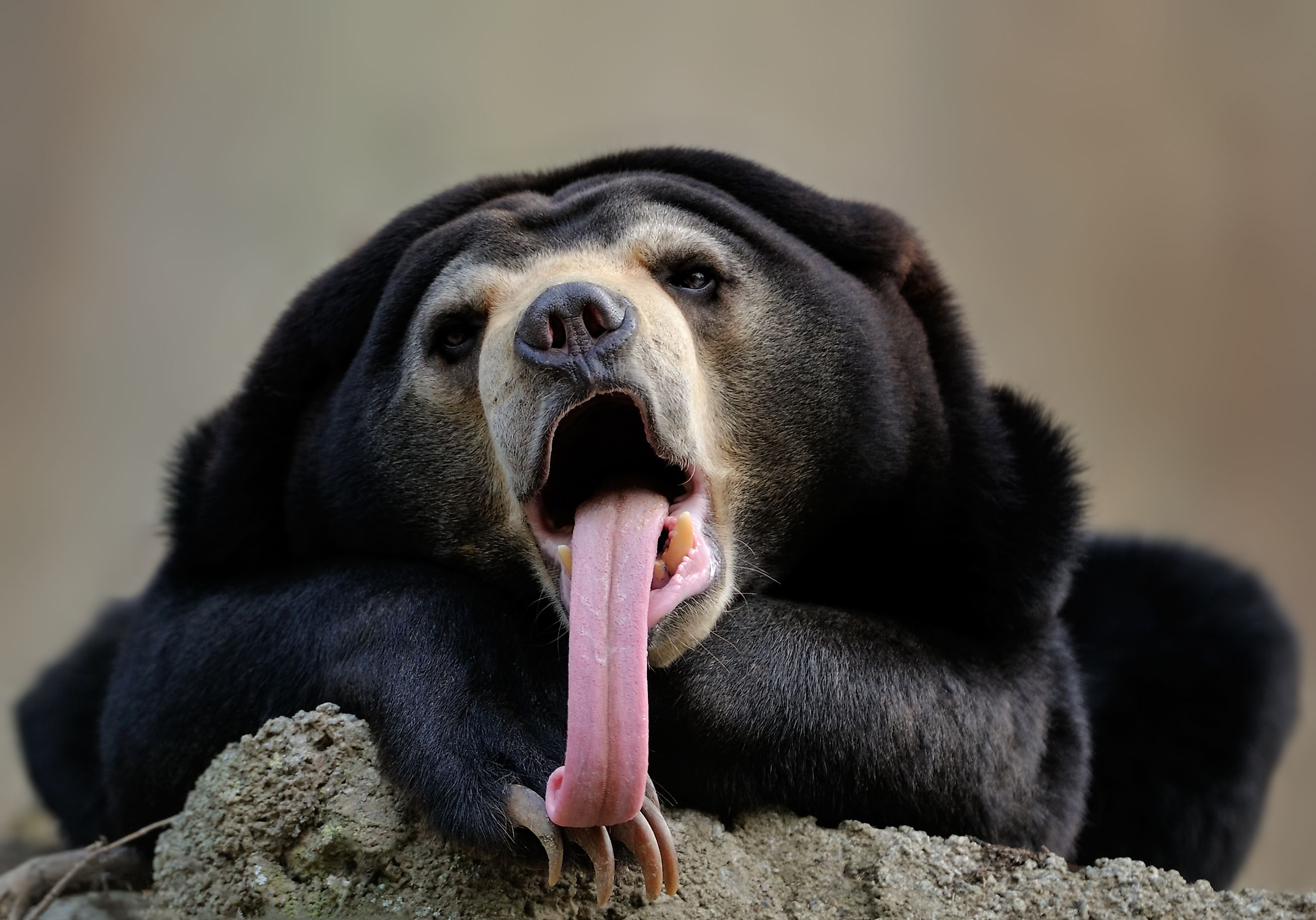
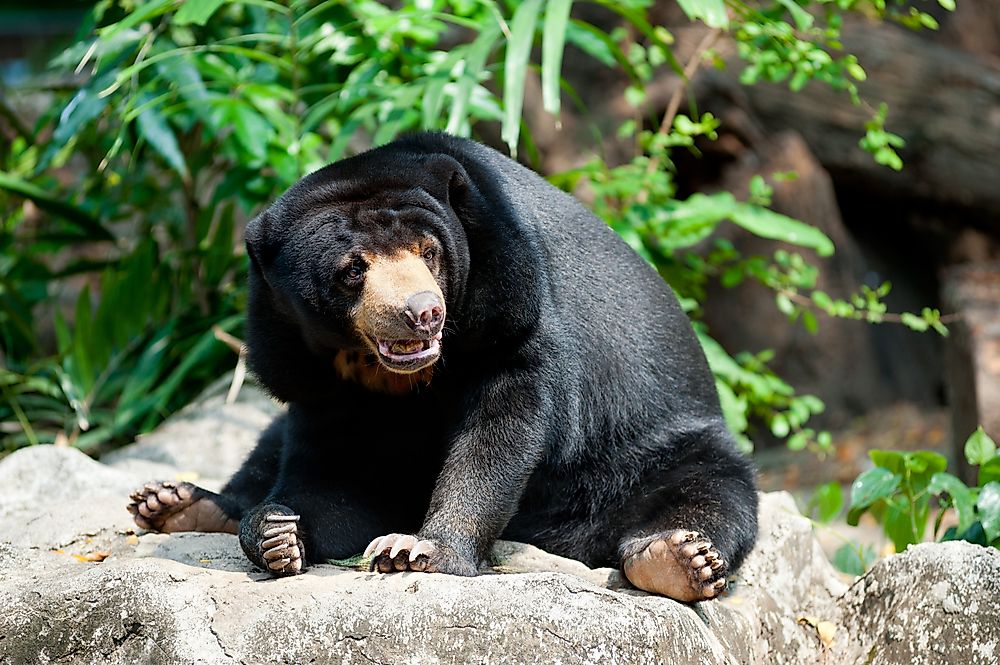
From a distance, the sun bear looks almost like a dog. They weigh between 60 and 150 pounds, and they can grow to be up to 4 feet long, with their tails usually reaching at least 2 inches in length. They have large forepaws with curved claws that they use to tear and dig when searching for food. These claws help them rip apart rotting logs in search of insects and sap, and they enable them to scale trees to forage for flying insects and other food sources. With their 10-inch tongues, they can locate termites easily or reach into the furthest crevices of a beehive.
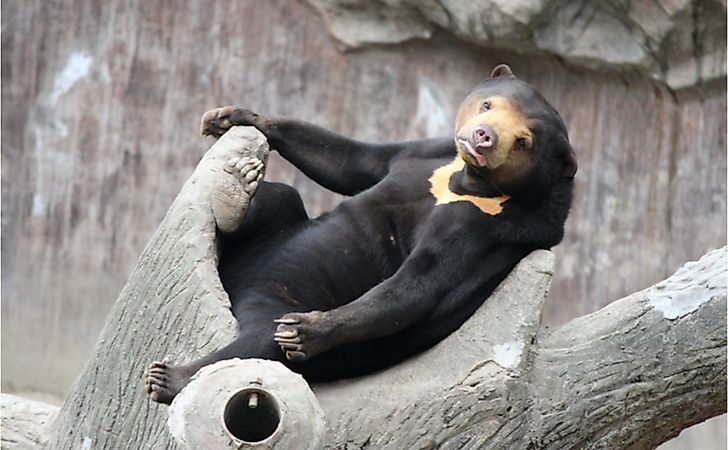
One of the sun bear’s most distinctive traits is its loose, baggy skin, which allows it greater flexibility when threatened, helping it twist and defend itself if attacked. Sun bears can also vocalize with barks or roars to deter predators. Another striking feature is the orange or yellow crescent-shaped patch on their chest. Each patch is unique, like a birthmark. Folklore sometimes suggests this marking represents the rising sun; however, scientifically, it is simply a natural variation in fur coloration.
Range & Habitat

Historically, sun bears occupied a continuous stretch of Southeast Asia, but that range has fragmented over time. Today, these bears can be found in Northeastern India (Assam), Bangladesh, Thailand, Laos, Myanmar, Vietnam, and Cambodia. They also live on the Sundaland islands of Sumatra (Indonesia) and Borneo (shared by Indonesia, Malaysia, and Brunei). It is interesting to note that sun bears are not found on Java, despite the island being a seemingly suitable habitat for them.
While most bears are terrestrial, the sun bear is the most arboreal member of the Ursidae family. Even though they forage on the forest floor for fallen fruit, they retreat into the highest trees to avoid predators such as tigers, leopards, and reticulated pythons, where they build nests and platforms for sunbathing.
Diet

Bears in North America eat all through the fall so they can hibernate through winter. Sun bears do not hibernate and therefore forage consistently throughout the year to meet their energy needs. Southeast Asian forests do experience “mast fruiting” events, during which many trees produce fruit at the same time, providing temporary abundance. However, this only happens every few years, so the rest of the time, sun bears are hard at work looking for food.
Sun bears have thick fur and skin that protects them when they go in search of honey, so they will take the stings if it means they can feast on a beehive. They break into tree trunks and use their long tongues to extract honey, as well as bee larvae, which provide both sugar and protein. In addition to honey, sun bears feed on insects such as termites and ants, as well as a variety of fruits, including durian. By consuming fruits and later dispersing seeds through their droppings, they play an important role in maintaining forest ecosystems and supporting plant regeneration.
Socialization
Sun bears are largely solitary animals and typically avoid one another, except during mating or when females are raising cubs. This behavior is common among bear species and helps reduce competition for food in environments where resources can be scattered. They also have a well-developed sense of smell, which they use to locate food such as insects, fruit, and honey, as well as to remain aware of other animals in their surroundings. Their activity patterns can vary depending on environmental conditions and human disturbance, with some individuals being more active during the day and others at night. Rather than coordinating their movements, this flexibility may help to further reduce encounters between individuals.
In addition to their solitary habits, sun bears are notable as one of the few bear species known to regularly build nests or resting platforms in trees, similar to those constructed by great apes. These nests are made by bending and breaking branches and are used for resting or sleeping, often high above the ground. Living and resting in trees provides safety from predators and access to food sources, and may also offer more comfortable resting conditions in the forest canopy.
Behavior

Scientists believed for many decades that facial mimicry was a trait displayed primarily by humans, dogs, and chimpanzees. But now it is evident that sun bears engage in mimicry when they do interact, such as during play. For instance, if one bear opens its mouth in a playful expression, the other bear will mirror that exact mouth shape instantly. This type of mimicry is thought to play an important role in communication, helping animals signal that their behavior is playful rather than aggressive and allowing interactions to continue safely. Beyond mimicry, sun bears are also incredibly intelligent. Some in captivity have been observed using sticks to pry open lids or manipulating locks. These behaviors suggest a degree of cognitive flexibility and adaptability, highlighting that sun bears are more behaviorally complex than was once assumed.
Mating & Reproduction

Sun bears do not exhibit a strictly defined breeding season, and reproduction can occur throughout the year. Females are capable of entering estrus (heat) at any time, and when males and females encounter one another, their interactions often include extended periods of social play. These interactions may involve chasing, wrestling, and play-fighting behaviors, which can persist for several days prior to mating. Such behaviors are thought to facilitate social bonding and may play a role in mate assessment.
After mating, the fertilized egg does not always attach to the female’s uterus immediately. Sometimes, implantation may be postponed for weeks or months. This delay allows the female to time the onset of active pregnancy with favorable environmental conditions, particularly food availability. Once implantation occurs, the gestation period typically lasts approximately 95 days.

Newborn cubs weigh between 300 and 400 grams, are hairless and blind, and cannot survive without their mothers. They are born blind, nearly hairless, and entirely dependent on maternal care. The mother provides nourishment and protection within a den, and during this period, her activity is limited. As the cubs develop, their eyes open, their fur begins to grow, and they gradually gain mobility; by around two months of age, they are capable of walking.
Juvenile sun bears remain with their mother for an extended period, often up to two to three years. During this time, the mother plays a critical role in teaching essential survival behaviors, including foraging strategies, identification of suitable food sources, and the use of claws to access insects and other resources. Cubs also learn arboreal skills, such as constructing resting platforms in trees. Due to this prolonged period of maternal investment, reproductive rates in sun bears are relatively low, with females producing only a small number of offspring over their lifetime.
Sun Bear Status
Sadly, like many other animal species, the sun bear is facing a significant decline. Deforestation and habitat degradation in Southeast Asia are continually diminishing the sun bear's forest environment. Consequently, their populations have dropped by 30% over the past 30 years, leading to their official classification as ‘vulnerable’ in 2007. This status indicates a high risk of extinction in the wild.
A more severe threat to sun bears is illegal poaching. They are often killed under the guise of protecting crops, and many are captured and subjected to cruel conditions in the illegal pet trade. Some bears are confined to small cages, while others end up in bear bile farms, where bile is extracted from their gall bladders for the purpose of obtaining ursodeoxycholic acid. This bile is marketed as medicine, even though it can be synthesized in labs. This exploitation is largely driven by economic demand, similar to the market for bear paws, which are viewed as a culinary delicacy.