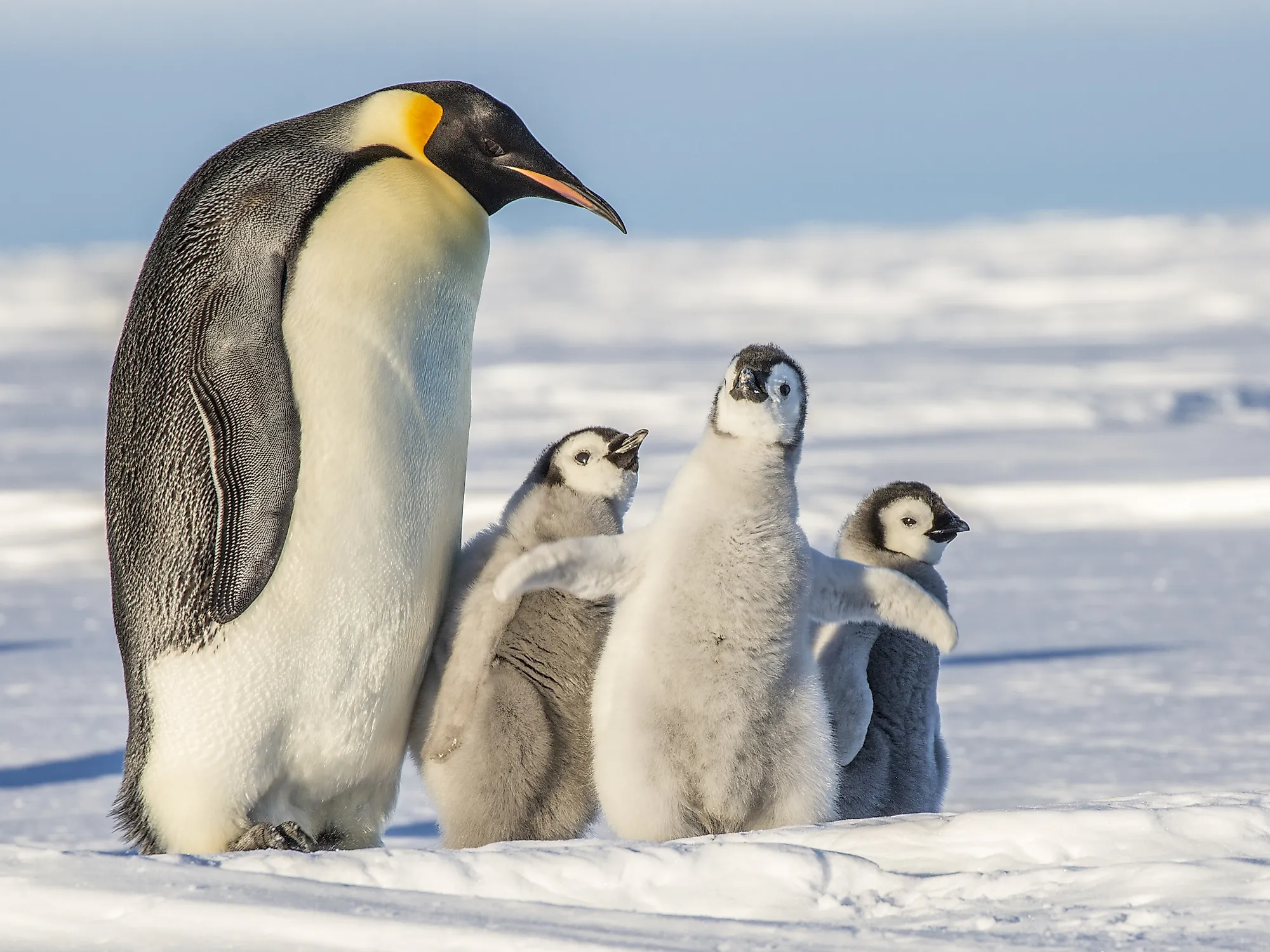
Penguin
Penguins are some of the most recognizable birds on Earth, with most picturing them standing on a huge block of ice in Antarctica. While this is a true representation of Emperor penguins that are endemic to the Antarctic, the penguin species itself is incredibly diverse. Only a few of the 18 penguin species live here, with others found in the Southern Hemisphere and one species inhabiting the Galapagos. Penguins essentially ‘came down’ from the sky millions of years ago, and are now flightless as they navigate some of the harshest environments on the planet.
Taxonomy

Penguins are flightless marine birds classified within the phylum Chordata and the class Aves, which includes all bird species. They belong to the order Sphenisciformes and the family Spheniscidae, the latter being unique to penguins alone. Although they may resemble northern seabirds such as puffins, penguins are not closely related to them; instead, their nearest living relatives are oceanic birds like albatrosses and petrels. The evolutionary lineage of penguins dates back roughly 60 million years, when their ancestors gradually adapted from flight to an aquatic lifestyle. Over time, their wings evolved into stiff, flipper-like structures, while their bones became denser to aid in diving. Today, penguins are divided into six primary genera, reflecting their diversity in size, habitat, and behavior. These include Aptenodytes, which contains the largest species such as the emperor and king penguins; Pygoscelis, known for species like the Adélie and chinstrap; and Spheniscus, which includes temperate-climate penguins like the African and Galápagos species. Additional genera such as Eudyptes, Eudyptula, and Megadyptes encompass crested and smaller penguins. Across these classifications, scientists recognize 18 distinct species, each uniquely adapted to life in the Southern Hemisphere.
Physical Description
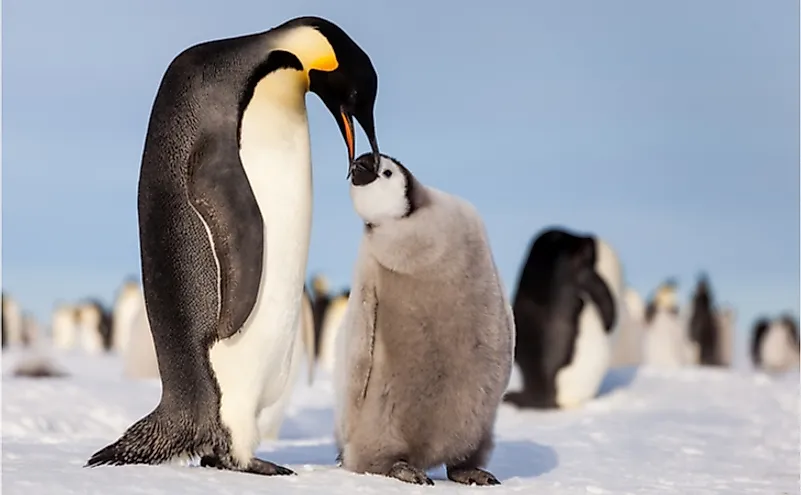
Penguins have a feather pattern that resembles a tuxedo. This is more than just cute styling; it helps the penguin camouflage itself in the water as it searches for prey. Essentially, this counter shading of black and white helps make them nearly invisible to seals and whales. Penguin patterns and coloring look different according to species. Penguins also have flippers instead of wings, thanks to the aforementioned adaptation. Their bodies are streamlined for swimming and diving, and some penguin species are quite fast. They also have large heads with short necks and longer bodies, as well as short, stiff tails. If they are not walking on land, penguins slide on their bellies over ice (when it snows). Their feathers create a waterproof shield that covers a layer of down and a coat of blubber that keeps their body heat trapped inside, no matter how low the temperature. When they hunt, they drink seawater, from which the salt is filtered out through a gland above their eyes.
Range and Habitat

The 18 recognized species of penguins live in the Southern Hemisphere, with the most northerly of them (Galapagos penguins) inhabiting the area around Fernandina Island and the west coast of Isabela. Galapagos penguins are at home at the equator and survive the tropical heat thanks to the ocean currents that bring cold water up from the depths. Some species, like the Adelie and Emperor penguins, survive the cold in the Antarctic, while others prefer the sub-Antarctic islands where the grass grows green. The African penguin is found along the southern coast of Africa, often near populated towns. The smallest penguin, the Little Blue, lives in the waters of Australia and New Zealand, while the Magallanic and Humboldt penguins occupy the coastlines of South America.
Food and Diet

All penguins are carnivores that eat squids, fish, and krill. The northern species tend to prefer fish, while the smaller penguin species found in the Antarctic and sub-antarctic prefer krill and squid. Emperor penguins and king penguins are known to mainly feast on squids and fish, while Adelie penguins typically eat krill. Prey is found at sea, usually within 18 meters of the surface. Scientists still do not know how penguins see prey at night or far below the surface, but they theorize that bioluminescence might help. Once a penguin catches its prey, it swallows it whole using its spiny tongue, while continuing to swim. A penguin’s tongue and mouth features papillae, which are backward-facing spines. Once they grab their prey, these spines prevent the prey from swimming back out.
Penguins also swallow stones, and this has been found to be true for the Emperor, Magallanic, yellow-eyed, African, gentoo, and Adelie penguins. The king, macaroni, and rockhopper penguin have been observed swallowing stones, with some of them ingesting a lot of them. Experts do not know why penguins do this, but it is believed that it may be to curb the sensation of hunger or to reduce buoyancy while diving. Some scientists also believe that stones may help penguins digest some of the food they eat. When they are not swallowing stones, penguins are building up layers of fat before they go into their annual period of fasting. They fast during their breeding seasons, which means they do not leave their nests to find food. Some penguins also fast during mating, nesting, and incubation. Other reasons for fasting include annual molting and shedding of juvenile feathers.
Behavior

Penguins are known for being extremely social animals. They almost never live alone, instead preferring to exist in massive colonies or rookeries. It is safer for penguins to live in these groups and also helps them survive by huddling together during Antarctic winters. When they huddle, they share their body heat by taking turns to stand outside of the group and then moving into the warm center. This ensures that every penguin in the group survives the harsh temperatures. Penguins also preen to stay warm, which means they keep their feathers clean and well-oiled by using the oil gland at the base of their tail to spread oil across their bodies.
Other penguin behaviors include head shaking, which typically happens during courtship, and slender posturing to let other penguins know there is no threat. The African penguin is loud, braying with its wings lifted and chest heaved. This behavior happens when a penguin wanders into another penguin’s territory and is known as an ecstatic display. When aggressive behavior occurs, there is usually pecking, pointing, and bill slapping. Penguins often bill-slap if a female refuses to mate, while pecking happens if one bird tries to steal nesting material from another. Penguins fight with their flippers and growl while pecking.
Reproduction

Penguins take between three and eight years to reach sexual maturity, and different species have different breeding seasons. The most common seasons are spring to summer, with the king penguin’s breeding season lasting up to 16 months. Emperor penguins breed every year during winter in the Antarctic, which also brings the harshest temperatures. Temperate penguins breed year-round, while the little penguin’s cycle lasts only around 50 days.
Ecstatic and mutual ecstatic behaviors happen during courtship, and some of the behaviors also include vibrating bills and bowing. Temperate and crested penguins typically face each other during mutual ecstatic behaviors, while Emperor penguins stand face to face, holding their heads down while braying.
Females compete for males, and some females may have up to three partners in one breeding season. Adelie, chinstraps, and gentoos are known to re-pair with previous mates, only selecting a different mate when the previous one does not return to the nest. Some penguins also interbreed; for instance, rockhoppers mix with erect-crested, royal, and macaroni penguins.
Not all penguins build nests. Emperor and king penguins carry their single egg on top of their feet, tucked under a fold of skin called a brood patch. This process allows them to keep the egg off the ice while still moving around. When the chicks hatch, they are covered in grey down. They join creches when they are old enough, where they huddle for warmth and protection while both parents go on the hunt for food.
Adelies nest around 60 kilometers from the edge of sea ice, while emperors form colonies around the Antarctic shoreline. King penguins prefer sub-Antarctic and Antarctic islands, while gentoo penguins breed on ice-free grounds. Chinstrap penguins tend to build nests on steep slopes, while Fjordland penguins prefer coastal rainforest habitats. Galapagos penguins usually nest in volcanic caves or rock cracks, while temperate penguins nest underground in crevices, caves, or burrows. Humboldt penguins create nests in guano deposits.
Why Penguins are Important

Penguins are a lot more than just quirky marine birds. Because they live on both land and in the sea, they fertilize plants in both habitats. Their feces are rich in carbon and nitrogen, without which both ocean and soil health could suffer. If there were no penguins, it would impact the species they hunt in the form of predator release. Prey species would grow out of control, decimating ecosystems. At the same time, penguins are a food source for orcas, seals, and sea lions. If these predators could not feed on penguins, they would quickly become endangered due to the loss of food.
Moreover, the presence of penguins helps scientists ascertain the health of a specific environment. For example, if a penguin colony abruptly shrinks, it could mean the ocean temperature is changing or that fish populations are thinning out.
Threats

Unfortunately, half of the eighteen penguin species are listed as vulnerable or endangered. They are threatened by habitat loss, reduced food, disease, and pollution. Climate change is also a big factor because, as the sea ice melts, there is less space to build nests and fewer food sources. In warmer regions, the change in ocean temperatures pushes fish further away from penguin nesting sites. This means parents must swim so far for food that their chicks starve before they return.
Overfishing is another huge problem. When humans take too many small fish or krill out of the sea on a continuous basis, penguins have less food to eat. And, pollution, in particular oil spills, is deadly to penguins. When penguins get their feathers coated in oil, they can no longer stay warm or waterproof.
To try to slow the boulder of destruction when it comes to endangered penguin species, many organizations are working to create more marine protected areas where fishing is restricted, allowing penguins to hunt safely. Other strategies include protecting penguin habitats and continuously rescuing individuals that become sick, injured, or covered in oil. Abandoned eggs and chicks are also rescued and hand-reared before being released back into the wild.
A Better Future for Penguins
The story of the penguin is an incredible one, but due to various threats, it may be a story that ends too soon. This group of birds that gave up flying so they could inhabit the southern oceans is resilient and adaptable, but melting ice, warming seas, and a lack of food are proving to be their nemesis. Because these birds are so connected to ocean health, their survival reflects human efforts to protect the planet. The penguin spent millions of years perfecting its own sea-based life, and with help from humans they will hopefully be able to waddle and dive for many more years to come.