Giant Pacific Octopus
The Giant Pacific octopus inhabits the chilly waters of the North Pacific Ocean and is the largest octopus species on Earth. This marine invertebrate is believed to be one of the sea ‘monsters’ that gave rise to the legend of the fearsome Kraken. For centuries, sailor stories told of eight-armed beasts that pulled down ships effortlessly. Fortunately, the truth is far more fascinating than terrifying. The giant Pacific octopus is a shy creature that keeps to itself, is exceptionally flexible, and very smart.
Taxonomy

Known scientifically as Enteroctopus dofleini, the giant Pacific octopus belongs to the phylum Mollusca. This is the same group that snails and clams belong to. However, the octopus also fits within a much more advanced class called Cephalopoda, which includes squid and cuttlefish. Among the cephalopods, it falls under the order Octopoda because it is distinguished from squids for having eight arms instead of ten. And within the order of Octopoda, it is included in the family Octopodidae because it has a large body and a specific skin texture.
Range and Habitat

The giant Pacific octopus inhabits the waters around the Pacific, including Korea and Japan, all the way to Canada, the U.S., and Mexico. It can survive in both shallow water and deep water (4,900 feet deep and more) and has been known to crawl around in tide pools. These octopuses are saltwater creatures that prefer cold water to allow their blood to function better. They spend most of their time on the ocean floor, where they look for crevices and caves to wedge themselves into. Octopus homes are called dens, and octopuses are extremely protective of their dens. They often sit for days inside just watching the entrance. Scientists can spot octopus dens by looking for piles of crab and clam shells (middens) outside the entrance. Giant Pacific octopuses create mounds of these shells after feeding.
Physical Description and Anatomy

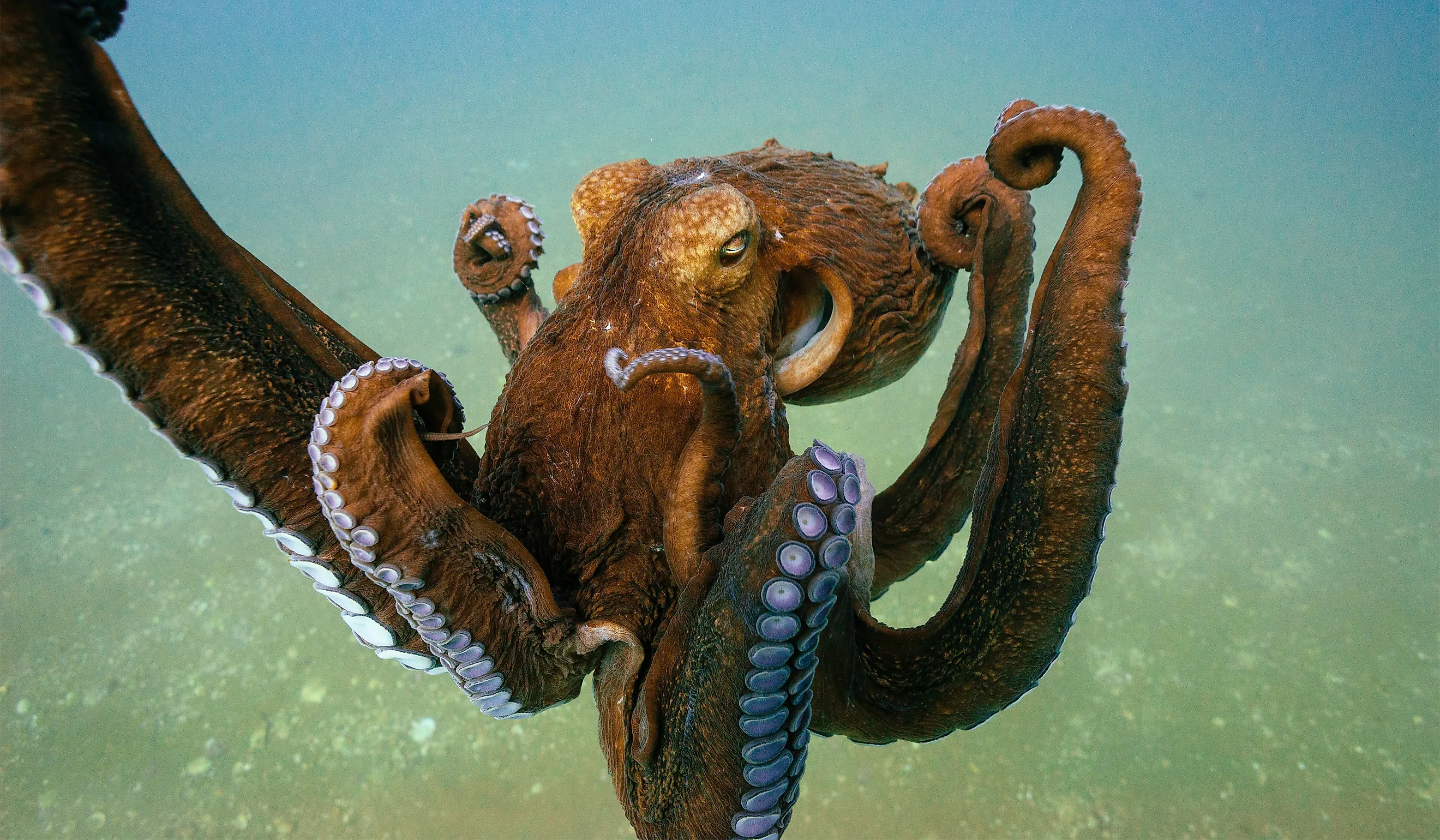
Giant Pacific octopuses are very big, and a full-grown octopus can weigh more than fifty pounds. However, that is a minor figure compared to the heaviest ever recorded at a massive 200 pounds. Because octopuses are mollusks, they have soft bodies with a complex system of muscles that support the head and mantle. Giant Pacific octopuses also have a strong beak and incredibly strong suction cups on their arms. They use their arms to grip and pull, as well as to ‘taste’ whatever they touch. These octopuses also have three hearts. Two help move the blood through the gills, while the third pumps blood to the rest of the body. When the octopus swims, the third heart stops beating. This is why they prefer crawling over swimming, as swimming becomes exhausting for them.
Food and Hunting Tactics

Using their beaks, giant Pacific octopuses inject a venomous saliva before cracking open their prey’s shells. The saliva helps them break down their meal. Before they attack their prey, the octopuses use their skin texture and pigment to blend into their surroundings. They mainly feed on shrimp, scallops, snails, lobsters, and crabs, but will take the opportunity to snag a fish if it swims too close. Giant octopuses typically hunt at night because it is easier to camouflage themselves into the background.
Intelligence and Behavior

Scientists believe that the giant Pacific octopus is one of the most intelligent of all invertebrates. This is no surprise considering the creature has nine brains. One brain is centralized, while each of its eight arms also has one small brain (or neural clusters known as ganglia). These tiny brains control each limb and also allow each arm to perform a different task at the same time. Using their limbs and brains, these octopuses can open jars and navigate mazes. They can solve puzzles and even recognize humans who provide them with food. Some have been observed ‘playing’ by pushing floating objects around in the water or squirting water at lights to cause short circuits (in aquariums).
Reproduction and End of Life

The life of a giant Pacific octopus can be defined as ‘live fast, die young.’ They may be massive marine creatures, but they only live for up to five years. They only reproduce once in their lives and, once they have done this, they die. After mating, the female finds a safe den where she lays tens of thousands of eggs in long strands. Once this is done, the female essentially becomes a prisoner to her eggs. She stays in the den permanently to protect the eggs from predators while blowing water over them to provide them with oxygen. This process takes around six months, and the female does not eat at all during this time. While she waits for the eggs to hatch, she wastes away, losing all her strength.
Importance

These sea animals are an important species in the North Pacific. They prevent crabs and snails from overpopulating and destroying kelp forests. Giant Pacific octopuses are also a major food source for other animals, including harbor seals and certain types of sharks. For humans, these octopuses are both culturally and scientifically important. The Indigenous cultures of the Pacific Northwest have included the octopus in their art and stories for thousands of years, respecting it as a symbol of both resourcefulness and wisdom. Researchers also study their many brains to understand how intelligence evolves in a body that in no way resembles that of a human.
Threats and Conservation

Right now, the giant Pacific octopus is not considered an endangered species. However, this status can change quickly, considering the threats that may impact their habitat. The biggest problem is climate change. These animals are ectothermic and have a metabolism that is extremely sensitive to water temperature. Additionally, ocean acidification (absorbing too much CO2) is another issue. Acidification makes it harder for crabs and clams to grow their shells, impacting the octopuses' food sources. If the food disappears, the octopus will soon follow.
Moreover, pollution is becoming a major threat, since octopuses are exposed to the trash and chemicals on the ocean floor where they crawl. They can ingest microplastics or absorb toxins that can make them sick. And, unregulated, destructive fishing methods see heavy nets being dragged across the ocean floor. This is destroying the rocky reefs where octopuses live. Without dens to retreat to, octopuses become easy targets for sharks or seals.
The Real Giant of the North Pacific
While there is no monstrous, tentacled beast in the Pacific waters looking for ships to destroy, there is a highly intelligent creature that relies on nine brains and blue blood to stay alive until it can reproduce. This animal is essentially fluid, can fit into the tiniest crevices, and remains greatly adaptable, all while ensuring that it can bring more of its own species into the ocean. And even though it lives a short life, it keeps the North Pacific ecosystem in balance. Protecting them and preventing them from becoming endangered will also help protect the planet and other species.