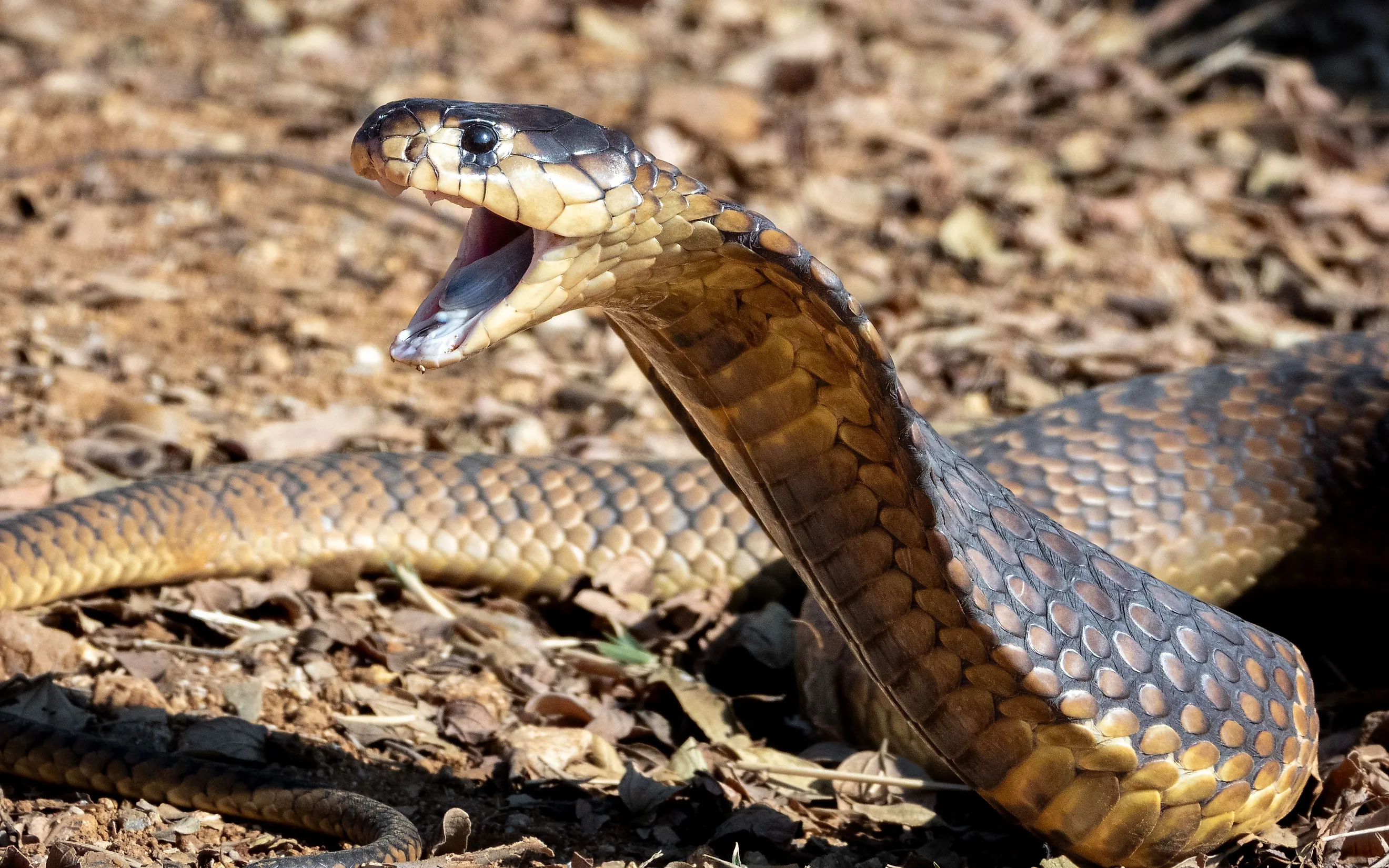
How Many Types Of Cobras Are There?
Cobra is a common name for several groups of venomous snakes in the family Elapidae. When most people say "cobra," they mean the true cobras in the genus Naja, which includes around 38 species spread across Africa and Asia. But the name is also used for king cobras (Ophiophagus), rinkhals (Hemachatus), shield-nosed cobras (Aspidelaps), African tree cobras (Pseudohaje), and desert black snakes (Walterinnesia), all of which belong to the same broader family.

All cobras are venomous. Most can raise the front of their body off the ground when threatened, and many true cobras can spread the ribs in their neck to form the distinctive hood they are known for. Some species, known as spitting cobras, can also spray venom toward the face and eyes of a threat from several feet away.
Jump to the table of living cobra species and ranges.
How Cobra Venom Affects People

Cobra venom is a complex mix of toxins, and its effects depend on the species. Broadly, a cobra bite can cause three types of harm:
- Nerve damage (neurotoxicity): The venom attacks the nervous system, which can lead to progressive paralysis. Without medical treatment, this can cause breathing to stop. Antivenom and assisted breathing are critical in serious cases.
- Tissue damage (cytotoxicity): Some cobra bites cause severe pain, swelling, blistering, and destruction of tissue around the bite. This is especially common with spitting cobra species.
- Eye injury: If a spitting cobra's venom reaches the eyes, it causes intense pain and inflammation. Flushing the eyes with clean water immediately is essential to prevent lasting damage.
What "Most Venomous" Actually Means

Online lists often rank snakes by something called an LD50 value. LD50 stands for "lethal dose, 50%," and it measures the amount of venom needed to kill half of a test group of mice under controlled lab conditions. A lower number generally means a more potent venom in that particular test.
However, lab potency is not the same as real-world danger. How dangerous a cobra actually is to humans depends on several other factors: how much venom it injects per bite (some species deliver far more than others), where on the body the bite occurs, how quickly the person receives medical care, whether effective antivenom is available, and the specific mix of toxins in the venom. Venom composition can also vary between populations of the same species in different regions, which is why simple "most venomous" rankings can be misleading.
LD50 Examples (for Context, Not as a Ranking)
To show the range of potency reported in scientific studies, here are a few published mouse intravenous (IV) LD50 values. A lower number indicates higher potency in that specific test:
- Monocled cobra (Naja kaouthia): around 0.18 mg/kg in some studies.
- Indochinese spitting cobra (Naja siamensis): around 0.28 mg/kg in some studies.
- Samar cobra (Naja samarensis): around 0.18 mg/kg, with venom that is heavily neurotoxin-driven.
These numbers can vary depending on the testing method and where the venom sample was collected. They are useful as one piece of the picture, but they should not be treated as a definitive danger ranking.
The Main Types of Cobras
True Cobras (Naja)

Naja is the largest cobra genus, with around 38 recognized species found across Africa and Asia. It includes both spitting and non-spitting species. Only three Naja species lack the ability to spit venom: the Indian cobra (N. naja), the Egyptian cobra (N. haje), and the Caspian cobra (N. oxiana). Many Naja bites cause serious nerve damage, and spitting cobras can also cause severe tissue destruction and eye injuries. In terms of public health, several Naja species rank among the most medically important snakes in their regions because of how often they come into contact with people.
King Cobras (Ophiophagus)

King cobras are the longest venomous snakes in the world, with adults typically measuring 3 to 4 meters (10 to 13 feet) and the largest on record reaching 5.85 meters (19.2 feet). Despite their common name, they are not true cobras and belong to their own genus, Ophiophagus. A 2024 taxonomic revision split what was previously considered a single species into four: O. hannah, the Sunda king cobra (O. bungarus), the Western Ghats king cobra (O. kaalinga), and the Luzon king cobra (O. salvatana). These species are found across parts of South and Southeast Asia and the Philippines. King cobras can deliver large volumes of venom in a single bite, and envenomation is a medical emergency that can lead to paralysis and respiratory failure without prompt treatment.
Rinkhals (Hemachatus)

The rinkhals is often called a spitting cobra, but it is not a member of the true cobra genus Naja. It belongs to its own genus, Hemachatus, and is found in southern Africa. Like spitting cobras, it can accurately spray venom at targets up to 3 meters (about 10 feet) away. Its venom is both neurotoxic and cytotoxic. In 2023, a distinct population from the eastern highlands of Zimbabwe was described as a separate species, H. nyangensis (the Nyanga rinkhals), though this population may already be extinct.
Shield-Nosed Cobras (Aspidelaps)

Shield-nosed cobras are smaller elapids found in southern Africa. They can form only a modest hood compared with true cobras, but they are venomous and should be treated with caution. The two recognized species are the Cape coral snake (A. lubricus) and the shield-nosed cobra (A. scutatus).
African Tree Cobras (Pseudohaje)
African tree cobras are forest-dwelling snakes that spend more time in trees than most other cobras. Two species are recognized: Goldie's tree cobra (P. goldii) and the black tree cobra (P. nigra), both found in the forests of West and Central Africa. They are venomous and should be considered dangerous.
Desert Black Snakes (Walterinnesia)
Walterinnesia is a Middle Eastern desert elapid commonly called the desert cobra or black desert snake. It is found in arid regions from the Sinai Peninsula through the Levant and Arabian Peninsula into Iraq. Whether this genus contains one species or two has been debated in recent taxonomic studies.
Living Cobra Species and Where They Are Found
The table below lists all currently recognized cobra species and their broad native ranges. Taxonomy follows modern references including The Reptile Database and recent revisions for certain groups. Ranges are simplified for a general overview.
| Genus | Species | Common Name | Native Range |
|---|---|---|---|
| Naja (True Cobras) | |||
| Naja | N. anchietae | Anchieta's cobra | Southern Africa (Angola, Namibia, Botswana, Zambia, Zimbabwe) |
| Naja | N. annulata | Banded water cobra | Central Africa (Congo Basin) |
| Naja | N. annulifera | Snouted cobra | Southern Africa |
| Naja | N. arabica | Arabian cobra | Arabian Peninsula (Oman, Saudi Arabia, Yemen) |
| Naja | N. ashei | Ashe's spitting cobra | East Africa (Kenya and nearby) |
| Naja | N. atra | Chinese cobra | Southern China, Taiwan, northern Vietnam/Laos |
| Naja | N. christyi | Congo water cobra | Central Africa (Congo Basin) |
| Naja | N. fuxi | Fuxi's cobra | Southwest China and parts of mainland Southeast Asia |
| Naja | N. guineensis | West African forest cobra | Upper Guinea forests (West Africa) |
| Naja | N. haje | Egyptian cobra | North Africa and parts of sub-Saharan Africa |
| Naja | N. kaouthia | Monocled cobra | South and Southeast Asia |
| Naja | N. katiensis | Mali cobra | West Africa |
| Naja | N. mandalayensis | Mandalay spitting cobra | Myanmar |
| Naja | N. melanoleuca | Central African forest cobra | Central Africa (Congo Basin and nearby) |
| Naja | N. mossambica | Mozambique spitting cobra | Southern and southeastern Africa |
| Naja | N. multifasciata | Burrowing cobra | Central Africa |
| Naja | N. naja | Indian cobra (spectacled cobra) | Indian subcontinent |
| Naja | N. nana | Katanga dwarf cobra | DRC (Katanga region) |
| Naja | N. nigricincta | Zebra spitting cobra | Namibia and southwestern Angola |
| Naja | N. nigricollis | Black-necked spitting cobra | Sub-Saharan Africa (widespread) |
| Naja | N. nivea | Cape cobra | Southern Africa |
| Naja | N. nubiae | Nubian spitting cobra | Northeast Africa |
| Naja | N. obscura | Egyptian coastal cobra | Egypt |
| Naja | N. oxiana | Caspian cobra | Central Asia (parts of Iran, Afghanistan, Pakistan, India) |
| Naja | N. pallida | Red spitting cobra | East Africa |
| Naja | N. peroescobari | Sao Tome cobra | Sao Tome (Gulf of Guinea) |
| Naja | N. philippinensis | Philippine cobra | Philippines (Luzon and nearby islands) |
| Naja | N. sagittifera | Andaman cobra | India (Andaman Islands) |
| Naja | N. samarensis | Samar cobra | Philippines (Mindanao and Visayas) |
| Naja | N. savannula | Savanna forest cobra | West Africa |
| Naja | N. senegalensis | Senegalese cobra | West Africa |
| Naja | N. siamensis | Indochinese spitting cobra | Mainland Southeast Asia |
| Naja | N. sputatrix | Javan spitting cobra | Indonesia (Java and nearby islands) |
| Naja | N. subfulva | Brown forest cobra | Central and East Africa |
| Naja | N. sumatrana | Equatorial spitting cobra | Maritime Southeast Asia |
| Ophiophagus (King Cobras) | |||
| Ophiophagus | O. hannah | King cobra | Parts of Southeast Asia and the Indo-Malayan archipelago |
| Ophiophagus | O. bungarus | Sunda king cobra | Southern Thailand, Malaysia, Indonesia (Sumatra, Borneo, Java, Bali), southern Philippines |
| Ophiophagus | O. kaalinga | Western Ghats king cobra | India (Western Ghats) |
| Ophiophagus | O. salvatana | Luzon king cobra | Philippines (Luzon) |
| Hemachatus (Rinkhals) | |||
| Hemachatus | H. haemachatus | Rinkhals | Southern Africa (South Africa, Lesotho, Eswatini, Zimbabwe) |
| Hemachatus | H. nyangensis | Nyanga rinkhals | Zimbabwe (eastern highlands); possibly extinct |
| Aspidelaps (Shield-Nosed Cobras) | |||
| Aspidelaps | A. lubricus | Cape coral snake | Southern Africa (Namibia, South Africa, southern Angola) |
| Aspidelaps | A. scutatus | Shield-nosed cobra | Southern Africa (Namibia, Botswana, Zimbabwe, South Africa, Mozambique) |
| Pseudohaje (African Tree Cobras) | |||
| Pseudohaje | P. goldii | Goldie's tree cobra | West and Central African forests |
| Pseudohaje | P. nigra | Black tree cobra | West African forests |
| Walterinnesia (Desert Black Snake) | |||
| Walterinnesia | W. aegyptia | Desert cobra | Middle East (Sinai, Levant, Arabian desert regions, Iraq) |
Sources
- World Health Organization (WHO): guidance on snakebite and clinical effects of cobra envenoming.
- The Reptile Database: current taxonomy and broad distributions for living species.
- Peer-reviewed venom studies for selected Naja species, including published mouse LD50 data and geographic variation research.
- 2024 taxonomic revision for king cobras (Ophiophagus); 2023 revision for rinkhals (Hemachatus).