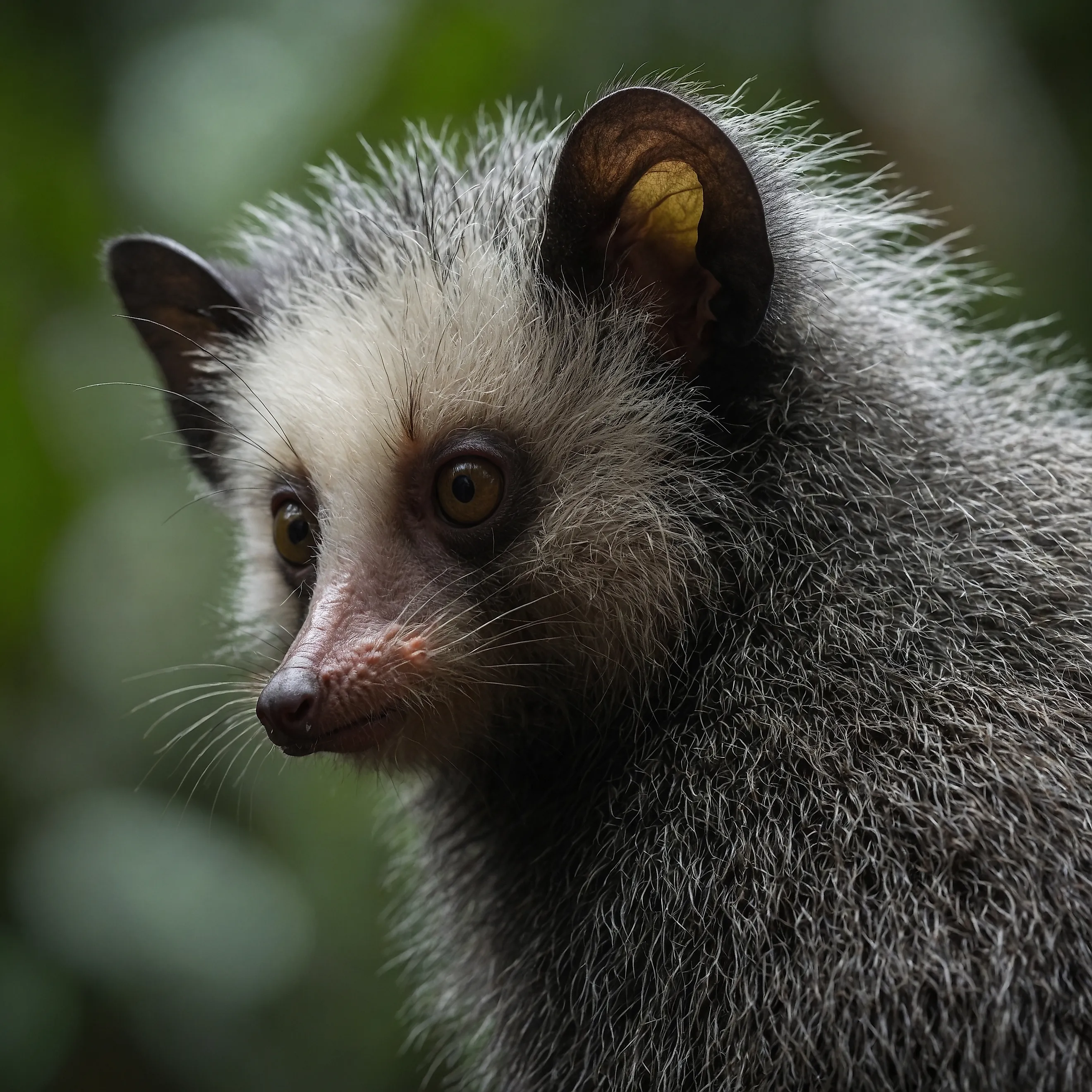
Aye-aye
The enigmatic aye-aye is a lemur with long fingers and rodent-like teeth that keep growing. This strepsirrhini primate is the world’s largest nocturnal primate and possesses a skeletal third finger that, for some, seems more of a magic wand than an appendage. Unfortunately, that very same long finger is what signed its apparent death warrant, as many in the animal’s native home of Madagascar believe it to be bad luck when they see the lemur point that finger at them.
Taxonomy

The aye-aye’s scientific name is Daubentonia madagascariensis, and the species belongs to the order Primates, its own family known as Daubentoniidae, its own genus called Daubentonia, as well as the suborder Strepsirrhini, which includes lorises, bushbabies, and lemurs.
In the 18th century, taxonomists were befuddled by the aye-aye’s physical traits. They saw continuously growing incisors and thought the animal was a rodent. It was not until detailed anatomical studies were done that the aye-aye was confirmed to be a primate. In 2026, it is the only surviving member of its family, making it a taxonomically unique species with no close living relatives.
Physical Description

The aye-aye’s appearance seems to be a collection of features borrowed from other animals. An aye-aye typically weighs from 4 to 6.5 pounds and grows to a length of 14 to 17 inches. Its bushy, squirrel-like tail can add another 24 inches to its total body length. The aye-aye has coarse fur that is usually dark brown or black with white guard hairs that give the animal a shaggy appearance. It can raise these guard hairs when it feels threatened.
The aye-aye’s head is its most striking feature, with its leathery ears and massive amber eyes. These eyes are adapted for peak night vision, and the ears can hear the slightest movement of larvae beneath tree bark. As mentioned, their sharp teeth never stop growing, which allows them to gnaw through seed husks and even hardwood.
Still, the aye-aye's most prominent and most famous trait is its third, elongated, and thin finger that it uses for percussive foraging. This behavior is found in no other primate. This finger can rotate nearly 360 degrees around the knuckle, allowing the aye-aye to use it as a tool for sensing and extracting food.
Range And Habitat

The aye-aye is endemic to Madagascar and has a broad distribution compared to many other native lemur species. As such, they are found in rainforests and deciduous forests as well as coconut or lychee groves. Some individuals have also been observed in mangroves. At the same time, a aye-aye sighting is rare because of low population numbers and the animals’ nocturnal nature. They spend most of their time high up in the tree canopy and rarely descend to the forest floor. They build their oval-shaped nests in the forks of tall trees and often construct several different ones within a single home range. They sleep in these nests during the day and then forage for insects and fruits at night.
Aye-ayes are incredibly acrobatic and can leap significant distances between branches. They can also scale tree trunks with ease. They use acoustic sensing to find prey inside these trunks, which means they tap on them with their long finger up to eight times per second. The vibrations from the tapping tell them what is inside, for instance, hollow cavities with grubs. When they locate these grubs, they use their teeth to tear a hole in the wood before hooking the prey with their specialized finger.
Food And Diet

The aye-aye is an omnivore with a very specific diet. They mainly eat the larvae of wood-boring beetles for the protein. But, they also love seeds, nectar, fruits, and fungi. One of their favorite meals is the seeds of the ramy tree, which have hard shells that only the aye-aye’s teeth can penetrate. When they inhabit agricultural areas, they feed on coconuts and lychees. They use their long finger to tap on the coconuts to ascertain the amount of coconut water inside before gnawing a hole to reach the meat. They also face very little competition when it comes to food, because they can access foods that other animals cannot.
Reproduction And Life Cycle

The reproductive rate of the aye-aye is very slow, which does not help their vulnerability status. Females reach sexual maturity around the age of three or four, and they give birth to one infant only once every two or three years. There is no specific breeding season, so aye-aye births happen throughout the year.
The mating process typically involves several males competing for a single female. This competition is known as ‘scrambling,’ which means a lot of chasing and vocalizing. Males also occasionally get into shoving matches. However, the female stays in charge and often chooses to mate with different males over a period of a few days. Once an infant is born after a gestation period of 150 to 170 days, it remains in the safety of a specially-built, extra-sturdy nest for several weeks. The babies stay with their mothers for up to two years. During this time, the mothers teach their young to forage with their specialized finger. Generally speaking, aye-ayes live for over twenty years. But, in the wild, predation and habitat loss drastically cut down on this lifespan.
Importance

Madagascar’s ecosystem needs the aye-aye. Aye-ayes keep the populations of wood-boring beetles under control. If they did not do this, these beetles would overproliferate and damage the forest structure. Aye-ayes also help with seed dispersal. After eating fruits, they move about in their large home ranges, depositing the seeds in their droppings. This helps to regenerate the forest.
Aside from helping the ecosystem, the aye-aye is incredibly important to science. They are the only surviving member of their family, providing a unique perspective on primate evolution. Scientists study their anatomy and neurological processes to understand the limits of biological adaptation.
Threats

Unfortunately, the one-of-a-kind aye-aye is listed as endangered. The biggest threat is the loss of the Malagasy forests. Madagascar is one of the poorest countries in the world, and many of its inhabitants rely on tavy to clear land for rice and cattle. Deforestation is more devastating to aye-ayes than to smaller lemurs, because of the large home ranges they require, sometimes up to 80 acres for a single male. When a forest is decimated or cut into smaller pieces, aye-ayes essentially become trapped. They cannot safely cross open ground to find mates, leading to inbreeding. This, in turn, makes aye-ayes more susceptible to disease and less able to adapt to climate change.

Even worse, as the natural forests disappear from under them, aye-ayes flee into areas where humans cultivate coconut, lychee, and clove plantations. But, they cannot feast here, because they are seen as crop pests and are subsequently killed. They are also seen as a sign of bad luck or death. Some Malagasy cultures believe that if an aye-aye points its skeletal finger at someone, that person will die. Therefore, villagers often kill the animal on sight. Sometimes, the body of a killed aye-aye is hung on a pole to allow the ‘evil’ to leave the area.
Conservation Efforts

Conservationists have long since realized that fences will not save the aye-aye. When locals fear an animal, they will kill it regardless. As such, modern conservation efforts focus on so-called pride campaigns. Conservationists work with elders and schools to impress the idea of the aye-aye being a symbol of the island’s unique heritage. They focus on the animal’s role as a ‘forest doctor’ that helps save the trees by eating the grubs that kill them. And, they are making progress, slowly but surely, one campaign at a time.
Moreover, national parks like Masoala and Ranomafana provide habitats for the aye-ayes along with wildlife corridors that connect the parks, so there is more room. And, while the situation in Madagascar is still precarious, the Duke Lemur Center and the Durrell Wildlife Conservation Trust run breeding programs to ensure that if the wild population goes extinct, the entire species does not also go extinct.
Madagascar’s Most Misunderstood Resident

The aye-aye is not an animal to be feared, and it poses no threat to humans. There is no reason that superstitious beliefs should be used as a reason to kill off an already thinned-out species. The aye-aye is a misunderstood creature with incredible traits and features that deserve to be protected. And protecting it is not just about saving one type of animal, but about preserving an evolutionary line that has existed for millions of years. If we can successfully tackle habitat loss and superstition in Madagascar, the ghost of the forest will continue to roam the island’s tree canopy for generations to come.