Are Blobfish Real?
At depths of roughly 2,000 to 3,900 feet off the coasts of Australia, Tasmania, and New Zealand, the blobfish lives under crushing pressures that can exceed 100 times those at the surface. Two species share the common name: Psychrolutes marcidus, first described by ichthyologist Allan Riverstone McCulloch in 1926, and Psychrolutes microporos, described by Joseph Nelson in 1995. Both belong to the family Psychrolutidae, sometimes called fatheads, and both inhabit deep waters in the same region of the Pacific.
In this environment, gas-filled swim bladders are ineffective, so both species rely on a body composed of soft, gelatinous tissue that is slightly less dense than seawater. This allows them to remain neutrally buoyant, hovering just above the seafloor without expending much energy. With minimal muscle mass and a slow-moving lifestyle, they conserve energy in a habitat where food is scarce. Psychrolutes marcidus is typically shorter than 30 centimeters (12 inches), while specimens of P. microporos collected during the 2003 NORFANZ expedition averaged around 1.7 kilograms (about 4 pounds).
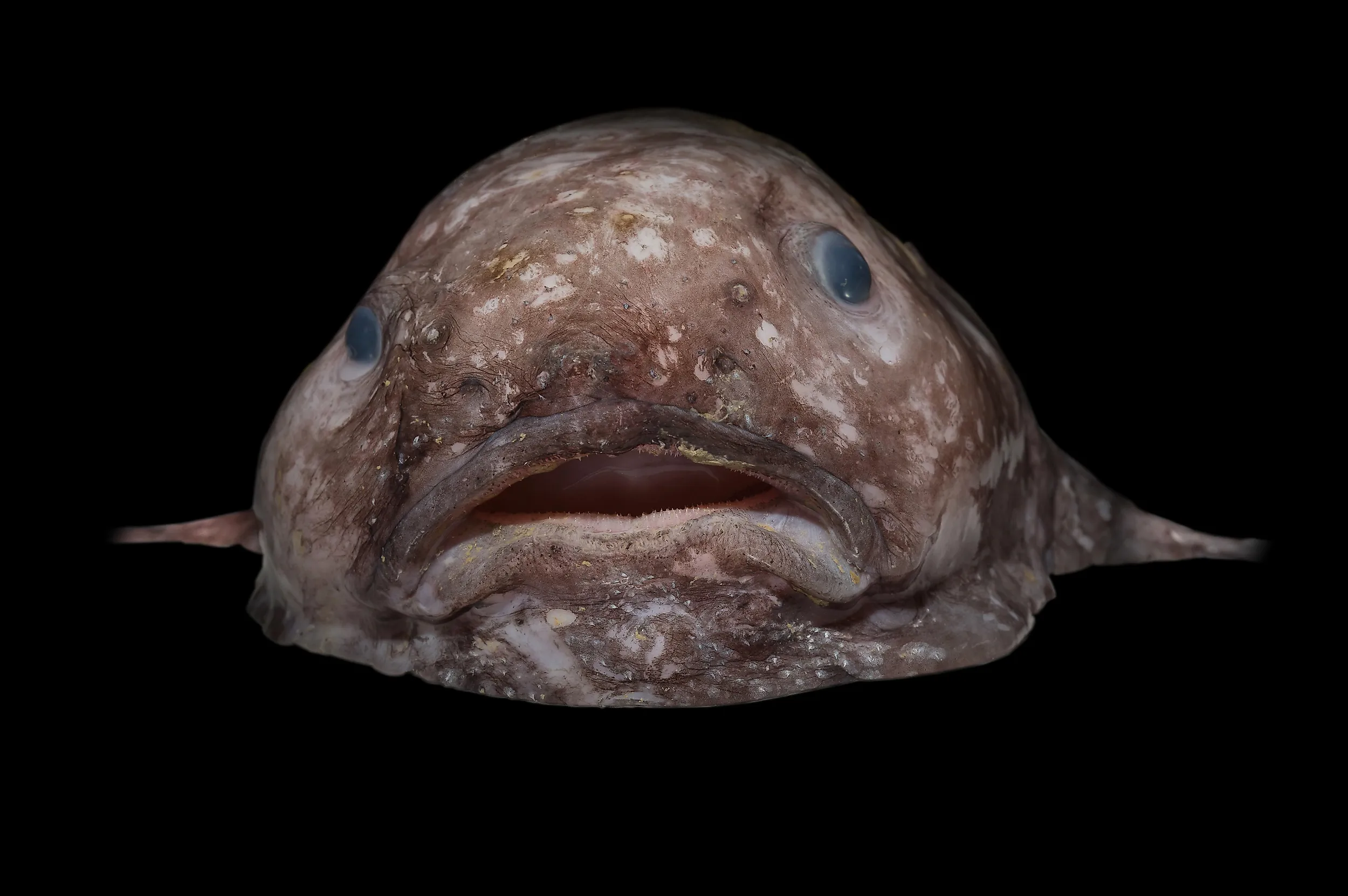
Despite their reputation as some of the world's ugliest animals, neither species appears amorphous in its natural environment. Their familiar sagging features are the result of severe tissue damage from rapid decompression when individuals are brought to the surface, where the drop in pressure causes the body to lose shape. In the deep ocean, both species maintain a more compact, recognizably fish-like form.
Are Blobfish Really Ugly?

The blobfish gained global attention in September 2013 when it was voted the world's "ugliest animal" by the Ugly Animal Preservation Society, a conservation campaign founded by biologist Simon Watt. The famous photograph behind the vote actually depicts a specimen of Psychrolutes microporos nicknamed "Mr Blobby," which was caught during the 2003 NORFANZ expedition between Australia and New Zealand and photographed by Kerryn Parkinson. The image went viral as an internet meme before becoming the society's official mascot.
Much of the blobfish's ugly reputation comes from photographs taken after individuals have been brought to the surface. At depth, intense pressure supports the fish's soft body, giving it a more typical form. The gelatinous tissue, lack of scales, and reduced muscle mass found in both species are adaptations to deep-sea life, not deformities. When rapidly hauled up in trawling nets, the sudden drop in pressure causes the body to expand and lose structure, producing the familiar drooping appearance. This is decompression damage, not a reflection of how either species looks in the wild.
Two Species, One Name

Both species share the same basic adaptations: gelatinous body composition, minimal musculature, and a passive approach to feeding. The overlap in their common name and geographic range has led to widespread confusion between the two, with most public references to "the blobfish" blending characteristics of both species without distinction.

Psychrolutes marcidus inhabits depths between 600 and 1,200 meters (2,000 to 3,900 feet) and is found off mainland Australia, Tasmania, and New Zealand. It was originally classified as Neophrynichthys marcidus before being moved to the genus Psychrolutes. This is the species most commonly referred to as "the blobfish" in popular media, though it was not the specimen behind the famous photograph.

Psychrolutes microporos occupies a similar depth range, from around 980 to 1,200 meters (3,200 to 3,900 feet), in the deep waters between the Australian mainland, Tasmania, and New Zealand. It was described scientifically in 1995, with the holotype specimen housed at the Museum of New Zealand Te Papa Tongarewa. This is the species behind the "Mr Blobby" photograph and the 2013 ugliest animal vote. Research has also found that P. microporos can absorb arsenic at microscopic levels from its deep-sea environment.
Adaptation to Survive

Life in the deep ocean is shaped by extreme pressure, near darkness, and limited food. Many deep-sea species avoid gas-filled structures like swim bladders, which would compress and become useless under these conditions. Both blobfish species instead rely on their gelatinous body composition to maintain neutral buoyancy just above the seafloor, eliminating the need for constant swimming.
Their bodies do have structure and muscle, though both are significantly reduced compared to fish in shallower waters. This minimal musculature is sufficient for species that do not actively chase prey. Rather than hunting, both blobfish species feed opportunistically on whatever drifts within reach. P. marcidus is known to consume deep-ocean crustaceans, while P. microporos is thought to be an ambush predator that takes anything edible that comes close. Other documented food sources for blobfish include brittle stars, anemones, and carrion. This passive feeding strategy allows them to survive in one of the ocean's most resource-limited habitats.
Lifespan and Lifecycle
Much of the blobfish life cycle remains poorly understood, largely because both species live at depths that are difficult to study. Their lifespan in the wild is not well documented, though some deep-sea fish species in similar environments are known to live for several decades.
Like other fish, blobfish reproduce by laying eggs, which are deposited in large clusters on the seafloor, with females producing as many as 100,000 eggs per clutch. At least one parent is believed to remain near the egg mass, tending the eggs as they develop. This parental care is notable for a deep-sea species and suggests a significant investment in each reproductive cycle.
After hatching, the young develop as larvae before maturing into juveniles and eventually adults. Growth rates and the time it takes to reach maturity remain largely unknown due to the challenges of observing these fish in their natural habitat.
Threats and Conservation

Neither blobfish species has a formal conservation status, and population data are limited. However, deep-sea bottom trawling poses a real threat. Blobfish are not targeted by commercial fishing operations, but they are frequently caught as bycatch in trawl nets that scrape the ocean floor at the depths where they live. Because they suffer fatal tissue damage when brought to the surface, any blobfish caught in this way does not survive.
Climate change also presents a potential concern. Both species are adapted to the cold, stable temperatures of the deep ocean, and shifts in ocean temperature or chemistry could affect their habitat over time. While they are not currently classified as endangered, the difficulty of studying deep-sea populations means that declines could go undetected for years.