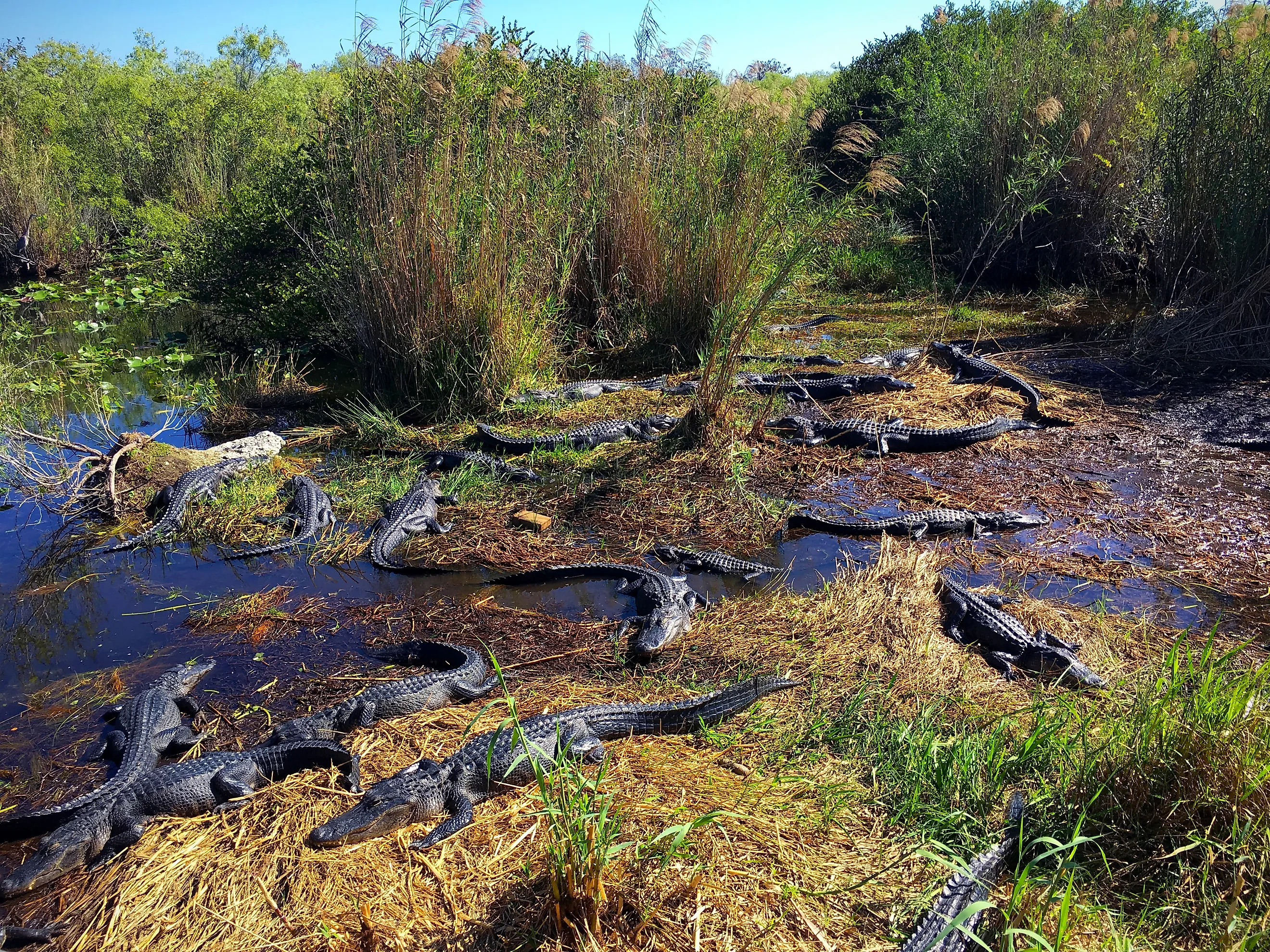
Where Alligators and Crocodiles Overlap in the US
There is exactly one place on Earth where wild American alligators and American crocodiles share the same habitat: South Florida. At the southern tip of the state, Everglades National Park and the surrounding coastal estuaries create a rare overlap zone where freshwater marsh meets brackish and saltwater habitat. This coexistence depends on a narrow set of biological and ecological conditions. Alligators primarily favor freshwater. Crocodiles tolerate brackish and saltwater habitats. That difference allows both species to live in the same broader landscape without competing for the exact same space. Their survival here also reflects decades of conservation work. Both species were pulled back from the edge of regional decline. For anyone exploring South Florida’s waters, understanding these apex predators is part of enjoying the landscape safely and responsibly.
Introducing American Alligators and American Crocodiles

American alligators (Alligator mississippiensis) live across the southeastern US. They are found from eastern Texas through the Gulf Coast states to northeastern North Carolina. That marks the northern edge of the species’ territory. Alligators are freshwater animals and high salinity levels are harmful to them. According to researchers at the University of Florida's Institute of Food and Agricultural Sciences, salinity functions as a direct limiting factor for alligator distribution in coastal areas. Because they lack efficient salt-excreting organs, high salinity causes dehydration and cellular damage. Consequently, the vast majority of alligators stay in the lowest salt zones of any estuary.
American crocodiles (Crocodylus acutus) operate on entirely different terms. Their range runs through the Caribbean, coastal Central America, and northern South America. South Florida represents the absolute northern limit of where they can survive. Unlike alligators, crocodiles possess functional lingual salt glands, small secretory structures on the tongue that allow them to excrete excess sodium when living in brackish or marine habitats. This physiological trait is why American crocodiles gravitate toward coastal mangrove swamps, tidal creeks, and the brackish margins where freshwater and saltwater mix.
How to Tell Them Apart

While these reptiles are closely related, they are not simply different species of the same genus. Instead, American alligators belong to the genus Alligator and family Alligatoridae. American crocodiles belong to the genus Crocodylus and the family Crocodylidae. Both are crocodilians and share the same taxonomic order, Crocodylia. At a glance, they may appear difficult to distinguish, but these animals feature a number of distinct characteristics that set them apart from each other.
American alligators have a broad, rounded snout. When their mouth is closed, the lower teeth disappear into sockets in the upper jaw, making them invisible. They are grey-black in color, often appearing nearly black in older individuals. They have a pale yellowish-white underside. Younger alligators show yellow banding across the body that fades with age.
Crocodiles have a narrower, more tapered snout with a triangular profile. Their large fourth tooth on each side of the lower jaw remains visible even when the mouth is closed. Crocodiles are usually grayish-green. They are noticeably lighter than an alligator of similar size and age. Their skin also has a more textured, uneven surface along the sides compared to the smoother lateral scales of an alligator.

Body size overlaps considerably, as both species can reach up to about 15 feet in length. However, their overall build differs. Alligators tend to look more heavyset and low-slung. Crocodiles carry a leaner, longer-limbed profile that reflects the more active coastal hunting lifestyle of the species. The South and Central American populations of American crocodiles can grow larger, but in the northernmost part of their range, they share a similar size to American alligators.
Paying attention to the microhabitat is also a useful clue. A crocodilian spotted in a freshwater marsh well inland in Florida is almost certainly an alligator. One observed in a coastal mangrove, a tidal flat, or the brackish waters near Florida Bay has a much higher chance of being a crocodile. This is particularly true if the sighting is in the southern quarter of the state between Biscayne Bay and Cape Sable.
Why the Everglades Makes Coexistence Possible

The ecological reason these two species can share South Florida without serious conflict is that they are not actually competing for the same territory in a meaningful way. The Everglades function as a gradient. Freshwater pours south from Lake Okeechobee through the River of Grass, eventually reaching the coastal estuaries of Florida Bay and the Gulf of Mexico. That transition from fresh to salt creates a layered mosaic of habitats. Alligators are concentrated in the freshwater marshes and slough inland. Crocodiles inhabit the brackish and saltwater edges closer to the coast.
The US Geological Survey has tracked how both species respond to shifts in that gradient. Research shows that when freshwater flow into estuaries is reduced and salinity rises, crocodile populations are affected negatively and alligator distribution contracts inland. When freshwater flow is restored and salinity drops to more natural levels, both species expand and stabilize. The two animals are not just ecological neighbors. They are living indicators of the Everglades' hydrological health.

That same geographic logic extends to where each species builds its nest. Alligators construct mounded vegetation nests in the freshwater marsh, situated back from the coastline. Crocodiles use hole nests or mound nests depending on the available substrate and habitat. They primarily nest along the coastal strip between northeastern Florida Bay and Cape Sable. Closer to the coastline and on small islands, they build mounded nests above high tide marks. Farther inland, crocs dig holes into the marl and peat of canal banks.
The University of Florida conducted a 50-year monitoring study on American crocodile nests and found that alligator nesting activity is minimal at these coastal sites. This is because the high salinity and specific shoreline substrate favor crocodiles over alligators. So while these nesting zones sit within the same broad region, they occupy opposite ends of the salinity gradient. This means the two species are rarely building nests near each other or competing for the same microhabitats.
A Close Call with Extinction

Crocodiles' presence in this overlap zone is itself a conservation story. By the 1970s, American crocodiles had been reduced to only a few hundred in Florida. This resulted from the combined result of hide hunting, coastal development destroying nesting habitat, road mortality, and a growing human footprint in the mangrove zones the species depended on. The species was listed as federally endangered in 1975.
Recovery came in part from an unexpected source. Florida Power and Light's Turkey Point Nuclear Power Plant, built south of Miami, created an extensive network of cooling canals that turned out to be excellent crocodile habitat. The canals were warm, low-traffic, and isolated enough for successful nesting. The crocodile population settled in throughout the canal system and used it as a refuge during the species' most vulnerable decades. By 2007, population trends had improved enough that the US Fish and Wildlife Service downlisted American crocodiles from endangered to threatened. A five-year review conducted between 2013 and 2017 estimated the non-hatchling population in Florida at a minimum of 898 individuals, with the full count likely higher. Today, the estimated population has recovered to around 2,000 adult crocodiles.
Alligators' recovery story in South Florida is equally instructive. Once nearly hunted to extinction by the 1960s, alligators rebounded dramatically after receiving federal protection under the Endangered Species Act and were removed from the endangered list in 1987. Today, the species is one of conservation’s clearest success stories, with populations described as healthy across the southeastern US.
The recoveries of both species unfolded in the same ecosystem and under much of the same conservation framework. However, each tells a meaningfully different story. Alligators rebounded across millions of acres of freshwater habitat spanning multiple states. Crocodiles' recovery happened in a single, narrow coastal zone at the northern edge of the species' range. It was measured in nest counts and hatchling survival rates within Everglades National Park and a handful of adjacent sites. Every crocodile in the country lives within the range of the alligator, but only a small fraction of alligators live within range of crocodiles.
Hunting and Raising Young: How These Species Overlap and Differ

Both alligators and crocodiles are nocturnal ambush predators. At the broadest level, their hunting strategies look nearly identical. Both species remain motionless at the water surface, eyes and nostrils barely exposed, and strike with explosive speed when prey comes within range. Both use pressure-sensitive receptors along the jaw to detect movement in the water at night.
The differences become sharper when looking at what animals they prey on most consistently in their preferred habitat zones. Alligators in freshwater marshes target fish, wading birds, and mammals that come to drink. University of Florida researchers fitted alligators with cameras and found that prey attack frequency was highest at night. They had a capture success rate of around 52 percent per attack. Crocodiles working the brackish coastal zone lean more heavily on marine prey, with mullet, crabs, and fish making up a larger share of the diet. Their menus shift with the habitat in a way that keeps the two species from competing directly. This is the case even when they share the same general stretch of South Florida coastline.
Their nesting seasons are similar but not identical. Alligator courtship begins in early April with mating following in May or June. Females deposit an average of 32 to 46 eggs in late June or early July. Incubation takes approximately 63 to 68 days, with hatching occurring from mid-August through early September. Crocodiles move through the same calendar on a slightly earlier schedule. Males begin courting in late January and early February. Nesting occurs in late April and early May, and females lay 20 to 60 eggs that incubate for approximately 85 days before the female digs up the nest and carries the young to water.
Female American alligators guard their nests aggressively throughout incubation and then protect their hatchlings for up to three years. This commitment is unusual among reptiles. Hatchlings form tight groups called pods and stay within the mother's range while they grow. American crocodile parental care is considerably shorter. Female crocodiles provide early assistance but far less prolonged protection than female alligators.
Encountering Alligators and Crocodiles in the Wild

South Florida's overlap zone is not a remote wilderness. Everglades National Park draws around one million visitors annually. The coastal communities between Biscayne Bay and Cape Sable sit within one of the fastest growing metropolitan regions in the country. Both species regularly appear in residential canals, golf course ponds, and along the roadside. This means encounters are not unusual.
The Florida Fish and Wildlife Conservation Commission receives thousands of alligator-related calls each year through its Statewide Nuisance Alligator Program. Crocodile encounters generate far fewer calls simply because of the population difference. Still, the FWC handles crocodile nuisance reports through the same framework. Documented sightings of crocodiles in developed areas of Miami-Dade County have increased steadily alongside the species' population recovery.
For either species, the FWC's guidance is consistent. Do not feed alligators or crocodiles under any circumstances. Prolonged feeding of either animal causes them to lose their natural wariness of people. This is the primary documented factor in aggressive encounters. Keep a safe distance away from any basking crocodilian, and never approach a nest.

Crocodiles in Florida, despite their fearsome reputation elsewhere in the world, behave differently than their larger relatives. The FWC specifically describes American crocodiles as shy and reclusive. Wildlife managers in South Florida note that crocodiles almost always retreat rather than confront. Documented harmful encounters with American crocodiles in Florida are rare. However, they are not unheard of, particularly in areas near Turkey Point where the population is densest.
The numbers put the actual risk in perspective. According to the FWC's Human Alligator Incidents Fact Sheet, 453 unprovoked alligator bites were recorded in Florida between 1948 and 2022, resulting in 26 fatalities over that 74-year period. For a state with more than 1.3 million alligators and tens of millions of residents and visitors, the FWC calculates the odds of being seriously injured in an unprovoked alligator encounter at roughly one in 3.1 million. American crocodile encounters are rarer still. According to the FWC, the first confirmed crocodile attack on a human in Florida on record occurred in 2014. A second documented attack occurred in Everglades National Park in 2024. In both cases, the incidents involved close-range encounters in crocodile habitat.
That context matters because the greater concern for both species is human behavior toward them. Feeding either species in Florida is documented by the FWC as the primary behavioral driver behind incidents. For two species that came as close to disappearing from this landscape as both American alligators and crocodiles did, the simplest and most meaningful act of conservation available to anyone visiting South Florida is to give them room to be wild.
South Florida: Where Crocodilians Meet

South Florida is the only place where wild American alligators and American crocodiles share the same ecosystem. This coexistence is made possible by the Everglades' unique transition zone from freshwater marsh to saltwater estuary. Alligators’ strong preference for freshwater and crocodile's preference for brackish coastal zones keep the two species from competing directly within the shared landscape. Both animals serve as reliable indicators of the ecosystem's overall health. Their recovery and continued presence in Everglades National Park stand as direct evidence of what targeted conservation can accomplish.