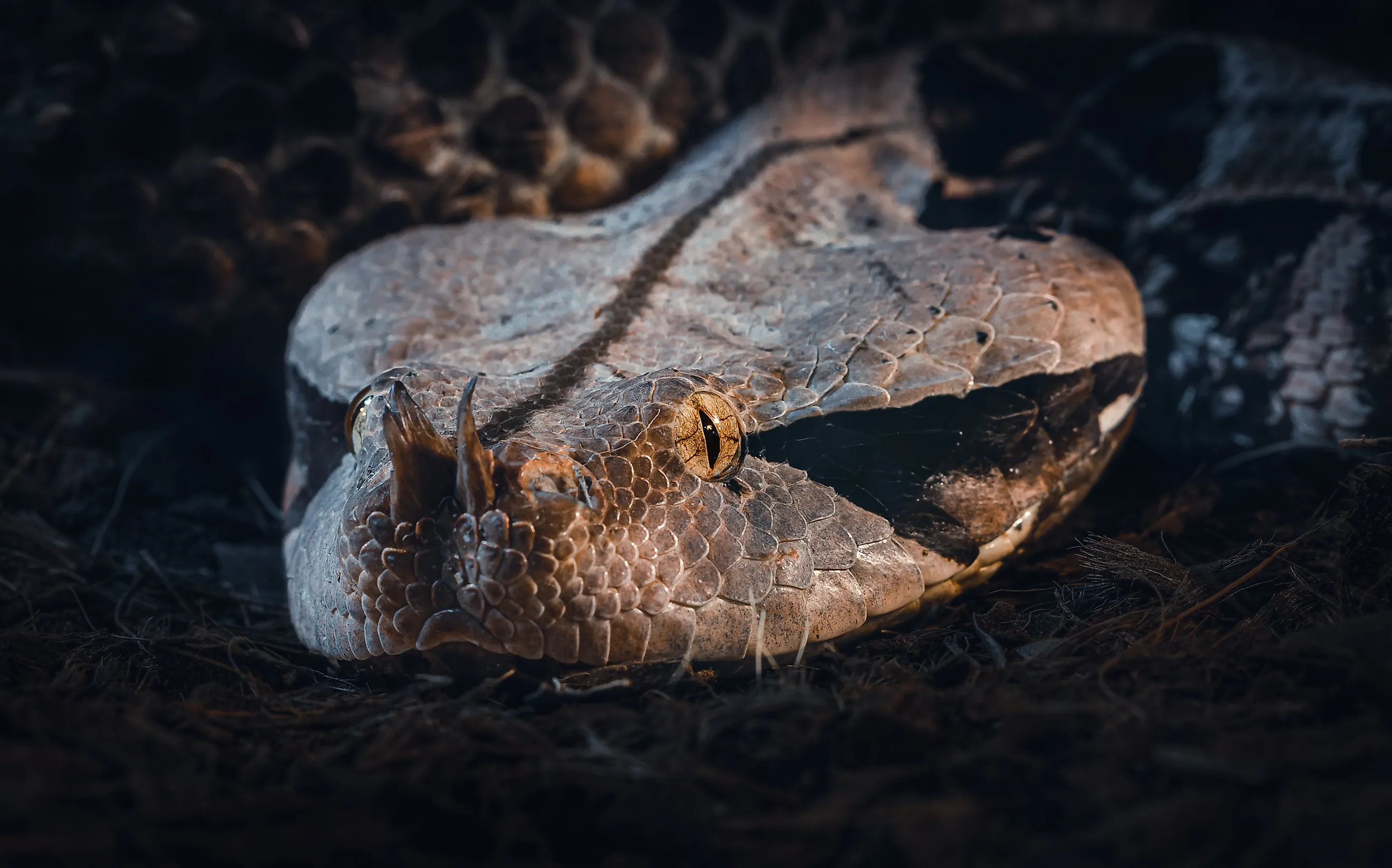
Gaboon Viper
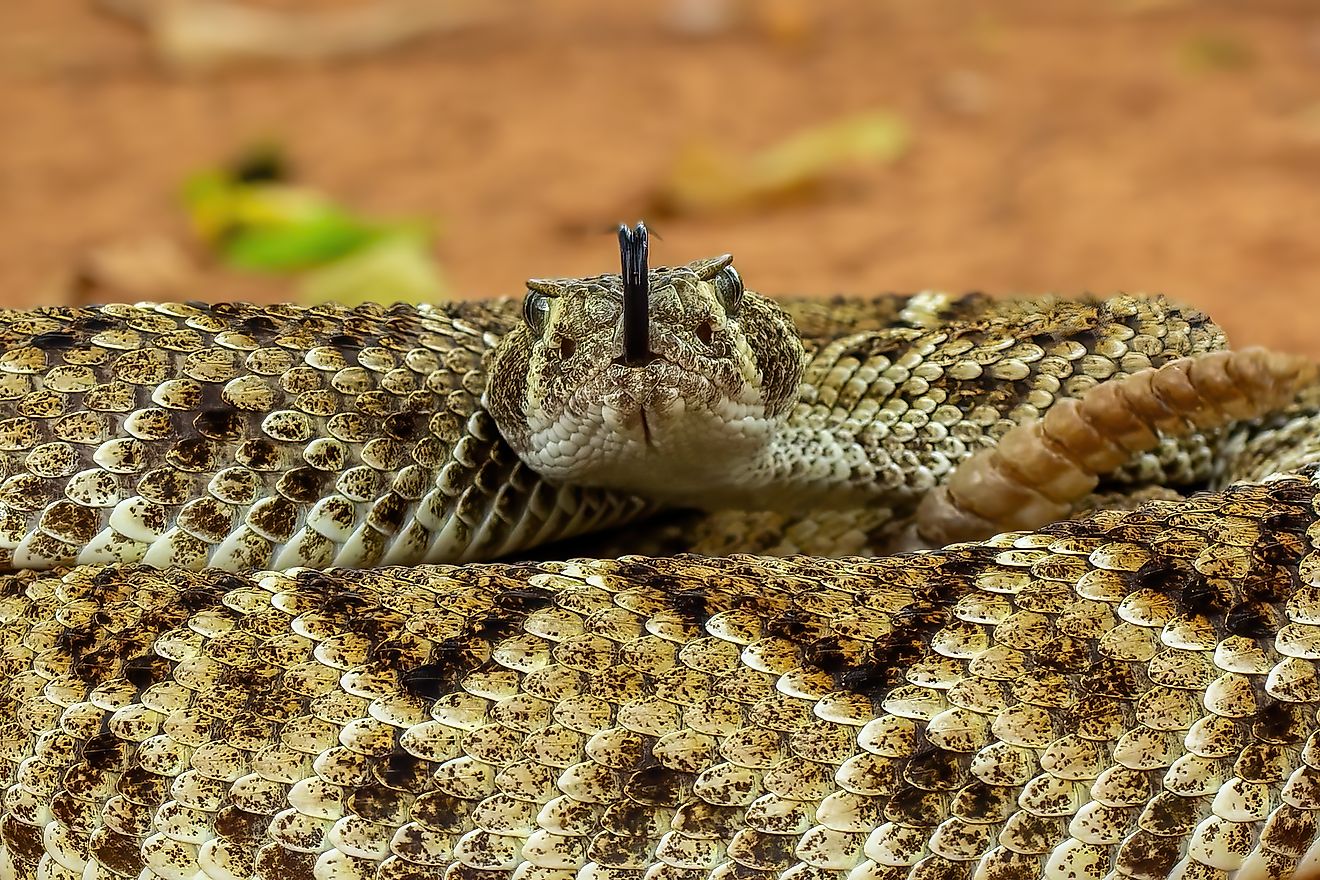
The Gaboon viper (Bitis gabonica) holds an accolade of titles that make it as iconic as it is: at up to two inches, it has the longest fangs of any venomous snake on earth; it is the largest viper in all of Africa; and it is also the largest “true viper” species in the world. While the bushmaster (Lachesis) of Central and South America can exceed it in length, the bushmaster belongs to the pit viper subfamily Crotalinae, whereas the Gaboon viper belongs to the ‘true viper’ subfamily Viperinae. Its intricate coloration and broad, leaf-shaped head mimic fallen leaf litter, allowing it to blend almost seamlessly into the forest floor throughout its native range in Central, East, and West Africa.
Taxonomic Classification and Physical Description
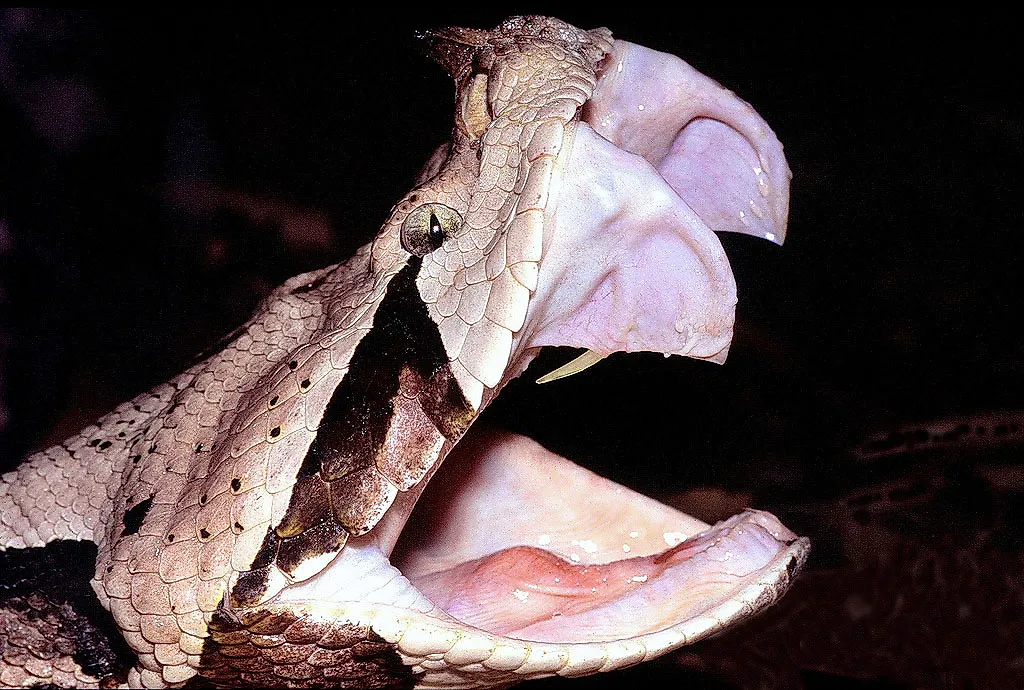
The East African Gaboon Viper (Bitis gabonica) was first described as Echidna gabonica in 1854 by French zoologists André Marie Constant Duméril, Gabriel Bibron, and Auguste Duméril. Echidna derives from Greek mythology, referring to a serpent-like monster, whereas gabonica refers to the Gabon Estuary in West Africa, where the species was located. The Gaboon viper was later transferred to the genus Bitis, which had been established in 1842 by British zoologist John Edward Gray.
In 1855, German zoologist Hermann Schlegel described the West African form as Bitis gabonica rhinoceros, treating it as a subspecies. However, in 1999, Lenk et al. analyzed immunological distances and mitochondrial DNA sequences that revealed genetic divergence between eastern and western populations of Gaboon vipers. As a result, the West African Gaboon viper was elevated to full species status as Bitis rhinoceros, a revision supported by differences in scalation, coloration, and nucleotide sequences.
The easiest way to distinguish each species is that the West African Gaboon viper has large nasal horns and a single triangular marking between each eye, whereas the East African Gaboon viper has small nasal horns and a triangular marking leading from the eyes towards the angle of the mouth. Additionally, the East African Gaboon viper is generally smaller than its West African relative. The largest individual recorded is often regarded as a specimen from Sierra Leone, which measured 205 centimeters (81 inches).
Range, Habitat, and Diet

The East African Gaboon viper has a wide range throughout the tropical forests, moist woodlands, and forest-edge habitats of Central and East Africa, occurring in countries including Nigeria, Cameroon, Democratic Republic of Congo, Central African Republic, South Sudan, Uganda, Kenya, eastern Tanzania, Zambia, Malawi, eastern Zimbabwe, Mozambique, and northeast KwaZulu-Natal Province in South Africa. The West African Gaboon viper is found strictly in West Africa from Togo, extending west to Guinea through Ghana, Côte d’Ivoire, Liberia, and Sierra Leone.
Gaboon vipers favor humid, tropical environments and are therefore absent from the Sahara Desert to the north and the Namib Desert along southwestern Africa. Despite the Gaboon viper’s already broad range, its populations are fragmented across rainforest, woodland, and forest-edge habitats. Depending on the region, they are found in secondary thickets, cashew plantations, and agricultural land in Tanzania, in forests and adjacent grasslands in Uganda, in evergreen forests in Zambia, and only in areas of high rainfall along forested escarpments in Zimbabwe.
As a terrestrial species, they usually inhabit the forest floors at low elevations, although they are sometimes found as high as 1,500 meters above sea level. They may also occur near swamps and other humid environments. Their habitat often contains roots, fallen logs, and deep leaf litter, which provide shelter, camouflage, and opportunities for thermoregulation. Gaboon vipers are ambush predators that will spend prolonged periods of time waiting for rodents, hares, rabbits, and birds to come within striking distance.
Behavior

Gaboon vipers are primarily nocturnal. Most of their activity occurs during evening and nighttime hours when they will emerge from their shelters to hunt or travel large distances. Early mornings and late afternoons when the weather is cool may also constitute active times, and activity is minimal during midday hours as the temperature is too hot. Gaboon vipers live largely sedentary lives within small home ranges. Their activity levels intensify during the wet season as the rain brings increased prey activity and humidity.
Due to their sedentary lives, Gaboon vipers are characterized by their docile and sluggish dispositions. Individuals are more likely to try to avoid detection by remaining motionless and relying on their camouflage to evade predators and passersby. However, if they are disturbed or threatened, they will hold their ground and release a loud hiss while raising their body off the ground. This defensive posture is exhibited by the snake to discourage further approach without escalating to biting. Despite their heavy build, Gaboon vipers can strike sideways, covering distances up to half their body length with surprising speed.
Reproduction

In many populations, mating occurs during the rainy season, often between September and December. Male Gaboon vipers engage in a combat ritual in which they will raise their heads and intertwine their bodies and try to push each other’s heads down onto the ground, and it is settled when one male overpowers the other. The dominant male will then mate with the female.
Females indicate that they are ready to mate by raising their tails and sometimes swaying back and forth. The gestation period lasts between seven months and a year. Gaboon vipers are viviparous, meaning the young develop within an egg membrane inside their mother and are born live. Females can birth up to 60 offspring, although 30-40 is more common. Young Gaboon vipers are fully independent from the moment they are born and must fend for themselves while avoiding predation from birds, mammals, and other snakes.
Importance to the World

Gaboon viper venom is predominantly cytotoxic, meaning it destroys tissue. It also contains a combination of hemotoxins and cardiotoxins, which affect both the blood vessels and the heart. The hemotoxic properties of the venom impair clot formation through a proteolytic action on fibrinogen, releasing soluble breakdown products into the bloodstream. Consequently, victims of severe envenomation may experience prolonged bleeding and extensive tissue damage.
Although viper venom can be medically dangerous, certain compounds isolated from snake venoms have contributed to the development of important pharmaceuticals. For example, the experimental antiplatelet drug Anfibatide was derived from venom proteins found in pit vipers and works by inhibiting platelet adhesion and aggregation. While the venom from this particular species is not known to have any medical uses, research into snake venom compounds has helped advance treatments related to thrombosis, heart disease, and stroke.
Threats

Due to their size and elusiveness, adult Gaboon vipers have relatively few predators, though large birds of prey, monitor lizards, mongooses, honey badgers, and some mammals may occasionally prey on them, especially juveniles. Other threats include deforestation and illegal collection or killing by humans. Zimbabwe’s population of Gaboon vipers already exists in a limited range, and they are further threatened by illegal wildlife trade and habitat destruction due to deforestation. The Chipangali Wildlife Orphanage in Zimbabwe facilitates a conservation breeding program to help maintain the country’s Gaboon viper population.