Musk Ox
The shaggy haired, horned musk ox may not be the sleekest looking mammal, but there's a lot of character hiding beneath its incredibly warm fur. Musk oxen survived largely unchanged through the Ice Age, making them living relics, and despite the latter part of their name, these woolly mammals are more closely related to goats than to bison or cattle. On the other hand, they do live up to the "musk" title, as males release a pungent odor to attract a female during mating season.
Taxonomically, Ovibos moschatus, as it is known, branches off into a few subtribes largely connected to antelope and caprine species. The term "Ovibos" (latin for "sheep-ox") is also a reference to the species' sheep and goat roots.
Range And Habitat

The ancestors of the musk ox were once far more widespread than they are today. Fossil evidence showed that they were all across the Siberian and North American Arctic and even from the Urals to Greenland. Furthermore, during the Wisconsinan glacial episode, which took place over 20,000 years ago, the musk ox thrived in an area that is now the Appalachians and Virginia. Over time, the species moved further north and across the Canadian Arctic Archipelago, eventually reaching Greenland from Ellesmere Island.
Musk ox are largely confined to these Arctic areas, dwelling primarily in Northern Canada, Greenland, Siberia, and Alaska, with a smaller population surviving in Scandinavia. Population estimates place the number of living muskox anywhere from 80,000 to 169,000. At one time, they were considered extinct in Alaska, as the population was wiped out from excessive hunting and changes in the climate. Recently, efforts have been put in place to reintroduce musk oxen to the area. In Alaska alone there are four general areas where musk oxen live. Those places are: Nunivak and Nelson Islands, the Seward Peninsula and Nulato Hills, the Western Brooks Range and Kotzebue Sound, and the Central and Eastern Arctic Slope.
Food

Similar to their goat and sheep brethren, musk oxen are strictly herbivores, with their primary feed being grasses, woody plants, and moss. Despite their size and their weight, and a sparsely vegetated frozen tundra habitat to navigate, musk oxen are adept diggers, rooting through snow to uncover the nutrients they need. Requiring about 4 to 6 kilograms (9 to 13 pounds) every day, musk oxen spend much of their day eating whatever greens they come across.
Physical Description

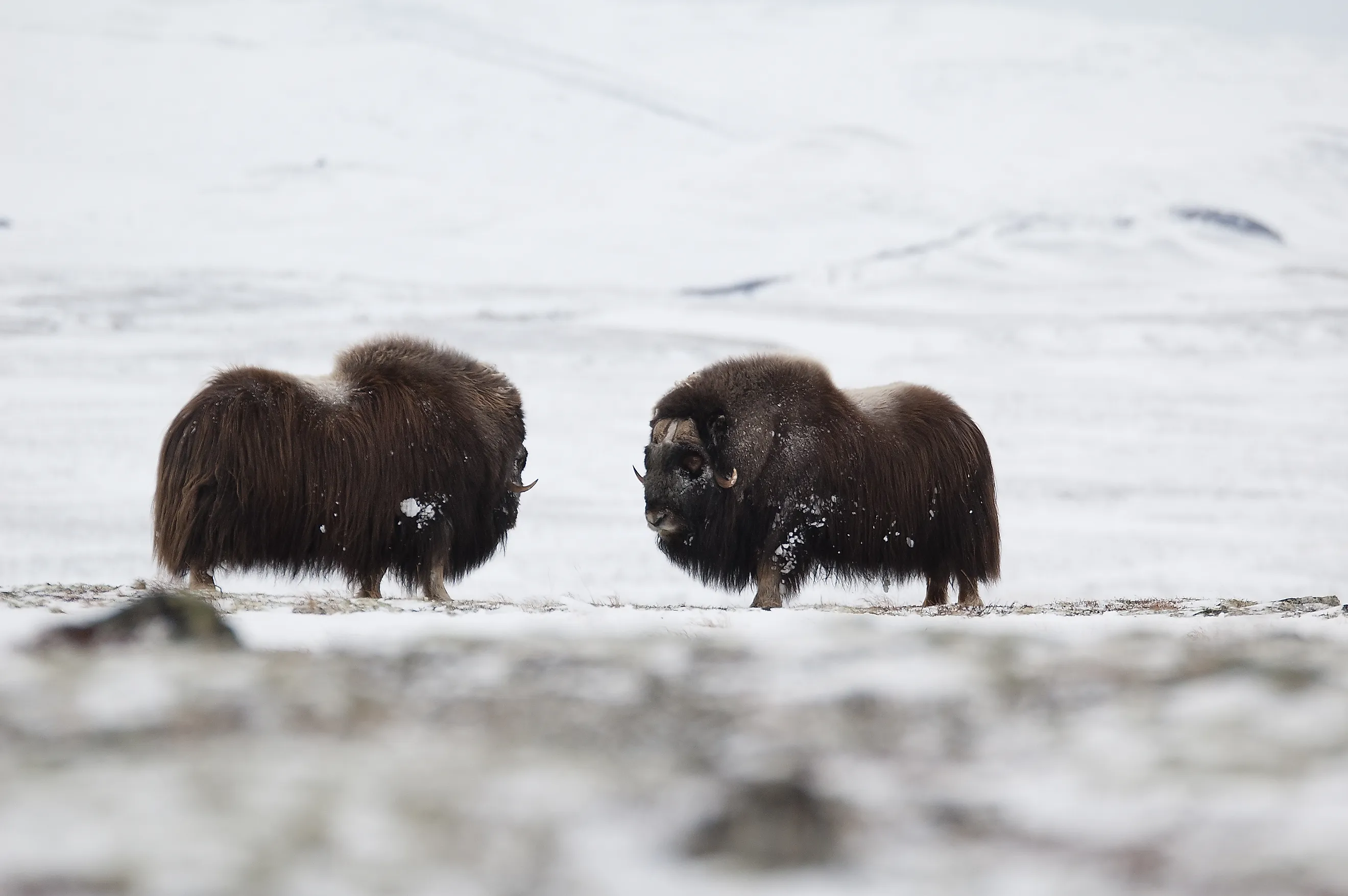
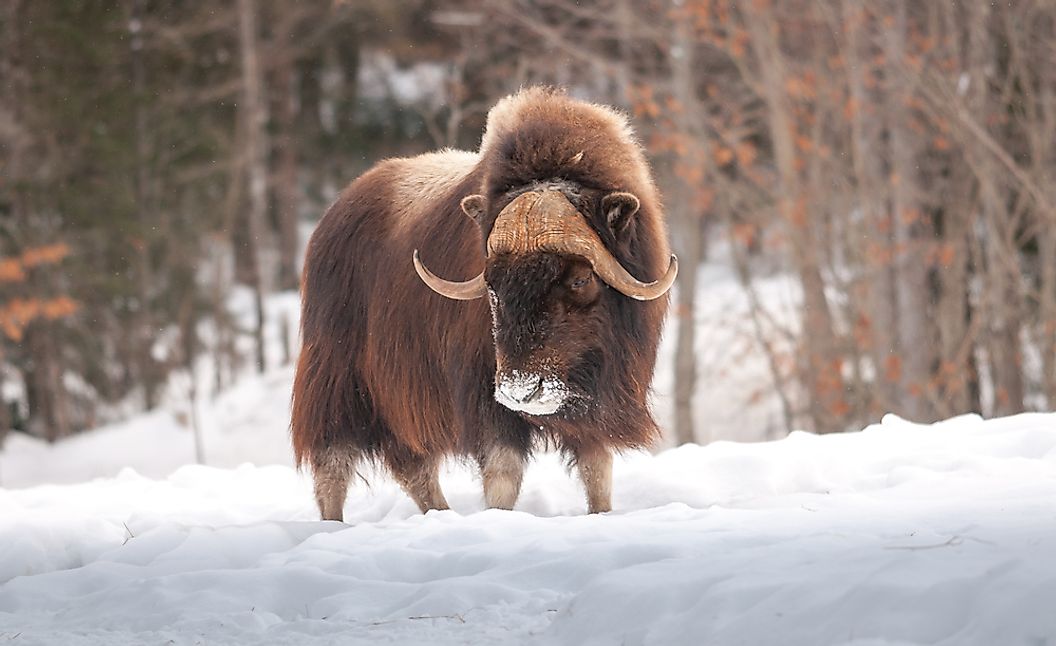
From a distance, musk oxen could pass as boulders with their stocky build, slight shoulder hump, and short tail. There's a reason that the Eskimos continue to refer to the musk oxen as "itomingmak," meaning "the animal with skin like a beard. " It's a more apt description because regardless of whether the musk ox is a male or female, their long hair hangs nearly to the ground.
In terms of the coats themselves, both male and female musk oxen have similar attributes. Their outer coat is long and coarse, while the underhair is short, fine, and soft. Depending on the area, coloration can vary as well, and the Greenland musk ox, the race that's found in Alaska, will generally have dark brown with creamy-colored hair on its back, forehead, and legs. In addition, all musk oxen have cloven hooves, with all four of them being the same size too.
What distinguishes musk oxen's gender comes down to their horns. The mature male musk oxen (bulls) will have larger and heavier horns than those of the mature female musk oxen (cows). For the bulls, their horns will have a large base too, which nearly stretches across their entire forehead. This is also on top of their size, as the bulls will grow to be about five feet tall at their shoulder and will be heavier too, around 600-800 pounds. Meanwhile, the cows will be smaller at 4 feet in height and weigh 400-500 pounds.
Behavior

Whenever you see a musk ox, there will likely be several more nearby, as they largely travel and live in herds of 12 to 24 during the wintertime and 8 to 20 during the summer. They're not at all territorial; however, they still leave some marks along their trails with preorbital glands.
Like many other herd animals, musk oxen retain a strong sense of cooperation. Interestingly, they also maintain a hierarchy. Many herds can sometimes be led by a single cow. Male musk oxen also have separate age-based hierarchies, with mature oxen being dominant over the younger ones. As such, dominant oxen will have access to the best resources and will even remove their brethren from patches of grass during the winter if they so desire. This pecking order is further emphasized during mating season with contests determining who will be dominant.
Beyond hierarchical disputes, they are mostly defensive creatures. If the herd is ever threatened, the adults of the pack will face outward and form a ring or semicircle around their children. The bulls will typically be in the front while the cows and children huddle close to them. Who gets to be at the front of this circle is also based on that pecking order.
Reproduction
The mating (or rutting) season starts in June or early July, and during that time dominant bulls will be seen fighting one another in the attempt to establish harems, which consist of six or seven cows alongside their offspring.
These fights begin with a musk oxen rubbing its preorbital glands against its legs, bellowing loudly, and displaying their long, curved horns. Next, bulls will back up around 66 feet (20 m), lower their heads, and charge at one another and will keep doing so until one of them gives up.
Once the victor is established, bulls will prevent cows from leaving the newly established pack during this time. Once mating begins, it's often signaled by the bull tapping an estrous cow with his foreleg to calm her down and be open to his advances.
By the time the summer ends, the herds will return to their usual formation. That much is further reinforced by the fact that the cows of the pack will take charge as they're going through gestation. For the next eight to nine months, they are more aggressive and decide what distance the herd is going to travel during the day as well as where they'll sleep. Generally speaking, calving will start to occur from April to June of the following year.
Importance to the World

As herbivores more or less contained to the Arctic Circle and snowy areas, musk oxen serve as a reliable food source for their predators, which sometimes includes humans. The meat that musk oxen have is filled with important nutrients such as protein, iron, vitamin B, and vitamin D. Several parts of the musk ox can be used to eat, as the meat, fat, bone marrow, tongue, and heart can be cooked up. Despite their bulkier appearances, musk oxen actually have a lower fat percentage when compared to beef, pork, or chicken. In moderation, its fat would be a healthy form of nutrition.
And all of this is before getting into the coat. The underwool, referred to as "qiviut", is soft and is widely considered the world's warmest wool for its weight. It was for this reason musk oxen were almost rendered extinct as they were hunted down for their wool centuries ago. Today, though, only a controlled amount is harvested every year, and Alaska knitters use the qiviut to knit exquisite garments.
Threats and Future Survival
The biggest threat to musk ox these days is climate change. Even in the last decade, two major herd populations have dropped by 80 percent. Beyond their ecological significance as one of two ungulate species in the arctic ecosystem, along with reindeer, these woolly giants are a source of nutrition for wolves, bears, and local Inuit communities. Their fur, with its incredible insulation properties, is a valuable resource for Native communities and an aid to economic production. As populations of this magnificent creature dwindle, its worth asking what can be done to preserve it.