How Many Rats Are There In The World?
Counting the world's rats is impossible. They breed quickly, live mostly out of sight, occupy human structures alongside natural burrows, and concentrate in places where casual observation undercounts them by orders of magnitude. The often-repeated claim of one rat per human, or about 8 billion globally, has no rigorous scientific basis. Recent peer-reviewed urban studies suggest that, in most cities, the ratio is much lower. What is known with more confidence is which rat species dominate, where their numbers concentrate, and where humans have managed to keep them out, including one Canadian province that has held breeding populations at zero for 75 years and a sub-Antarctic island declared free of all rodents in 2018 after the largest eradication project ever attempted.
The Two Species That Matter

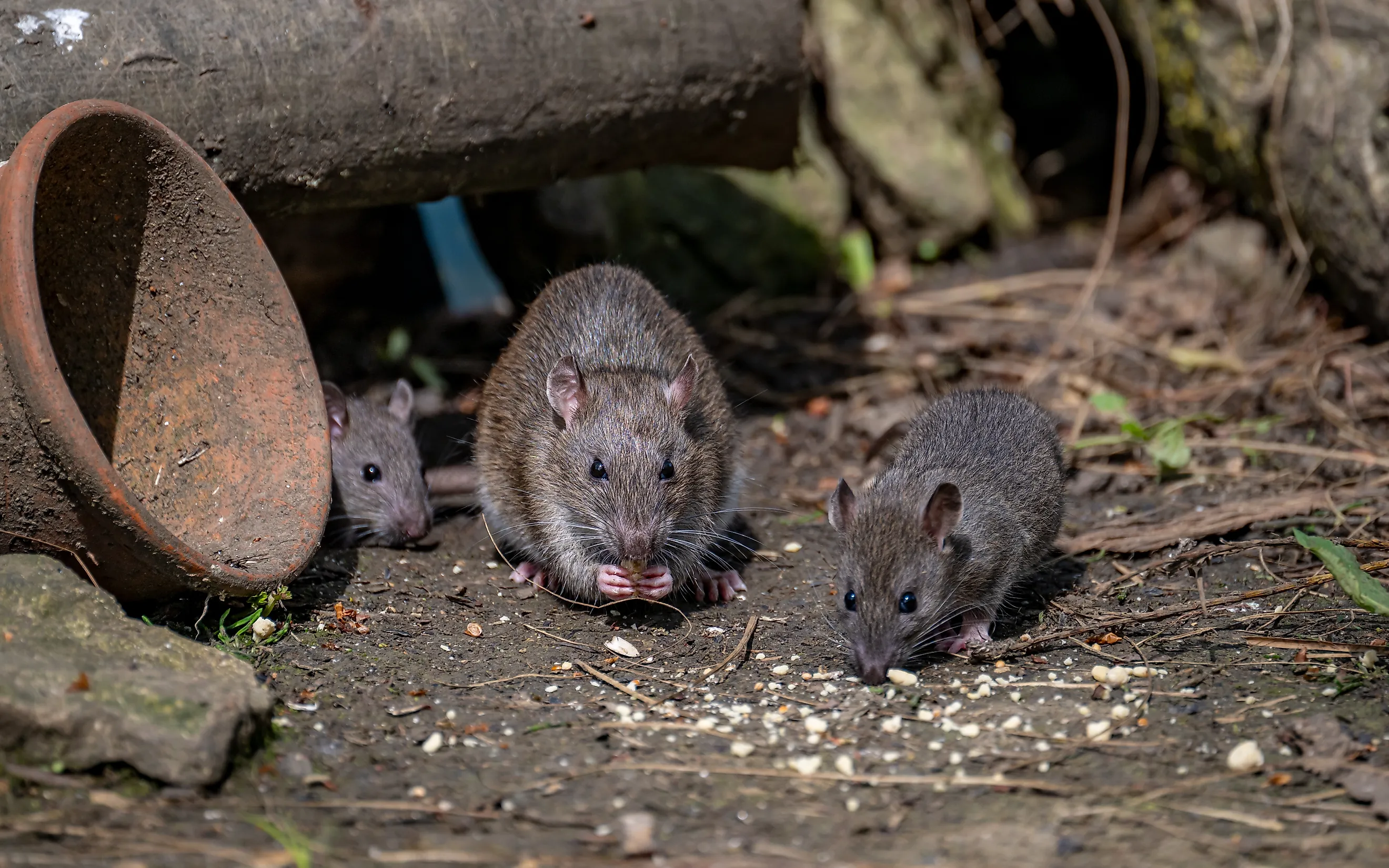
The genus Rattus contains roughly 56 species, native almost entirely to Asia and the Australia-New Guinea region. Two of those species have spread to nearly every part of the inhabited world and account for the overwhelming majority of human contact with rats: the brown rat (Rattus norvegicus), also called the Norway rat, common rat, sewer rat, or wharf rat; and the black rat (Rattus rattus), also called the ship rat, roof rat, or house rat.

The brown rat is native to northern China and the surrounding region. It reached Europe in the mid-1500s and North America around 1750. Adult brown rats reach 28 cm in body length with a slightly shorter tail and weigh 140 to 500 g. They dominate temperate climates and most large cities outside the tropics. The black rat is native to the Indian subcontinent and is generally smaller, lighter, and a better climber. It dominates warmer climates and tropical port cities. Both species are listed as Least Concern by the IUCN. Beyond these two, most of the world's other Rattus species occupy specific Asian and Australasian habitats and rarely cohabit with humans.
Why Rats Are Hard to Count
The "one rat per human" estimate began as a 1909 guess by an English researcher, W.R. Boelter, who counted rats on a few farms and extrapolated nationally. Modern urban ecology research has largely abandoned the estimate as unreliable. Rats are nocturnal, secretive, and concentrate in sites that defy systematic counting: sewers, subway tunnels, alleyways, food-service waste streams, agricultural barns, and underground burrow networks. They move quickly between sites in response to food availability and disturbance. Mark-and-recapture studies, the gold standard for wildlife population estimates, are difficult to scale to citywide populations.
A 2014 study by mathematician Jonathan Auerbach, working with New York City building inspection data, estimated New York's rat population at around 2 million, not the long-cited 8 million figure that matched the city's human population. Independent studies in Vancouver, Baltimore, and London since 2010 have similarly produced lower estimates than the popular one-to-one ratio. National and global figures are extrapolations from these scattered urban estimates, sometimes combined with agricultural rodent surveys.
The Cities With the Most Rats

The pest-control firm Orkin publishes an annual ranking of US cities by the number of rodent control treatments performed in residences, which is treated by researchers and journalists as the best available proxy for relative rat density. In its 2025 ranking, Los Angeles overtook Chicago for the first time in a decade. The top ten were Los Angeles, Chicago, New York, San Francisco, Hartford, Washington DC, Detroit, Philadelphia, Minneapolis, and Denver.
Chicago held the top spot for the ten years immediately prior. The city's dense alley network, abundance of underground utility infrastructure, and severe winters (which push rats indoors) all support large urban populations. New York's enormous subway system, dense restaurant and food-service economy, and aging building stock similarly favour rat populations. The mayor of New York City created a "Rat Czar" position in April 2023; the first appointee, Kathleen Corradi, left the role in September 2025.
How Rats Reproduce So Quickly

Brown rats reach sexual maturity at four to five weeks. Gestation runs 21 to 23 days. An average litter contains six to eight pups, and a female can produce five to seven litters per year (roughly 30 to 50 offspring per female per year in theory). Mortality in wild populations is high, with most rats dying within their first year, but adults that survive past weaning have a strong protective social structure and few natural predators in urban environments.
Rats adapt readily to human food systems. A single rat eats roughly 25 to 30 g of food per day and contaminates many times that amount with droppings, urine, and shed hair. Their senses of smell and hearing are highly developed, helping them detect both food sources and threats, and their nocturnal habits keep most of their activity out of human sight. In northwestern India, the Karni Mata Temple at Deshnoke in Rajasthan houses an estimated 20,000 to 25,000 rats (mostly black rats) considered sacred by worshippers; visitors are required to enter barefoot, and harming a rat is prohibited.

Where Rats Don't Live
A small number of places have managed to keep breeding populations of rats out, either through climate, isolation, or sustained eradication effort.
Alberta, Canada. The province of Alberta has had no breeding population of rats since 1953 and is widely cited as the largest inhabited rat-free area in the world. Brown rats reached the province's eastern border with Saskatchewan in 1950, and the Alberta government immediately established a Rat Control Program under Napoleon Louis Poulin, who later became known as "the man who killed ten million rats." The program established a Rat Control Zone running 600 km along the Saskatchewan border from Cold Lake in the north to the Montana border in the south, 29 km wide, where seven municipalities still conduct semi-annual inspections of farms, grain bins, and outbuildings. Owning a pet rat is illegal in Alberta and carries a fine of up to CAD $5,000; only zoos, universities, and licensed research institutions may hold laboratory rats. The province marked the program's 75th anniversary in July 2025; in 2024, residents reported 450 suspected sightings, of which only 23 turned out to be actual rats. Most reports identified muskrats, pocket gophers, ground squirrels, or mice. The native bushy-tailed woodrat (Neotoma cinerea), which occurs in the Alberta Rockies, is a different species and is not regulated.
South Georgia, sub-Antarctic Atlantic. The British overseas territory of South Georgia was declared free of rats and mice on May 8, 2018, the conclusion of a £10 million decade-long effort by the South Georgia Heritage Trust and its US affiliate. The eradication covered 1,087 km², over eight times the area of the previous record-holder (Macquarie Island, Australia, cleared in 2014). The project used helicopter-dropped poison bait followed by a multi-year verification phase in which a team called "Team Rat" deployed more than 4,600 monitoring devices and three trained rodent-detection dogs (Will, Ahu, and Wai) covered 2,420 km on foot through rugged glacial terrain. Rats had been introduced to the island by sealers and whalers starting in the late 18th century and had devastated populations of ground-nesting seabirds, including the endemic South Georgia pipit.
Antarctica. The continent itself has no resident rat populations. Brown rats and black rats are obligate commensals that depend on warm human structures to survive winter, and the few human research stations on the Antarctic mainland do not provide enough habitat for breeding populations to establish. Strict biosecurity protocols at the major research stations (McMurdo, Scott Base, Amundsen-Scott, Vostok, and others) prevent accidental introduction through cargo and food shipments. Some sub-Antarctic islands historically hosted introduced rats, but the major ones (Macquarie, South Georgia, the Auckland Islands, Campbell Island) have now been cleared.
New Zealand offshore islands. New Zealand has cleared rats from more than 100 offshore islands as part of a national effort to restore native bird populations, with the long-term Predator Free 2050 programme aiming to eliminate rats, stoats, and possums from the entire country by 2050. Notable cleared islands include Campbell Island (covering 11,300 hectares, completed in 2003), Rangitoto and Motutapu islands in Auckland Harbour, and the predator-fenced Maungatautari mainland reserve in the Waikato. Mainland eradication remains technically difficult and controversial.
Hawadax Island, Alaska. The Aleutian island previously known as "Rat Island" was cleared of Norway rats in a 2008-2009 eradication project led by the US Fish and Wildlife Service, The Nature Conservancy, and Island Conservation. Rats had been introduced by a Japanese shipwreck in the 1780s and had devastated seabird colonies for over two centuries. The island was officially renamed Hawadax (its Aleut name) in 2012 after the eradication was confirmed successful.
Iceland and other limited-rat areas. Iceland has only small populations of brown rats, mostly concentrated in Reykjavik's port area, where they were introduced through shipping in the 19th century. The country's cold climate, low population density outside the capital, and limited grain agriculture all constrain rat range. Various other isolated regions (parts of the Arctic, remote Pacific atolls without significant human shipping, and high-altitude regions of the Andes and Himalayas) also have either no rats or only small, marginal populations.
The History of Modern Rat Eradication
![By D. Horwood (signature; probably Doris Horwood, 1911-2003, see [1])Provincial Archives of Alberta - https://www.flickr.com/photos/alberta_archives/26497442131/, No restrictions, https://commons.wikimedia.org/w/index.php?curid=52888545](https://www.worldatlas.com/r/w960-q80/upload/df/f7/2b/alberta-department-of-public-health-rat-poster-26497442131-s3cdn.jpg)
Sustained island rat eradication began in New Zealand in the 1960s with small-scale removal of Norway rats from offshore reserves. The introduction of helicopter-dropped brodifacoum bait in the 1980s and 1990s transformed the field, allowing efforts to scale from a few hectares to whole islands of hundreds of square kilometres. Major milestones include Campbell Island (New Zealand, 11,300 ha, 2001-2003); Macquarie Island (Australia, 12,780 ha, declared rodent-free in 2014 after a 2011 baiting); and South Georgia (108,723 ha, the current record-holder, declared rodent-free 2018). The Galapagos Islands, the Falklands, and several Hawaiian outlying islands have all been targets of ongoing or completed eradication projects.
The biggest current frontier is mainland eradication. The Predator Free 2050 programme in New Zealand and broader proposals for rodent control on the South Island remain technically difficult because of the open boundary problem, in which animals from neighbouring untreated areas can recolonise faster than they can be removed. Alberta's case is the principal mainland-scale exception, and its success depends partly on geography (Rocky Mountains, boreal forest, and treeless prairie all serve as natural barriers to recolonisation) and partly on 75 years of continuous and well-funded public effort.
What the Total Probably Is
The honest answer to "how many rats are there in the world" is that nobody knows within an order of magnitude. The widely-cited "billions" figure is almost certainly correct in the broadest sense (global brown and black rat populations almost certainly run into the billions when subsistence farms and rural areas are included), but more precise figures remain out of reach. What is more useful is to recognise that rats are not evenly distributed. They concentrate in places with abundant food, warm shelter, and limited predation pressure, which means dense urban areas in temperate climates carry far more rats per square kilometre than rural or remote areas of the same continent. And in the small set of regions where humans have decided to keep rats out (Alberta, South Georgia, the Antarctic, and a growing list of cleared offshore islands), the count, for now, is zero.