The Fascinating Arboreal Mammals
- Arboreal animals are those that spend most of their time on trees.
- The emerald green boa spends much of its time on trees, coiled on branches.
- Orangutan is the largest arboreal mammal on Earth and also considered the most intelligent of all animals that live on trees.
Arboreal mammals are the ones that spend most or all of their lives in trees, with anatomies built for the canopy: prehensile tails, opposable digits, curved claws, lightweight skeletons, and in a few cases gliding membranes or specialized brachiating shoulders. Twelve of the most striking arboreal mammals are below, ranging across every inhabited continent and several of the world's tree-dwelling adaptations. The list is alphabetical rather than ranked.
Gibbon
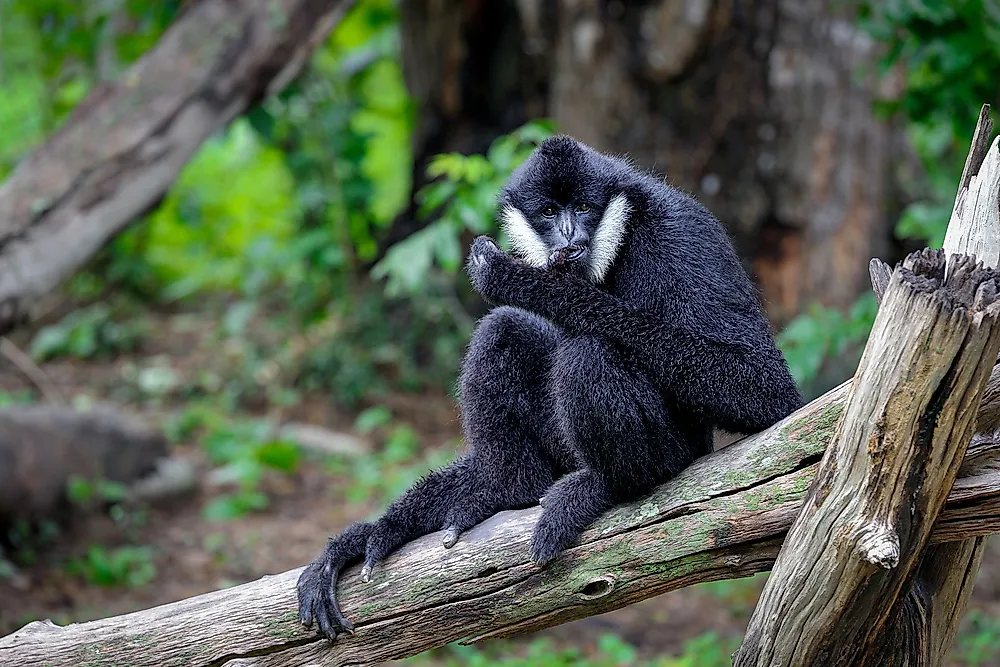
Gibbons (family Hylobatidae) are the fastest tree-dwelling non-flying mammals on Earth. They brachiate, swinging arm-over-arm through the canopy at speeds reaching 34 mph and clearing gaps of 50 feet between branches in a single arc. The family contains four genera (Hylobates, Hoolock, Nomascus, and Symphalangus) and twenty recognized species, all native to the tropical and subtropical forests of Bangladesh, northeast India, southern China, and Southeast Asia south through Sumatra, Borneo, and Java. Gibbons are apes rather than monkeys (they have no tails), but they are the smaller of the apes, weighing 12 to 30 pounds depending on species. They form long-term pair bonds and sing duet songs that can carry for miles through dense forest. Habitat loss has put most gibbon species in serious trouble. The IUCN lists nearly every species as Endangered or Critically Endangered, with the Hainan gibbon (Nomascus hainanus) reduced to roughly 30 individuals in a single forest patch on Hainan Island and considered one of the rarest mammals on Earth.
Howler Monkey

Howler monkeys (genus Alouatta, family Atelidae) make the loudest call of any land animal: a deep guttural roar that can carry three miles through dense rainforest and approaches 90 decibels at close range. The call comes from an enlarged hyoid bone at the base of the tongue, which acts as a resonating chamber, and the swollen throat sac visible on calling males. Fifteen species are recognized across Central and South America, occupying tropical forests from southern Mexico to northern Argentina. Howlers are the largest of the New World monkeys, with males reaching 24 to 36 inches in body length plus an equally long prehensile tail with a bare friction pad on the underside used for gripping branches. They are primarily folivores, with a slow-moving canopy lifestyle adapted to a leaf-heavy diet that yields little energy. The dawn and dusk choruses, in which troops bellow at neighboring groups to mark territory, are one of the signature sounds of tropical American forests.
Kinkajou

The kinkajou (Potos flavus) looks like a monkey, lives like a monkey, and is not a monkey. It belongs to the family Procyonidae alongside raccoons, coatis, and olingos, and is the only arboreal procyonid with a fully prehensile tail. Native to the rainforests from southern Mexico through Central America into much of northern and central South America, the kinkajou is strictly nocturnal and forages high in the canopy for fruit (especially figs), nectar, and the occasional insect or small vertebrate. The protrusible tongue, about five inches long, is adapted for extracting nectar from flowers and earned the species its alternate common name, "honey bear." Adults weigh three to ten pounds. The IUCN lists the species as Least Concern, but populations are declining where they are hunted for the pet trade or for their fur and meat. Kinkajous are important seed dispersers and pollinators in their forest habitats and can live more than 20 years in the wild.
Koala

The koala (Phascolarctos cinereus) is a marsupial, not a bear, and one of the most specialized eaters in the mammalian world. Of more than 600 eucalyptus species in Australia, koalas eat the leaves of roughly 50, with most individual animals concentrating on just two or three local species. The eucalyptus diet is so low in calories and so high in toxins that koalas have evolved an enlarged caecum and specialized gut microbes to detoxify and ferment the leaves. They sleep 18 to 22 hours per day to conserve energy. Koalas live only in the eucalyptus forests of eastern and southeastern Australia, from northern Queensland through New South Wales and Victoria into South Australia. The IUCN lists the species as Vulnerable, and the Australian government in February 2022 listed the koala populations in Queensland, New South Wales, and the Australian Capital Territory as Endangered, citing combined pressure from habitat loss, chlamydia infection, the 2019-2020 bushfires, and climate change.
Opossum

Opossums are the only marsupial group native to the Americas. Order Didelphimorphia contains over 120 species across Central and South America, but only the Virginia opossum (Didelphis virginiana) reaches as far north as Canada. They originated in South America and crossed into North America during the Great American Interchange after the Isthmus of Panama closed about three million years ago. Most opossums build leaf-and-twig nests in tree hollows and use prehensile tails as a fifth limb for climbing, although the tail cannot support the weight of an adult animal hanging by itself for more than a few seconds, despite the popular image. The defensive behavior of "playing possum" is involuntary thanatosis: a stress reaction that mimics death, accompanied by a strong odor from the anal glands, and that can last several hours before the animal recovers. Most opossum species are doing well in their native ranges, and the Virginia opossum has expanded its North American range significantly with human-modified landscapes.
Orangutan

The orangutan is the largest arboreal mammal on Earth and the only great ape native to Asia. Three species are now recognized: the Bornean orangutan (Pongo pygmaeus), the Sumatran orangutan (Pongo abelii), and the Tapanuli orangutan (Pongo tapanuliensis), described as a separate species in 2017 and restricted to a single forest area of about 1,000 individuals on Sumatra. All three are listed Critically Endangered by the IUCN. A large adult male can weigh 200 pounds and reach an arm span (fingertip to fingertip across both arms outstretched) of seven to eight feet, longer than his standing height. The long arms, opposable thumbs and toes, and rotatable shoulder and hip joints give orangutans a greater range of arboreal motion than any other ape. They build a new sleeping nest of bent branches and leaves in the canopy each night. Habitat loss to oil palm plantations and logging is the primary threat across all three species.
Red Panda

The red panda (Ailurus fulgens) is the only living member of family Ailuridae and shares no close relationship with the giant panda despite the name and similar bamboo-heavy diet. Both species independently evolved a "false thumb," an enlarged radial sesamoid bone that functions as an opposable digit and is used to strip bamboo leaves. Red pandas live in the temperate broadleaf and conifer forests of the eastern Himalayas, southwestern China, Nepal, Bhutan, northern Myanmar, and the northeastern Indian states, at elevations of 7,000 to 14,000 feet. They spend most of their lives in trees, sleeping curled on branches and descending only to find food or move to another tree. Bamboo accounts for roughly two-thirds of the diet, supplemented by fruits, acorns, eggs, and occasional small mammals. The IUCN lists the species as Endangered, with population declines driven by habitat fragmentation and poaching. A 2020 genetic study by Hu and colleagues proposed splitting the species into two: the Himalayan red panda (A. fulgens) and the Chinese red panda (A. styani), though the taxonomy is still debated.
Sloth

Sloths are the slowest mammals on Earth. Six species in two families occupy the Central and South American rainforests: four three-toed species in family Bradypodidae (genus Bradypus) and two two-toed species in family Megalonychidae (genus Choloepus). They have the lowest metabolic rate of any non-hibernating mammal, an extraordinarily slow gut transit time, and a habit of descending from the canopy only once a week to defecate. The classic "20 hours of sleep" statistic came from captive animals; a 2008 EEG study by Rattenborg and colleagues of wild brown-throated three-toed sloths found that they sleep closer to 9.6 hours per day. Sloths grow algae in their fur, which provides camouflage and supports a small ecosystem of insects and mites. Curved claws up to four inches long allow them to hang upside down from branches with essentially zero muscle effort. They are surprisingly strong swimmers and can hold their breath for up to 40 minutes underwater.
Spider Monkey

Spider monkeys (genus Ateles) get their name from their tendency to hang from a branch by all four limbs and their tail at once, giving them a vaguely arachnid silhouette in the canopy. Seven recognized species occupy the tropical forests from southern Mexico through Central America and into the Amazon basin. They are among the most acrobatic of all primates, with long arms and legs and a fully prehensile tail with a bare friction pad at its tip, used as a true fifth limb for swinging through the upper canopy. Spider monkeys lack opposable thumbs (or have only vestigial ones), an adaptation for hooking branches rather than gripping them. They eat primarily ripe fruit and are major seed dispersers in their forests. The IUCN classifies all seven species as Vulnerable, Endangered, or Critically Endangered, with the brown spider monkey (Ateles hybridus) of Colombia and Venezuela among the 25 most endangered primates in the world.
Sugar Glider
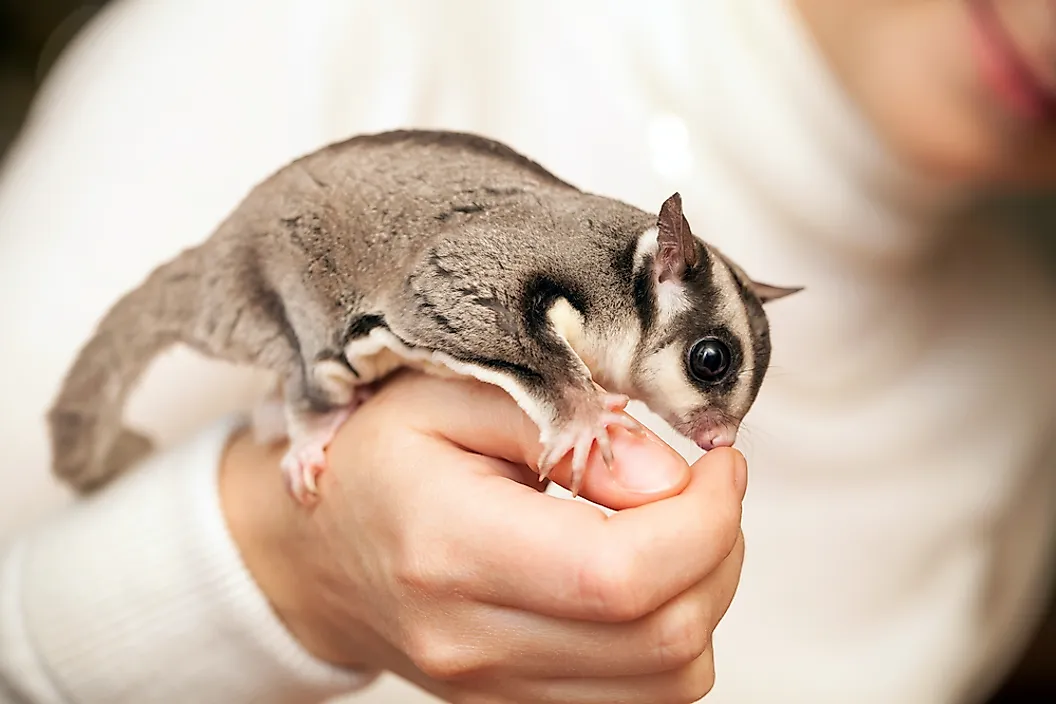
The sugar glider (Petaurus breviceps) is a marsupial that glides like a flying squirrel, an example of convergent evolution between two unrelated mammal lineages on opposite sides of the world. A thin furred membrane called the patagium stretches from the fifth finger on each forelimb to the first toe on each hindlimb, and when extended it forms an airfoil that allows controlled glides of up to 165 feet between trees. Sugar gliders are native to the eucalyptus forests of eastern and northern Australia, New Guinea, and several Indonesian islands. They live in colonies of up to a dozen adults plus young, defend group territories, and feed on the sap of acacia and eucalyptus, nectar, pollen, and insects. A 2020 study by Cremona and colleagues using genetic data split the broadly defined P. breviceps into three separate species (with two new species, P. notatus and P. ariel, given full species status). The animals popular as exotic pets in the United States and elsewhere are now thought to be predominantly P. notatus rather than true P. breviceps.
Tree Kangaroo

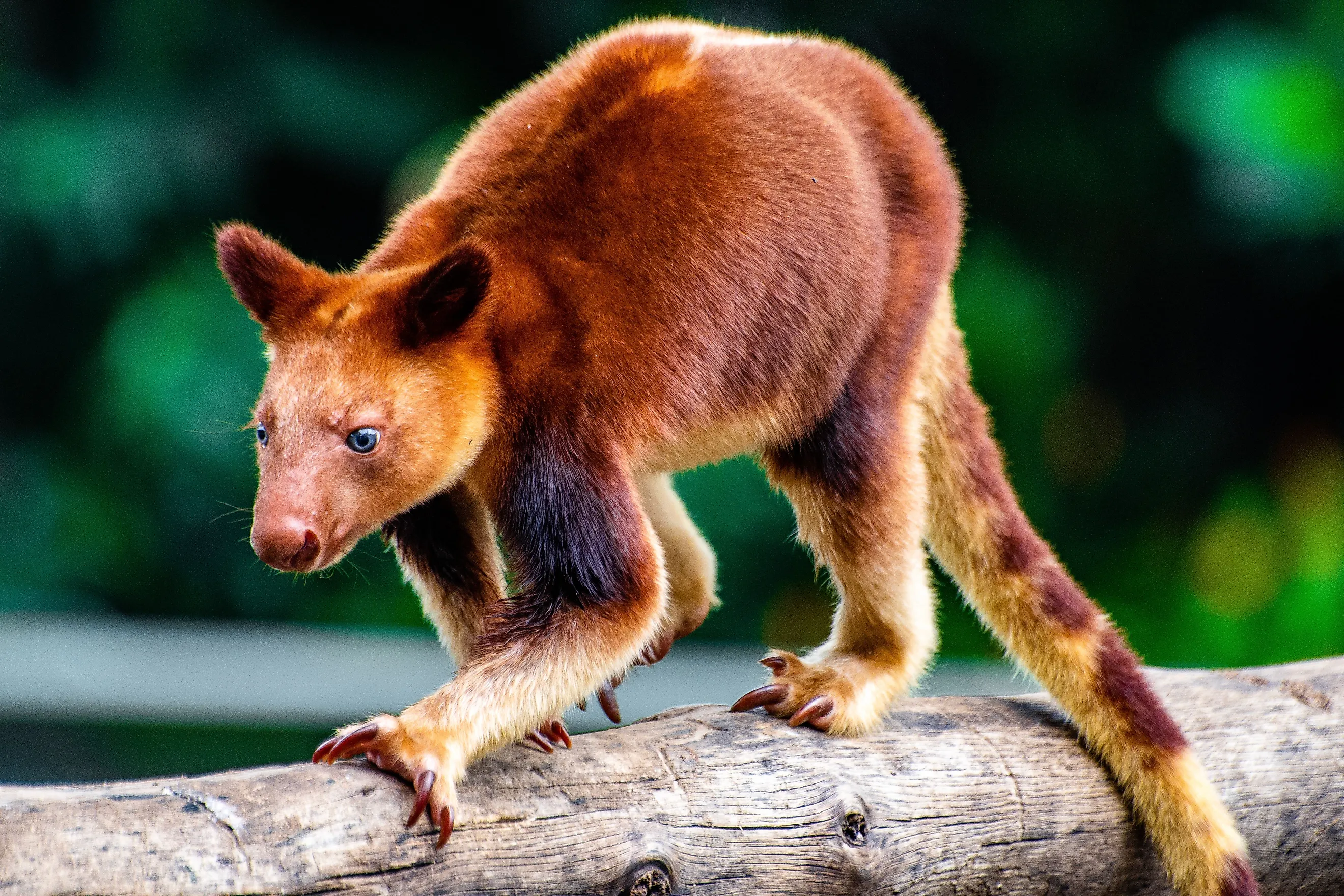
Tree kangaroos are the result of an evolutionary U-turn: ground-dwelling kangaroos that returned to the trees their ancestors had originally come from. Fourteen species in genus Dendrolagus live in the rainforests of New Guinea, the surrounding islands, and the Cape York and Atherton Tableland regions of northeastern Queensland. Compared to ground kangaroos, tree kangaroos have shorter hindlimbs proportional to the forelimbs (the standard kangaroo body plan rebalanced for climbing), stronger forelimbs, longer tails for balance, and gripping pads on their hindfeet. They are the only macropods that can move their hindlimbs independently rather than only together, an adaptation for the careful footwork required on branches. The IUCN lists most species as Vulnerable, Endangered, or Critically Endangered, with the Wondiwoi tree kangaroo (D. mayri) once thought extinct before a 2018 rediscovery in West Papua. Hunting and habitat loss are the principal threats.
Tree Squirrel

Tree squirrels are by far the most widespread of the arboreal mammals on this list, with over 120 species in family Sciuridae spread across every continent except Australia and Antarctica. The family includes the familiar Eurasian red squirrel (Sciurus vulgaris), the North American eastern gray squirrel (Sciurus carolinensis), and the New World fox squirrels (also Sciurus), as well as the gliding flying squirrels (subfamily Sciurinae, tribe Pteromyini), which include 50-plus species across North America, Europe, and Asia. Tree squirrels are diurnal except for the flying squirrels (nocturnal), and they cache food in scattered hoards across their territories, a behavior that makes them important seed dispersers for many tree species (including most North American oaks, which rely partly on uncached squirrel acorns to germinate). They feed primarily on seeds, nuts, fruit, fungi, and tree buds, with the occasional bird egg or insect supplementing the diet.