Green mambas are gorgeous, vibrant green arboreal snakes with silky, velvety scales. These elusive snakes spend most of their lives high up in the canopies of trees, only coming down to the ground to hunt and feast. Native to the tropics of East, South, and West Africa, they prefer a warm, humid climate. Although less aggressive than their relative, the black mamba, they are still extremely venomous and will strike when they feel threatened. Their venom is potent and extremely toxic, carrying cardiotoxins, neurotoxins, fasciculins, and calcicludines. Although being bitten by a green mamba is rare, it is life-threatening if not treated immediately. Originally, the black mamba and green mamba were considered different color variations of the same species until it was discovered that they were their own distinct species. Green mambas are fascinating snakes and well worth learning more about.
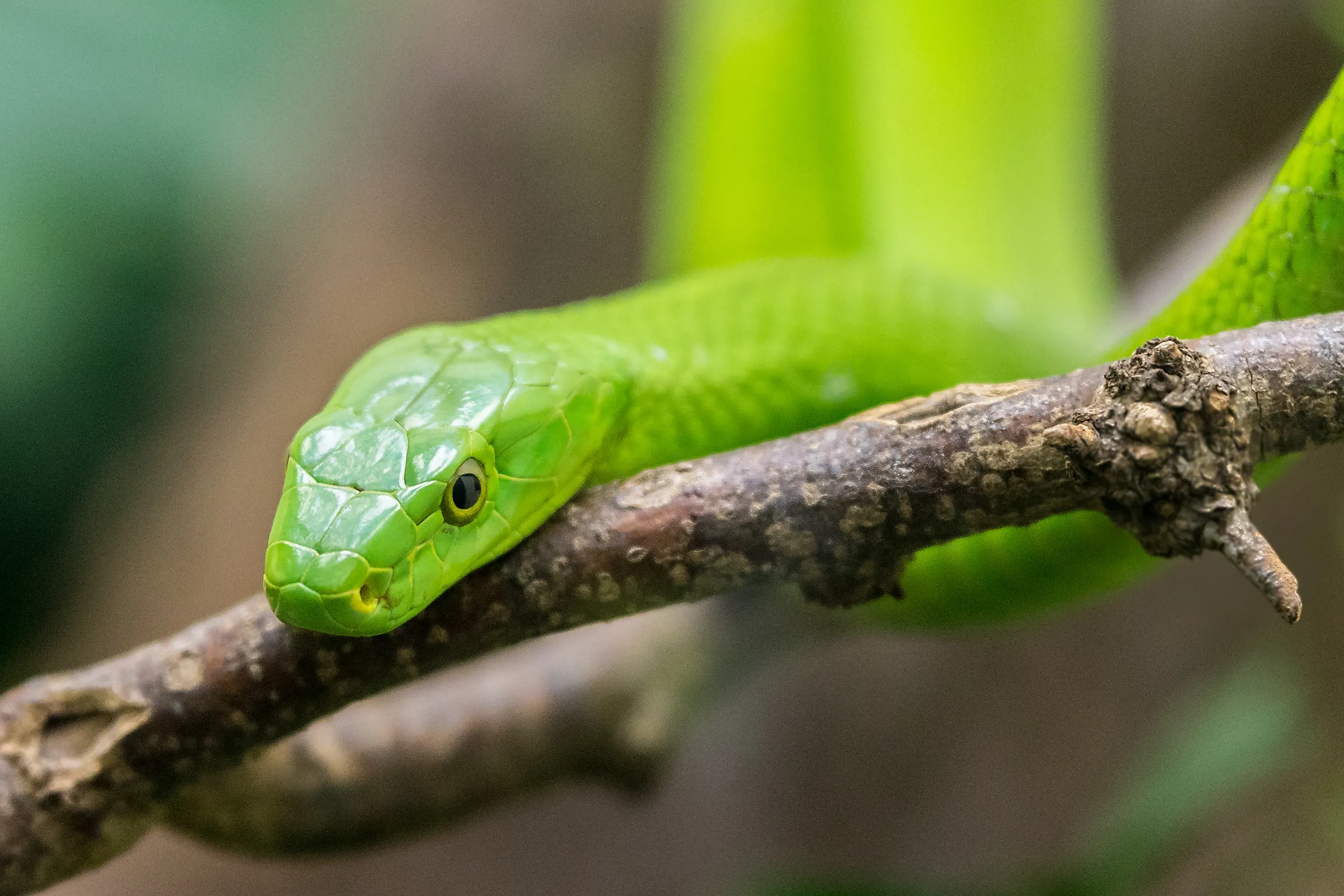
Close-up view of an Eastern Green Mamba (Dendroaspis angusticeps).
The Green Mamba is in the phylum Chordata, class Reptilia, order Squamata, family Elapidae, and genus Dendroaspis. The genus Dendroaspis has four main species: the black mamba, D. Polylepis, and three green mambas: the West African green mamba, D. Virdis, the Central African green mamba, D. Jamesoni, and the East African green mamba, D. Angusticeps. In Latin, Angustus means narrow, and ceps means head, making the East African green mamba a narrow-headed snake. In 1946, the South African herpetologist Vivian FitzSimons studied approximately 50 species of eastern green mambas and 85 species of black mambas. Through this research, he concluded that there were, in fact, differences between them, separating their species for the first time in history. Their coloration, their scales, their build, as well as their behavior, are what make the two distinguishable from one another, thus making them the different species they’re known as today. Before this was disproven, it was thought that younger mambas were green and turned darker or black as they got older.
Physical Description
An Eastern green mamba snake.
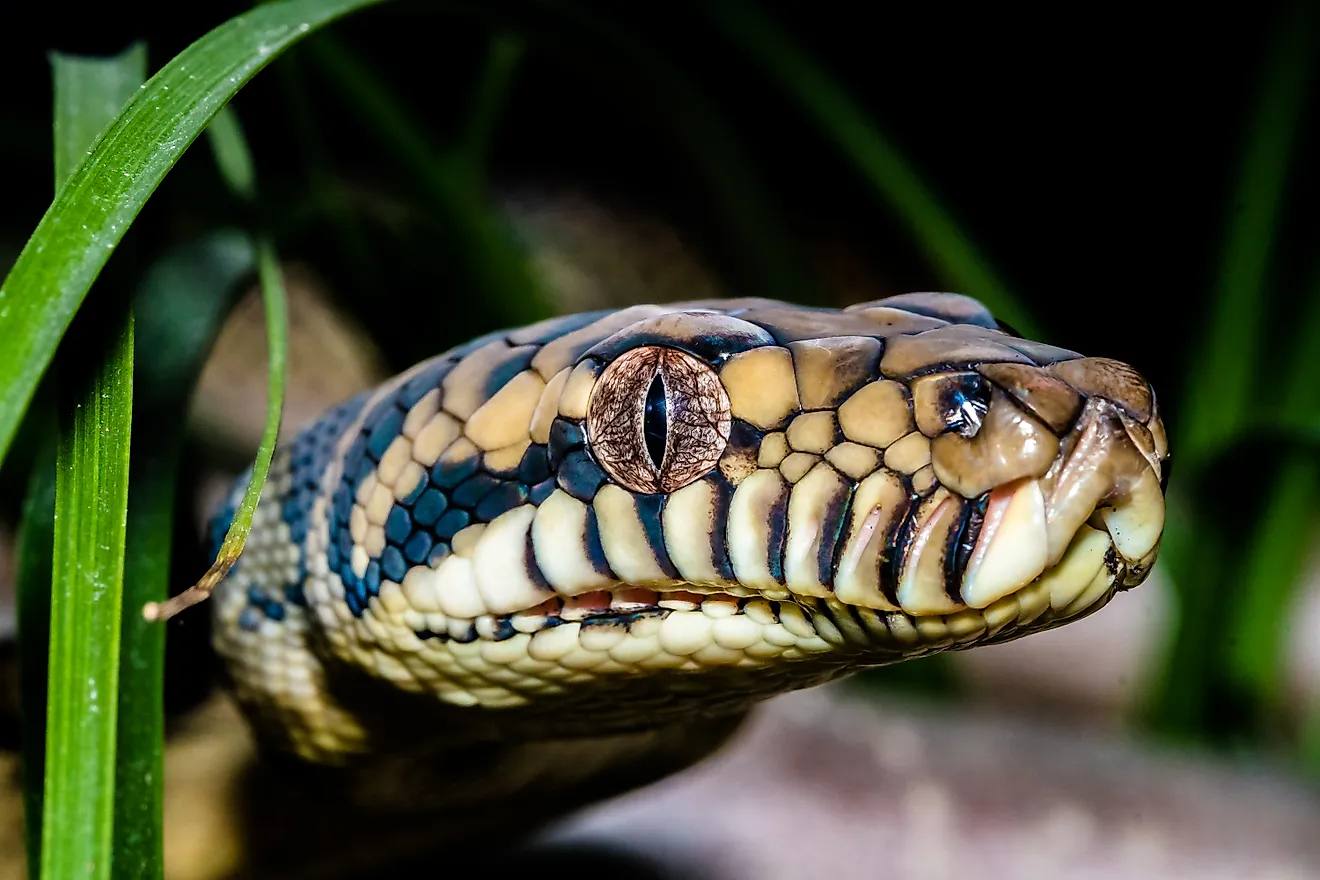
These snakes are bright and colorful, with vibrant emerald and lime green hues. Their velvety and silky scales shine brightly, illuminated by the sun. Flecks and shades of yellow seamlessly complement the green throughout their body; sometimes, an individual scale will be bright yellow, which helps them blend into their vegetative surroundings. They have smooth and glossy keratinized scales that overlap evenly. These scales protect them when moving around and over rough surfaces. Their heads have large scales, and they also have ventral scutes and locomotion, which allow them to grip onto branches without slipping. Their underbelly colors shift between light greens and pale or vibrant yellows. The Western green mamba can have scales with edges that range from black to yellow or orange near the tail. A juvenile's body color can range from dark turquoise or olive green to a mixture of blue-green colors, although their heads are always a lighter green than their bodies. Green mambas have coffin-shaped heads with medium-sized eyes. Their long, thin, slender bodies often grow to between 6 and 8ft. The combination of having a long tail and a narrow body allows it to move easily up in the trees. Since they are an Elapid, a snake belonging to the Elapidae family, their front fangs on their upper jaw are fixed and hollow, which produce their neurotoxic venom. Their colors allow them to camouflage themselves flawlessly, blending into vegetation without notice, which protects them from predators.
Range and Habitat
A green mamba snake in a tree.
Green mambas are native to East, West, and South Africa and are found near coastal regions, preferring tropical climates, coastal forests, and moist savannas. It is crucial that they live in a warm, humid climate. Eastern green mambas live in the coastal regions of Tanzania, Kenya, Mozambique, Malawi, eastern Zimbabwe, and KwaZulu-Natal on the eastern coast of South Africa. They live in mangroves, lowland tropical forests, and dense coastal bushes. The Western Green Mamba lives anywhere in between Senegal and Benin, all the way down towards Liberia, Ghana, Togo, and the Ivory Coast. These coastal tropical rainforests are a perfect habitat for them, as they spend most of their lives high up in the tree canopy. These forest canopies are dense and easy to move around, due to the large number of branches and vines. They don’t descend to the ground often unless to hunt or sunbathe.
Behavior and Diet
A South African green mamba.
Green mambas are quite fast; although they are not as fast as the black mamba, they still move at speeds up to 12 miles per hour. They can move this quickly, whether on the ground or up in the tree canopies, which is incredibly impressive. Their agility up in the canopies allows them to navigate the branches and brush with ease. This also means they are incredibly nimble, allowing them to act fast and with deliberate movements. Normally, they are shy and elusive and tend to avoid confrontation, leading them to flee or camouflage themselves into their surroundings when around possible predators. These solitary snakes are active during the day and rarely spend time on the ground. They spend their time sleeping up in the trees, coiled into heavy sections of leaves. Eastern green mambas can stay in the same exact location for days on end, moving only to hunt and feed themselves, or when it is time to mate. Certain species of green mambas only move about 18 feet per day, if at all.
Since they are ambush hunters and diurnal, active during the day, they rely heavily on their vision, hiding out and striking quickly, or chasing their prey with precision. Unlike other ambush snakes, they do not use heat-sensing pits or chemical trails to hunt. They strike at the speed of lightning, often striking multiple times in rapid succession. The mechanics of their head and neck allow them to move faster and strike quicker, even when hiding in thick vegetation. They are highly venomous, and although they can deliver fatal strikes easily, they are less unpredictable and less aggressive than the black mamba. Since they are tree-dwelling carnivores, they seek out birds, bird eggs, squirrels, bats, chameleons, rodents, and other arboreal mammals.
Reproduction
Eastern green mamba snakes.
Males roam around during the breeding season, tracking females by their scent. The mating season begins in April and continues until the end of June. When two male green mambas meet, they engage in combat with one another. Fighting on the ground, wrapping their bodies around one another, and trying to push the other snake's head down to the ground. They do this to show dominance and are fighting to decide which one will pursue the nearest female. Although the pre-mating rituals usually happen on the ground, when it's time to mate, they move up into the trees. Once two snakes have mated, the female seeks a warm, hidden cavity to lay her eggs. This is usually either a rotten log, a hollow tree, or a thick pile of leaves and vegetation. It must be an area with a stable temperature and high humidity. The incubation period is normally 10-12 weeks. The females will lay their eggs in the middle of summer, and their babies will hatch between March and April. Each clutch usually has between 4 and 17 eggs. Once they hatch, they are usually around 30-40cm long, but they grow extremely quickly. They begin shedding and growing into their adult forms at about 2 feet 6 inches long. This is also when they will develop their velvety, bright green scales. As juveniles, they also have a darker inner jaw color that fades over time into the white-pink color seen in adults. Captive green mambas have lived up to 18 years.
Threats and Importance
A heron catching a green mamba in Tanzania.
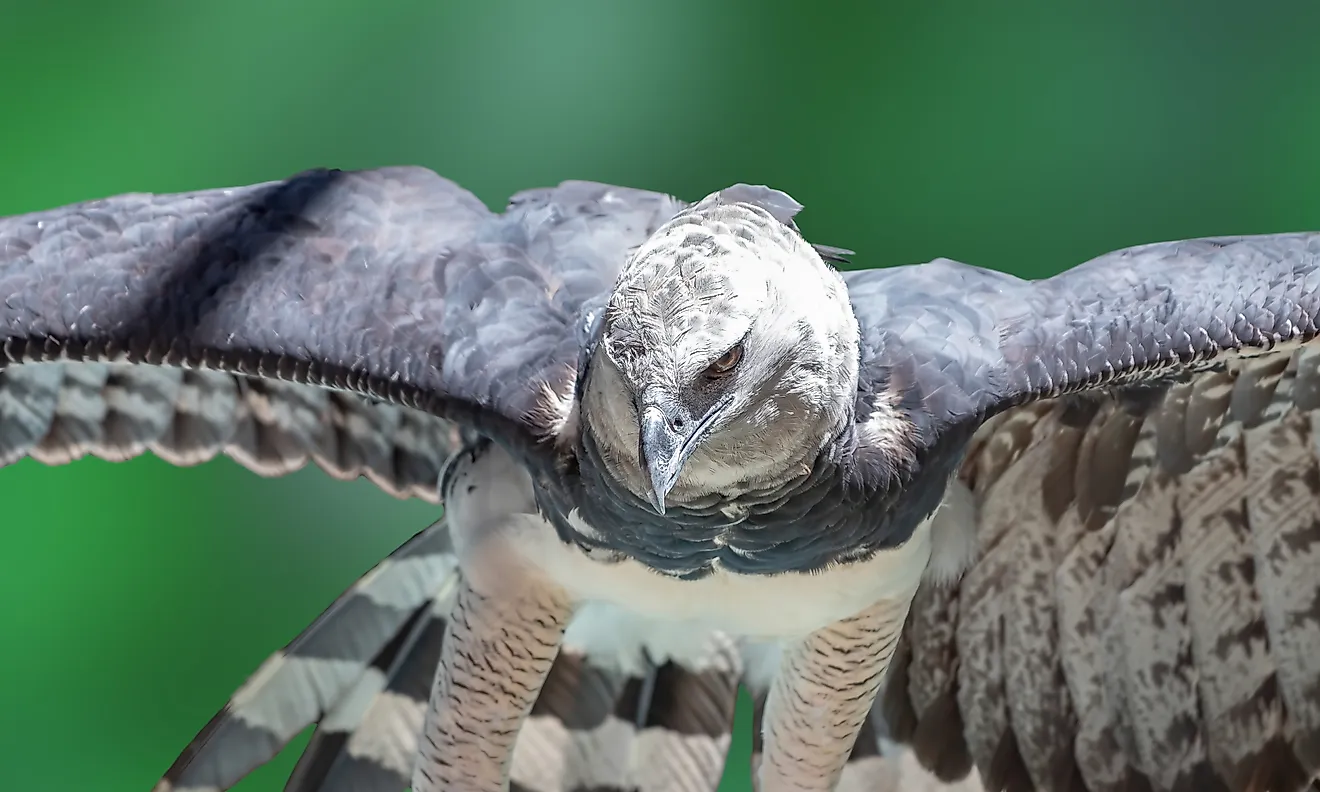
Green mambas are ecologically important because they are a top predator in their ecosystems and their food chain. They control rodent, bat, and bird populations, keeping them in balance. The populations of these snakes are stable, but their threats include human harm, habitat destruction, and deforestation. Their predators include large birds or prey like the African Harrier-Hawk, serpent eagles, mongooses, and genets. Due to their potentially fatal bites, they are often killed by humans when spotted near settlements or towns, and especially when seen in a home. Many of the areas they inhabit in South Africa are being turned into urban developments, which negatively impacts their habitats, forcing them to move around, and in turn, making humans a larger threat to them as they are encountered more often.
Although these slithering mambas are a stunning species, they are not so sweet. Despite being less aggressive than their relative, the black mamba, they can still be potentially fatal and warrant caution. Other non-venomous snakes are often commonly mistaken for these beautiful and vibrant green mambas, due to the similarity in their shape and color. It is important to recognize the differences to distinguish between dangerous and non-dangerous species. Luckily, they will try to avoid you as much as you’ll try to avoid them, and if you’re lucky enough to see one in the wild from a safe distance, that is an incredibly special snake encounter.