Honey Badger
The honey badger (Mellivora capensis) is among the most resilient carnivores in Africa and Asia. This stocky member of the weasel family survives in environments ranging from dry savannas and rocky grasslands to mountain regions and sparse forests. Known for raiding beehives, hunting venomous snakes, and defending itself against much larger predators, the honey badger has earned a reputation for intelligence, persistence, and toughness.
Despite its common name, the honey badger is not a true badger. Scientists classify the species within the family Mustelidae alongside otters, ferrets, and wolverines. Thick skin, powerful foreclaws, and a highly opportunistic diet allow honey badgers to thrive across a vast geographic range that stretches throughout much of sub-Saharan Africa and into parts of the Middle East and South Asia. In addition to their reputation as fearless hunters, honey badgers also play an important ecological role through predation, scavenging, and digging behavior that influences surrounding ecosystems.
Taxonomic Classification

Scientists classify the honey badger as Mellivora capensis, a mammal within the family Mustelidae, which also includes otters, ferrets, martens, and wolverines. German zoologist Johann Christian Daniel von Schreber first described the species in 1776. Although the animal carries the common name “badger,” researchers place it outside the group of true badgers in the genera Meles and Arctonyx. True badgers form a distinct evolutionary lineage within the mustelid family, while honey badgers diverged from this group along a separate branch around 2.5 million years ago. Although honey badgers share traits with true badgers, including a stocky body and strong digging ability, these similarities reflect convergent evolution rather than close evolutionary relationship. Instead, the honey badger belongs to its own genus, Mellivora, and its own subfamily, Mellivorinae.
The species falls within the order Carnivora and the phylum Chordata under the kingdom Animalia. Researchers also commonly refer to the honey badger as the ratel across parts of Africa and Asia. Subspecies include the Ethiopian ratel, Arabian ratel, and Indian ratel.
Range and Habitat

Honey badgers have one of the widest geographic ranges of any member of the weasel family. Their coverage extends across much of sub-Saharan Africa and into parts of the Middle East and South Asia, including Saudi Arabia, Iran, Turkmenistan, Afghanistan, Nepal, and western India. Populations also live from southern Morocco to South Africa and across portions of western Asia.
This species can adapt to a vast swathe of environments, including savannas like the Serengeti in Tanzania, grasslands found across the South African Highveld, semideserts, and mountainous regions including sections of the Atlas Mountains in North Africa.
Honey badgers are semifossorial animals that spend a significant amount of time digging and sheltering underground. They frequently construct their own burrows, which may extend up to 9 feet in length and 5 feet in depth. In other areas, they use abandoned dens created by aardvarks, foxes, porcupines, mongooses, and other species. Rock crevices, hollow trees, old termite mounds, and exposed root systems also serve as resting sites.
Home range size varies depending on food availability and habitat quality. In parts of southern Africa, particularly in regions such as Namibia’s Namib Desert and Botswana’s Kalahari Basin, individual honey badgers may travel across territories measuring as much as 193 square miles (500 square kilometers).
Physical Description

The honey badger has a compact, muscular body built for strength and digging. Short but powerful legs support the animal’s low frame, while long front claws help it excavate burrows and defend itself from predators. Adult honey badgers typically measure 22 to 30 in in body length and stand about 9 to 12 in tall at the shoulder. Their tails add another 5 to 12 in in length. Most adults weigh between 13 and 30 lbs, and males generally grow larger than females.
Coloration gives the species one of the most unique appearances among mustelids. Most honey badgers have black fur across the legs, underside, and lower body, while a broad gray or white stripe extends from the top of the head down the back and toward the tail. This contrasting pattern is common across the species as a whole.
Honey badgers also possess several physical adaptations that improve their survival. Their skin is unusually thick and loose, allowing them to twist around even when another animal grabs them. This flexibility helps the honey badger bite and defend itself during confrontations. Scent glands near the base of the tail release a strong odor used for territorial marking and defense, similar to the defensive spray produced by skunks.
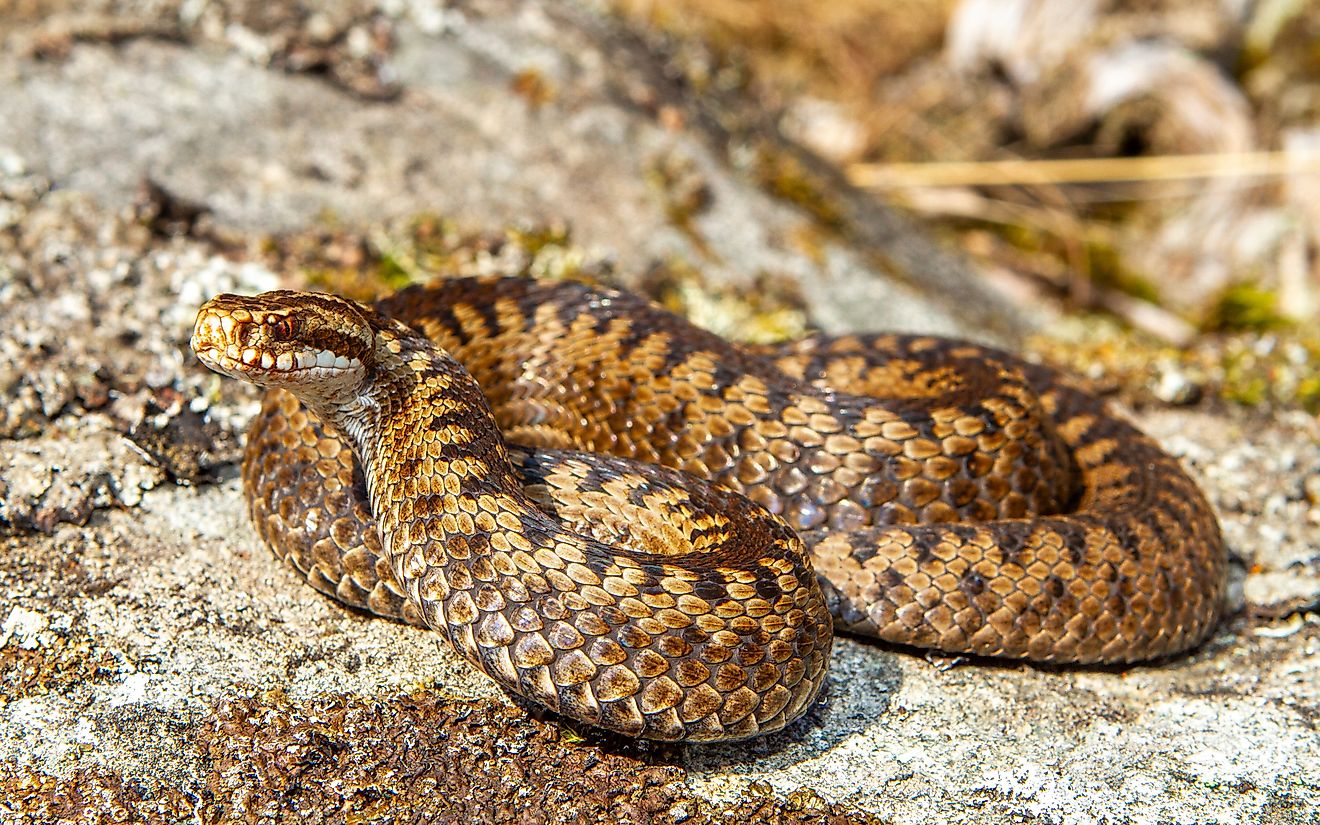
The species can also withstand several natural hazards that injure other animals. Honey badgers show notable resistance to bee stings during hive raids, porcupine quills encountered while attacking or scavenging in scrubland habitats, bites from territorial domestic dogs near human settlements and livestock areas, and venom from several snake species, including puff adders (Bitis arietans) and cobras.
Ecological Importance

Honey badgers occupy an important role in ecosystems as both predators and scavengers. As mesopredators, they help regulate populations of rodents in savanna systems, reptiles including small monitor lizards and agamas, and insects like beetle larvae and termites. Their hunting of snakes, including venomous species, can influence local reptile community dynamics by reducing pressure on small prey species and changing predator-prey interactions within grassland and savanna food webs.
In addition to predation, honey badgers support nutrient cycling through scavenging. By consuming carrion, they help break down organic matter and return nutrients to the soil. Their digging behavior further supports these processes by aerating compacted soil in savanna and grassland habitats, redistributing nutrients through the breakdown of termite mounds and abandoned rodent burrows, and creating small patches of disturbed ground that encourage seed germination and early plant growth. These excavations also form microhabitats that can be used by insects, reptiles, and small mammals seeking shelter or cooler ground conditions. In this way, honey badgers function as minor ecosystem engineers in some habitats, shaping microenvironments through their activity.
Diet

Honey badgers are opportunistic omnivores with a highly varied diet that reflects their adaptability across diverse environments. While they actively hunt a diversity of small animals, they also scavenge and consume plant material when available, allowing them to persist in habitats where food availability changes seasonally or unpredictably, like the Kalahari savannas of Botswana and South Africa, where rainfall patterns strongly influence rodent and insect abundance throughout the year.
The honey badger's diet includes rodents and other small mammals, birds and eggs, reptiles including snakes, amphibians, insects, scorpions, carrion, fruits, berries, roots, and bulbs, as well as honey and bee larvae. This vast dietary breadth supports their survival in both arid and more resource-rich ecosystems.
Honey badgers are particularly well known for raiding bee colonies. Their thick skin and partial resistance to stings allow them to endure defensive attacks while they feed on honeycomb and larvae. Using strong foreclaws and sharp teeth, they tear open hives, dig into burrows, and break apart carcasses to access food sources that many other animals cannot exploit.
They also take advantage of opportunities to steal food from other predators when encounters occur, sometimes taking kills from cheetahs on the East African savannas or scavenging carcasses left behind by leopards in scrubland habitats of Namibia.
Behavior

Honey badgers are primarily solitary animals, although mating pairs occasionally remain together for short periods. They are generally nocturnal and spend much of the night traveling considerable distances in search of food. In regions with minimal human disturbance, for example, remote semi-arid areas of Namibia’s Etosha region, they may also become active during the day, adjusting their patterns in response to environmental conditions.
Honey badgers demonstrate high levels of intelligence and adaptability. They are capable climbers, strong swimmers, and efficient diggers, using these skills to access a wide array of resources. Observations in wildlife facilities and nature documentaries have documented the honey badger’s problem-solving abilities. At the Moholoholo Wildlife Rehabilitation Centre in South Africa, captive honey badgers repeatedly escaped secured enclosures by stacking logs, moving rocks, and using tools like rakes to climb fences. Other observations have recorded individuals opening latches, pulling apart coverings, and manipulating obstacles to reach enclosed food sources.
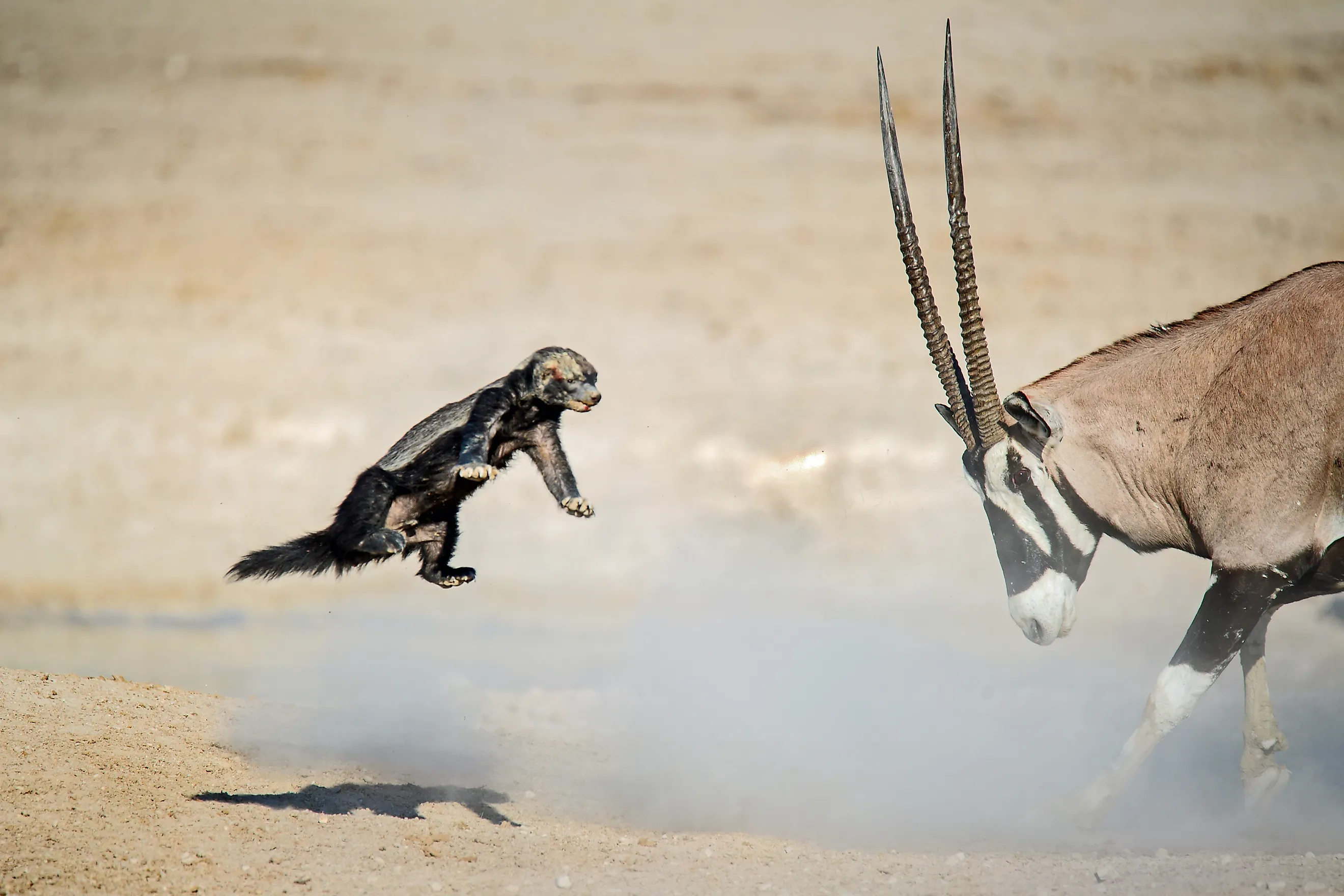
When threatened, honey badgers respond with strong defensive behavior. They use a spectrum of vocalizations, including growls, hisses, whines, squeaks, and grunts, to communicate distress or warning signals. Their reputation for boldness stems from their willingness to confront much larger animals, including hyenas and lions, when they feel cornered.
During daylight hours, honey badgers typically rest in burrows or other sheltered spaces. While resting, they often curl their bodies to protect their vulnerable faces and abdomens, using enclosed spaces for added security and temperature regulation.
Reproduction

Honey badgers reproduce throughout the year, with no clearly defined breeding season. Females typically give birth to a single cub, although twins occasionally occur.
Following a gestation period estimated at seven to ten weeks, females give birth in a secure underground chamber, often inside a self-dug burrow or an abandoned aardvark den lined with dry grass, leaves, and loose vegetation that helps insulate and protect the cubs during early development. Newborn cubs are blind, nearly hairless, and fully dependent on their mother during the earliest stages of life.
Development occurs quickly during the first months. Cubs open their eyes at around one to two months of age, while the distinctive white dorsal stripe begins to appear within several weeks after birth. By approximately three months, young honey badgers start to follow their mother outside the den. Weaning takes place at about six months of age.
Young honey badgers often remain with their mother for an extended period compared to many other carnivores. Some individuals stay for more than one year, and occasionally up to two years, as they continue developing hunting and survival skills through observation and gradual independence. By contrast, many small carnivores, including foxes and mongooses, typically become independent within only a few months after weaning.
Female honey badgers provide all parental care, raising and protecting their young without assistance from males.
Threats and Conservation

The honey badger is currently classified as a species of Least Concern on the IUCN Red List due to its vast distribution and adaptability. However, several regional populations continue to experience decline as local pressures increase across parts of their range, particularly in densely populated areas of India, agricultural regions of southern Africa, and sections of the Middle East where habitat fragmentation and human conflict have intensified.
Human activity is the primary set of threats facing the species. Habitat loss driven by agricultural expansion and infrastructure development reduces available territory, while ongoing conflicts with farmers and beekeepers contribute to direct persecution. Beekeepers often view honey badgers as destructive pests because the animals can tear apart traditional ground-level hives to access honey, bee larvae, and wax, sometimes damaging multiple hives during a single raid. Additional factors like accidental trapping in snares set for other wildlife, poisoning near livestock and apiaries, hunting for bushmeat and traditional medicine in parts of Africa, and road mortality along expanding rural transportation corridors, are factors that reduce local population stability.
Despite these challenges, honey badgers face relatively few natural predators once fully grown. Lions, leopards, and spotted hyenas may prey on younger or vulnerable individuals, although healthy adults often defend themselves successfully due to their strength and aggressive behavior.
Future
The future of the honey badger depends largely on how effectively human activity and wildlife conservation efforts align across its habitat. Although the species remains widespread, increasing agricultural expansion, habitat fragmentation, and local human conflict continue to place pressure on certain areas of the species' population.
Conservation strategies that reduce conflict between honey badgers, farmers, and beekeepers have shown measurable success in several regions. Improved hive protection systems, habitat preservation initiatives, and community education programs help reduce retaliatory actions while supporting more stable coexistence between people and wildlife. These approaches also support larger ecosystem balance by allowing honey badgers to continue their ecological role as opportunistic predators. This hearty species is expected to remain resilient throughout the world, however, continued monitoring and region-specific conservation remain important to ensure that localized population declines do not become more widespread.