Nile Monitor
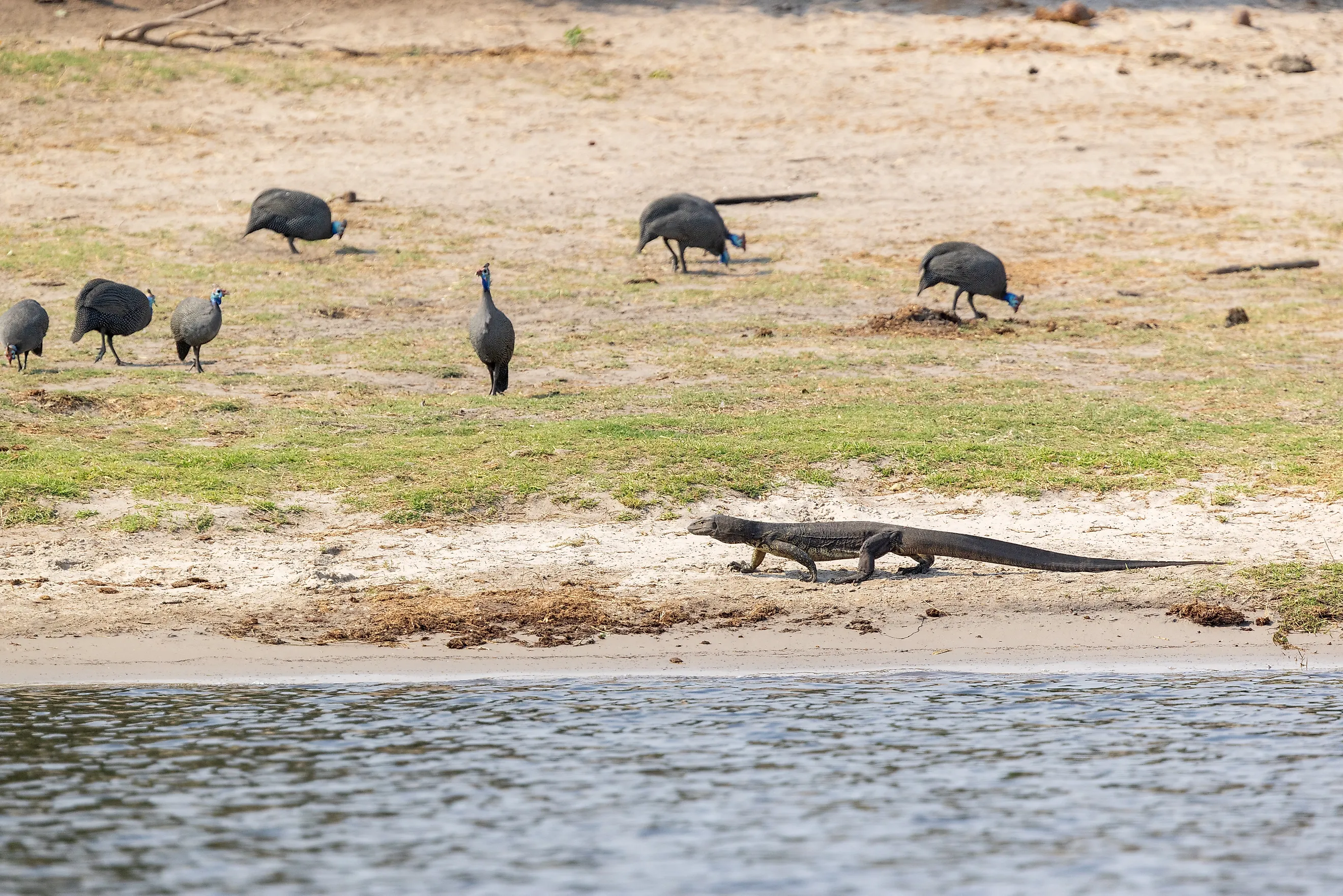
Slinking around the waterways of sub-Saharan Africa, the Nile Monitor lizard (Varanus niloticus) is usually doing one of three activities: hunting, swimming, or basking. It's not uncommon to see these powerful reptiles perched high atop a pile of hot rocks, soaking up the sun. As a cold-blooded (ectothermic) reptile of the monitor family (Varanidae), they require external heat to regulate their body temperature and digest food. In terms of appearance, the adults are typically dark gray-brown to olive-green, splotched with faint, yellowish, or cream-colored spots.
The Nile monitor is one of Africa's largest lizards, with most specimens growing to a length of 5 ft (a little over 1.5 meters) and a typical weight of around 7 kg (15 pounds), though some can grow larger. They can be physically imposing, with powerful jaws and sharp claws, and should be considered dangerous to humans. The Nile monitor will whip its considerably muscular tail at perceived threats, often while hissing, when challenged or cornered, which is worth steering clear of.
Range, Diet, and Habitat

A particularly interesting facet of the Nile monitor is its semi-aquatic nature. When not prowling land for prime warming spots, it actively hunts in water for fish, frogs, and insects. As one would expect, the species' ideal settings are wetlands, rivers, and mangrove swamps, tending to avoid deserts, though they are highly adaptable and can handle relatively dry climates. Waterways are also an escape mechanism for monitors, which can remain submerged for 10 minutes at a time. In terms of geographical range, they are found in Senegal in the west of Africa, stretching over to Somalia in the east, and even down into northeastern South Africa. Of course, they are also often seen patrolling throughout the Nile River valley and its tributaries (as well as southern Egypt).
Physical Description

These lizards spend a great portion of their lives swimming around, stalking the waterways they inhabit, and as a result, they have very muscular bodies (and are also excellent climbers and burrowers). As previously mentioned, they have rather sharp claws as well as a non-regenerative, durable, heavy-duty tail. Their tails are somewhat compressed, which allows them to also use that appendage as a paddle for swimming. Once again, the adults feature a gray-brown or dark olive base color, while the juveniles feature more vivid, high-contrast patterns of bright yellow or cream spots amidst a black backdrop. Their heads are typically narrower and wedge-shaped, with a pointed snout, and their nostrils are located higher up (in order to assist with breathing while submerged).
Behavior

Like most reptiles, the Nile monitor is a decidedly diurnal creature (operating during daylight hours) and is also known for being both solitary and unusually aggressive. They will not hesitate to stand their ground if threatened, and they possess several physical and non-physical deterrents in that regard. For instance, the usual retaliatory posturing, which could include stiff-legged stances, hissing, or throat inflation (clearly indicating that one should back off) might also come alongside the emission of a foul odor. The Nile monitor is also something of a frantic feeder, often seeming like it is in desperation mode, eager to secure its next meal quickly, even if that is not the case (a trait often attributed to environment-based evolution or adaptation). It should also be noted that these are highly intelligent lizards, not only in the wild when hunting or evading predators, but also in captivity. They are said to be amazing escape artists, but also have shown cooperative hunting behavior, having been observed working together to more effectively raid crocodile nests. One monitor acts as a distractor, while another steals eggs.
Reproduction

It doesn't take very long for Nile monitors to reach sexual maturity, which occurs at roughly 2 to 4 years of age. The rainy season is their optimal time for romance (or just shortly thereafter). A typical nest will be a clutch of 20 to 60 eggs, often coupled with an active termite mound where heat and humidity provide ideal incubation conditions. Once again, these clever creatures use these insects in a symbiotic fashion, much to their advantage, as the termites will repair the hole dug by the expectant mother. After 6 to 9 months, the hatchlings will emerge of their own accord, already 8 to 12 inches long and very fast-moving as well. In terms of mating habits, Nile monitors are polygynandrous, and will have multiple partners throughout their lives. Typically, males will track females by scent, followed by somewhat violent wrestling matches between other males competing for female attention.
Ecological Impact

Aside from the Nile monitor's ecological importance (in balancing waterways or itself acting as sustenance for elements of the larger environment), it is also a storied animal with links to the Egyptian God Sobek, the crocodile god of strength and the Nile. Similarly, many cultures have seen these lizards as "guardian spirits of rivers", with several indigenous groups admiring the lizard’s stealth, strength, cunning, and resilience. Some local communities even use them as a food source, trade their hides, or extract oil from these animals for use in native medicines.
However, their strongest positive ecological impact lies in their real-world ability to stabilize pest populations along critical waterways. Specifically, this includes the regular hunting of "rodents, insects, fish, and even venomous snakes", all of which helps provide natural limits to any one species' population. Additionally, they feed on carrion, or decaying organic matter, which helps to prevent the spread of disease throughout the environment. Perhaps one of their most critical balancing jobs, however, is their natural limit to crocodile populations. The Nile monitor is known to aggressively and specifically seek out crocodile eggs and hatchlings, thereby helping to maintain lower numbers of these gigantic, ferocious predators.
Modern researchers and environmental scientists are even using Nile monitor lizards these days as a sort of living litmus test. In short, because these lizards are sensitive to toxins and tend to be quite mobile, they can be used to effectively evaluate waterway health issues (specifically, the presence of industrial pollution or heavy metals in an environment).
Modern Threat and Invasive Species Listing
The Nile monitor sits near the top of the food chain and is listed as a species of Least Concern for endangerment, so generally, humans are the primary threat to these animals, often through habitat destruction. In Florida, however, Nile monitors have been listed as an invasive species, and therefore are subject to "eradication campaigns". Florida's Everglades are ground zero for dumping of unwanted exotic pets, and unfortunately, Nile monitors taken as pets are often discarded for their size, aggression, restlessness, and general unsuitability for home life. What makes them less than ideal pets makes them highly adaptable in a climate that matches their home turf. When released in Florida's swamps, Nile monitors generally travel where they want and eat what they like, as generalist feeders, crowding out native species which are already struggling for a spot in their own habitat. Currently, a large percentage of the Everglades' 350 native species are endangered, primarily due to invasive species.