Gray Wolf
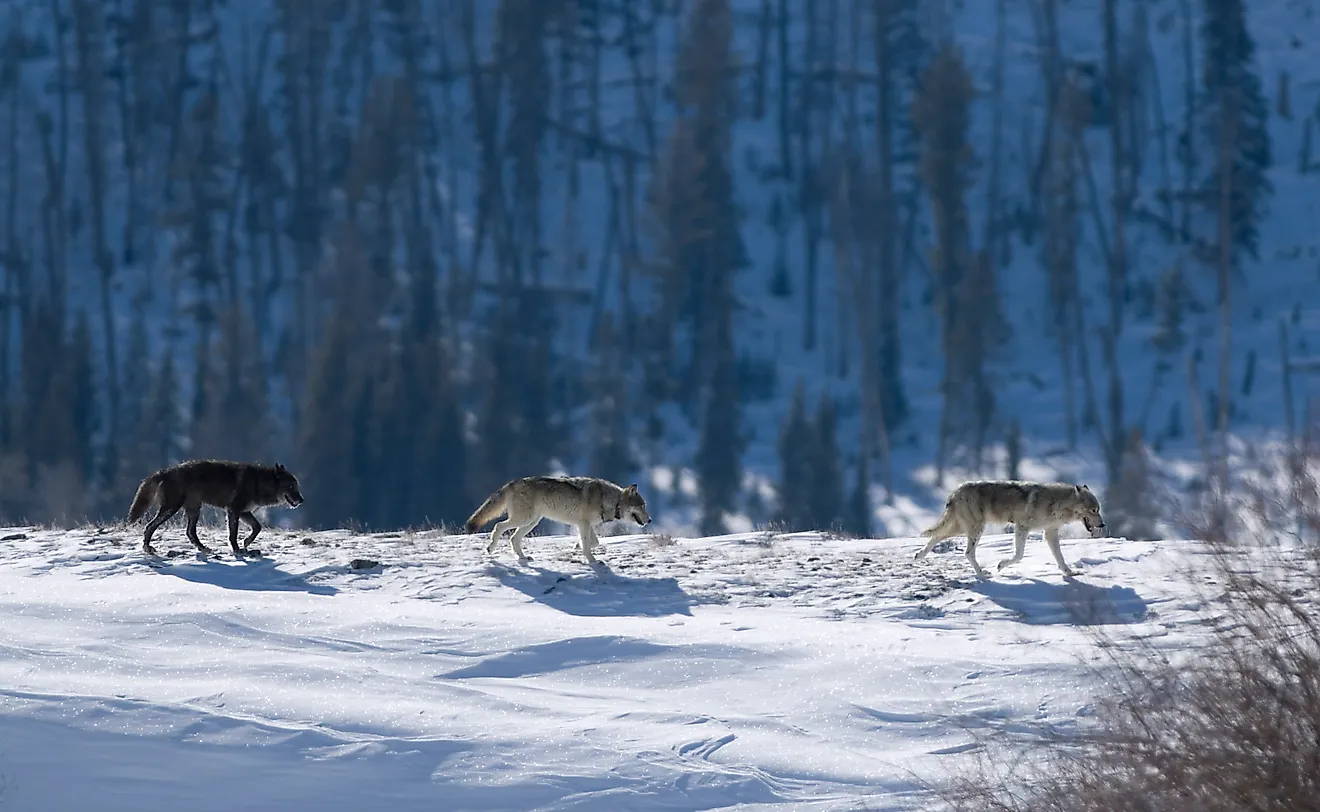
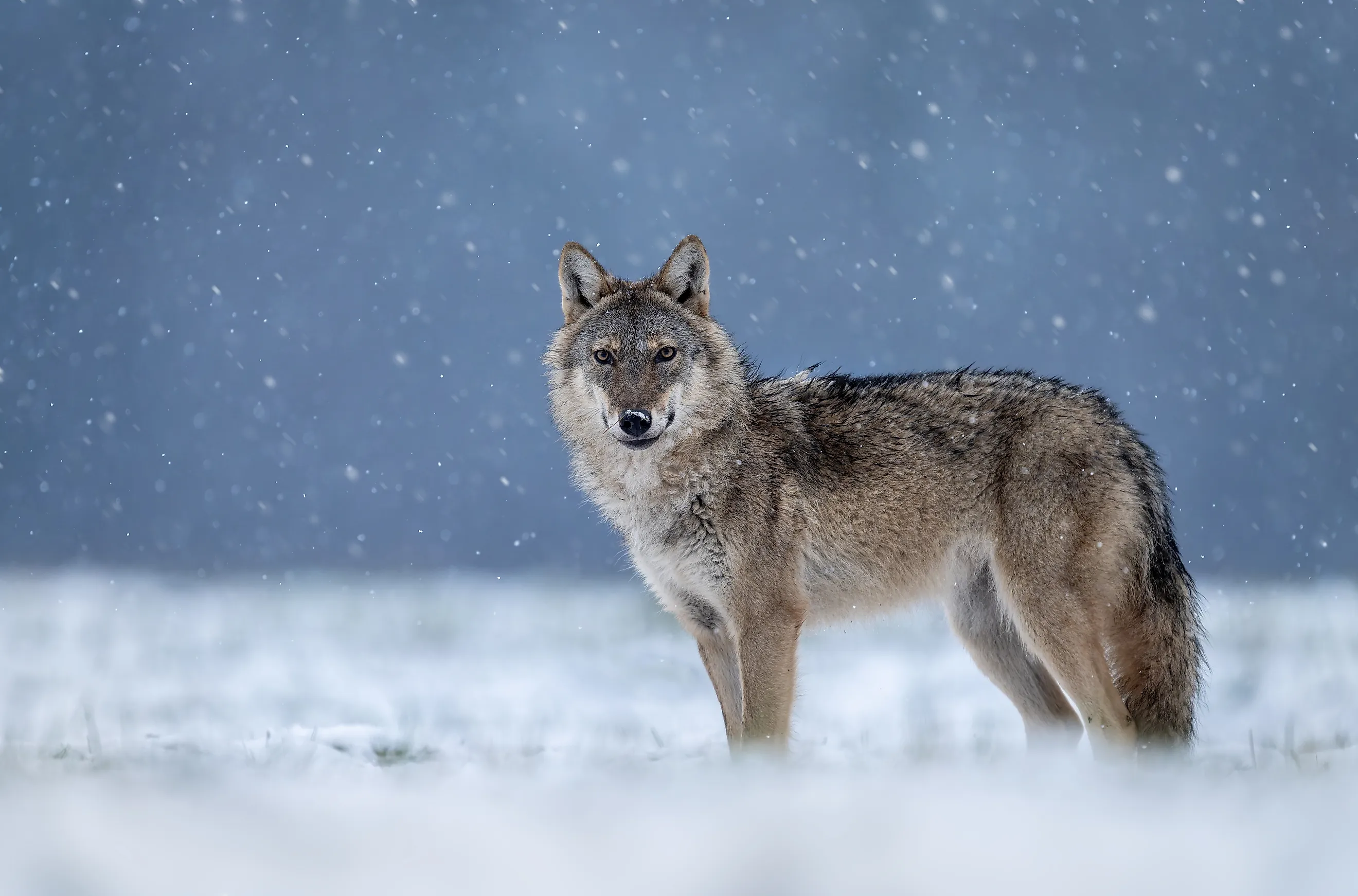
The gray wolf is the largest member of the Canidae, or dog, family. It is the most common wolf species and is found throughout the Northern Hemisphere, in North America, Europe, and Asia, with small numbers in North Africa, although there is some dispute over whether the African wolf is a separate species. Gray wolves are known for their social pack structure, and despite the name, come in a range of colors, including gray, black, white, and brown. They live in a variety of habitats, including tundra, mountains, forests, and grasslands.
Hunting in packs, gray wolves are primarily carnivorous, feeding on large mammals such as deer, elk, moose, and bison. Gray wolves are related to domestic dogs and coyotes, and they are listed globally as Least Concern. Mostly secure in Canada and Alaska, elsewhere, many populations are endangered or heavily managed. After near-extinction, populations in the Great Lakes and Northern Rockies have recovered but still face threats from human encroachment.
Taxonomic Classification And Subspecies

There are generally two extant wolf species accepted: the gray wolf (Canis lupus) and the red wolf (Canis rufus), native to the southeastern United States. The eastern wolf (Canis lycaon) is increasingly recognized as a separate species from the gray wolf, although it is often listed as the subspecies Canis lupus lycaon.
There are over 30 recognized subspecies of gray wolf, including up to five in the United States and Canada: arctic wolf (Canis lupus arctos), northwestern wolf (Canis lupus occidentalis), Great Plains wolf (Canis lupus nubilus), Mexican wolf (Canis lupus baileyi), and sometimes the eastern wolf, or eastern timber wolf. The gray wolf is also known by several non-scientific names, depending on location. This includes timber wolf, the spelling variant of grey wolf, and sometimes simply wolf.
Range And Habitat

The gray wolf was once the most widely distributed land mammal other than humans. At one point in history, gray wolves were found across almost all available land in the Northern Hemisphere, in North America, Europe, and Asia. Wolves thrived in many different habitats, including forests, grasslands, and tundra. With human encroachment, habitat loss, hunting, and other human activities, wolves have lost one-third of their historical range. In the 20th century, wolves were almost eradicated in the contiguous United States, Mexico, and Western Europe.
Currently, the largest and most stable wolf populations are found in Canada and Alaska, with over 60,000 in Canada and around 11,000 in Alaska. In the contiguous United States, wolves are found in the Western Great Lakes, in Minnesota, Wisconsin, and Michigan; in the Northern Rockies, Idaho, Montana, and Wyoming; and in the Pacific Northwest, in Washington, Oregon, and Northern California. A small population was reintroduced in the Southwest United States and northern Mexico. In the contiguous United States, the gray wolf population is between 5,500 and 6,000 and is growing, with 286 individuals in the US Southwest according to the Wolf Conservation Center. In Mexico, approximately 50-60 Mexican gray wolves (Canis lupus baileyi) are found, primarily in Sonora and Chihuahua.

In Russia and Asia, there are over 65,000 gray wolves, with ranges extended through China, Mongolia, and Western Asia (Israel, Saudi Arabia, and Iran). European populations are recovering, with wolves found in Poland, Germany, Italy, France, and Scandinavia. The current population of gray wolves in Europe, excluding Russia, is between 20,300 and 21,500, a 58% increase over the previous decade. There are also some limited populations in Northern Africa, particularly for the Egyptian wolf (Canis lupaster lupaster), a subspecies of the African wolf (Canis lupaster), itself a subspecies of the gray wolf, although it is increasingly recognized as a separate species. Due to their elusive nature and sparse available data, the population of the Egyptian wolf is unknown.
Physical Description

The gray wolf is the largest member of the Canidae family. Standing at 27-33 inches (69-83 cm) tall at the shoulder, they weigh between 60 and 120 pounds (27-54 kg). Their build is powerful, yet lean, and they have long legs and large feet. The torso is deep-chested and narrow, and is ideal for running, and the muzzle is narrow, while the skull shape is fairly broad. The coat is a dense double coat composed of coarse outer guard hairs and a thick undercoat, with color variations. All wolf species have strong senses of smell, hearing, and vision.
Physical Variants
Adult males are larger than females, with males weighing 65-175 pounds (29-79 kg) and females weighing 50-120 pounds (23-54 kg). The total length from nose to tail ranges from 4.5 to 6.5 feet (137-198 cm). Gray wolves found in Alaska and Canada tend to be larger than those found in southern climates. There are several color variations, and they often include mixtures. The colors include gray, brown, cinnamon, white, and black, and some are entirely white or black. In Arctic populations, white is the most common fur color, whereas in temperate forest populations, gray and black color phases are more common.
Distinction From Other Canids
Gray wolves are 50-100% larger than coyotes, with broader, less pointed ears. Red wolves are smaller than gray wolves, and they have a much narrower muzzle. Domestic dogs, of course, come in a vast array of sizes and shapes, and are the most varied animal species on Earth, albeit as bred by humans. On the whole, gray wolves tend to have narrower chests, large paws, and legs that turn outward.
Diet And Behavior

Gray wolves are primarily carnivorous, relying mostly on ungulates, such as deer, elk, moose, caribou, and bison. They are generally the apex predator in their territory. Gray wolves are also highly opportunistic and will forage for smaller mammals, such as beavers and hares, fish, birds, and even carrion, particularly when other food is scarce. They have a limited intake of fruits and grass. Diet also varies depending on geography: Arctic wolves prey primarily on caribou and musk oxen, while European and Asian gray wolves hunt wild boar, wild sheep, and various species of deer.
If wolves live near farms, they may hunt domesticated animals such as sheep, cattle, and horses, though this accounts for less than 3% of their diet. Gray wolves are pack hunters, which allows them to take down prey much larger than themselves. Ungulates form over 80% of the gray wolf’s diet, while in the summer months, their diet may include a wider variety of food. Wolves are gorgers; they eat almost every part of their prey, other than bones. They can go without food for several weeks before gorging on up to 20 pounds at a time.

As a pack, wolves work cooperatively, using strategic hunting formations to isolate and exhaust their prey. This would include preying on weak or young individuals in a herd. Typically, they use a surrounding tactic, spreading out to encircle the prey and force a chase. The experienced wolves initiate the hunt and direct the attack.
The commonly held belief that an “alpha male” leads the pack and asserts its dominance by fighting other males is a myth. Wolf packs are not a rigid hierarchy with one male wolf in charge. Wolf packs are family units led by a mother and father who both guide their offspring. When hunting, the more experienced wolves will take the lead, but not in the sense that one male is always in charge of the pack.
Pack Structure And Family Units

As highly social animals, gray wolves generally live in packs of up to about 15 members. Together they hunt, raise the youngest offspring, and defend their territory. A pack is a family, normally made up of a breeding pair and their offspring of different ages, from pups to 2- and 3-year-olds. The breeding pair leads the pack, guiding the young and making decisions. Gray wolves reproduce once a year, usually between January and March. Wolves are monoestrous, producing one litter per year, with a gestation period of 60 to 63 days. Pups are usually born in the spring, in litters of 4-6, born in a den. The entire pack takes care of the pups.

Wolves are sexually mature between 22 months and up to three years. Between ages 1 and 3, young wolves will normally leave their parents’ pack and seek out a mate, forming a new pack in a new territory. A pack will be broken due to death or disease, or if a large number of offspring leave the pack at once. The pack helps to raise the pups by bringing food and protecting them. As a pack, they will hunt together, with the breeding pair usually taking the lead. This is also how older offspring learn the skills they need to lead their own packs. Pack territories can range from 20 sq. mi to over 1,150 sq. mi, depending on available prey.
Importance To The World

As apex predators, gray wolves play an important part in maintaining ecological balance and biodiversity. As a keystone species, gray wolves play a crucial role in the ecosystem. By maintaining the ecosystem structure, the absence of gray wolves, through hunting or habitat loss, can lead to negative ecosystem changes or even collapse. They control prey populations, especially ungulates, thereby preventing overgrazing by not only thinning herds but also moving ungulates to new grazing locations.
Gray wolves, through hunting, also provide food for scavengers and lifeforms that feed on decaying matter. The cycle encourages vegetation recovery and maintains the populations of other small mammals, birds, and fish. Gray wolves also aid ungulate herds by weeding out the sick and weak, thereby strengthening the herd over time. Another consequence of gray wolf preservation is the impact on wildlife preserves and national, state, and provincial parks.
Threats

Primarily driven by human activity, threats to the gray wolf include habitat loss, illegal hunting and culling, and lethal measures taken due to livestock conflicts. Populations are stable but are under constant threat from human encroachment, reduced prey availability, and hybridization risks, particularly breeding with domestic dogs and coyotes.
With habitat fragmentation, wolf populations become isolated, leading to inbreeding, particularly in the Mexican gray wolf. In Canada, populations are stable, and in some areas, increasing, but there remain localized pressures from land-use changes, especially in the southern reaches of gray wolf territory.
Human-wolf conflict remains the biggest threat to gray wolves, not only through habitat destruction and fragmentation, but also because of fear and ignorance. Wolves continue to be trapped, shot, or poisoned due to livestock predation. Further infrastructure incursion into wolf territory, in the form of roads and pipelines, shrinks the habitat of wolves, thereby limiting space for survival.