9 Overlooked Towns In The Northern United States Worth Visiting
Some of the most compelling corners of the Northern United States are also some of the region's best-kept secrets. Take Lubec, Maine, for example. Here, the candy-striped West Quoddy Head Light rises at the easternmost point of the contiguous United States, a short bridge crossing from Canada's Campobello Island. Houghton lifts the double-deck span of its 1959 Portage Lake Lift Bridge to let ships through the Keweenaw Waterway. In Chisholm, riders explore 25 miles of singletrack at Redhead Mountain Bike Park, carved into the red-rock walls of a reclaimed iron mine. Havre Beneath the Streets leads tours through re-created basement corridors that recall how shopkeepers stayed open after a 1904 fire. These nine overlooked towns across the Northern United States deserve some attention.
Lubec, Maine

The typical coastal Maine road trip ends around Acadia National Park, leaving this town relatively free of tourist congestion. Sitting on the eastern tip of the contiguous United States, this working fishing village runs on maritime industries rather than seasonal crowds. West Quoddy Head Light stands watch on the shoreline inside the 541-acre Quoddy Head State Park, where the Coastal Trail leads to rocky drop-offs at Gulliver's Hole and High Ledge.
Lubec also makes an international side trip remarkably simple. The Franklin Delano Roosevelt Memorial Bridge links the town to Campobello Island in New Brunswick, Canada, where Roosevelt Campobello International Park maintains the 34-room summer estate used by the 32nd president. Back along the harbor, Monica's Chocolates sells handcrafted bonbons rooted in Peruvian cacao traditions, and Lubec Brewing Company pours beers brewed with Maine-harvested grains.
Wellsboro, Pennsylvania

Many travelers treat Wellsboro as a pit stop before visiting Pennsylvania's famous Pine Creek Gorge, but this town of roughly 3,500 residents merits an extended stay on its own terms. Gas lamps along the grassy median of Main Street light up the downtown strip each evening, preserving an early 20th-century streetscape. The Wellsboro Diner has operated out of its original 1939 dining car, serving slices of pie alongside classic counter meals.
Across from the diner, the courthouse green displays the 1938 bronze "Wynken, Blynken, and Nod" fountain by sculptor Mabel Landrum Torrey, based on Eugene Field's 1889 children's poem. About 10 miles west, Leonard Harrison State Park sits on the eastern rim of Pine Creek Gorge with panoramic views into the canyon. Its Turkey Path drops hikers 800 feet over a single mile, making the return climb deceptively demanding.
Houghton, Michigan

The story of the Keweenaw Peninsula starts beneath the soil, where a 19th-century copper boom carved out the identity Houghton still carries today. Many travelers treat this town of about 8,300 inhabitants as a transit hub for island ferries, but the town itself rewards a closer look. On the Michigan Technological University campus, the A.E. Seaman Mineral Museum unpacks that subterranean legacy with thousands of native copper and regional geological artifacts.
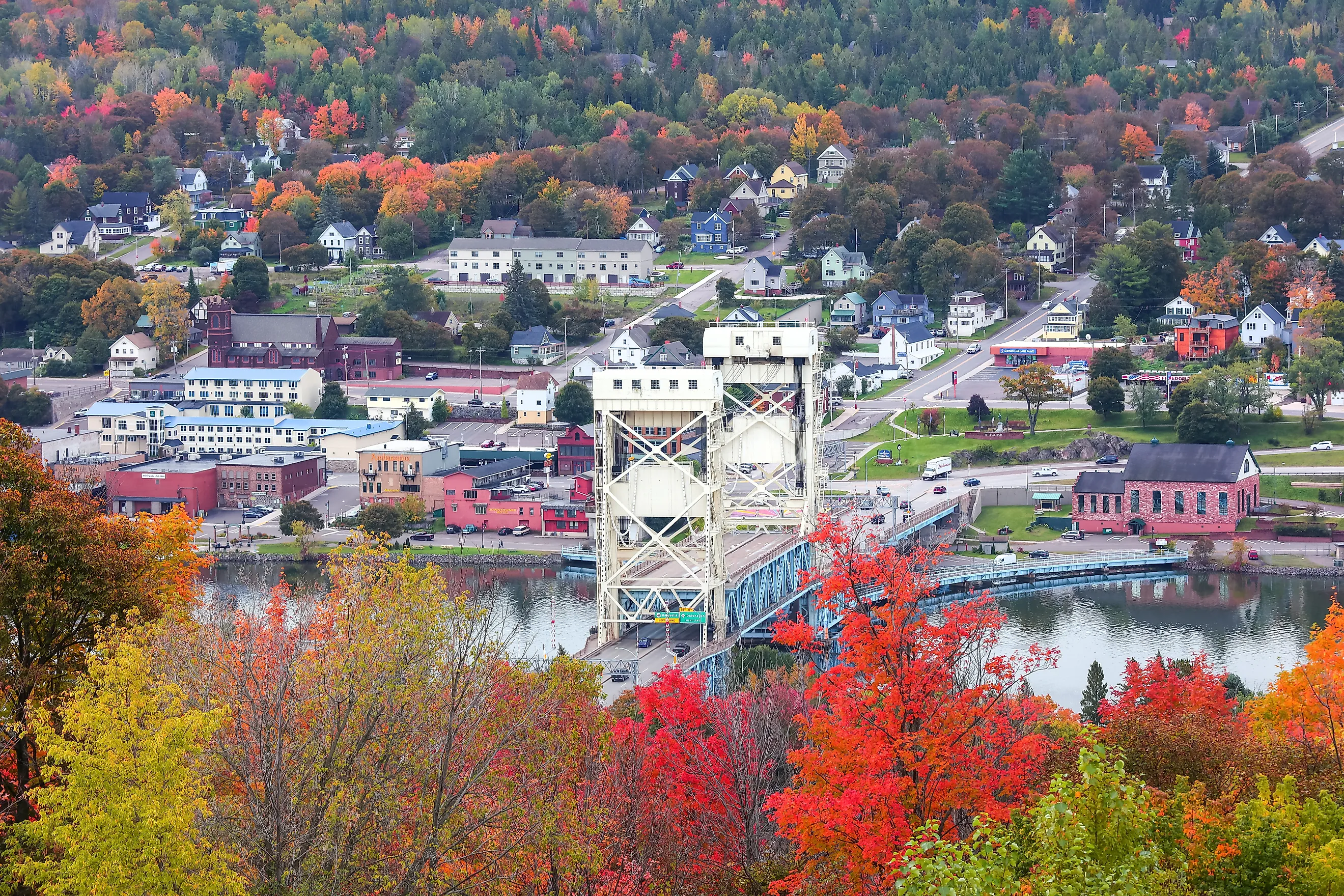
Toward the shoreline, the Portage Lake Lift Bridge has linked Houghton and neighboring Hancock across the Keweenaw Waterway since 1959, its two-level center section rising whenever boats need to pass. Nearby, Keweenaw Brewing Company has been pouring craft beers, including its Widow Maker Black Ale, since the early 2000s. Docked close by, the National Park Service ferry 'Ranger III' makes its six-hour voyage to Isle Royale's Rock Harbor from late May through early September.
St. Johnsbury, Vermont

The state of Vermont relies on ski slopes and autumn foliage to attract visitors, leaving St. Johnsbury and its approximately 7,400 residents quietly bypassed by most of its tourism. Set in the Northeast Kingdom, Vermont's remote three-county corner bordering Canada, this former industrial nexus trades mountain resorts for cultural archives. On the edge of town, artist Stephen Huneck's 150-acre Dog Mountain centers on Dog Chapel, where visitors pin handwritten notes and photos to the walls in memory of lost pets.
Near the town center, the 1871 St. Johnsbury Athenaeum operates as a public library with an art gallery running since 1873, where Albert Bierstadt's 1867 painting The Domes of Yosemite fills the back wall on a fifteen-by-ten-foot canvas. A short walk away, the Fairbanks Museum and Planetarium displays more than 30,000 natural science, history, and ethnology artifacts in a Romanesque Revival building, alongside the Lyman Spitzer Jr. Planetarium.
Chisholm, Minnesota

Mountain biking on the steep slopes of a former open-pit iron mine gives Chisholm an outdoor identity few other Northland towns can match. Redhead Mountain Bike Park opened in 2020 on the edge of this community of about 4,800 people, and its roughly 25 miles of trail now spread across some 1,200 acres of former mineland. Its main trailhead is at the Minnesota Discovery Center, a museum complex that details the Iron Range's geology, immigration, labor movements, and Ojibwe heritage.
In the same area, the 81-foot Iron Man Statue honors the generations of miners who excavated the surrounding terrain. Valentini's Supper Club has served timeless Italian meals since 1934, offering a warm neighborhood gathering space after a day on the red-rock trails. Exploring these reclaimed mining grounds shows how Chisholm has repurposed its industrial past into a full-fledged outdoor destination.
Bottineau, North Dakota

Rising where flat agricultural plains give way to the forested slopes of the Turtle Mountains, Bottineau sits just 10-12 miles from the Canadian border and subverts typical expectations of the North Dakota landscape. A giant fiberglass monument of Tommy Turtle riding a snowmobile greets visitors at Tommy Turtle Park, a nod to the brutal winters that define this town of about 2,200 residents.
Close by, the Turtle Mountain State Recreation Area offers more than 12 miles of multi-use trails for hiking, snowshoeing, mountain biking, and horseback riding, while Bottineau Winter Park takes over in snow season with downhill skiing, tubing, and snowboarding. Northeast of town, the International Peace Garden straddles the Manitoba border across more than 2,300 acres, with colorful flowerbeds, a conservatory, and a Peace Chapel built directly on the boundary line.
Havre, Montana

From the open stretches of the Hi-Line, Havre can seem like a routine fuel stop, but the most intriguing history of this town of about 9,400 people sits beneath the sidewalk. When a 1904 fire leveled the commercial district, merchants moved their businesses into a network of connected basements while the town rebuilt overhead. Today, Havre Beneath the Streets guides visitors through that underground world, with recreated spaces including a laundry, a saloon, and a bakery.
Toward the edge of town, the Wahkpa Chu'gn Buffalo Jump preserves approximately 2,000 years of Indigenous bison hunting, with guided site visits explaining traditional harvesting methods. The Frank DeRosa Railroad Museum pays tribute to the Great Northern Railway that established the town, displaying model trains, hand-pushed carts, and a functioning signal box. The Duck Inn, a community staple on First Street since 1932, rounds out the day with a burger and a pint.
Ashland, Wisconsin

While neighboring Bayfield draws the bulk of the crowds bound for the Apostle Islands, Ashland carries itself as an unpretentious Lake Superior harbor town with a strong shipping and industrial past. The community of approximately 7,900 inhabitants wears its heritage on its brick facades, with more than 20 large-scale public murals. The Lumberjack Mural documents the logging era, while the massive Ore Dock Mural recalls the shipping legacy that tied Ashland to the iron range.
Mornings can begin at The Black Cat Coffeehouse, which has been open since 1995 and serves organic coffee alongside vegan and vegetarian options. Beneath Highway 2, the Ed Griffiths Pedestrian Pass turns an underpass into a nearly 3,700-square-foot tile mosaic of regional history and ecology. From there, the Ashland Waterfront Trail traces about 12 paved miles along the shore, passing municipal parks, fishing piers, and public art before reaching Maslowski Beach.
Bonners Ferry, Idaho

Set within the Kootenai River Valley north of the Panhandle's crowded resort corridors, Bonners Ferry operates as an unhurried, working county seat roughly 30 miles from the Canadian border. A few miles west of downtown, the approximately 2,800-acre Kootenai National Wildlife Refuge draws birdwatchers to its wetlands, forests, and meadows, where over 220 species, including bald eagles and migratory waterfowl, appear depending on the season.
Closer to the town's center, the Boundary County Historical Society & Museum traces regional history through the Kootenai Tribe, local labor networks, and early homesteaders. Cultural life centers on the Historic Pearl Theater, a former church from the late 1800s that now hosts art programs, live music, and performances. Along the Kootenai River, Kootenai River Brewing Company serves burgers and fish and chips, with house-brewed beers and views of the river flowing past.
Towns Off The Beaten Path
True discovery rarely happens on a scheduled timetable or along a manicured strip. Across these northern towns, character lives inside working harbors, reclaimed earth, and serene streetscapes that persist far past the highway exit ramp. These communities do not ask to be packaged or curated for mass consumption; they simply endure. To travel here is to trade convenience for presence, and to find the real heart of the United States in the quiet persistence of towns built to last.