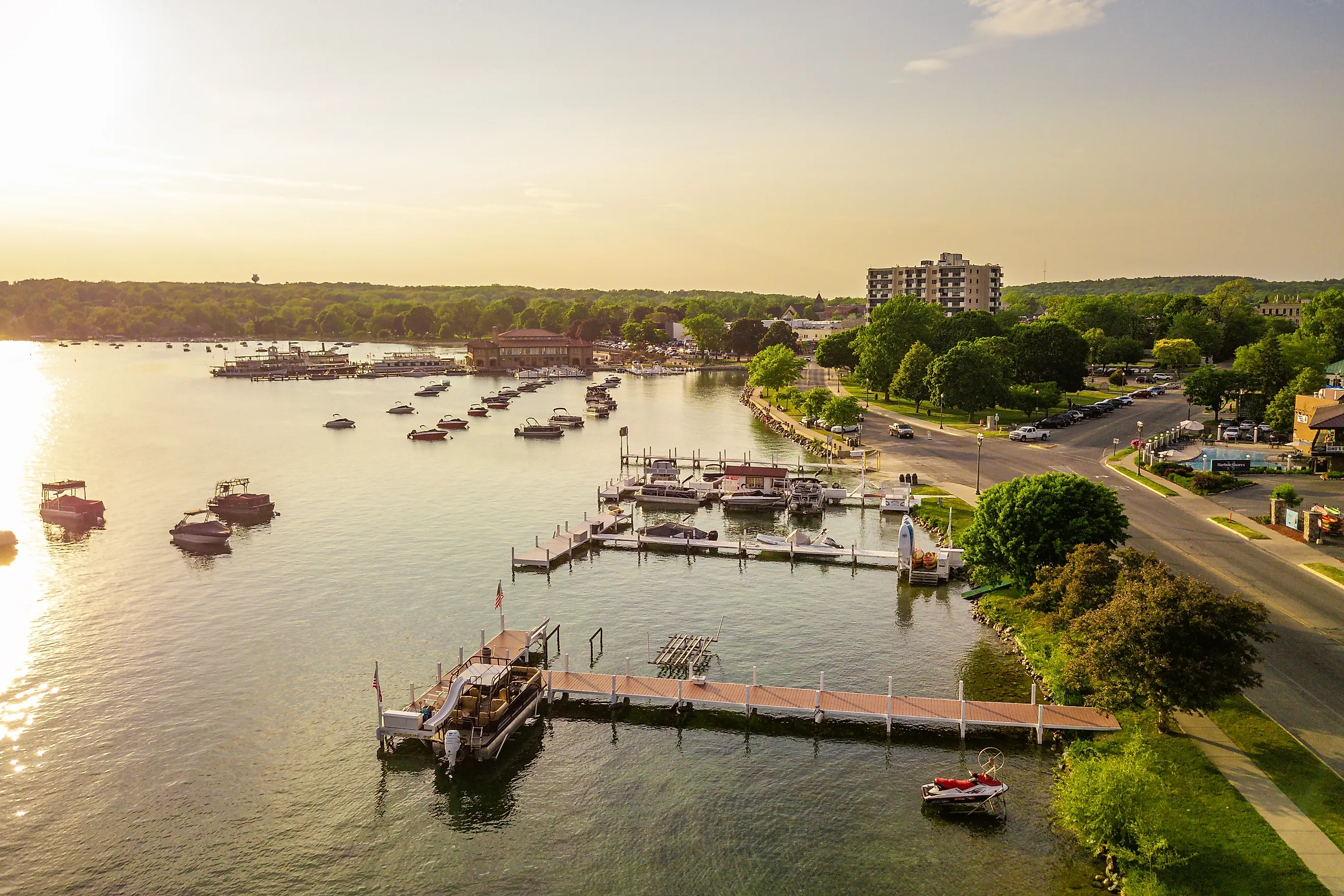
Wisconsin’s Newport Of The West Is Ringed By Gilded Age Mansions
Lake Geneva, Wisconsin, has long been called the "Newport of the West." And the comparison with Newport, Rhode Island, the summer colony of New York's richest families, stuck.
It was a name first used by a Chicago preacher in the late 1800s to describe an area that was becoming increasingly popular with the city's wealthiest households after the Great Chicago Fire of 1871.
These mega-rich families built grand summer homes to show off the fortunes they'd made from businesses centered on beer, meatpacking, chewing gum, and real estate. Many of those houses still stand, and some can even be visited.
Here's how Lake Geneva came to be known as the Newport of the West, and why you should pay it a visit.
The Preacher's Nickname
Regular train service between Chicago and what was then the village of Geneva had already begun in July 1871 on the Chicago & North Western Railway, cutting the trip from the city to less than a day. Three months later, on October 8, the fire that burned out the city center also burned the homes of many of its wealthiest families.
A few of them had already found the lake: Maple Lawn, built between 1870 and 1871 for Shelton Sturges, heir to a grain elevator fortune, was one of the first of the big estates.
After the fire, families who had been summering in the lake's hotels began building houses of their own, and some lived in them year-round while their Chicago mansions were rebuilt.
The names that followed over the next 50 years, beginning a period now known as the Gilded Age of industrial fortunes, read like a directory of Chicago's most successful businesses.
They include Conrad Seipp, the brewer; Edward Swift, of the meatpacking family; Levi Leiter, Marshall Field's original partner in the Chicago department store that became Marshall Field & Company; the Pinkertons, of the detective agency; William Wrigley Jr., the chewing gum manufacturer; and Otto Young, who bought downtown Chicago real estate while the ground was still warm.
What's In A Name?
The "Newport of the West" tag is credited to David Swing, a Presbyterian minister described by the Chicago press of the day as the city's most popular preacher. Swing liked the area so much he even built his own summer home, Six Oaks, on the lake in 1884.

Geneva Lake was never only a playground. Until the start of World War II, ice cut from it each winter was shipped to Chicago by rail, and the Geneva Lake Ice Company was formed in 1891 to do exactly that. The town's frozen legacy is just one of the stories told at the Geneva Lake Museum in the former Wisconsin Power & Light building.
Founded in 1983 and moved here in 2004, its 20,000 square feet include a recreated Main Street with brick paving and shopfronts covering the years 1890 to 1980, as well as exhibits on the lakeshore estates, including fixtures salvaged from Stone Manor, the largest of them. There's also a display featuring Gary Gygax, the Lake Geneva resident who co-created the fantasy role-playing game, Dungeons & Dragons, here in the 1970s.
The museum's name also points to a distinction that trips up most visitors. Locals call the water "Geneva Lake" and the town on its northeast shore "Lake Geneva." The Potawatomi, the Native nation that lived around the lake until 1836, called it Kishwauketoe, meaning "clear water," and the first settlers knew it as Big Foot Lake, after the Potawatomi chief whose village overlooked it.
In 1835, a government surveyor renamed it Lake Geneva after Geneva, New York, and the settlement at its outlet took the name Geneva. The U.S. Post Office changed the village's mailing name to Lake Geneva in 1882 to stop mix-ups with yet another Geneva, this time one in Illinois. Calling the water Geneva Lake to tell the lake and town apart only caught on in the late 20th century, and nobody's quite sure who started it.
The Beer Baron's Cottage

Only one of the Gilded Age houses on Geneva Lake is open for tours, and getting there is part of the fun. Black Point Estate and Gardens, on the lake's south shore in the town of Linn, was built for Conrad Seipp, the German-born owner of the Conrad Seipp Brewing Company in Chicago.
Completed in 1888, it was what the language of the era called a "cottage." In practice, it's a 20-room house in the Queen Anne style, the turreted Victorian look made popular in the 1880s, with 13 bedrooms and a four-story tower visible from much of the lake. All of it stands on a bluff with 620 feet of shoreline below it.

With no roads or utilities on that side of the lake when the house went up, the Seipps relied on boats to get them to and from their cottage. And that's still how people get there. The Wisconsin Historical Society works with the Lake Geneva Cruise Line on tours of the property, with boats departing the Riviera Docks in downtown Lake Geneva.
The cruise portion of the experience sails past other large estates on the lake before depositing visitors at the Black Point pier. From here, it's a 100-step climb up the bluff to the house. The whole outing takes three and a half hours, with one version of the tour ending with an optional beer or wine toast to the summer home's first owner.
Stone Manor And The Wrigley Shore

Stone Manor, on the south side of Geneva Bay, at the lake's eastern end and within sight of downtown, is the largest of the Gilded Age cottages. It was built for Otto Young, a German immigrant who started out selling costume jewelry from a pushcart in New York City and ended up owning a large share of the Chicago Loop, the city's downtown business district, much of which he snapped up cheaply after the fire of 1871.
Completed in 1901, the house, which Young named Younglands, has seven levels, 50 rooms, and 40,000 square feet of floor space behind a limestone front that's 174 feet wide. Young died in 1906, and his family kept the house until 1939, when his granddaughter gave it to the Episcopal Church for use as a girls' school.

The school soon failed, and the county took the property for unpaid taxes in the 1960s. Since then, it has been the Stone Manor Inn restaurant, a Christmas tree museum, and six condominiums, which a new owner has been buying up to turn back into a single home.
The Wrigley connection is on the lake's north shore, where the family of William Wrigley Jr. once owned six adjoining properties. Green Gables, the main one, was originally built in 1892 for C.K.G. Billings, a Chicago millionaire sportsman who even shipped in the Norway Building, a timber pavilion made in Norway, from Chicago's 1893 World's Fair. Wrigley bought the estate in 1911.
The Gilded Age Up-close
Two other historic mansions survive in town, and both can be slept in. Maxwell Mansion was built two blocks from the lake in 1856 for Dr. Philip Maxwell, a Chicago surgeon, and is now a hotel with 28 rooms spread across the house, the stables, and the carriage house. Baker House, on the lakefront, is the 17,000-square-foot summer house completed in 1885. It's now a hotel and restaurant.
The Geneva Lake Shore Path is a great way to explore Geneva Lake's 21 miles of shoreline. It weaves in and out of wooded sections and follows a route that's even older than the homes you'll pass. Native peoples are known to have used the shoreline from 2500 BC until 1836, when the Potawatomi were forcibly removed. The estate builders who came later kept the route open as a path for workmen, and the public right of passage has survived every change of ownership since.

Along the way, you'll pass between each mansion and its pier, through what owners here call the front yard. The lawns and piers on either side are private, and cutting through them to reach a road isn't allowed, so walkers use public access points, such as the Lake Geneva Public Library downtown and Big Foot Beach State Park, to join the loop. The entire loop takes eight to ten hours to complete, so a good shorter option is the 1.9-mile stretch from the library to Big Foot Beach, which can be walked out and back.
Beaches, Boats, And Boogie Nights
Located two miles south of downtown Lake Geneva, Big Foot Beach State Park covers 271 acres and has a sand swimming beach, 100 campsites, five miles of trails, and a lagoon shaped like a miniature Geneva Lake. The lake was dug by the Maytag family, the washing machine dynasty that owned the land before it became a state park in 1949.
If the opportunity presents itself, hop aboard one of the eight boats operated by the Lake Geneva Cruise Line. The company traces its history to 1873, when steamboats were the only way to reach most of the estates. Its fleet includes the Steam Yacht Louise, which once carried Chicago families to their piers, and its boats leave from the Riviera Docks downtown.

The best-known trip is the U.S. Mailboat Tour. Since 1916, the mail for lakefront houses has been delivered by boat, and because the boat never stops, a "mail jumper" steps off the moving bow onto each pier, runs to the mailbox, and leaps back aboard before the stern slides past. Six jumpers are hired each spring after public tryouts.
The Riviera Docks, where the mailboat and the rest of the cruise line's fleet tie up, belong to the Riviera, a Mediterranean-style structure built as a bathhouse, row of shops, and dance hall that opened in 1932 during the Great Depression. Notable performers in its ballroom included jazz trumpeter Louis Armstrong, who played ten consecutive summers there in the 1950s, and the Glenn Miller Orchestra, the swing-era big band.
Newport, But Without The Ocean
While Newport has its Cliff Walk, the public path along the shore below the mansions of New York dynasties such as the Vanderbilts, Lake Geneva has a few Gilded Age surprises of its own. The Wisconsin houses were built by brewers, meatpackers, and gum makers rather than railroad dynasties, and most of them are still lived in, rather than run as museums.
Pay a visit to Lake Geneva and the shores of Geneva Lake, and you'll enjoy views that have changed little since that preacher dubbed the town the "Newport of the West."