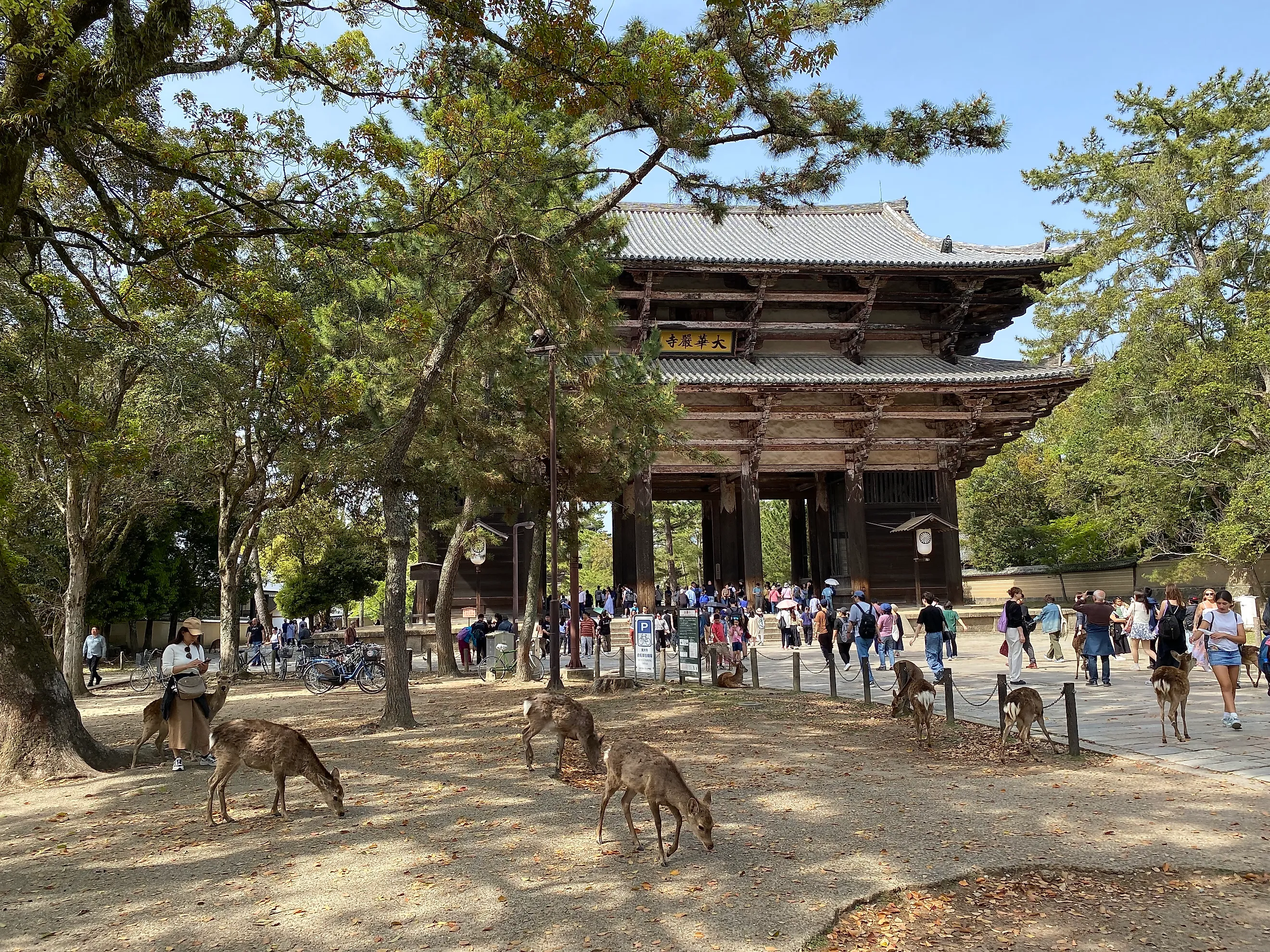
Exploring Japans Ancient Capital Where Deer Roam Freely
On the tourist trail between Kyoto and Osaka, Japan's ancient capital of Nara is typically relegated to a quick stopover. This was certainly the case my first time though, when I did little more than jump off the train and feed some eager deer.
More recently, I committed an entire week to this mecca of Mahayana Buddhism (with shades of Shintoism mixed in), for which I was rewarded with hikes up mountains and through primeval forests, traditional tea sessions, sake samplings, and of course, recurring excuses to feed the thousands of free-roaming deer — or should I say, messengers of the gods.
It's tough to go anywhere in Japan that doesn't have deep historical significance and Nara stands out as an approachable introduction to the religion and architecture of ancient Japan.
Arriving in Nara

Nara's main tourist attractions are predominantly clustered on the east side of the city, a fair distance from the JR Train Station on the west side. The silver lining behind this discrepancy is it encourages a walk through Nara's ordinary streets.
The blackened wood of traditional buildings, the low-lumen izakaya signs, the purple and pink accents perfectly graded to those Japanese sunsets, and the safe, quiet setting all validated my decision to stay in Nara for a full week.
Upon reaching my automated hotel (no staff, just simple and clean rooms with pre-sent codes), I found myself looking forward to the everyday rhythms of Nara as much as I did its World Heritage attractions.
Oh Deer...

There are more than 1,400 deer throughout Nara Park (and the surrounding streets). Considered in the Shinto religion as messengers of the gods, and protected as National Natural Monuments, Nara's deer have it made in the shade.
Sure, the crowds must get annoying from time to time, but that's the cost of doing business for an endless supply of specially made crackers. Bundles of these shika senbei can be purchased all over the park and it is the only food that tourists are permitted to give the deer... and they love it.
Once these otherwise cute and graceful animals get wind of your stash, they swarm insistently.

Steps from one of the cracker stalls, adult deer started nipping at my butt. Then, as more gathered around, it became a race to disperse the crackers as quickly as possible to whoever was nearest, or most aggressive. So much for snacktime equity!
Once I gave the open palms, "all gone" signal, they turned their attention to the next unsuspecting tourist and I got to enjoy the ensuing giggle-screams from a safe distance.
Deer don't exactly present grave danger, but if you leave your small child with a packet of deer crackers, you're likely to find them crying in the dirt moments later. An alternative is to simply observe the herds of deer resting in the grass, or wandering through the courtyards of Nara's Great Temples. When that deer crack, I mean cracker, is out of sight, they are quite docile, amenable creatures.
Historic Monuments of Ancient Nara

The United Nations Educational, Scientific, and Cultural Organization (UNESCO) World Heritage Site known as the "Historic Monuments of Ancient Nara" consists of 78 buildings, including several exemplary Buddhist temples and Shinto shrines, in addition to the Kasugayama (Mount Kasuga) Primeval Forest.
Collectively, these sites immortalize Japan's first permanent capital (710 to 784 CE), one of its religious epicenters, and the natural surroundings that effortlessly infuse Shinto's brand of animistic spirituality.

Most mornings, I would begin by running through the complex of temples and lantern-lined trails, or by visiting a specific monument before the crowds amassed. I couldn't believe the difference a few hours made passing in and out of the iconic Nandaimon Gate.
I walked freely up and over the wooden steps guarded by the fierce Nio Guardian statues, but by midday, large families, tour groups, and the corresponding deer herds impeded the wide walkways.
My keen 7:30 a.m. arrival to the Todaiji Temple also proved fruitful. Approaching the Big Buddha Hall (Daibutsuden), so-called for its 50-foot-tall bronze Buddha statue, I was elated to have the place practically to myself. The architectural and historical magnitude of this temple was arresting.
Though 30 percent smaller than the original ninth century structure, Daibutsuden was only recently supplanted as the world's largest wooden building. During its peak, the strength of Buddhism in Nara challenged even the Emperor, which is what spurred the relocation of the capital to Nagaoka. Whether you're a Buddhist (like me) or not, the power and tranquility of this place imposes a state of mindfulness.

The Kasuga Taisha Shrine is another of Nara Park's primary attractions worth setting an alarm for. In the early morning, I could jog freely on the path lined by stone lanterns and approach different sections of this orange shrine unencumbered.
By mid-morning, large crowds created bottlenecks, with everyone eager to photograph this founding symbol of Nara, and monument to the Fujiwara clan.
After resetting with some grocery store sushi (honestly, even the gas stations in Japan serve great sushi), I would usually investigate some of the modestly-trafficked (ex. Kofuku-ji), or outright overlooked (ex. Gango-ji) temples, but also natural monuments such as the 17th century Isuien Garden.
On top of its groomed natural spaces, Isuien has traditional tea houses where you can sit cross legged on tatami floors, sip green tea (or have a light lunch), and ogle the pond's scenery through sliding paper doors. Nature is commonly incorporated into Nara's layout, but Mount Kasuga Primeval Forest takes things to another level.
Mount Kasuga Primeval Forest

Behind Nara Park, hiking trails lead up to Mount Wakakusa, where even more deer and expansive views reward the effort. From here, Mt. Kasuga Primeval Forest — the natural component of Nara's World Heritage collective — reveals herself.
Gravel trails whisked me through lush, unlogged swaths, while stone staircases tempted me toward scattered surprises. One such reward was a mossy Shinto shrine sporting mysteriously untranslated text.

At its base, a waterfall added even more ambience to the anachronistic scene. Sure, you can reach these sites by driving back roads, but the mindful walk through the woods made me feel like I was back in ancient Japan, paying homage to the Shinto spirits.
Nara's Street Level Experiences

In between the temples and trails, Nara's modern core was always engaging without being overpowering (nothing like Shibuya Crossing here). Artisanal coffee shops and general cafes are plentiful, but my favorite find was a little place called Cafe Plum.
Hiding in an alley off of Mochiidono Shopping Street (a lengthy, open-concept string of vendors and stalls), a sweet 85-year old woman worked the six seat counter, serving up pancakes, breakfast sandwiches, and coffee on the cheap. Even with steady turnover, she always flashed me a big smile whenever I said anything in Japanese (or gave even a modest tip).
I experienced similar hospitality at Koushi — a fancy, inventive tofu restaurant. I didn't realize there were so many ways to serve tofu: boiled, fried, raw with sauces, made into a soup, and yuba (aka "tofu skin").
Nara is considered the birthplace of modern sake so I just had to venture to the Harushika Sake Brewery. Founded in 1884, this brewery continues the refined rice wine legacy by offering a five-sake sampling. The venue was spacious like modern American breweries, but being in good spirits on the walk back, I also stopped by a tiny street bar doing samplings of its own. For every obvious Google Maps attraction, there seemed to be an understated version nearby.
Another culinary concoction that Nara is famous for is its mochi. At Nakatanidou, long lines form to watch chefs pound the green, gelatinous rice/mugwort mixture before stuffing it with red bean paste.
The first time I reached this famous shop at the north end of Mochiidono, I couldn't be bothered to join the queue. But as with Nara's cultural attractions, there is an ebb and flow to the traffic. The next time I walked through, there was no one waiting at all, giving me the space to walk right up and sample some of that sweet (but not too sweet) mochi. Yet another bonus of extending my stay in Nara.

The only negative experience I had in Nara was a continuation of the no-foreigner policy upheld by the tiny traditional bars known as izakayas. As is the case in Tokyo and Osaka, these places aren't keen on tourists. Part of the problem is the language barrier.
The bartender can't speak English, and the menus are only in Japanese. Another part of the equation is cultural guarding (to put it politely). In another country, this policy would be branded as racist, but given my affinity for Japanese culture, I try to take it in stride and recognize that these centuries-old establishments would quickly lose their essence if flooded with tourists.
The problem is, from the street it's hard to tell which ones will welcome the outsiders. Some have the infamous "No Foreigners" signs on the door, but for many, it is only upon entering that you get a blatant refusal or a gesture to sit at the bar.
The izakaya closest to my hotel gave me a bit of both. When I stuck my head in, the owner waved me out, but the four patrons enthusiastically ushered me in. I politely declined but they insisted, much to the dismay of the bartender.
I felt caught in the middle. On the one hand, the locals were so friendly and fun. But on the other hand, I couldn't fully relax into the space. In fairness to the bartender and this cultural dynamic as a whole, the other patrons and I immediately defaulted to broken English, proving what happens when such concessions are made.
Distinctly Nara

I always get a kick out of Tokyo. Kyoto, despite its ever-growing crowds, is a must-see cultural hub and Osaka mixes in more of that "salaryman" culture while still sporting Tokyo-esque neon shopping streets.
But in terms of places along this well-trodden route that are reachable by train, Nara is distinctly appealing. Its blend of ancient religious monuments and modern museums, its herds of adorable (albeit nippy) deer, its introspective forest trails, and its delightfully ordinary streets surrounding its handful of commercial rallying points works out to a satisfying balance.
Even its crowds, which are certainly palpable at times, are easily managed thanks to the spaciousness of Nara Park and the flexible hours of the major historical sites. I enjoyed my initial introduction to Japan's ancient capital, brief as it was, but the full week spent here during my subsequent trip made Nara all the better.