The State Parks Where You Can See Bald Eagles Nest
There is nothing quite as spectacular as a bald eagle in flight, with its huge wingspan and intense yellow eyes that constantly scan the ground below. This is likely why the Second Continental Congress chose this bird for the Great Seal of the US in 1782. For Native Americans, their meaning is even deeper, as they are seen as messengers from Great Spirit. In many tribes, receiving an eagle feather is the highest honor that can be given. Visiting a state park that protects eagles is an excellent way to view their nests. A plus is that entering a state park is often free or low cost. These are the state parks where you can view a bald eagle nest.
Facts And History About Bald Eagles

The bald eagle, or Haliaeetus leucocephalus, is found in the US, Canada, and northern Mexico, with the biggest concentration in Alaska and Canada. According to the US Fish & Wildlife Service, in the mid-20th century their numbers became dangerously small due to illegal hunting and the proliferation of pesticides such as DDT. The pesticides actually caused the egg shells to become so thin that parents would inadvertently crush them when trying to keep them warm. By 1963, only 417 nesting pairs remained in the lower 48 states.
In 1940, Congress passed the Bald Eagle Protection Act, later expanded and renamed the Bald and Golden Eagle Protection Act, and in 1972, DDT was banned. In 2007, the bald eagle was finally removed from the Endangered Species list.

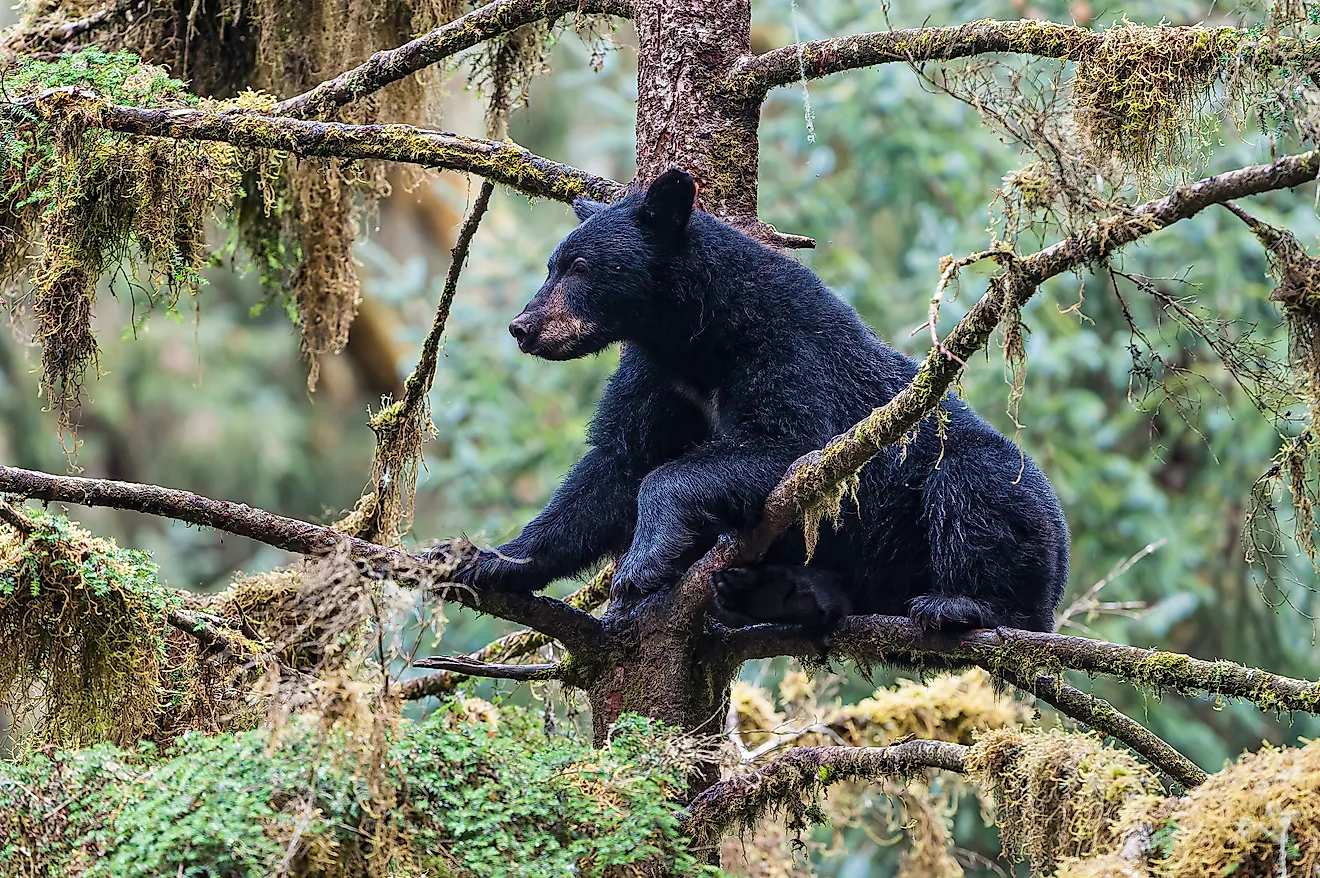
Eagles subsist primarily by hunting fish, although they will also hunt small animals such as birds and rodents, and are known to steal from other birds or eat carrion. They live in the wild up to 25 years and usually mate for life. Eagles grow up to 14 pounds with a wingspan as wide as 8 feet. The female is markedly larger than the male.
Bald Eagle Nesting

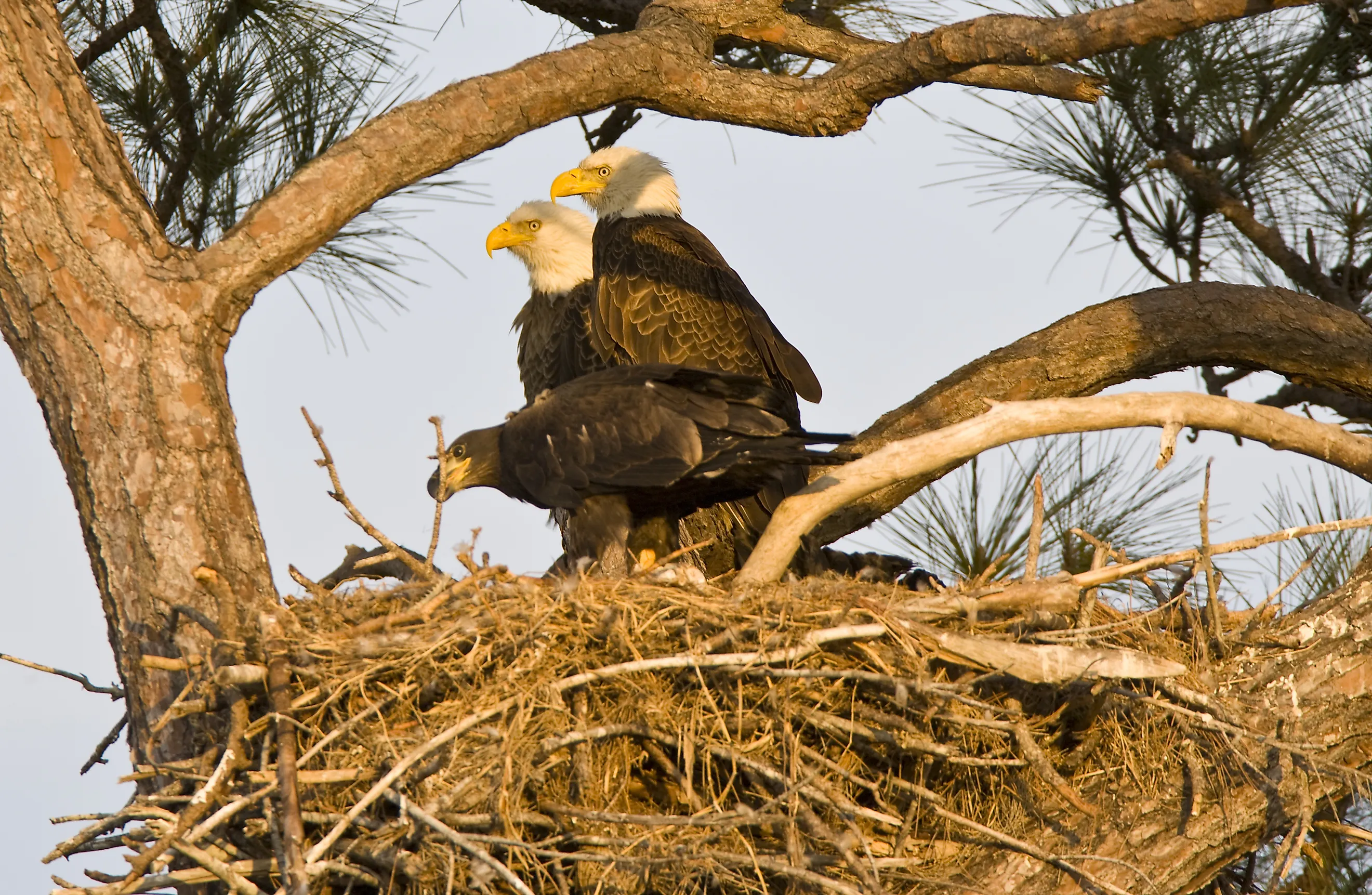
Bald eagles build huge nests, normally up to about five feet wide, but the record was 9.5 feet wide and 20 feet deep, according to the National Park Service. They are built from twigs and branches, and then padded with grasses and moss and built atop tall trees. Eagles are very loyal to their nest but sometimes will build a "back-up" nest nearby.
Bald eagles are excellent parents. Both partners actively participate in nest building, incubating, and feeding the eaglets after they hatch. When the chicks are born, which takes about 35 days, they stay in the nest for another 10 to 14 weeks before they fledge. Even then, the parents continue to feed them for another 4 to 6 weeks while they learn to hunt. After that they fly off on their "grand adventure," as it is called, eventually finding their own territory to live in. As adolescents, they are fully brown in color and do not have the signature white and dark brown color, with a white head and tail, until they are four to five years old.
Promised Land State Park, Pennsylvania

A pair of bald eagles first visited Promised Land State Park in 1995 but did not begin building a nest until they reached sexual maturity in 1999. They hatched eaglets in this first nest, in a white pine, until it blew down during a snowstorm in 2008 (fortunately the pair were not nearby at the time). They then built a new nest in a maple tree the following spring, conveniently right across from the Wildlife Observation Station. Since 2010 they have successfully fledged at least one eaglet a year.
The best time of year to observe the nest is before trees grow their new leaves in mid-May. Before then, you can actually see the nest with the naked eye, although having binoculars or a scope makes it easier. Staff at the park office keep some to borrow. After this, you can still enjoy watching them fly overhead or hunt over the water. This park also has over 50 miles of hiking trails and several types of campgrounds. As is true in all Pennsylvania state parks, it is free to enter. There is a fee to reserve a camping site.
Little Pine State Park, Pennsylvania

Several pairs of resident bald eagles have nested in Little Pine State Park since 2004. Their nest is at the upper end of the lake, by the Little Pine Dam. Exceptional viewing can be had from the park's dedicated viewing area directly opposite from the nest. If you don't have your own binoculars, there is a scope at the viewing area that is free to use. Eagles can be observed year-round, but the most activity at the nest is when they lay their eggs in early spring and while the chicks hatch.

The 2,158-acre park also has over 10 miles of hiking trails, swimming, and fishing. There are campgrounds, and several yurts and cottages are available to rent. As is true in all Pennsylvania state parks, it is free to enter. There is a fee to reserve a camping site.
Lake Bemidji State Park, Minnesota

Lake Bemidji State Park has a nesting eagle pair on the west arm of Lake Bemidji. This is also a great place to view osprey, loons, and pileated woodpeckers. To see the nest, built atop a tall white pine on the far side of the beaver pond, you must either hike or bike to Sundew Pond along the Paul Bunyan State Trail about 1 to 1.5 miles in. Bringing binoculars or a scope is recommended. Rangers also lead guided "Guardians of the Sky" naturalist programs.
A large network of trails runs through the park for hiking. There is a 95-site campground with fees that vary depending on the type of spot you want. There is a vehicle entrance fee, which was $7.00 in 2026. You can also buy a year-long permit for $35.00.
Bald Eagle State Park, Pennsylvania

Bald Eagle State Park in Pennsylvania is named for the 18th century Native American Chief Woapalanne, which translates to "bald eagle" in English. This is a huge park, at 5,900 acres in the north-central part of the state, with an eagle nest at the upper end of the lake. There are a number of viewing areas where the nest, soaring eagles, and other raptors can be seen. The Nature Inn, which sits atop a hill, is another spot to view both the resident eagles and visiting eagles while they fish. Scopes and binoculars are available at the inn.
There are all kinds of things to do in this park, including swimming, boating, and hiking. There are campgrounds and the aforementioned Nature Inn for lodging. It is free to enter, although there are fees for lodging.
Radnor Lake State Park, Tennessee

Radnor Lake State Park is home to a nesting pair of bald eagles. Their nest is located near the lakefront and is best viewed from the Lake Trail Observation Deck or along the non-vehicle sections of Otter Creek Road. Rangers also post scopes along the lakefront at different spots so that you can view the eagles and other birds who live in the park. You may also see other adult eagles, but those come through to hunt and don't nest there. The nesting schedule is a bit earlier than in the north, beginning in November.
This park also has an aviary with a number of captive birds who cannot be released into the wild, including three bald eagles. You can see these birds up close. Each year in late June, rangers hold the park's American Eagle Day, with educational workshops to increase awareness of bald eagle recovery and conservation.
Because this park's focus is on nature preservation and education, there is no camping or other recreational activities allowed. There are seven different nature trails and no entrance fee.
Pumpkin Hill Creek Preserve State Park, Florida

One of the best places to see bald eagles in the south is Pumpkin Hill Creek Preserve State Park. To see the park's resident pair's nest, you must hike about 1.5 miles along a spur path of the Red Loop hiking trail. At that point there is an observation bench where you can see the nest, built atop a pine tree.
Eagles that live in the southern states, such as Florida, follow a very different nesting schedule than those in the north. Nest building occurs in September and October and egg laying is in November and December. Eggs hatch in December and January and the eaglets fledge in April.

The park has over 4,000 acres of protected coastal wilderness, with recreation that includes kayaking, biking, and hiking. There is no camping in this park, but there are nearby campgrounds. There are no vehicle or pedestrian fees.
Montauk State Park, Missouri

Since 2004, Montauk State Park has had a nesting pair of bald eagle parents. The park is known as a prime spot for trout fishing, and the well-stocked lake does not generally freeze over in winter. This means eagles feast easily too. The Pine Ridge Trail is a good vantage point for watching them hunt, and rangers also run a number of public eagle-viewing programs that take visitors near a nest, using scopes and binoculars for the best views. An ideal time to view eagles is in May, when the parents are vigorously hunting fish on the river to feed their young.
If you use one of the outfitters that offer tube floating on the northern part of the Current River, just outside the park boundaries, you can also get excellent views of eagles. Floating inside the park is forbidden.
This park has numerous modern camping areas as well as motel rooms, remote cabins, and a restaurant. There is also a historic grist mill to visit. As is true for all Missouri state parks, there is no entrance fee, although there are fees for camping.
Respect For Bald Eagles

When you visit any of the parks named above, it is important to remember that federal and state laws prohibit getting closer than 330 feet to an eagle nest. Getting too close can upset both parents and offspring, causing them a great deal of anxiety and possibly forcing them to leave the area. To keep enjoying them for years to come, we must be respectful.