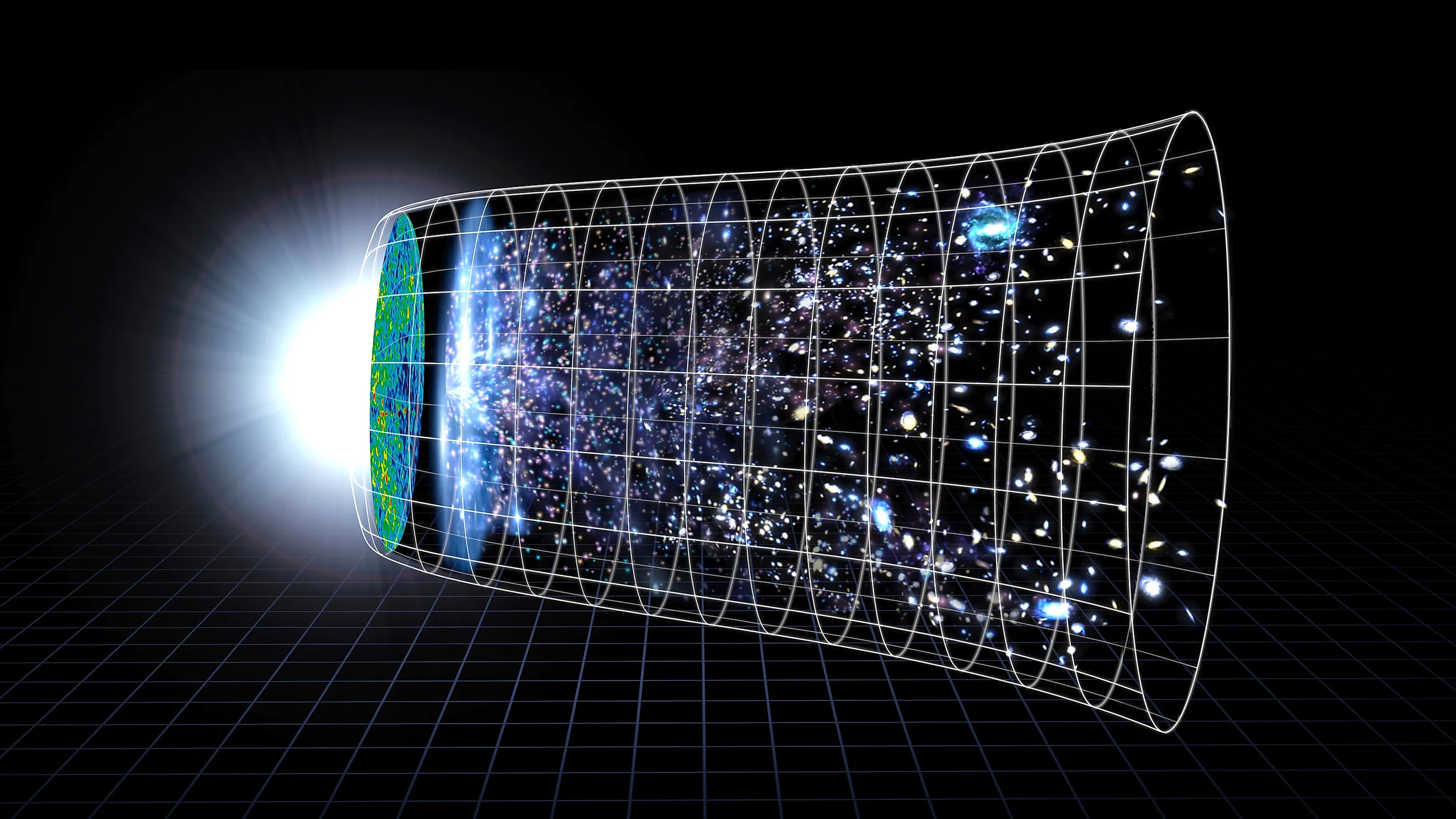
Is the Universe Getting Bigger?
The universe is bigger now than it was when you started reading this sentence. Every distant galaxy is drifting away from us as the space between them stretches. Astronomers spotted this a century ago in the reddened light of far-off galaxies. They still argue over exactly how fast that stretching happens. Dark energy seems to be pushing the whole process faster every year. Where it all leads remains the strangest open question in cosmology.
The stretching has been going on ever since the Big Bang, around 13.8 billion years ago. Galaxies, stars, planets, and people are not themselves growing. It is the space between galaxies that keeps stretching, while gravity holds everything inside them bound together. We can only see out to a certain distance, yet astronomers think the universe extends far beyond what any telescope can reach.
How do we know the universe is expanding?

We've known the universe is expanding for over a century. In 1912, astronomer Vesto Slipher began measuring Doppler shifts in the light coming from distant spiral nebulae, which we now know are galaxies. Over the following years, he found that many of them appeared to be moving away from us.
While this isn't something you can see with the naked eye, astronomers can detect it using telescopes through a phenomenon known as redshift. As galaxies move farther away, the light they emit stretches into longer wavelengths, making it appear redder.
In the 1920s, Edwin Hubble discovered something even more remarkable. The farther away a galaxy is from us, the faster it appears to be moving away. This relationship became known as Hubble's Law, which states that a galaxy's recession speed is proportional to its distance. Put simply, if one galaxy is twice as far away as another, it will appear to be moving away twice as fast.
As we established earlier, it is the space between galaxies that is stretching. Gravity keeps galaxies, solar systems, and planets bound together, preventing them from expanding along with the universe.
This also means there is no center of the universe that everything is moving away from. Instead, all galaxies appear to be moving away from one another as space expands.
Another key piece of evidence is the cosmic microwave background (CMB), the oldest light we can observe, a faint glow that fills all of space. It is thought to be leftover radiation from shortly after the Big Bang and provides astronomers with a snapshot of what the early universe may have looked like.
How fast is the universe expanding?

The rate at which the universe expands is described by the Hubble Constant, which measures how quickly galaxies move apart over vast distances.
Scientists have two ways of measuring this expansion.
One method examines nearby galaxies by measuring the brightness of observable objects, such as Cepheid variable stars and Type Ia supernovae. Using these "cosmic distance markers," astronomers calculate a present-day expansion rate of around 73 kilometers per second per megaparsec.
The second method works differently. Instead of measuring distances to nearby galaxies, scientists study the cosmic microwave background (CMB), which is the oldest light in the universe. By analyzing this ancient radiation and applying our current model of cosmology, they calculate an expansion rate of around 67-68 kilometers per second per megaparsec. So the local universe is expanding faster than the calculations based on the early universe suggest.
The problem is that both methods appear highly accurate, yet they consistently yield different answers.
This disagreement is known as the Hubble Tension, and it has become one of the biggest unsolved problems in modern cosmology. Most scientists don't think the universe is literally expanding at two different rates simultaneously. Instead, the mismatch suggests that either one of the measurements contains an unknown source of error, or our current understanding of the universe is incomplete, or simply wrong. Some scientists suggest the tension points to a whole new branch of physics yet to be uncovered.
What is the universe expanding into?

Scientists don't actually think the universe is expanding into empty space. Instead, space itself is expanding.
Imagine drawing dots on the surface of a balloon. As you inflate the balloon, every dot moves farther away from every other dot. The dots aren't moving across the surface; the surface itself is stretching.
Cosmologists think something similar is happening in the universe. Space itself is expanding, pushing galaxies farther apart.
Why is the expansion speeding up?

When astronomers first discovered that the universe was expanding, they assumed gravity would gradually slow that expansion over time.
Instead, observations revealed something unexpected: the expansion of the universe is actually accelerating.
The leading explanation is dark energy, a mysterious form of energy thought to make up roughly 70% of the universe. Although scientists don't yet know exactly what dark energy is, observations suggest it acts against gravity on the largest scales, causing the expansion of the universe to accelerate. Dark energy appears to dominate over gravity in the vast regions between galaxies, where gravity's pull is weakest.
The vast regions of space between galaxies probably aren't empty. One possibility is that this space contains a tiny amount of energy known as vacuum energy, which some physicists think could be related to dark energy. However, this idea raises major problems because theoretical predictions of vacuum energy differ from what astronomers actually observe.
While most scientists currently believe the universe's expansion is speeding up, that doesn't mean every detail is settled. For example, recent research has raised questions about whether dark energy may change over time. These findings remain controversial; however, current evidence still strongly supports the view that the universe's expansion is accelerating.
Scientists still don't know much about dark energy (or dark matter), and until we understand them better, we won't have a complete picture of why the universe is expanding the way it is.
Does the universe have an edge?

Scientists still don't know whether the universe is finite or infinite.
Is it vast but finite, with an edge somewhere far out there? Or does it simply go on forever?
One possibility is that the universe is a hypersphere, an impossibly large four-dimensional shape in which space eventually curves back on itself. If you could somehow travel far enough in one direction, you would end up back where you started (although it would take an unimaginably long time).
Albert Einstein's General Theory of Relativity showed that mass bends spacetime, and some cosmologists think the universe itself could be curved in this way. If so, the universe could eventually loop back on itself.
Another possibility is that the universe has a shape more like a doughnut. In this model, traveling far enough in one direction could also bring you back to where you started. If this were true, light from the same object might reach us along different paths, causing it to appear in two different places in the sky at different stages in its history.
What if the universe never stops going?

Another possibility is that the universe has no edge at all and simply goes on forever.
An infinite universe can still expand, which sounds impossible until you picture it the right way. Nothing has to spread outward into empty space beyond the edge, because there is no edge. Instead, every gap inside the universe grows. Two galaxies a billion light-years apart slowly become two billion light-years apart, then more, with no limit and no outer wall to run into.
In a universe like this, expansion never has to stop. Space keeps stretching between the galaxies forever, and the cosmos just grows colder, darker, and more spread out as they drift ever farther apart.
How will the universe end?

If our current view of how the universe works is correct, we are probably heading for the Big Freeze. As space continues to expand, galaxies will drift farther apart; stars will eventually burn out; new stars won't be able to form once the gas needed to make them is used up; and the universe will become increasingly cold, dark, and empty.
Other possibilities include the Big Crunch, in which gravity eventually overcomes expansion, and the universe contracts back in on itself. This is part of the formerly popular "bouncing" universe idea, which suggested that a collapsing universe could eventually be followed by renewed expansion. This theory has fallen out of favor, but that doesn't mean we've heard the last of it. Then we have the theory of the Big Rip, in which the expansion accelerates so rapidly that galaxies, stars, planets, and eventually even atoms are pulled apart with violent force.
Scientists don't yet know which of these endings, if any, will happen. The answer depends on the true nature of dark energy, which remains one of the biggest mysteries in modern physics.
The Universe's Unwritten Ending
So, is the universe getting bigger? According to what astronomers currently know, the answer is yes. Space itself has been expanding ever since the Big Bang, and observations suggest that expansion is accelerating. What no one can say yet is how it all ends: a slow fade into the cold and dark of the Big Freeze, a violent tearing apart in the Big Rip, or a collapse back in on itself. Until scientists work out what dark energy really is, the universe's final chapter stays unwritten.