What Is The Farthest Thing We Can See In Space?
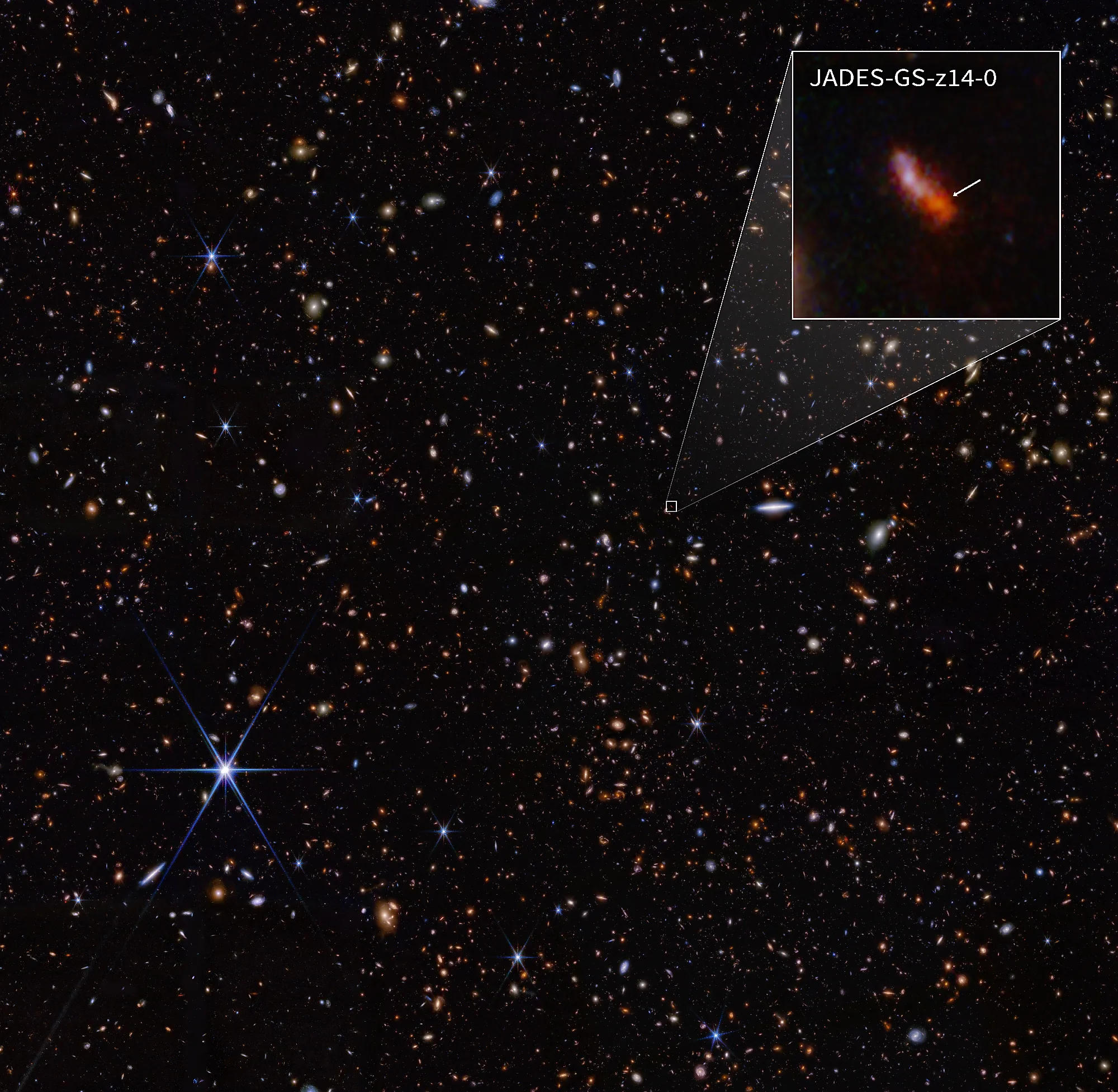
The observable universe is roughly 93 billion light-years across, and almost everything inside it is too faint, too small, or too far away to see directly. Even so, modern telescopes have pushed the visible frontier back to within a few hundred million years of the Big Bang itself. The current record for the most distant confirmed object is held by a galaxy called JADES-GS-z14-0, identified by the James Webb Space Telescope in 2024 at a redshift of z = 14.32. Its light has been traveling for about 13.5 billion years, leaving it when the universe was only around 290 million years old. Because every new generation of telescope tends to break the previous record, today's farthest known object is best understood as a placeholder rather than a hard limit.
Quick facts: The farthest confirmed galaxy is JADES-GS-z14-0 (z = 14.32), seen as it was about 290 million years after the Big Bang. The previous record holder, GN-z11, was found by Hubble in 2016 at z = 10.957. The farthest human-made object is Voyager 1, currently more than 25 billion kilometers (about 167 astronomical units) from Earth.
How Astronomers Measure Cosmic Distance
Distance in cosmology is awkward because the universe itself is expanding. When astronomers say a galaxy is "13 billion light-years away," they almost always mean the light we are receiving has been in transit for 13 billion years, a quantity called the lookback time. The galaxy's actual present-day distance, called the comoving distance, is much greater because space has stretched while the light was on its way. JADES-GS-z14-0, for example, has a lookback time of roughly 13.5 billion years but a comoving distance of about 33.8 billion light-years. The two numbers describe the same object from different angles.
The measurement itself relies on redshift. As light travels through expanding space, its wavelengths get stretched toward the red end of the spectrum. The greater the stretch, the higher the redshift, denoted by the letter z. Astronomers usually identify a candidate galaxy first from photometry (how bright it looks in different filters), then confirm the distance with spectroscopy, which spreads the light into its component wavelengths and measures the shift directly. Gravitational lensing helps too: the combined gravity of a foreground galaxy cluster can bend space-time and act as a natural magnifying glass, brightening background galaxies that would otherwise be invisible.
The Current Record Holder: JADES-GS-z14-0

JADES-GS-z14-0 was identified in JWST data from the JADES survey (JWST Advanced Deep Extragalactic Survey) and confirmed spectroscopically in 2024. Its redshift of z = 14.32 places it about 290 million years after the Big Bang, making it the most distant confirmed galaxy at the time of writing. What makes it especially interesting to astronomers is not just the distance but the size and brightness: it is more luminous and more chemically evolved than early-universe models had predicted galaxies of that age could be. JWST has identified several other galaxies at z greater than 13, and a few candidates at even higher redshifts (such as MoM-z14) are awaiting confirmation. The frontier has shifted noticeably almost every year since JWST began science operations in mid-2022.
GN-z11 and the Pre-JWST Era

For roughly six years, the galaxy GN-z11 held the record. It was identified in 2016 by a team using the Hubble Space Telescope and the now-retired Spitzer Space Telescope, and was originally measured at a photometric redshift of about z = 11.1. JWST later refined the value to z = 10.957 using more accurate spectroscopy, which corresponds to a lookback time of roughly 13.4 billion years, or about 400 million years after the Big Bang. The "GN" in the name refers to the GOODS-North survey field where it was found, and the "z11" reflects its approximate redshift. GN-z11 is still extraordinarily distant by any reasonable definition; it has simply been outdone by instruments built specifically to look further.
Other Notable Distant Galaxies

Several galaxies sit between GN-z11 and the new JWST record holders. MACS1149-JD1, found behind a gravitational lens, was confirmed at z = 9.11 with a lookback time of about 13.28 billion years. EGSY8p7, briefly the record holder before GN-z11, sits at z = 8.68. JWST has since added a long list of confirmed galaxies between z = 10 and z = 14, including JADES-GS-z13-0 and CEERS-93316. The pattern is consistent: each refinement reveals more bright, surprisingly mature galaxies in the first few hundred million years of cosmic history than earlier models predicted.
A note on distance numbers: Older articles, including earlier versions of this one, often quoted GN-z11 as being "32 billion light-years away." That figure refers to its present-day comoving distance, not how long its light has been traveling. The light itself left GN-z11 about 13.4 billion years ago.
The Farthest Human-Made Object: Voyager 1

Jupiter's Great Red Spot as seen from Voyager 1
The farthest object in space made by humans is the NASA probe Voyager 1, launched on September 5, 1977. As of early 2026 it is more than 167 astronomical units from Earth, which is about 25 billion kilometers or 15.5 billion miles, and it continues moving outward at roughly 17 kilometers per second. That is still only around 0.0026 percent of a single light-year, a useful reminder of how unhelpful human-built spacecraft are as a yardstick for cosmological distance. Voyager 1 completed its primary planetary mission with flybys of Jupiter in 1979 and Saturn in 1980, including a close pass of Saturn's largest moon, Titan. It crossed the heliopause into interstellar space in 2012. Its plutonium-powered generators are now winding down, and NASA expects to lose contact sometime in the late 2020s or early 2030s as engineers shut off instruments to conserve power.
Limits of the Observable Universe
There is a hard ceiling on how far we can ever see, set by the age of the universe and the speed of light. The cosmic microwave background, the leftover thermal radiation from about 380,000 years after the Big Bang, marks the earliest light that can reach us in any form. Anything earlier than that is hidden behind the cosmological equivalent of a fog, because the universe was opaque to light before that point. Galaxies seen by JWST are showing us the period just after the cosmic dark ages, when the first stars and galaxies were beginning to reionize the gas around them. Whether even more distant galaxies will be confirmed depends on how bright the very earliest objects turn out to be and on what comes after JWST.
Looking Further

The next generation of observatories is already being built around this question. NASA's planned Habitable Worlds Observatory and the proposed Large Interferometer For Exoplanets, along with ground-based giants like the Extremely Large Telescope, will all push spectroscopy of the early universe deeper. None of them are likely to dethrone JWST in the near future for the absolute distance record, but they will fill in details about what those first galaxies were actually like. For now, JADES-GS-z14-0 holds the line. By the time the next major telescope comes online, that line will almost certainly have moved again.
Related reading on WorldAtlas: