What Hera Will Find At The Asteroid DART Crashed Into
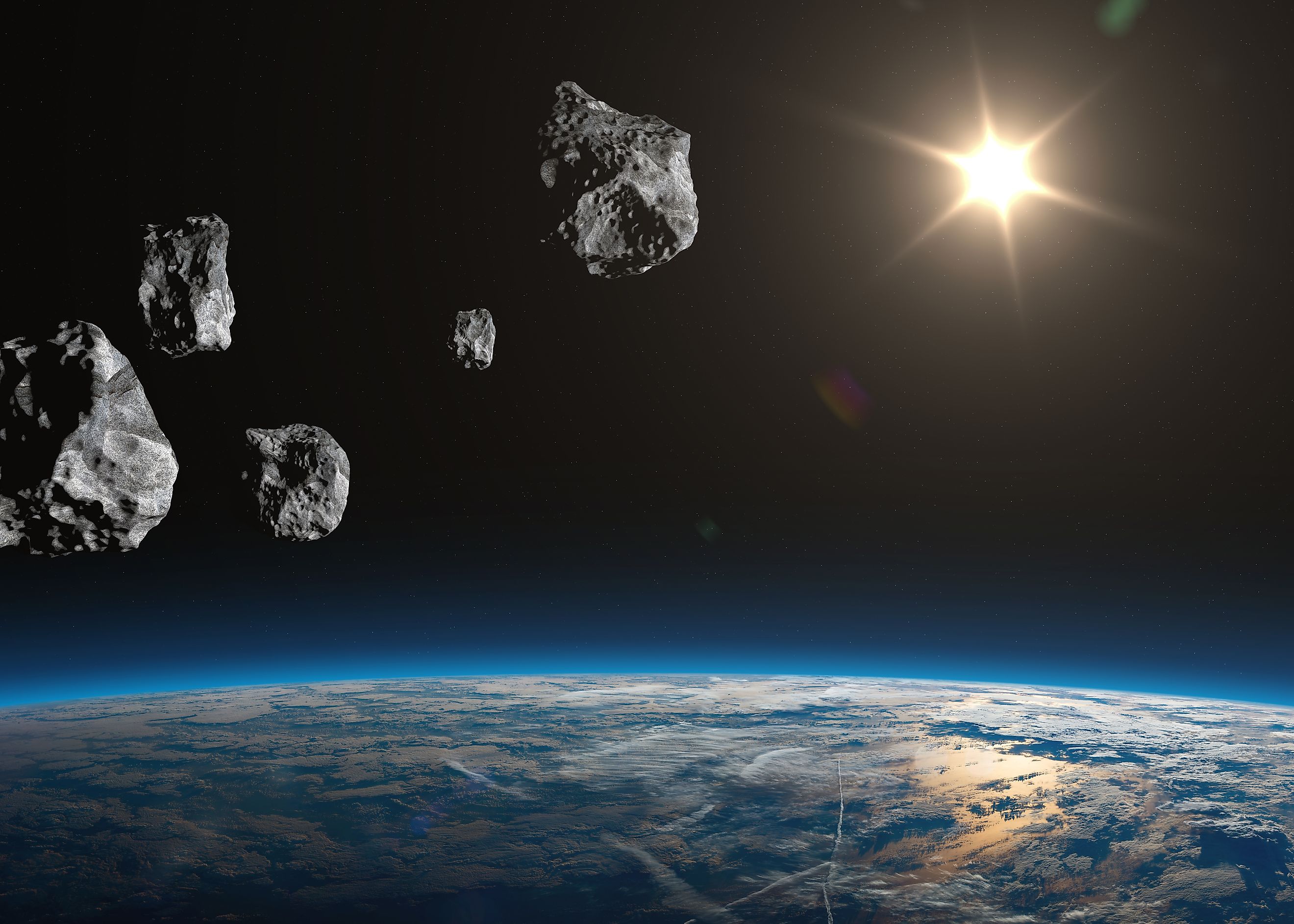
On September 26th, 2022, scientists deliberately crashed a spacecraft into an asteroid for the first time, and permanently changed its orbit around another asteroid. The target was Dimorphos, a rocky moonlet measuring 525 feet across, almost exactly the height of the Washington Monument tipped on its side. The larger asteroid it orbits around, Didymos, stretches 2,560 feet wide, roughly the length of eight football fields. The European Space Agency's (ESA) Hera spacecraft is now closing in on what remains of that impact to study the effects of the collision and how the impactor technique could be refined into a reliable defense against asteroids that genuinely threaten Earth.
A Crash That Changed An Asteroid's Orbit

NASA's DART spacecraft weighed approximately 1,280 pounds at impact and struck Dimorphos traveling at about 14,000 miles per hour. That's fast enough to cross the continental US in about 12 minutes.
The experiment was the first time humanity deliberately altered the motion of a natural object in space. It was part of the Asteroid Impact and Deflection Assessment collaboration between NASA and ESA. The goal was to nudge Dimorphos, measure how much its orbit around Didymos changed, and build a reliable playbook for deflecting any future asteroid that strays toward Earth.
The nudge worked spectacularly. DART shortened Dimorphos's orbital period around Didymos by 32 minutes. This dropped its orbiting time from 11 hours and 55 minutes down to about 11 hours and 23 minutes. Scientists at NASA defined a minimum successful orbit time change as 73 seconds or more. Getting over 25 times that benchmark for success signaled that the physics of what happened to Dimorphos was far more dramatic than the models predicted.
An Unexpected Impact Effect

The original expectation was that DART would punch a clean crater into Dimorphos's surface, much like a stone dropped into dry sand. A study published in Nature Astronomy in February 2024, led by planetary scientist Sabina Raducan at the University of Bern, used detailed impact modeling to analyze what actually happened.
Dimorphos is a rubble-pile asteroid: a loose, jumbled collection of boulders, gravel, and dust held together primarily by gravity. It has almost no cohesive strength binding the materials together. The impact redistributed roughly a tenth of the asteroid's mass and reshaped Dimorphos globally, rather than forming a contained crater. The debris cone that erupted from DART's impact point shows exactly how different this collision was than anticipated. A typical impact on Earth produces a crater cone about 90 degrees wide. Observations from the Italian Space Agency's LICIACube spacecraft, which trailed DART during the approach, recorded the impact cone opening to around 140 degrees at Dimorphos. As co-author Dr. Martin Jutzi from the University of Bern explained, the crater kept expanding because both the gravity and material cohesion of Dimorphos were so low that nothing in the asteroid's structure stopped the spread. The crater grew until it encompassed the entire impacted side. Dimorphos did not gain an impact scar, but a new shape.
After the impact, a massive amount of material was ejected, some of which formed a debris tail like that of a comet. That tail remained observable for months. The debris plume, pushed outward by the Sun's radiation pressure, stretched more than 6,000 miles from the point of impact, more than twice the width of the US from coast to coast. Telescopes across the Southern Hemisphere captured the sight in the days that followed.
What Hera is Flying Into

ESA launched Hera on October 7th, 2024, and after a Mars gravity-assist flyby in March 2025, the spacecraft is on track to arrive at the Didymos system in November 2026. This is a full month earlier than originally planned.
When Hera arrives, it will spend months in close orbit around Dimorphos, precisely measuring the asteroid's mass for the first time. It will map every surface scar the explosive impact left behind, and deploy its two CubeSats to study the body from the inside out. CubeSats are small nanosatellites built up from standardized four-inch units, and Hera's are six-unit models about the size of a suitcase, often used by space agencies for research.
During Hera's mission, the main spacecraft and its two companion CubeSats will conduct detailed surveys of both asteroids, with particular focus on the surface disturbances left by DART's collision and a precise determination of the mass of Dimorphos. That mass measurement is the linchpin of the whole experiment. Without knowing exactly how heavy Dimorphos is, scientists cannot calculate the precise momentum transfer from the DART impact. This is the one number that determines whether the deflection technique can be scaled to a larger asteroid.
Radar That Will Look Through Dimorphos

Hera carries two CubeSats named Juventas and Milani, which will be deployed to orbit Dimorphos independently and gather data far closer to the surface than the main spacecraft can safely operate.
Milani will conduct multispectral mineral analysis of the surface, while Juventas will carry the first radar instrument ever built to probe an asteroid's interior. The Juventas radar, called JuRa, is the smallest radar ever flown into space. It will unfurl four antennas, each roughly five feet long, and fire signals up to 330 feet into the body of Dimorphos. Since the asteroid is only 525 feet across, that penetration depth will reach most of the way through the entirety of Dimorphos. The result will be a three-dimensional map of its internal structure, showing whether the loose rubble pile models hold up or whether denser, harder regions exist deeper inside.
No instrument has done this before. Scientists have extensive surface imagery of several asteroids from missions like Hayabusa2 and OSIRIS-REx, but the interior has remained completely invisible to direct measurement. Being able to see how the interior of an asteroid is structured will give scientists valuable insights into planetary defense.
Juventas, weighing just 26 pounds, will become the smallest spacecraft ever to land on a celestial body. Once its radar survey is complete, it will descend to the surface of Dimorphos at just a couple inches per second, touching down gently enough to avoid bouncing off into space in the asteroid's near-zero gravity.
Mapping Dimorphos for Planetary Defense

The deeper purpose behind both missions is establishing a planetary defense technique that works reliably, not just once. The key to this technique is what scientists call the momentum enhancement factor, also called the beta factor. When you throw a stone into a river, the stone transfers some of its momentum to the water. But the water also sprays backward, pushing against the stone in the opposite direction. A kinetic impactor hitting a loose rubble-pile asteroid works on the same principle. The spacecraft delivers one unit of force, but the debris blasting outward from the impact sprays in the opposite direction like a pressure valve releasing. This shoves the asteroid even further off course. The looser and more fragmented the asteroid, the bigger that spray, and the more the deflection is amplified.
When DART struck Dimorphos, it delivered one unit of force, but the debris blasting outward from the loose rubble sprayed backward like a pressure valve releasing, shoving the asteroid even further off course. That amplification pushed the beta factor to an estimated range of 2.2 to 4.9, meaning Dimorphos received up to five times more total force than DART delivered alone.
The problem is that the range is far too wide to be operationally useful. If scientists had to plan a real deflection mission, that level of uncertainty could be the difference between a successful redirect and an impact that barely moves its target. The missing piece is the actual mass of Dimorphos, which will be measured by Hera. With Dimorphos's actual mass in hand, scientists can pin down the beta factor to a single confirmed number for this specific impact, giving them the first real data point for how a rubble-pile asteroid absorbs a kinetic strike and how much the erupting debris amplifies it.
Any structural changes and deformations from the DART impact will still be geologically fresh when Hera arrives. In cosmic terms, four years is barely a moment. The surface of Dimorphos has not had time to be erased by solar wind or micrometeorite bombardment. So the evidence of what happened in September 2022 is still sitting there, largely intact.
The Significance of DART's Impact
Dimorphos is historically significant as the first object in the solar system to have its orbit shifted by scientists in a measurable way. A 1,280-pound spacecraft moving 90 times faster than a Category 5 hurricane permanently altered the orbital path of a 525-foot asteroid. The data Hera collects there on the asteroid's mass, internal structure, and the precise beta factor will help determine whether scientists can engineer that result again when it truly counts.