What Euclid Is Mapping In The Dark Universe
About 95% of the universe is made of something scientists still cannot fully explain.
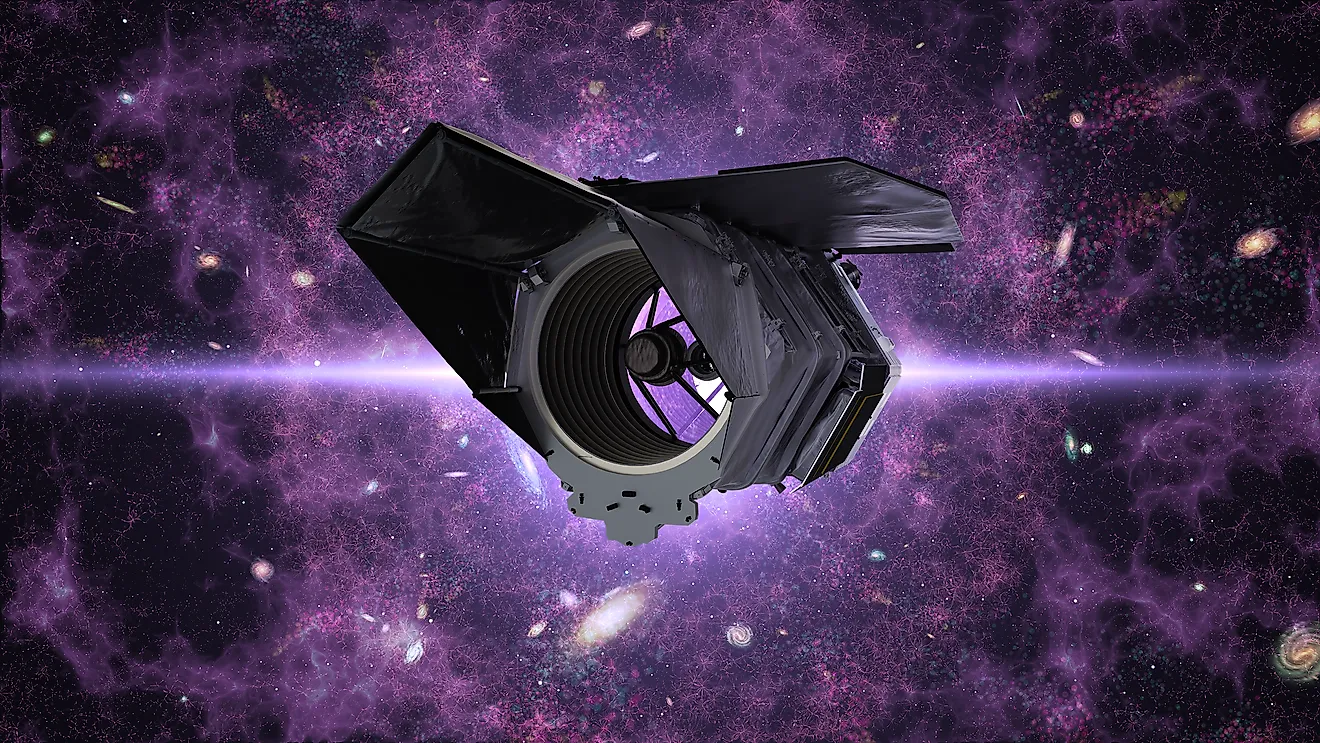
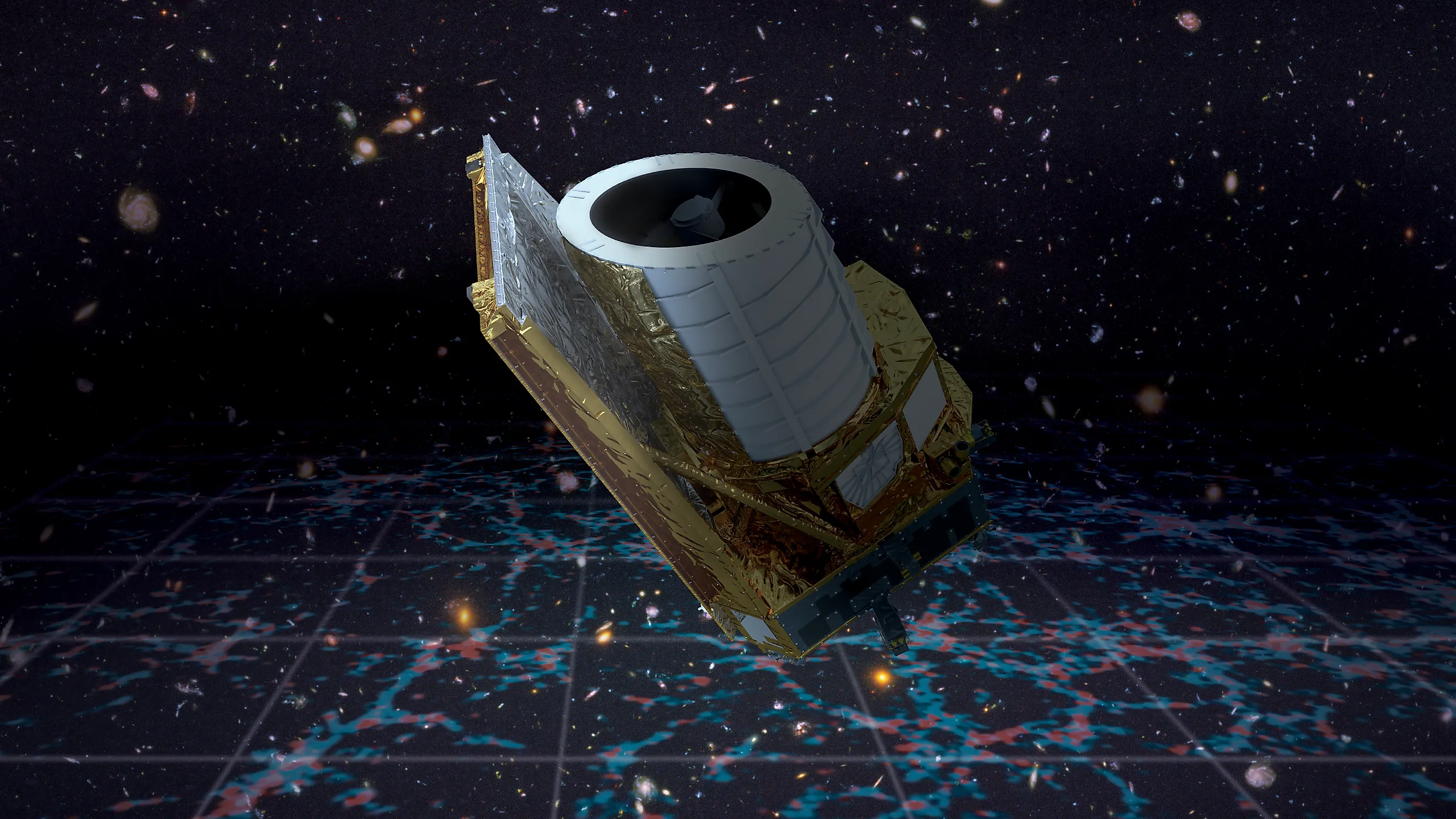
That mystery is what sent the Euclid telescope into space on a clear July day in Cape Canaveral, Florida. Attached to a Falcon 9 rocket, Euclid launched toward a point about 1.5 million kilometers from Earth, in the direction opposite the Sun.
Euclid was built to help scientists answer some of their biggest questions about space: how the universe has evolved, what it is made of, and why its expansion is speeding up.
What is the Euclid Telescope?

The Euclid Telescope was created by the European Space Agency to study the geometry of the dark universe. That focus is why it was named after Euclid of Alexandria, the mathematician often called the father of geometry.
The mission of Euclid is to map one-third of the sky and, in doing so, create the largest 3D map of the universe. To achieve this, the telescope uses optical and near-infrared light. In a single week of observations, scanning each deep-field region once, Euclid captured 26 million galaxies. The farthest sits 10.5 billion light-years away. Euclid's images are about four times sharper than those from ground-based sky surveys, sharp enough to resolve faint, distant galaxies that appear as a single blur from the ground.

Euclid will scan space in two ways. It will conduct a wide survey spanning 14,000 square degrees and a deep survey examining three smaller patches of the sky in greater detail.
The three smaller patches being observed are called Deep Field South, Deep Field Fornax, and Deep Field North. By studying these three patches closely, scientists hope to map how galaxies are organized and to learn more about dark matter and dark energy.
What is Dark Energy and Dark Matter?

Right now, you are surrounded by dark energy and dark matter, even if you cannot feel or see a trace of either. While the names may sound ominous, dark energy and dark matter are the dominant components of our universe, making up about 95% of it (dark energy accounting for 68% and dark matter for 27%). That leaves only about 5% for ordinary matter: every atom, every star, every planet, and everyone reading this. Almost everything we can actually see adds up to a sliver of what is out there. That is a major reason why scientists want to figure out exactly what dark energy and dark matter are. With the help of Euclid, that mystery may be unveiled.
What scientists do know is that the universe’s expansion is accelerating; dark energy is the name for the mysterious “something” thought to be behind that acceleration. In other words, the universe is not static. It is constantly stretching wider. Scientists aren't certain what dark energy actually is, but they have competing ideas. One is that empty space itself carries a small, constant push built into the vacuum. Another is that there may be no dark energy at all, and that our understanding of gravity needs rethinking instead.
We can't talk about dark energy without also talking about dark matter. While dark energy seems to push the universe apart, dark matter seems to do the opposite. It acts like invisible scaffolding, pulling ordinary matter together so galaxies can form and hold their shape. Dark matter does not emit, absorb, or reflect light, so scientists know of its existence only through its gravitational pull on other objects in space. Scientists think it pulls together into vast clumps that ordinary galaxies then settle into.
Scientists might be able to answer some questions about dark energy and dark matter soon, thanks to the Euclid Telescope.
What Can the Telescope Tell Us?

Euclid studies these invisible ingredients by measuring gravitational lensing, which happens when normal matter and dark matter warp the space around galaxies and bend the light passing through. From those measurements, scientists can start to infer how dark matter is tugging on the galaxies around it.
Even though scientists cannot see dark matter or dark energy directly, they can track their effects, much like working out what is casting a shadow by studying the shape of the dark patch on the ground.

A striking example of dark matter revealing itself through light is an Einstein ring, which Euclid spotted during testing in September 2023 and announced in February 2025. An Einstein ring forms when light from a distant galaxy bends around a closer object and wraps into a glowing circle. The one Euclid captured loops around the center of the galaxy NGC 6505, the first time such a ring has been seen around it. This galaxy is around 590 million light-years from Earth, which might sound incredibly far, but is actually considered fairly close on the scale of the universe.
That ring matters for dark matter research because dark matter is thought to add to the bending that shapes it. Euclid will rely on other methods, too, but capturing this ring so early is an encouraging start.
Euclid will also hunt for a subtler form of gravitational lensing, called weak lensing, in which galaxies appear only slightly stretched or nudged out of place. Scientists will need to measure the shapes of about 1.5 billion galaxies for weak lensing. For related Euclid image-classification work, ZooBot AI and Galaxy Zoo volunteers work together on the Zooniverse platform.
What Else is Euclid Seeing?

Dark energy and dark matter are not the only things that Euclid is seeing during its journey.
On March 19, 2025, a quick data release offered the first real look at what Euclid had been finding. Many scientific papers have been written using Euclid’s first quick data-release findings.
One early finding is that galaxy mergers are closely tied to supermassive black holes and seem to fuel their rapid growth. Euclid data are helping scientists understand how black holes and their host galaxies grow together.
Euclid has also added to the study of dwarf galaxies, the most common galaxy type in the cosmos. Euclid has identified 2,674 dwarf galaxies, which matters because these small galaxies are thought to be the building blocks of larger ones.
Euclid’s Next View of the Universe

Euclid’s journey is still underway. The telescope launched on July 1, 2023, and began routine science observations on February 14, 2024. Its main survey is set to run for about six years, with several data releases along the way to show what Euclid has been capturing. The March 19, 2025 release was Quick Data Release 1.
The second Quick Data Release, published on June 24, 2026, gives scientists a detailed look at the Milky Way’s crowded central bulge, with data on more than 60 million stars. Each release adds another piece to Euclid’s larger map of the universe, bringing scientists closer to understanding the dark matter and dark energy shaping everything around us.