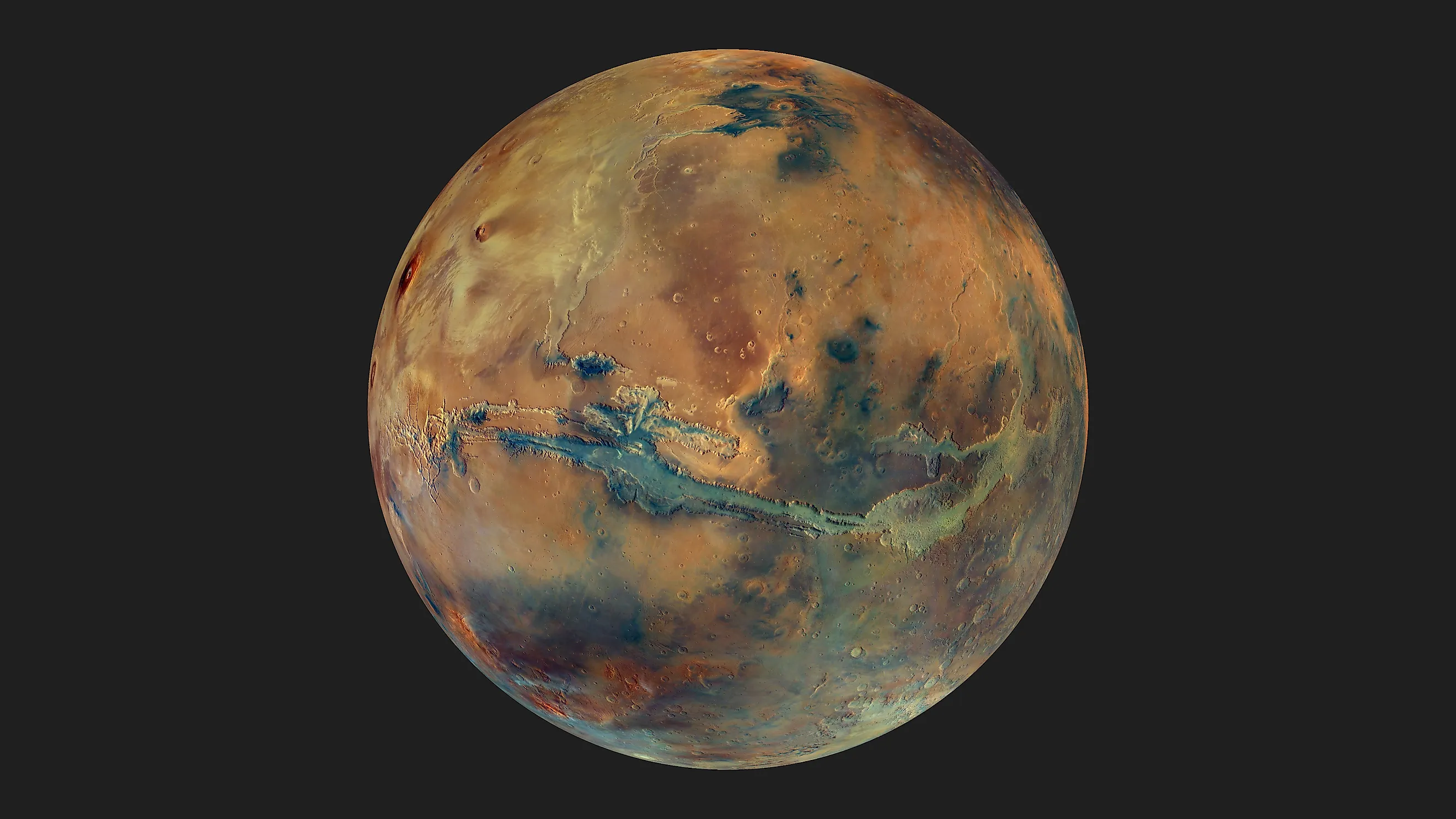
Why Mars Lost Most Of Its Atmosphere
Mars can glow with auroras across its whole night sky. There is nothing like it on Earth, where the Northern Lights stay penned near the magnetic poles. The reason is Mars' missing magnetic field. Earth has one that funnels the Sun's charged particles toward the poles. There, they strike the upper atmosphere and set the sky glowing green, blue, and pink. Mars lost its field long ago, so the solar wind now hits the atmosphere everywhere, and the whole planet's sky can glow.
As beautiful as that sounds, it is bad news for the planet. Every burst of solar wind that reaches Mars' upper atmosphere carries a little more of the planet's air off into space. The atmosphere is now only a sliver of what Earth has, and it keeps getting thinner.
People have spent decades picturing Mars as humanity's next home, which makes that vanishing air hard to ignore. The planet once held a far thicker atmosphere that slowly slipped away. With the data MAVEN returned, scientists are finally working out where it went.
The MAVEN Spacecraft

MAVEN stands for Mars Atmosphere and Volatile Evolution. The orbiter launched from Cape Canaveral in 2013 and reached Mars in September 2014. It had one main job: to study the planet's thin air closely enough to reconstruct its history. Its stretched-out orbit was built for it, dipping to about 150 kilometers above the surface to sample the air directly before swinging back out past 6,000 kilometers.
It tracked atmospheric leakage into space and measured gas streaming off the top of the planet. Its readings gave scientists a much clearer view of how the Sun and space weather act on Mars.
MAVEN's Findings

Mars' atmosphere, made up mostly of carbon dioxide, now accounts for less than 1% of Earth's. It was not always this thin; evidence suggests the surface was once much warmer and held liquid water.
Soon after arriving, MAVEN spotted oxygen, hydrogen, and carbon escaping the atmosphere into space. Its readings showed the solar wind striking Mars more deeply than anyone had expected. Because the planet follows an oval orbit, it swings closer to the Sun at some points than others. MAVEN found that Mars loses more hydrogen when it is nearest the Sun than when it is farthest, most likely because of the stronger sunlight and solar wind there.

MAVEN also watched a dust storm grow until it wrapped the entire planet in cloud. Studying it, scientists confirmed that heat from storms like this can push water molecules higher into the atmosphere than usual, where they too are lost to space.
MAVEN's view of the atmosphere has been invaluable, but it is not the only explanation on the table. A second theory looks down at the ground instead of up at the solar wind.
Could the Atmosphere be Absorbed into Mars?

Scientists at MIT have a different idea, one that has nothing to do with the Sun stripping the planet bare. They suggest the atmosphere may have partly soaked into the crust.
Their theory works like this. Water that once sat on the Martian surface set off a slow chain of chemical reactions that pulled carbon dioxide out of the air. That carbon dioxide may have turned into methane and ended up locked inside surface clay.
The clay they point to is a mineral called smectite, found on both Earth and Mars. It is very good at trapping carbon. Picture a single grain of it as a tightly folded sheet, with carbon held in the creases and undisturbed for ages.
More work is needed to confirm any of this. Set alongside the solar wind tearing at the atmosphere from above, the theory helps explain how Mars lost so much of its air.
The Effects of Not Having an Atmosphere

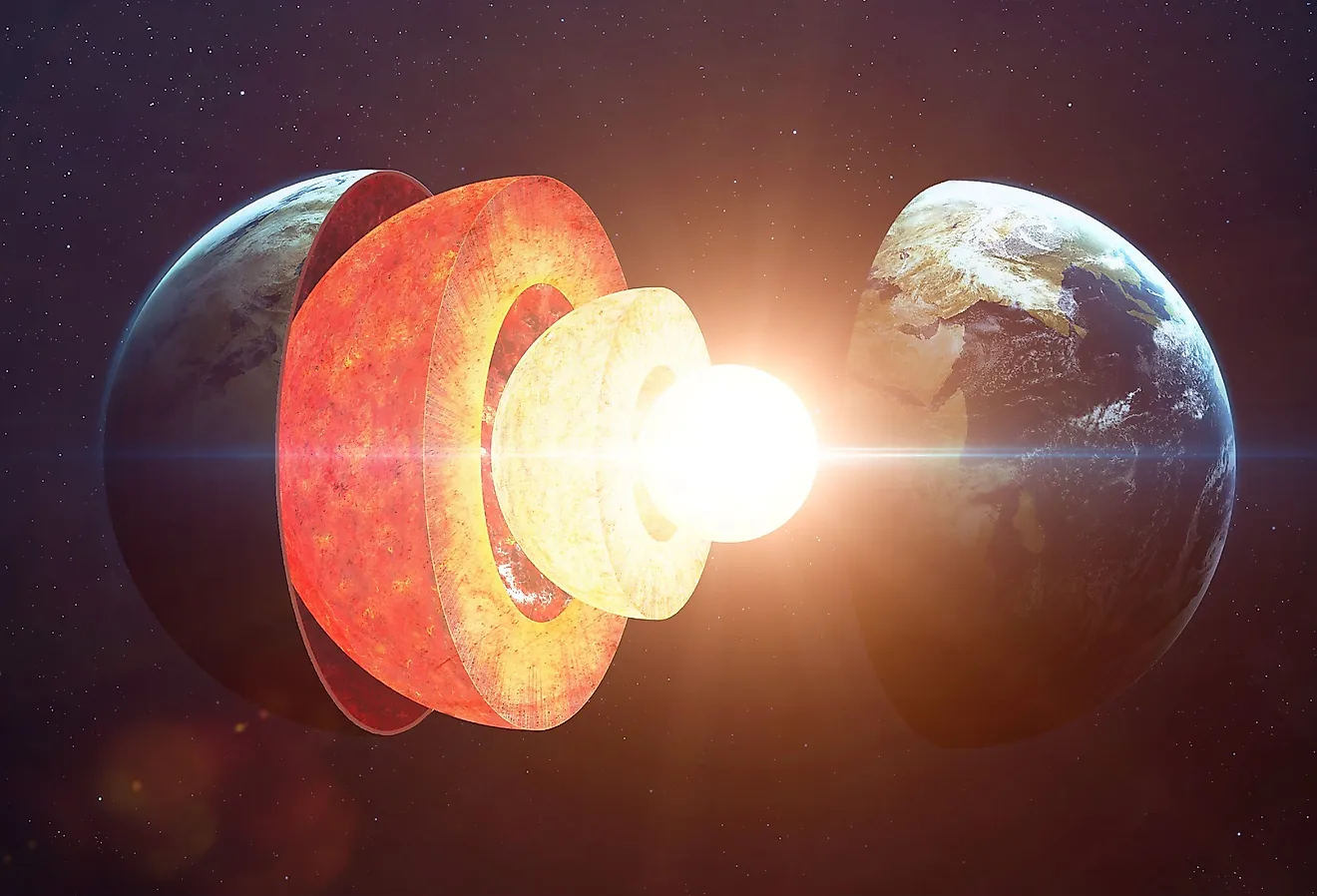
Early in its history, until about 4 billion years ago, Mars had a strong magnetic field much like Earth's. Back then, it was a warm world with plenty of water. The difference is that Mars cooled from within, while Earth's core remained hot. As its interior cooled, Mars stopped generating that field and was left exposed to the Sun's solar wind.
Over billions of years, the solar wind stripped away much of Mars' atmosphere. As the air thinned, the surface cooled, and the water dried up, leaving the cold, rust-colored desert we see today.
What Mars Lost To Space
MAVEN measured Mars losing roughly 100 grams of its atmosphere every second, with higher losses during solar storms. No one can say when the last of it will be gone, only that the leak has not stopped.
That is the real lesson of the red planet. It began warm and wet, not so different from Earth, and ended as a frozen desert with air far too thin for any human to survive unprotected. People still dream of settling Mars one day, and maybe they will. For now, it stands as a stark reminder of how completely a world can change once it loses the thin shell of gas that keeps it alive.