Is The Universe Infinite?
Whether the universe is infinite turns on a distinction that is easy to miss: the difference between the part we can see and the whole of what exists. Astronomers can measure the observable universe with real precision. They can map its galaxies, clock its expansion, and read the radiation left over from its first few hundred thousand years. What lies past that horizon is a separate question, and the honest answer is that the geometry of space allows for more than one shape. The total universe could run on without end, or it could be finite and still have no edge at all.
The Observable Limit

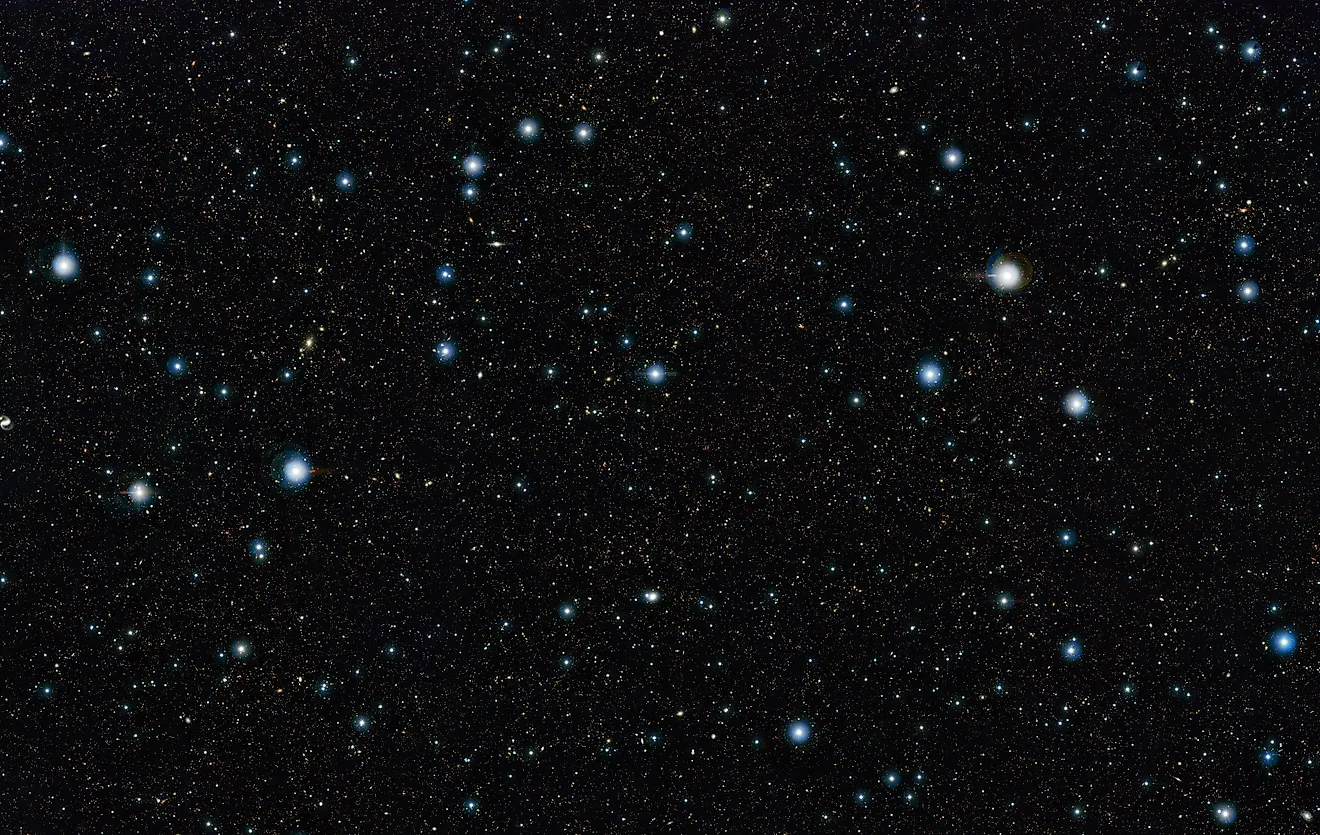
The observable universe is everything whose light has had time to reach Earth since the Big Bang roughly 13.8 billion years ago. Because light moves at a fixed speed and the universe has a finite age, there is a hard boundary on how far we can see, called the cosmic horizon. Light from anything past it has not had time to arrive. The Hubble Deep Field shows how much sits inside that boundary. A patch of sky smaller than a full moon, stared at for ten days, turned out to hold thousands of galaxies, most of them more than 12 billion light-years away.
The size of that visible region is larger than the speed of light alone would suggest. A naive estimate puts the edge at 13.8 billion light-years, one for each year of cosmic history. The real figure is a radius of about 46.5 billion light-years, a sphere roughly 93 billion light-years across. The gap comes from expansion. Space itself has stretched while the light was in transit, carrying each source much farther away than it was when the beam set out.

This is why looking out into space is also looking back in time. When we observe the Whirlpool Galaxy, 30 million light-years off, we see it as it looked 30 million years ago, and it now sits well beyond that mark. The farthest thing any telescope can detect is not a galaxy at all. It is the cosmic microwave background, the faint radiation released about 380,000 years after the Big Bang, when the cooling universe first turned transparent. Penzias and Wilson found it by accident in 1965, and it still glows at 2.73 degrees above absolute zero across the entire sky, varying by only about one part in 100,000. It marks the edge of the visible, a wall of light from the moment the cosmos stopped being an opaque fog. Inside this whole sphere sit hundreds of billions of galaxies, and by some earlier estimates as many as two trillion.
The Total Universe: Infinite, Or Finite Without An Edge

The observable universe is a bubble centered on us, but there is no reason to think we sit at the middle of anything. Past the cosmic horizon, the same kind of space almost certainly continues, filled with more galaxies arranged in the same web of filaments and voids seen everywhere else. The open question is whether that continuation goes on forever. The best handle scientists have is the geometry of space, and the clue comes from the cosmic microwave background.
Measurements by the WMAP satellite, and later the more precise Planck mission, found that space is flat to within a fraction of a percent. Flat geometry is the kind taught in school, where parallel lines never meet and the angles of a triangle add to 180 degrees. A flat universe can extend without end. But flatness measured locally does not prove infinity, because a finite universe large enough would look flat from the inside, the same way a small patch of Earth's curved surface looks level to someone standing on it.
The Case For An Infinite Universe
If space is exactly flat and keeps the same structure everywhere, it has no reason to close back on itself, and the simplest reading is that it is infinite. An endless universe would hold an unlimited number of galaxies, stars, and planets. It also carries a stranger consequence that some cosmologists take seriously. With infinite space and only a finite set of ways to arrange matter, configurations would eventually repeat, including regions that resemble our own. These remain logical extrapolations rather than observations, but they follow directly from taking infinity literally.
Finite, But Without An Edge

A finite universe does not require a wall somewhere out in space. Picture the surface of a globe. It has a finite area, yet a traveler heading in one direction never hits a boundary and simply circles back to the start. Space can do the same thing in three dimensions if it carries a slight positive curvature, closing on itself like the surface of a sphere lifted one dimension higher. A flat universe can also be finite if it wraps around, the way the edges of some video-game screens connect top to bottom and side to side. Either shape produces a cosmos with finite volume, no center, and no edge.
This also explains why the common picture of the universe expanding into surrounding empty space is misleading. Space is not growing into anything. The expansion stretches distances within the universe itself, and a finite but unbounded cosmos has no outside for it to expand into.
What The Evidence Can And Cannot Settle
Current data cannot close the case, because every measurement is taken from inside the observable bubble. The flatness reading is consistent with an infinite universe, but it fits a finite one too large for its curvature to register just as well. Telling the two apart would take either a curvature measurement far more sensitive than today's instruments allow, or a direct sign that space wraps around, such as repeated patterns in the microwave background. Searches for that wraparound signature have so far found nothing, which sets only a lower bound. If the universe is finite, it is at least as large as the part we can see, and probably much larger.
No Wall, Either Way
So the universe is either infinite or finite, and the measurements available today fit both. What they rule out is the picture most people start with, of a bounded space with an edge somewhere and emptiness beyond it. Flat or gently curved, wrapping around on itself or running on without limit, the cosmos has no wall to run into. The observable universe is the part we can study. The total universe is the part the geometry still leaves open.