Why The Everglades Is Actually A River
For most of American history the Everglades was filed under swamp, which is a category that carries a quiet instruction: drain it. Then in 1947 a Miami journalist named Marjory Stoneman Douglas published a book that reclassified the whole thing in five words. It is a river of grass. That reframing was not a poetic flourish, it was a hydrological argument, and it happens to be right. Water enters the Everglades in the north and leaves it in the south, moving continuously across a hundred miles of Florida, which is the definition of a river even though there is no bank, no channel and almost no perceptible current.
The catch is that Douglas got two of her five words wrong, and the corrections are more interesting than the phrase.
Where The Water Comes From

Historically the system began at Lake Okeechobee, which has no natural outlet river in the ordinary sense. In the wet season the lake simply filled past its low southern rim and spilled over, and that overflow spread out across the flat limestone shelf below rather than cutting a channel into it. From there the water moved south as an unbroken sheet, roughly 100 miles from the lake to the mangroves and estuaries of Florida Bay.
That is the whole mechanism, and it is why the Everglades exists at all. A river needs a source, a slope and a mouth, and this system has all three. What it lacks is banks.
The Slope Is Almost Nothing

The gradient across the Everglades runs to about two inches per mile. Over the full hundred-mile run that adds up to a fall of only a few feet from Okeechobee to the sea, which is a slope so slight that a person standing in the middle of it cannot tell which way is downhill.
Water moves anyway, because water always does, but it moves slowly enough that the flow is invisible to the eye. This is why the misclassification lasted so long. Every visitor who called the Everglades a stagnant swamp was looking at a river and simply could not see it moving.
Sheet Flow Rather Than A Channel
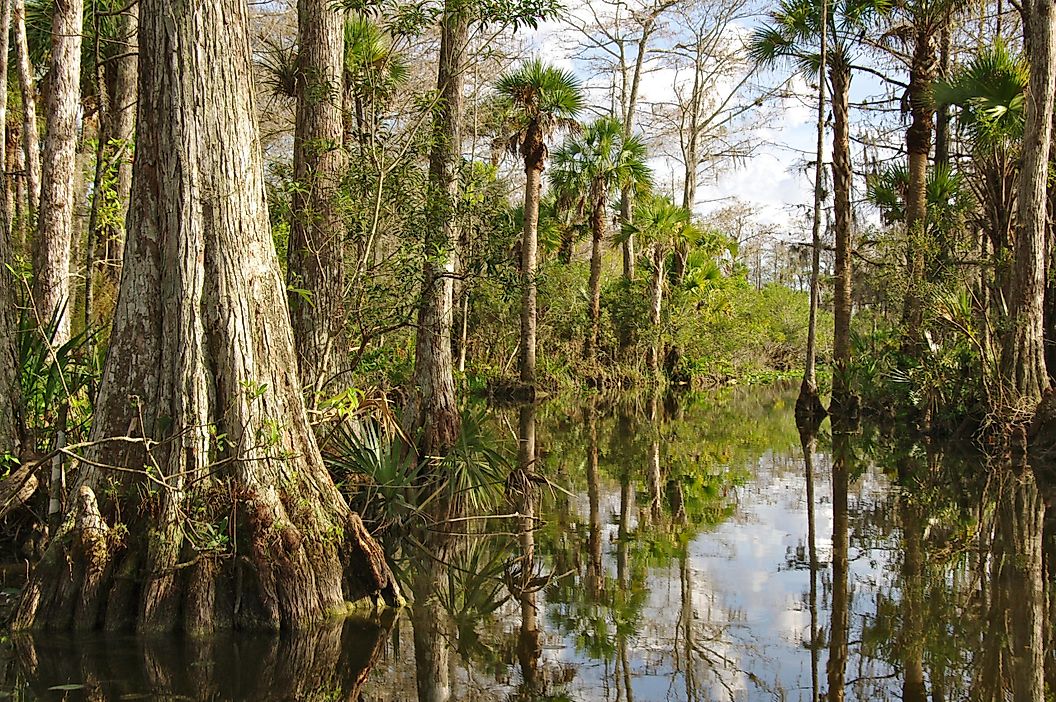
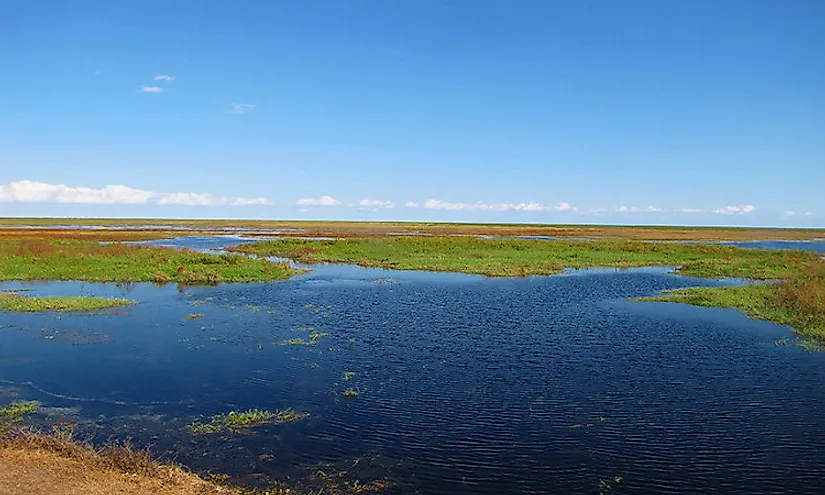
The technical term for what the Everglades does is sheet flow, and it is the feature that separates this place from every other freshwater system in North America. Instead of concentrating into a channel, the water spreads across a front that historically ran somewhere between 60 and 100 miles wide depending on which source you read, at a depth that in much of the marsh is measured in inches rather than feet.
Douglas herself described it as a river seventy miles wide. Other accounts stretch it to a hundred. The variation is not sloppiness so much as a genuine problem of definition, because the edges of a sheet of water a few inches deep are not obvious things to draw on a map.
Sawgrass Is Not Grass

The first error in the famous phrase is botanical. Sawgrass, Cladium jamaicense, is a sedge rather than a true grass, and the difference is real enough that field botanists teach a rhyme for it: sedges have edges, rushes are round, grasses are hollow right up from the ground. Run a sawgrass blade between your fingers and you will find the edges, along with the tiny serrated teeth that gave the plant its name and that will open a hand that grips it wrongly.
Those teeth are also the reason the Everglades resisted exploration for so long. Sawgrass was impassable on foot, useless as cattle forage and offered nothing anyone could sell, which is why virtually the entire United States was surveyed and mapped before anybody produced a serious account of this one.
The Miccosukee Named It First

The second correction is a matter of credit. Douglas is remembered for identifying the Everglades as flowing water, but the Miccosukee had called it Pa-hay-okee for far longer, a name that translates as grassy water.
So the insight Douglas is celebrated for delivering to a national audience in 1947 was already embedded in the local language. What she did was translate it into a frame that Americans outside Florida would act on, at a moment when the alternative frame was worthless swamp and the policy attached to that frame was drainage.
Marsh, Swamp, Or River

All three words get used and they are not interchangeable. A swamp is a wetland dominated by trees, which the sawgrass prairie plainly is not. A marsh is a wetland dominated by herbaceous plants such as sedges, rushes and grasses, and by that standard the Everglades is a marsh, which is how ecologists usually classify it.
The river argument is about behavior rather than vegetation. What makes it a river is not what grows there but that the water is going somewhere, continuously, from a source to a mouth. Both descriptions are correct, and Douglas chose the one that made people care.
Why The Word Mattered

This is the part that justifies the whole argument. A swamp is a problem to be solved, and the United States spent the better part of a century solving it with canals, levees and pumps. A river is a system with a beginning and an end, and you cannot cut one in the middle without consequences downstream.
The Everglades: River of Grass was published on November 6, 1947, a month before Everglades National Park opened to the public, and the timing gave the new park an argument as well as a boundary. Douglas opened the book by writing that there are no other Everglades in the world. She then spent 406 pages explaining what was being lost, and lived to 108 defending it, founding Friends of the Everglades in 1969 and campaigning into her nineties.
What Breaking A River Looks Like

Once you accept the river framing, the damage becomes legible in a way it is not otherwise. Cutting off the source at Lake Okeechobee did not merely reduce a swamp, it dewatered the top of a hundred-mile system. Diverting water east and west to the coasts did not simply move it, it removed it from the only route it had ever taken.
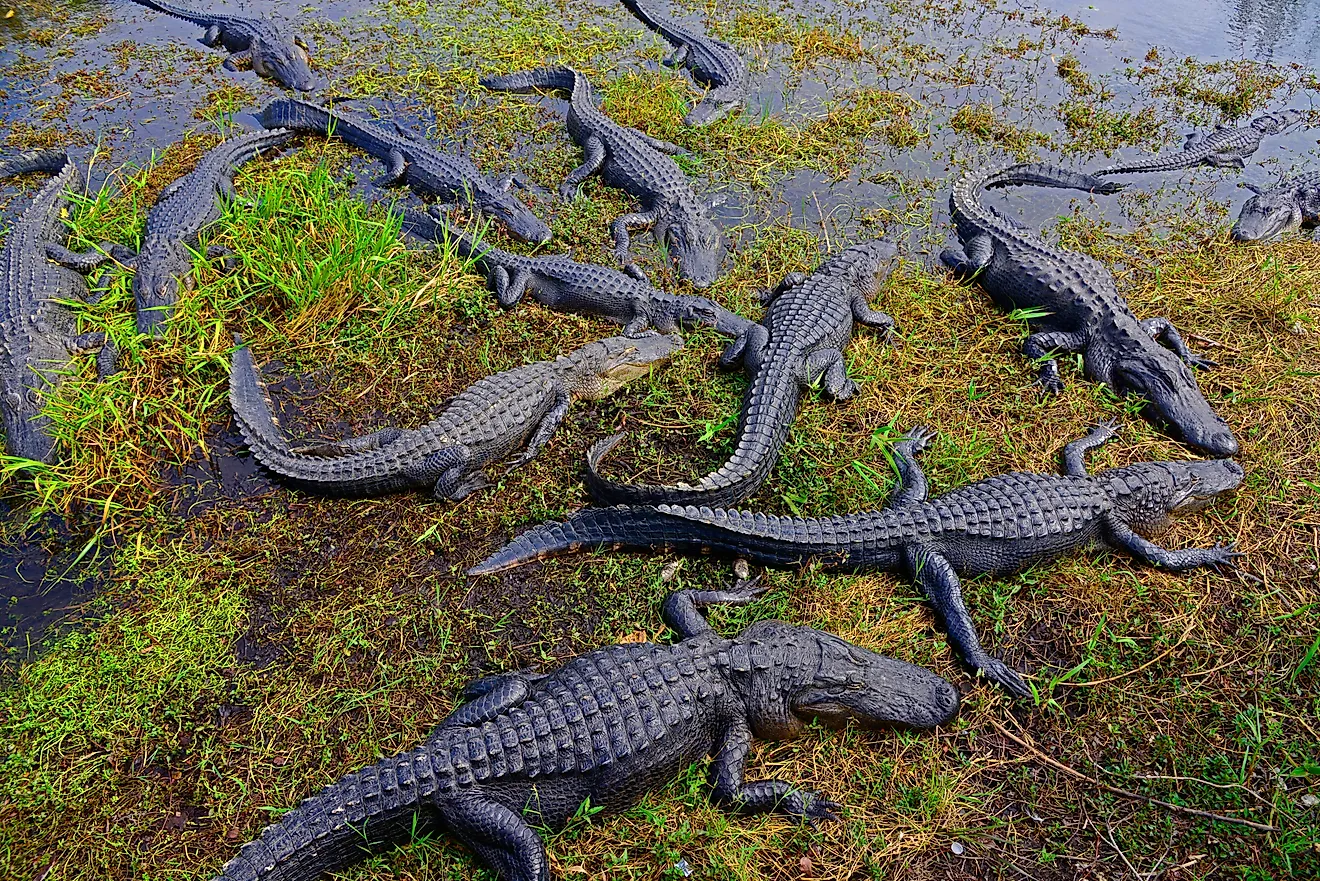
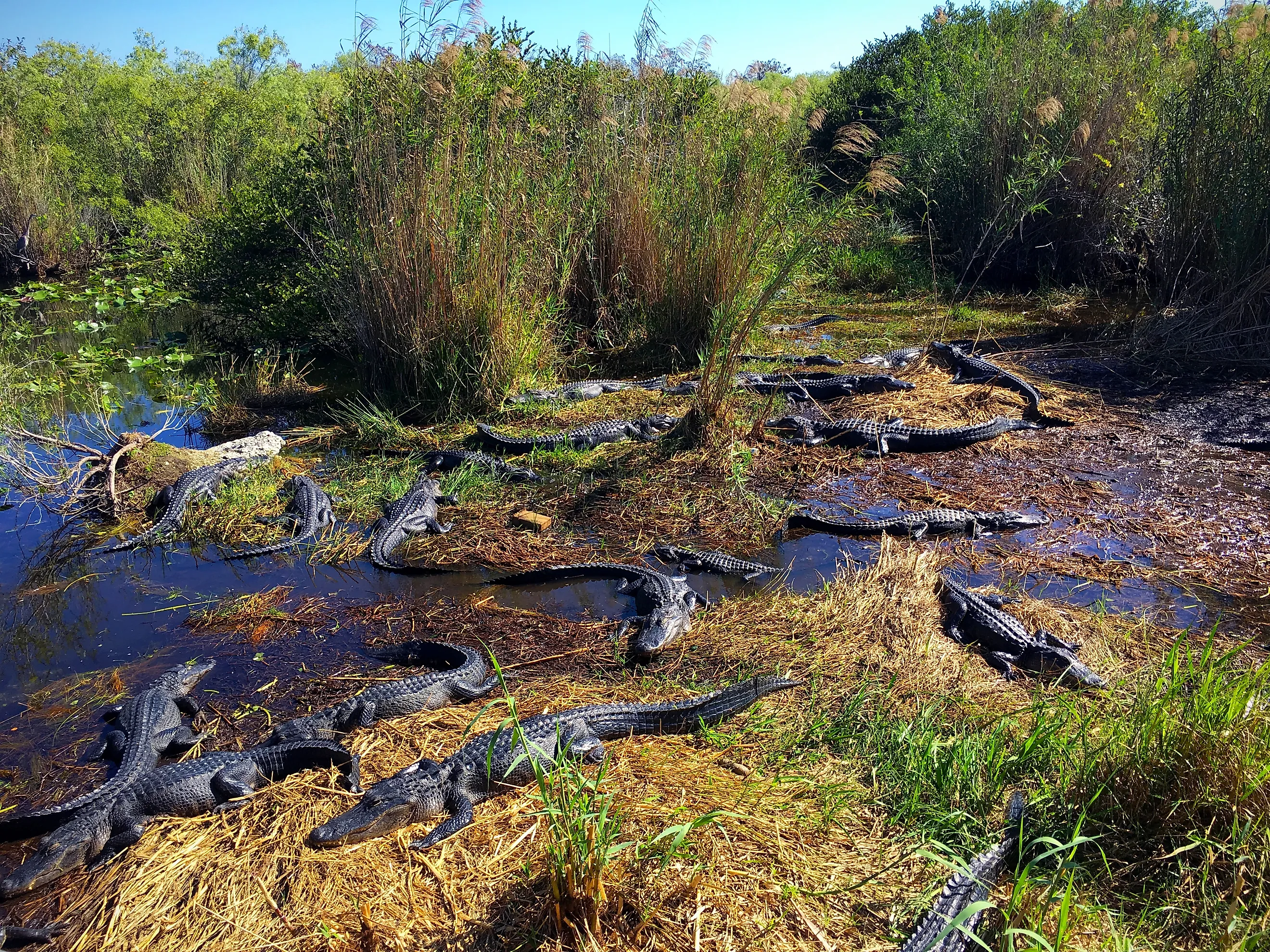
The current condition follows from that. Estimates vary but the Everglades retains only a fraction of its original extent, and Everglades National Park protects about 1.5 million acres of what is left, home to more than 2,000 species, including the invaders that arrived later, with dozens listed as endangered. The park is the surviving lower section of a river whose upper section was disconnected.
Restoration Is About Flow

The clearest proof that the river description is the operative one is what restoration actually consists of. The work is not about adding water in general, it is about restoring sheet flow: removing levees and road embankments that act as dams across the marsh, filling in canals that short-circuit the route south, and re-establishing the timing and volume of water moving from north to south.
Raising sections of the Tamiami Trail onto bridges is the most literal version of it. That road ran east to west directly across the flow and functioned as a wall for decades, and putting it on stilts lets the river resume passing underneath. Nobody spends that kind of money to improve a swamp.
The Phrase Was Doing A Job
So the honest verdict on river of grass is that it is a metaphor with an unusually high hit rate. The grass is a sedge and the river has no banks, no channel and a current you would need instruments to detect. Everything else about the description holds: there is a source, a slope, a direction of travel and a mouth, and the water has been making that journey for thousands of years.
Douglas was a journalist rather than a hydrologist, and she picked the five words that would change what people did about the place. That was the correct call. A swamp gets drained, and a river gets restored, and the entire multi-billion-dollar effort now underway in southern Florida rests on which of those two words the public settled on.