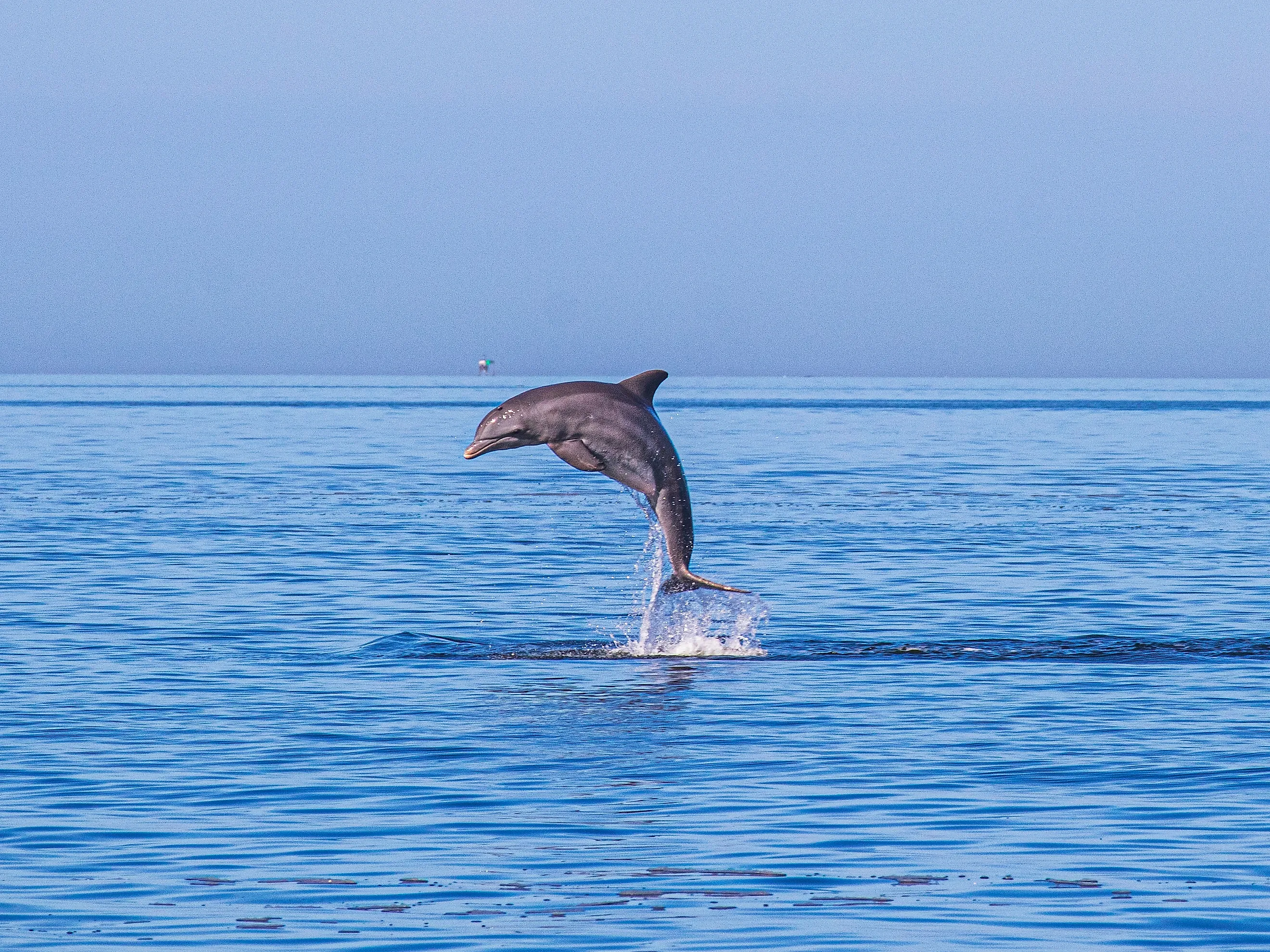
The US Waters Where Dolphins Live Year-Round
The bottlenose dolphin you wave at off a Gulf pier could be older than you are. Researchers in Mississippi Sound just photographed a wild female they have known since 1982.
Many American dolphins never leave home. They spend their whole lives in one bay or lagoon, and scientists know them by the nicks on their fins. Some have been tracked in the same water for more than 40 years. A few have even picked up tricks around people, like herding fish against docked cargo ships.
These stay-at-home dolphins live year-round along the Atlantic and Gulf coasts and around Hawaii. That fin slicing past the dock already has a name.
Pamlico Sound and Beaufort, North Carolina

North Carolina's resident dolphins live in the sounds and inlets behind the state's barrier islands. A fin catalog kept since 1995 holds 2,423 individual dolphins photographed between Cape May, New Jersey, and Georgetown, South Carolina, and the photos sort the state's residents into three social groups strung along the coast. The Pamlico Sound group sticks to the most sheltered estuary water, while the southernmost group spends more time near the ocean. Around Beaufort, dolphins from neighboring groups mix.
Each summer, about 500 migratory dolphins travel to the Outer Banks to give birth between May and September. Researchers tell these visitors apart from the locals partly by their barnacles, since a medium or heavy barnacle load on the fins usually marks a migrant.
Cape Romain National Wildlife Refuge, South Carolina

Down the coast in South Carolina, a core group of dolphins in Cape Romain National Wildlife Refuge was never once seen outside the salt marsh. Surveys there through August 2005 identified 22 year-round residents, and every sighting of them came from the tidal creeks and marsh around Bulls Bay. None of the 22 was ever seen in the coastal waters just beyond the marsh edge. Another 49 dolphins used the refuge seasonally, coming and going with the seasons. The refuge covers about 66,000 acres, including four barrier islands, along a stretch of coast with little industrial development.
Charleston Harbor, South Carolina

Charleston's resident dolphins share their harbor with container ships at the port's terminals, and some of them have turned that traffic into a way to eat. In 2021, a South Carolina Aquarium researcher and colleagues described a tactic called shipside feeding, in which dolphins herd fish against the side of a docked cargo ship to trap them. Dolphins in other parts of the world push prey against barriers, and this was the first documented case of dolphins using a commercial ship. The team found it by chance while studying the effects of dredging, then watched from six sites, including ship terminals on the Wando River. They recorded 34 mothers and calves feeding against large vessels, and how the young dolphins learn the trick is still an open question.
About 100 of the 300 to 900 bottlenose dolphins that use the Charleston area over a year live here permanently, according to the aquarium. In the Kiawah River south of the city, a mother named KoKo taught her calf, Kai, to strand feed. Strand feeders drive fish onto a mudbank and slide partway out of the water to grab them, and the behavior slows in winter when mullet move offshore.
Indian River Lagoon, Florida

The dolphins of Florida's Indian River Lagoon, a 156-mile chain of three connected lagoons along the Atlantic coast, changed what they ate after much of their seagrass died off. A phytoplankton bloom in 2013 shaded out more than half of the lagoon's seagrass, and 77 dolphins died that year, about 8% of the population. Nearly two-thirds of the dolphins observed in 2013 were underweight, and later research found them eating more sea bream and less of the energy-rich ladyfish they had relied on.
A few years later, most of the lagoon's dolphins were still there. A survey in 2016 and 2017 found very few dolphins passing through, and nearly three-quarters of the dolphins with distinctive fins were seen in only one section of the lagoon.
Sarasota Bay, Florida

Around the tip of the peninsula on the Gulf of Mexico (Gulf of America) side of Florida, Sarasota Bay is the site of the longest-running study of a wild dolphin population in the world, which began in October 1970. About 170 dolphins make up the resident community, ranging between the southern edge of Tampa Bay and Venice Inlet, and six generations of their families have been documented.
The best known of them was Nicklo, a female born in 1950. Researchers sighted her more than 820 times, and she gave birth to a calf named Eve at 48. Nicklo was presumed dead in 2017 at 67, making her the oldest known wild bottlenose dolphin, and by then Eve had already had a calf of her own.
A study in the journal Animal Behaviour tracked how feeding habits spread among these dolphins through the red tides of the early 2000s. Before the red tides, 12% of the dolphins studied fed around people by taking bait or catch from fishing gear or scavenging discarded fish, and afterward the figure was 41%. Dolphins that fed this way tended to spend more time with others that did the same.
Mobile Bay and Perdido Bay, Alabama

In Alabama, the dolphins of Mobile Bay spend the summer working the dredged ship channels and other human-made features of the bay. In winter, their locations follow water temperature and oxygen levels instead, and their numbers drop by about half, with about 1,500 dolphins in the bay in summer and about 740 in winter.
Perdido Bay, on the Alabama-Florida line, has a smaller group of between about 100 and 200 dolphins, and more of them stay. About 28% of the identified Perdido dolphins appeared in more than three seasons of surveys, compared with 9% in Mobile Bay, where far more of the dolphins are passing through.
Mississippi Sound, Mississippi

In Mississippi Sound, the shallow water between the Mississippi coast and its barrier islands, some dolphins still carry the freeze brands, permanent numbered marks, that researchers gave them during a 1982 health study. The Institute for Marine Mammal Studies has identified about 700 of the roughly 3,000 dolphins in its catalog as permanent residents of the sound. The oldest branded dolphin still being seen, a female catalogued as F649, was photographed in 1982, once more in the mid-1990s, and 16 times in the 11 years leading up to June 2026, when she was an estimated 47 years old. Over those 11 years she was photographed alongside 63 different dolphins that also kept returning to the sound.
One male, branded at age three off the western tip of Cat Island, was seen six times over eight years, always around that same island.
Barataria Bay, Louisiana

Across the state line in Louisiana, Barataria Bay is a shallow estuary averaging about 6.5 feet deep, and its roughly 2,000 bottlenose dolphins are genetically distinct from their neighbors. Tagged dolphins here keep the same home ranges year after year, which kept them in the path of the oil when the Deepwater Horizon spill released 134 million gallons into the Gulf over 87 days in 2010.
Health comparisons with Sarasota Bay's dolphins helped researchers measure the damage, which included lung disease and other chronic illness. In the years after the spill, only about 19% of detected pregnancies in Barataria Bay produced a calf that survived, against an expected 65%. Modeling cited by the Marine Mammal Commission puts the population's decline at about 45%.
Galveston Bay, Texas

Many of the dolphins in Galveston Bay on the Texas coast go by names the public picked through the Galveston Bay Foundation's adopt-a-dolphin program, and the research team uses each name permanently. Angelique, catalogued as dolphin 39, is one of the bay's best-known mothers. Three of her calves have their own numbers in the catalog, and a fourth was born in 2024. The Galveston Bay Dolphin Research Program, which began in 2014, has identified more than 1,000 dolphins by their fins and reports high site fidelity among the dolphins it follows in the bay.
Dana Point and the Southern California Bight, California

On the Pacific coast, the bottlenose dolphins closest to shore treat a whole stretch of coastline as home. California's coastal bottlenose dolphins stay within about a kilometer (roughly 0.6 mile) of the beach, yet they show little loyalty to any single bay. Photo-identification work off Orange County that began in 1981 found the same known individuals traveling back and forth along this narrow corridor, so a dolphin catalogued off one beach is often photographed again off another.
Farther offshore in the Southern California Bight, common dolphins are present in every season, and boat crews out of Dana Point regularly log thousands of them in a single day. Risso's dolphins are a regular sight off Dana Point as well.
Monterey Bay, California

Some of those coastal bottlenose dolphins pushed north into Monterey Bay during the El Niño of 1982 and 1983, when the population's range expanded out of Southern California. Nearly two-thirds of the dolphins identified in the bay in the early 1990s had already been photographed in Southern California before 1989. Two dolphins from the same coastal population, first photographed off San Diego in the 1980s, were seen in Washington's Puget Sound in 2017, at least 2,500 kilometers (about 1,550 miles) away. At least 13 of them stayed in Monterey Bay for the full three years of a study that began in 1990.
Main Hawaiian Islands

Around the main Hawaiian Islands, spinner dolphins spend their days resting in sheltered bays close to shore, where they socialize and care for their young. After dark they head offshore in large groups to feed, and they are the dolphins known for leaping out of the water and spinning up to seven times before falling back in. To protect that daytime rest, a federal rule in effect since 2021 bars swimming with, approaching, or remaining within 50 yards of a Hawaiian spinner dolphin within two nautical miles of the main islands.
Each island or island group has its own resident dolphin populations. Hawaii's bottlenose dolphins are settled too, with four island-associated populations around Kaua'i and Ni'ihau, O'ahu, the four-island group around Maui, and Hawai'i Island. Cascadia Research Collective has photographed some of the same individuals for 20 years, and movement between islands runs below 1% a year.
A dolphin that stays in one bay lives with whatever happens to that water, and the people photographing its fin can read that life one sighting at a time. Barataria Bay's recovery from the 2010 oil spill is projected to take about 40 years, long enough for researchers to follow today's calves through most of their lives. Galveston Bay's dolphins keep their public names permanently, so a calf named this year can be followed by name for decades. On the Pacific side, home covers more ground, with California's coastal dolphins ranging along a narrow strip of shore and Hawaii's bottlenose dolphins mostly keeping to their own islands. In Sarasota Bay, where the record runs longest, the dolphins swimming past the docks today are descendants of animals first photographed in the 1970s.