Oil Spill Disasters
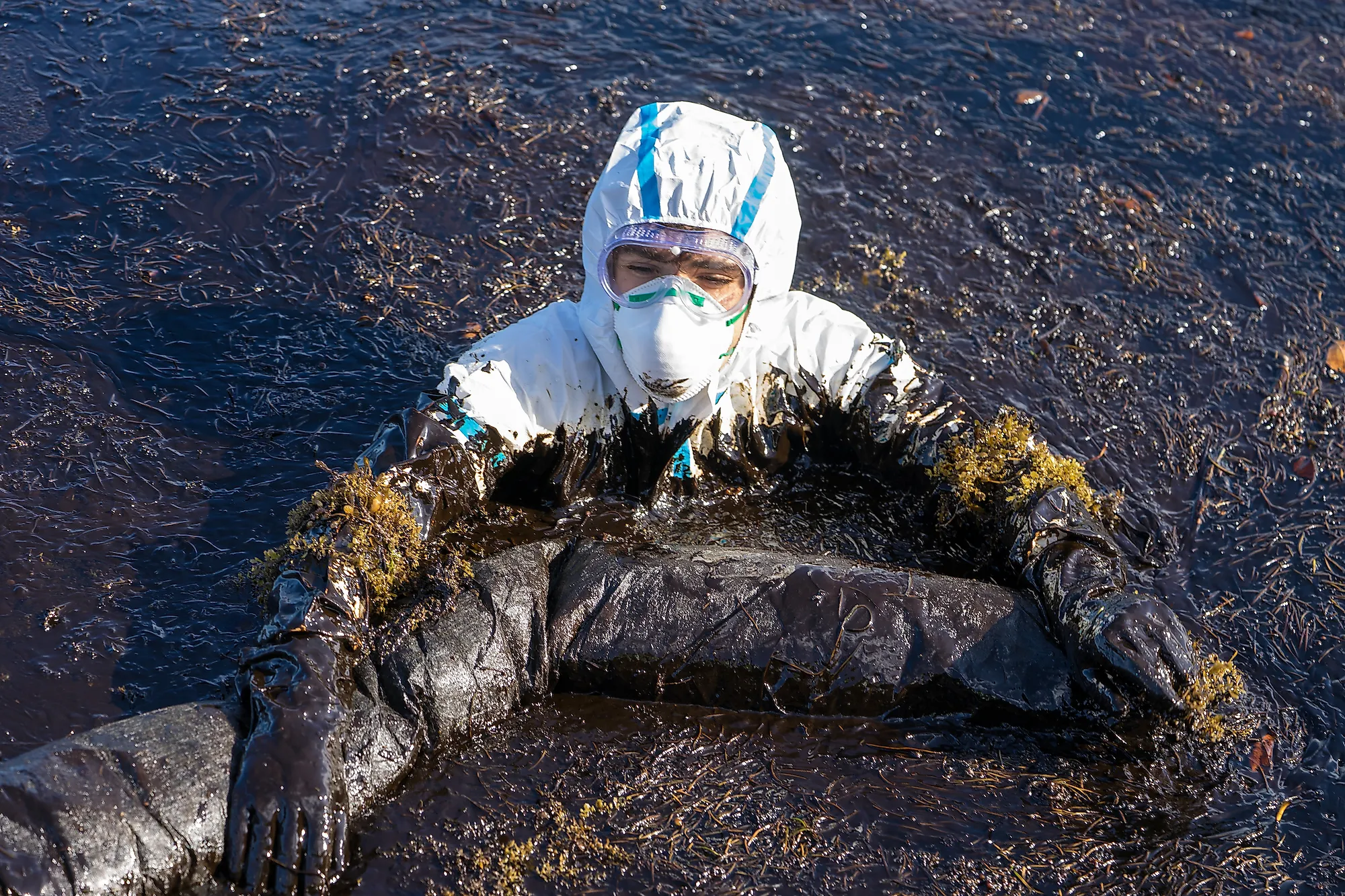
An oil spill is any release of liquid petroleum into the environment, and the worst ones have spilled enough crude to fill the cargo holds of dozens of supertankers and to coat coastlines as far apart as the Texas shrimp grounds, the Tobago beaches, and the Russian Arctic tundra. The ten disasters covered below are ranked by total volume released, from the 1991 Gulf War (the largest by a wide margin, and the only one on the list caused intentionally) down to the 1978 Amoco Cadiz grounding off the Brittany coast. Estimates of total volume vary across sources because deep-water and remote-region spills are difficult to measure directly; the figures below reflect the most widely accepted recent assessments from NOAA, the International Tanker Owners Pollution Federation, and academic literature.
1. Gulf War Oil Spill (January 1991, Persian Gulf)
The largest oil spill in history was deliberate. Between 19 and 28 January 1991, during the Persian Gulf War, Iraqi forces under Saddam Hussein opened the valves at the Sea Island terminal off Kuwait and released oil from at least five tankers, the Mina al-Ahmadi facility, the Sea Island terminal, and several pipelines into the northern Persian Gulf. The aim was to prevent a US Marine amphibious landing on the Kuwaiti coast and to slow allied naval operations.
The total volume released remains contested, with most authoritative estimates running between 4 and 11 million barrels (168 to 462 million gallons). The most commonly cited figure is approximately 8 million barrels, or about 336 million gallons. The resulting oil slick eventually covered approximately 4,000 square miles of the Persian Gulf and reached as much as 10 cm thick along the Saudi coast. Shoreline contamination extended along approximately 400 miles of Saudi coastline, with significant impact on sea turtles, dugongs, cormorants, and the regional shrimp fishery. Cleanup operations recovered about 1 million barrels of the released oil. The remainder either evaporated, broke down, or settled into Gulf sediments where traces remain detectable decades later.
2. Deepwater Horizon (April-September 2010, Gulf of Mexico)

The Deepwater Horizon disaster is the largest accidental marine oil spill in history. On 20 April 2010, a surge of high-pressure methane gas from the Macondo well in 5,000 feet of water blew through the recently installed cement well cap and ignited on the platform deck above. The resulting explosion killed 11 workers, injured 17, and caused the rig to capsize and sink two days later. The Macondo wellhead at the seabed continued to release oil uncontrolled for 87 days until it was capped on 15 July 2010 (the well was finally declared sealed on 19 September).
The US District Court for the Eastern District of Louisiana determined in 2015 that 3.19 million barrels (about 134 million gallons) of oil were released over the 87-day flow period, with some sources estimating the actual release at up to 4.9 million barrels. The spill contaminated approximately 1,300 miles of US Gulf Coast shoreline across Texas, Louisiana, Mississippi, Alabama, and Florida. BP and its drilling contractor Transocean were found grossly negligent under the Clean Water Act and BP agreed to a $20.8 billion federal settlement in 2016, the largest environmental damages settlement in US history. Oil residue continued to wash ashore along the Gulf Coast for years after the well was capped.
3. Ixtoc I (June 1979-March 1980, Bay of Campeche)

The Ixtoc I disaster was the largest accidental oil spill in history until Deepwater Horizon surpassed it in 2010, and remains the second-largest accidental marine oil spill ever recorded. On 3 June 1979, Pemex (the Mexican state oil company) lost drilling mud circulation at the Ixtoc I exploratory well in the Bay of Campeche, approximately 100 km northwest of Ciudad del Carmen in 50 metres of water. The blowout preventer failed to engage, gas reached the surface, ignited on the rig motors, and the platform collapsed within hours.
Pemex took nearly ten months (until 23 March 1980) to seal the well using relief wells drilled through the seabed. Total release was approximately 3 million barrels (130 million gallons), with the resulting slick eventually covering 1,100 square miles. Oil washed ashore along the western Yucatán Peninsula and as far north as the south Texas coast, where it damaged the shrimp fishery and several beach communities. Pemex paid no compensation to US claimants for damage to Texas shorelines (the company invoked sovereign immunity), a precedent that influenced US cross-border oil spill law for decades.
4. Atlantic Empress (July 1979, Caribbean)
Three weeks after the Ixtoc I blowout began, the Greek-owned VLCC Atlantic Empress collided with the tanker Aegean Captain in heavy fog about 18 nautical miles east of Tobago on 19 July 1979. Both vessels caught fire, with 26 crew killed across the two ships. The Atlantic Empress, carrying 287,000 tonnes (approximately 88-90 million gallons) of crude oil, burned and drifted for two weeks before sinking on 3 August 1979 in waters about 600 metres deep.
Most of the released oil burned at the surface during the fire, which limited the shoreline impact. The Atlantic Empress remains the largest oil tanker spill in history. The wreck site has been periodically monitored for residual leakage, with no significant additional release detected since the initial sinking.
5. Mingbulak/Fergana Valley (March 1992, Uzbekistan)
The largest inland oil spill on record happened on 2 March 1992 at the Mingbulak oil field in the Fergana Valley of eastern Uzbekistan. A wellhead blowout at well number 5 ignited and produced a fire that burned for two months while the well continued to release crude. Total release was approximately 285,000 tonnes (88 million gallons). Because the spill happened in a remote arid valley, much of the oil soaked into the ground rather than spreading across surface water, but the local groundwater table was contaminated and the topography limited the effectiveness of cleanup operations.
The Mingbulak spill is sometimes omitted from "worst oil spill" lists because it happened on land rather than in the ocean, but by volume it ranks fifth in modern history. Soviet-era pipeline and well infrastructure across central Asia produced multiple smaller blowouts and pipeline failures in the years before and after Mingbulak; the 1992 incident was the most catastrophic.
6. Kolva River / Komi Pipeline (August-October 1994, Russia)
The Komi pipeline rupture in northern Russia is one of the most poorly documented major oil spills in history. The 32-mile pipeline operated by KomiNeft developed multiple leaks beginning in February 1994, with crude oil accumulating behind temporary earthen dikes built around the leak sites. On 1 October 1994, heavy rains caused the dikes to fail and the accumulated oil flowed into the Kolva River, a tributary of the Pechora River that flows north into the Barents Sea.
Official Russian estimates put the total release at 79,000 tonnes (about 25 million gallons); independent Western estimates ranged from 580,000 barrels (24 million gallons) to 2 million barrels (84 million gallons). The Wikipedia and most international assessments use the higher estimate. The spill contaminated approximately 186 square kilometres of tundra grasslands and wetlands, an ecosystem that recovers from oil contamination extremely slowly because of low temperatures and short growing seasons. Source documents from the Soviet-era pipeline indicate it had been built in 1975 and was already severely corroded by the time the leaks were first discovered.
7. Nowruz Field Platform (February 1983, Persian Gulf)
The Nowruz oil field disaster was a casualty of the Iran-Iraq War, not an accident. On 10 February 1983, a tanker collided with the Nowruz field platform in the Persian Gulf, causing the platform to tilt and the well to begin leaking. Cleanup was delayed for weeks because the platform was inside the Iran-Iraq war zone and any approach was potentially under fire. Iraqi aircraft subsequently attacked the platform in March 1983, igniting the leak and complicating recovery. The well was not finally sealed until September 1983.
Total release was approximately 80 million gallons (about 260,000 tonnes), making it the largest oil spill in Middle East history outside of the deliberate 1991 Gulf War release. The blockading conditions meant that no significant shoreline cleanup could happen during the spill, and the long delay meant a substantial portion of the released oil persisted in the water column. Eleven workers were killed during the attempts to control the well, most by Iraqi air attacks rather than the oil release itself.
8. ABT Summer (May 1991, off Angola)
The ABT Summer, a 257,000-tonne VLCC carrying Iranian crude oil bound for Rotterdam, suffered an explosion in its cargo tanks approximately 700 nautical miles off the coast of Angola on 28 May 1991. The ship burned for three days before sinking on 1 June 1991, killing five of the 32 crew. Total release was approximately 260,000 tonnes (about 80 million gallons), with the resulting slick covering roughly 80 square miles.
The remote location, far from any coast, meant the spill had limited direct shoreline impact, though the airborne pollution from the three-day fire and the long-term effects on open-ocean ecosystems are difficult to quantify. The cause of the initial explosion was never determined; speculation has ranged from a static electricity discharge during cargo gas-freeing operations to a structural failure of the aging tanker (the ABT Summer had been built in 1974 and was nearing the end of its operational life).
9. Castillo de Bellver (August 1983, off South Africa)
The Spanish tanker Castillo de Bellver caught fire on 6 August 1983 about 110 km northwest of Cape Town while carrying 252,000 tonnes of crude oil from the Persian Gulf to South Africa. The fire spread rapidly through the cargo tanks and the ship split in two. The stern section, carrying approximately 100,000 tonnes of unburned oil, sank in deep water; the bow section drifted before being deliberately scuttled with explosives by the South African Navy a few days later.
Total surface release was approximately 250,000 tonnes (about 78 million gallons), most of which evaporated or dispersed at sea before reaching shore. The intentional sinking of the bow trapped a substantial volume of oil in the wreck on the deep sea floor, where it remains a potential long-term release source. The Castillo de Bellver incident drove a subsequent international push for the segregated ballast tank requirement that became part of the MARPOL 73/78 international maritime pollution convention.
10. Amoco Cadiz (March 1978, off Brittany)

The Amoco Cadiz, a VLCC owned by Amoco Transport and carrying approximately 220,000 tonnes of Iranian and Saudi crude, lost its steering gear during a severe storm in the English Channel on 16 March 1978. The ship drifted onto Portsall Rocks off the coast of Brittany, France, where it broke apart over the following two weeks. Total release was approximately 220,000 tonnes (about 69 million gallons), with oil coating around 360 km of Brittany coastline and devastating the regional oyster and shellfish industries.
The Amoco Cadiz disaster was the largest oil tanker spill in history at the time and produced the most extensive bird mortality on record from a single oil spill: over 20,000 seabirds confirmed killed, with actual mortality estimates running much higher. The case produced 14 years of litigation in the United States federal courts (the case was filed against the parent company Standard Oil of Indiana in Chicago) before a $200 million settlement was reached in 1992. The Amoco Cadiz settlement is still cited as a landmark case in international maritime tort law.
How Oil Spills Damage Marine Life

The damage oil does to wildlife splits into two mechanisms: physical fouling and chemical toxicity. Fouling refers to the physical coating of feathers, fur, and skin. The thick, sticky consistency of crude oil disrupts the waterproof barrier that seabirds and marine mammals maintain through preen oil and dense undercoats. Oiled birds lose buoyancy, lose the air pockets in their plumage that provide insulation, and often die of hypothermia within hours of significant contact. Sea otters, which rely on dense fur (the densest in the animal kingdom, at approximately 1 million hairs per square inch) for insulation rather than the blubber that whales and seals use, are particularly vulnerable; the Exxon Valdez spill in Prince William Sound in 1989 killed an estimated 2,800 sea otters despite an extensive rescue effort.
Toxicity is the longer-acting damage. Crude oil contains polycyclic aromatic hydrocarbons (PAHs), benzene, and other compounds that cause liver and kidney damage, immune system suppression, reproductive failure, and developmental abnormalities in exposed organisms. Birds and mammals that survive the initial coating often ingest oil while preening or grooming and die of internal damage days or weeks later. Fish eggs and larvae are extremely sensitive to PAH exposure even at very low concentrations; studies of Prince William Sound after the Exxon Valdez found pink salmon populations were affected for at least two decades after the spill. Coral reefs, oyster beds, and mangrove ecosystems are similarly slow to recover and in some cases never fully do.
Recent Major Marine Spills
No oil spill since Deepwater Horizon has approached the volume of the ten incidents above, but several recent disasters illustrate that the risk has not disappeared. The Sanchi tanker collision on 6 January 2018, in the East China Sea about 160 nautical miles off Shanghai, killed all 32 crew and released approximately 136,000 tonnes of natural-gas condensate (an ultra-light hydrocarbon, more toxic and explosive than crude oil but lighter and harder to track at sea). The Sanchi was the largest tanker spill since the Hebei Spirit disaster in 2007 off South Korea.
The Norilsk oil spill on 29 May 2020 in Russia's Arctic Krasnoyarsk Krai released approximately 21,000 tonnes of diesel fuel from a collapsed storage tank at a Norilsk Nickel facility, contaminating the Ambarnaya River and reaching as far as Lake Pyasino. The collapse was attributed to thawing permafrost beneath the tank's foundations, an emerging risk factor for Arctic oil infrastructure as climate change accelerates regional warming. The MV Wakashio grounding on 25 July 2020 off the southeast coast of Mauritius released approximately 1,000 tonnes of bunker fuel oil onto a coral reef and into the Blue Bay Marine Park, a smaller event by volume but catastrophic for one of the most biodiverse coastal ecosystems in the Indian Ocean. The combination of larger tankers, deeper offshore drilling, and aging onshore infrastructure means the conditions that produced the disasters on this list have not gone away.